

15 May 2025
Maxwell Equations, Displacement Current, and Potentials
First-principles derivation of Maxwell's equations, current continuity, and electromagnetic potentials.
We use SI units and let $\hat{\mathbf n}$ point outward from a closed surface. In a linear, isotropic medium,
\[\mathbf D=\epsilon\mathbf E,\qquad \mathbf B=\mu\mathbf H,\qquad \mathbf J=\sigma\mathbf E.\]Here $\mathbf E$ is in $\mathrm{V\,m^{-1}}$, $\mathbf D$ in $\mathrm{C\,m^{-2}}$, $\mathbf B$ in tesla, $\mathbf H$ in $\mathrm{A\,m^{-1}}$, $\epsilon$ in $\mathrm{F\,m^{-1}}$, $\mu$ in $\mathrm{H\,m^{-1}}$, and $\mathbf J$ in $\mathrm{A\,m^{-2}}$.
Electric and magnetic Gauss laws
For a point charge $q$ in a homogeneous medium, Coulomb’s field is
\[\mathbf E=\frac{q}{4\pi\epsilon r^2}\hat{\mathbf r}.\]Its flux through a sphere is $E(4\pi r^2)=q/\epsilon$. Superposition extends this result to any charge distribution and any closed surface $S$:
\[\boxed{\oint_S\mathbf D\cdot d\mathbf a=Q_{\mathrm f,enc}}.\]With $Q_{\mathrm f,enc}=\int_V\rho_{\mathrm f}\,dV$ and the divergence theorem,
\[\int_V(\nabla\cdot\mathbf D-\rho_{\mathrm f})\,dV=0.\]The volume is arbitrary, so the integrand vanishes:
\[\boxed{\nabla\cdot\mathbf D=\rho_{\mathrm f}}.\]Magnetic field lines have no observed beginning or end. Their flux through every closed surface is therefore zero:
\[\boxed{\oint_S\mathbf B\cdot d\mathbf a=0} \quad\Longleftrightarrow\quad \boxed{\nabla\cdot\mathbf B=0}.\]Faraday law and its sign
For a fixed contour $C$ bounding a fixed surface $S$, Faraday’s induction law is
\[\oint_C\mathbf E\cdot d\boldsymbol\ell =-\frac{d}{dt}\int_S\mathbf B\cdot d\mathbf a.\]The contour direction and surface normal obey the right-hand rule. The minus sign is Lenz’s law: the induced circulation opposes the change of magnetic flux. Moving the derivative inside the fixed surface and applying Stokes’ theorem gives
\[\int_S\left(\nabla\times\mathbf E+\frac{\partial\mathbf B}{\partial t}\right)\cdot d\mathbf a=0.\]Because the surface is arbitrary,
\[\boxed{\nabla\times\mathbf E=-\frac{\partial\mathbf B}{\partial t}}.\]Why Ampere’s law needs displacement current
The magnetostatic equation $\nabla\times\mathbf H=\mathbf J$ cannot describe time-dependent charge. Taking its divergence would give $\nabla\cdot\mathbf J=0$, whereas conservation of charge requires
\[\boxed{\nabla\cdot\mathbf J=-\frac{\partial\rho_{\mathrm f}}{\partial t}}.\]Use $\rho_{\mathrm f}=\nabla\cdot\mathbf D$ in the continuity equation:
\[\nabla\cdot\left(\mathbf J+\frac{\partial\mathbf D}{\partial t}\right)=0.\]The current density that can consistently source a curl is therefore
\[\mathbf J_{\mathrm{total}}=\mathbf J+\mathbf J_d, \qquad \boxed{\mathbf J_d=\frac{\partial\mathbf D}{\partial t}}.\]$\mathbf J_d$ has the same unit $\mathrm{A\,m^{-2}}$ as conduction-current density. The corrected law is
\[\boxed{\nabla\times\mathbf H =\mathbf J+\frac{\partial\mathbf D}{\partial t}},\]or, in integral form,
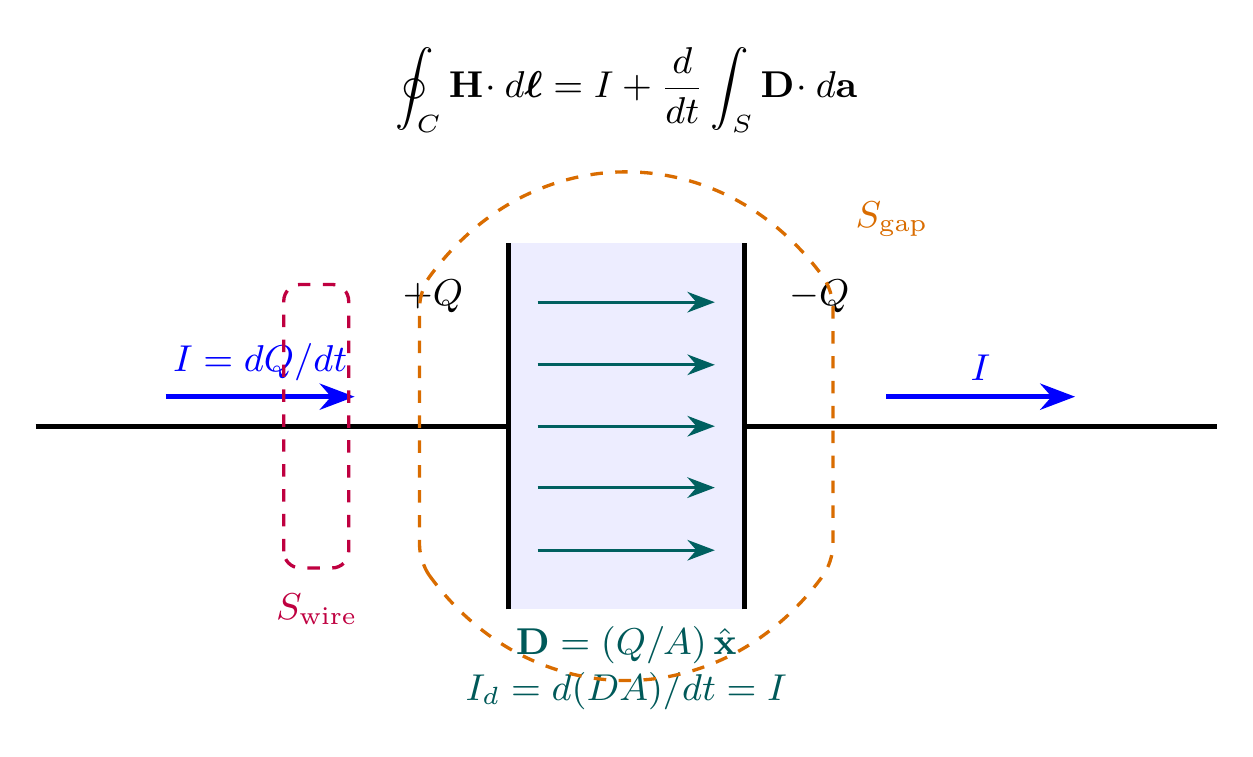
\[\boxed{\oint_C\mathbf H\cdot d\boldsymbol\ell =\int_S\mathbf J\cdot d\mathbf a +\frac{d}{dt}\int_S\mathbf D\cdot d\mathbf a}.\]For a charging parallel-plate capacitor of plate area $A$, neglecting fringing,
\[D=\frac{Q}{A},\qquad I_d=\frac{d}{dt}\int_A\mathbf D\cdot d\mathbf a =\frac{d}{dt}(DA)=\frac{dQ}{dt}=I.\]Thus a surface crossing the wire and a surface bulging through the capacitor gap give the same magnetic circulation.
Maxwell equations together
The four macroscopic equations, with free charge and free conduction current as sources, are
\[\boxed{\begin{aligned} \nabla\cdot\mathbf D&=\rho_{\mathrm f}, &\qquad \nabla\cdot\mathbf B&=0,\\ \nabla\times\mathbf E&=-\frac{\partial\mathbf B}{\partial t}, &\nabla\times\mathbf H&=\mathbf J+\frac{\partial\mathbf D}{\partial t}. \end{aligned}}\]Their integral forms are
\[\boxed{\begin{aligned} \oint_S\mathbf D\cdot d\mathbf a&=Q_{\mathrm f,enc}, &\oint_S\mathbf B\cdot d\mathbf a&=0,\\ \oint_C\mathbf E\cdot d\boldsymbol\ell&=-\frac{d}{dt}\int_S\mathbf B\cdot d\mathbf a, &\oint_C\mathbf H\cdot d\boldsymbol\ell&=I_{\mathrm f,enc}+\frac{d}{dt}\int_S\mathbf D\cdot d\mathbf a. \end{aligned}}\]Taking the divergence of the Ampere-Maxwell equation immediately reproduces charge continuity; the correction is therefore required, not optional.
Scalar and vector potentials
Because $\nabla\cdot\mathbf B=0$, a vector potential $\mathbf A$ exists locally such that
\[\boxed{\mathbf B=\nabla\times\mathbf A}.\]Substitution in Faraday’s law gives
\[\nabla\times\left(\mathbf E+\frac{\partial\mathbf A}{\partial t}\right)=0.\]A curl-free field is a gradient. Defining the scalar potential $\phi$ with the electrostatic sign convention,
\[\boxed{\mathbf E=-\nabla\phi-\frac{\partial\mathbf A}{\partial t}}.\]$\phi$ is measured in volts and $\mathbf A$ in $\mathrm{Wb\,m^{-1}}=\mathrm{V\,s\,m^{-1}}$. The same fields result from
\[\boxed{\mathbf A^{\prime}=\mathbf A+\nabla\chi, \qquad \phi^{\prime}=\phi-\frac{\partial\chi}{\partial t}},\]because $\nabla\times\nabla\chi=0$ and the added terms in $\mathbf E$ cancel. This is gauge freedom.
In a homogeneous medium choose the Lorenz gauge
\[\boxed{\nabla\cdot\mathbf A+\mu\epsilon\frac{\partial\phi}{\partial t}=0}.\]Gauss’s law then gives
\[-\nabla^2\phi-\frac{\partial}{\partial t}(\nabla\cdot\mathbf A) =\frac{\rho_{\mathrm f}}{\epsilon},\]and hence
\[\boxed{\left(\nabla^2-\mu\epsilon\frac{\partial^2}{\partial t^2}\right)\phi =-\frac{\rho_{\mathrm f}}{\epsilon}}.\]Similarly, substituting $\mathbf B=\nabla\times\mathbf A$ and $\mathbf E=-\nabla\phi-\partial_t\mathbf A$ in the Ampere-Maxwell law, then using the Lorenz gauge, gives
\[\boxed{\left(\nabla^2-\mu\epsilon\frac{\partial^2}{\partial t^2}\right)\mathbf A =-\mu\mathbf J}.\]In source-free regions both potentials propagate with speed $1/\sqrt{\mu\epsilon}$.
Solved Problems
1. Magnetic field produced by a uniform displacement current
Inside a circular dielectric region of radius $R=3.00\ \mathrm{cm}$, a spatially uniform electric field points along $+z$ and increases at
\[\frac{\partial E}{\partial t}=4.00\times10^8\ \mathrm{V\,m^{-1}\,s^{-1}}.\]The dielectric has $\epsilon_r=2.00$. Find $\mathbf H$ at $r=1.00\ \mathrm{cm}$, neglecting fringing and conduction current.
Solution. Take the contour direction to be $+\hat{\boldsymbol\phi}$ when the surface normal is $+\hat{\mathbf z}$. The displacement-current density is
\[J_d=\epsilon\frac{\partial E}{\partial t} =2\epsilon_0(4.00\times10^8) =7.083\times10^{-3}\ \mathrm{A\,m^{-2}}.\]Because $r<R$, the enclosed displacement current is $I_d=J_d\pi r^2$. Cylindrical symmetry makes $H$ constant on the circular contour, so the Ampere-Maxwell law gives
\[2\pi rH=J_d\pi r^2, \qquad H=\frac{J_dr}{2}=3.542\times10^{-5}\ \mathrm{A\,m^{-1}}.\]Therefore
\[\boxed{\mathbf H=(3.542\times10^{-5}\ \mathrm{A\,m^{-1}})\hat{\boldsymbol\phi}}.\]The positive azimuthal sign follows from the right-hand rule about an increasing $+z$ electric flux. Dimensionally, $\epsilon\,\partial E/\partial t$ is $\mathrm{A\,m^{-2}}$, so $J_dr$ has unit $\mathrm{A\,m^{-1}}$. The result tends to zero linearly as $r\to0$, as symmetry requires; outside the active radius it would instead vary as $1/r$.
2. Explicit check of gauge invariance
Let
\[\mathbf A=B_0x\,\hat{\mathbf y},\qquad \phi=0,\]and choose the gauge function $\chi=axt$, where $a$ has unit $\mathrm{V\,m^{-1}}$. Find the transformed potentials and verify the fields.
Solution. With the stated convention,
\[\mathbf A^{\prime}=\mathbf A+\nabla\chi =at\,\hat{\mathbf x}+B_0x\,\hat{\mathbf y}, \qquad \phi^{\prime}=\phi-\frac{\partial\chi}{\partial t}=-ax.\]The transformed electric field is
\[\mathbf E^{\prime}=-\nabla\phi^{\prime}-\frac{\partial\mathbf A^{\prime}}{\partial t} =a\hat{\mathbf x}-a\hat{\mathbf x}=\mathbf0,\]while
\[\mathbf B^{\prime}=\nabla\times\mathbf A^{\prime}=B_0\hat{\mathbf z}.\]Thus $\mathbf E^{\prime}=\mathbf E$ and $\mathbf B^{\prime}=\mathbf B$: the extra scalar-potential gradient and time derivative of $\mathbf A^{\prime}$ cancel with the required minus sign. Since $\chi$ has unit $\mathrm{V\,s}$, both $\nabla\chi$ and $\mathbf A$ have unit $\mathrm{V\,s\,m^{-1}}$. The limit $a\to0$ returns the original potentials, while every value of $a$ represents the same physical fields.
Descriptive Questions
- Why does taking the divergence of the Ampere-Maxwell equation enforce local conservation of free charge?
- Explain why the magnetic Gauss law permits a vector potential but does not determine that potential uniquely.
- Compare the information carried by the integral and differential forms of Maxwell’s equations.
- How do the Lorenz gauge and source-free potential equations reveal the propagation speed of electromagnetic influence?
Numerical Problems
- A charge of $3.00\ \mathrm{\mu C}$ crosses an area of $20.0\ \mathrm{cm^2}$ uniformly in $5.00\ \mathrm{\mu s}$. Find the mean current density. Final answer: $\boxed{J=300\ \mathrm{A\,m^{-2}}}$.
- A $150\ \mathrm{pF}$ capacitor is driven by $V=40.0\cos(2\pi\times2.00\ \mathrm{MHz}\,t)\ \mathrm V$. Find the peak displacement current. Final answer: $\boxed{I_{d0}=75.4\ \mathrm{mA}}$.
- A radial displacement field of magnitude $0.800\ \mathrm{\mu C\,m^{-2}}$ is uniform on a sphere of radius $5.00\ \mathrm{cm}$. Find the enclosed free charge. Final answer: $\boxed{Q_{\mathrm f}=25.1\ \mathrm{nC}}$.
- Let $\phi=0$ and $\mathbf A=A_0\cos(kz-\omega t)\,\hat{\mathbf x}$, where $A_0=2.00\times10^{-7}\ \mathrm{V\,s\,m^{-1}}$, $k=0.500\ \mathrm{m^{-1}}$, and $f=10.0\ \mathrm{MHz}$. Find the peak electric- and magnetic-field magnitudes obtained from the potentials. Final answer: $\boxed{E_0=\omega A_0=12.57\ \mathrm{V\,m^{-1}}}$; $\boxed{B_0=kA_0=1.00\times10^{-7}\ \mathrm T}$.
The algebra and numerical values in both solved problems and all four numerical problems are checked in the MJ-8 problem-verification worksheet; every printed check is zero.


Discussion