

16 Jun 2025
Electromagnetic Waves in Conductors: Relaxation and Skin Depth
Charge relaxation, complex propagation constant, attenuation, conductor impedance, and skin depth.
In a homogeneous ohmic conductor,
\[\mathbf J=\sigma\mathbf E, \qquad \mathbf D=\epsilon\mathbf E, \qquad \mathbf B=\mu\mathbf H.\]The conduction current and displacement current are both present. Their magnitude ratio for a harmonic field is
\[\boxed{\frac{J}{\lvert\partial D/\partial t\rvert}=\frac{\sigma}{\omega\epsilon}}.\]A good conductor at a given frequency satisfies $\sigma\gg\omega\epsilon$; a good dielectric satisfies $\sigma\ll\omega\epsilon$.
Charge-relaxation time
Take the divergence of Ohm’s law and use Gauss’s law:
\[\nabla\cdot\mathbf J =\sigma\nabla\cdot\mathbf E =\frac{\sigma}{\epsilon}\rho.\]Charge continuity, $\nabla\cdot\mathbf J+\partial\rho/\partial t=0$, then becomes
\[\frac{\partial\rho}{\partial t}+\frac{\sigma}{\epsilon}\rho=0.\]Separating variables gives
\[\boxed{\rho(t)=\rho(0)e^{-t/\tau}}, \qquad \boxed{\tau=\frac{\epsilon}{\sigma}}.\]$\tau$ is the charge-relaxation time in seconds. It is the time in which an initially deposited volume charge falls to $1/e$ of its initial value.
Wave equation with ohmic loss
In a source-free region inside the conductor,
\[\nabla\times\mathbf E=-\mu\frac{\partial\mathbf H}{\partial t}, \qquad \nabla\times\mathbf H=\sigma\mathbf E+\epsilon\frac{\partial\mathbf E}{\partial t}.\]Taking the curl of Faraday’s law, using $\nabla\cdot\mathbf E=0$ away from the relaxed charge, gives
\[\boxed{\nabla^2\mathbf E -\mu\sigma\frac{\partial\mathbf E}{\partial t} -\mu\epsilon\frac{\partial^2\mathbf E}{\partial t^2}=0}.\]The term proportional to the first time derivative produces attenuation.
Use the convention
\[\mathbf E(z,t)=\Re\!\left\{\mathbf E_0e^{i(\widetilde k z-\omega t)}\right\}, \qquad \widetilde k=\beta+i\alpha,\]where $\alpha>0$. Since $e^{i\widetilde kz}=e^{i\beta z}e^{-\alpha z}$, $\beta$ is the phase constant in $\mathrm{rad\,m^{-1}}$ and $\alpha$ is the attenuation constant in $\mathrm{Np\,m^{-1}}$. Substitution gives
\[\boxed{\widetilde{k}^{\,2}=\omega^2\mu\epsilon+i\omega\mu\sigma}.\]Equating real and imaginary parts of $(\beta+i\alpha)^2$,
\[\beta^2-\alpha^2=\omega^2\mu\epsilon, \qquad 2\alpha\beta=\omega\mu\sigma.\]Solving these two equations with $\alpha,\beta>0$ gives
\[\boxed{\alpha=\omega\sqrt{\frac{\mu\epsilon}{2} \left[\sqrt{1+\left(\frac{\sigma}{\omega\epsilon}\right)^2}-1\right]}},\] \[\boxed{\beta=\omega\sqrt{\frac{\mu\epsilon}{2} \left[\sqrt{1+\left(\frac{\sigma}{\omega\epsilon}\right)^2}+1\right]}}.\]The phase velocity is $v_p=\omega/\beta$ and the wavelength in the conductor is $2\pi/\beta$.
Skin depth
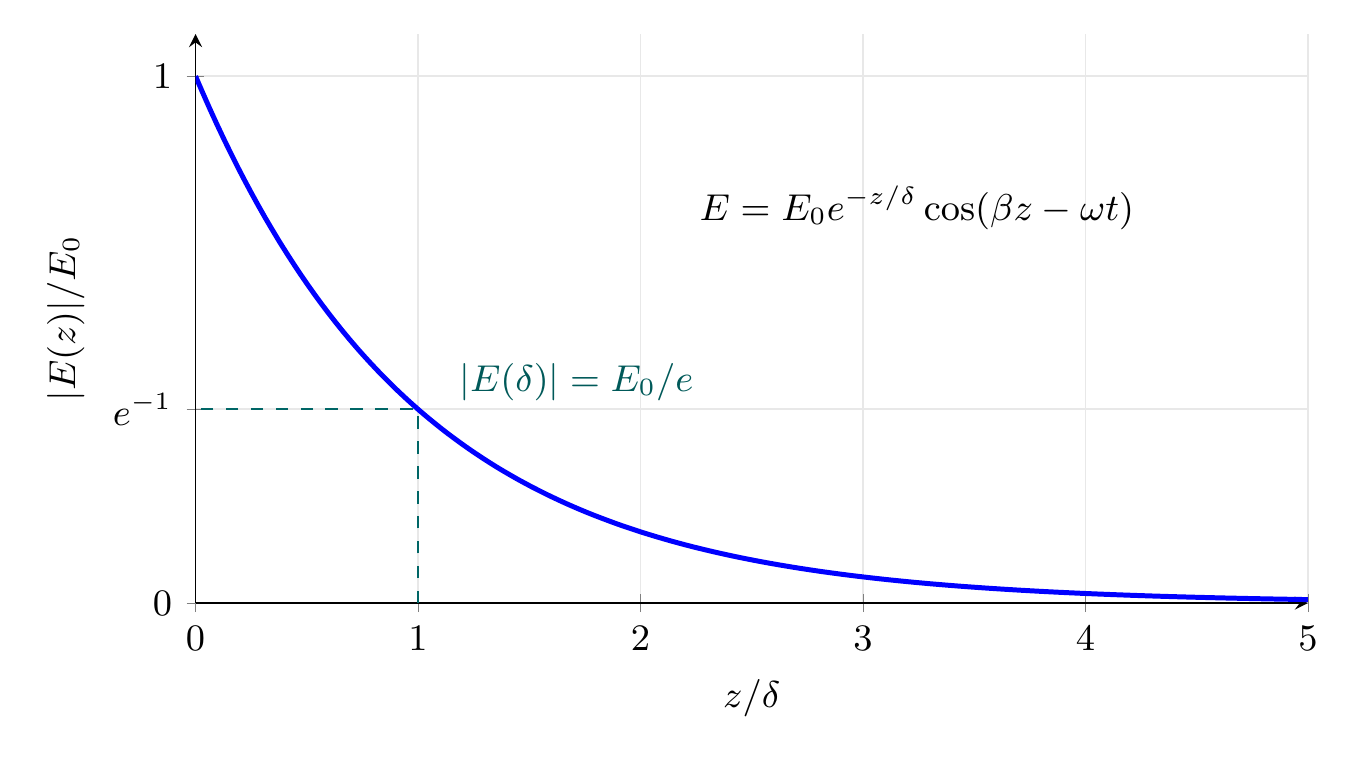
The field amplitude falls as $e^{-\alpha z}$. The skin depth is therefore defined by
\[\boxed{\delta=\frac1\alpha},\]so $\lvert E(\delta)\rvert=E_0/e$. Intensity is proportional to $\lvert E\rvert^2$, hence it falls to $e^{-2}$ at one skin depth.
For a good conductor, $\sigma/(\omega\epsilon)\gg1$, and the exact expressions reduce to
\[\boxed{\alpha\simeq\beta\simeq\sqrt{\frac{\omega\mu\sigma}{2}}}, \qquad \boxed{\delta\simeq\sqrt{\frac{2}{\omega\mu\sigma}}}.\]Thus increasing frequency, permeability, or conductivity confines the field more strongly to the surface.
Complex wave impedance
Faraday’s law for the same convention gives $\widetilde k\times\mathbf E_0=\omega\mu\mathbf H_0$. Therefore
\[\boxed{\widetilde\eta=\frac{E_0}{H_0} =\frac{\omega\mu}{\widetilde k} =\sqrt{\frac{\mu}{\epsilon+i\sigma/\omega}}}.\]Because $\widetilde\eta$ is complex, $\mathbf E$ and $\mathbf H$ are not exactly in phase. In the good-conductor limit,
\[\widetilde\eta\simeq(1-i)\sqrt{\frac{\omega\mu}{2\sigma}}\]for the $e^{-i\omega t}$ convention used here. Reversing the time convention complex-conjugates this expression but leaves all measurable attenuation and power unchanged.
Solved Problems
1. Field penetration into copper
Treat copper as a nonmagnetic good conductor with $\sigma=5.80\times10^7\ \mathrm{S\,m^{-1}}$. At $f=1.00\ \mathrm{MHz}$, find the skin depth and attenuation constant. Also find the amplitude and intensity fractions remaining at a depth $3\delta$.
Solution. With the $e^{i(\beta z-\omega t)}e^{-\alpha z}$ convention, $+z$ is the inward direction and $\alpha>0$. The good-conductor approximation gives
\[\delta=\sqrt{\frac{2}{\omega\mu_0\sigma}} =\sqrt{\frac{2}{(2\pi\times10^6)(4\pi\times10^{-7})(5.80\times10^7)}} =6.609\times10^{-5}\ \mathrm m.\]Therefore
\[\boxed{\delta=66.1\ \mathrm{\mu m}}, \qquad \boxed{\alpha=\delta^{-1}=1.513\times10^4\ \mathrm{Np\,m^{-1}}}.\]At $z=3\delta$,
\[\frac{\lvert E\rvert}{E_0}=e^{-3}=0.04979, \qquad \frac{I}{I_0}=e^{-6}=0.002479.\]Only $4.98\%$ of the field amplitude and $0.248\%$ of the intensity remain. The product $\alpha\delta=1$ is dimensionless. Increasing $f$ makes $\delta\propto f^{-1/2}$ smaller; the limit $z\to0$ returns unit amplitude.
2. Relaxation of charge in a lossy dielectric
A material has $\epsilon_r=80.0$, $\sigma=0.0200\ \mathrm{S\,m^{-1}}$, and initial volume charge density $\rho_0=5.00\ \mathrm{nC\,m^{-3}}$. Find its relaxation time and the charge density after $0.100\ \mathrm{\mu s}$.
Solution. The relaxation time is
\[\tau=\frac{\epsilon}{\sigma} =\frac{80\epsilon_0}{0.0200} =3.542\times10^{-8}\ \mathrm s=35.4\ \mathrm{ns}.\]The continuity-equation solution gives
\[\rho(t)=\rho_0e^{-t/\tau} =5.00e^{-100/35.42}\ \mathrm{nC\,m^{-3}} =0.2970\ \mathrm{nC\,m^{-3}}.\]Thus
\[\boxed{\tau=35.4\ \mathrm{ns},\qquad \rho(0.100\ \mathrm{\mu s})=0.297\ \mathrm{nC\,m^{-3}}}.\]The sign of $\rho$ is preserved while its magnitude decays; positive conductivity cannot amplify free volume charge in this model. Since $\mathrm{(F\,m^{-1})/(S\,m^{-1})=s}$, $\tau$ has the required unit. The limits $\sigma\to0$ and $t\to0$ respectively give infinite relaxation time and the initial charge.
Descriptive Questions
- Derive the charge-relaxation equation from Ohm’s law, Gauss’s law, and charge continuity.
- Explain physically why the propagation constant and wave impedance of a conductor are complex.
- Distinguish the $1/e$ amplitude skin depth from the corresponding intensity attenuation length.
- State the condition for a good conductor and explain how changing frequency can move one material between conduction- and displacement-current regimes.
Numerical Problems
- For $\sigma=4.00\ \mathrm{S\,m^{-1}}$, $\epsilon_r=80.0$, and $f=1.00\ \mathrm{GHz}$, calculate $\sigma/(\omega\epsilon)$. Final answer: $\boxed{\sigma/(\omega\epsilon)=0.899}$, so neither term is overwhelmingly dominant.
- Find the magnitude of the good-conductor wave impedance of copper at $1.00\ \mathrm{MHz}$ using $\sigma=5.80\times10^7\ \mathrm{S\,m^{-1}}$. Final answer: $\boxed{\lvert\widetilde\eta\rvert=0.369\ \mathrm{m\Omega}}$.
- At what frequency does nonmagnetic copper with $\sigma=5.80\times10^7\ \mathrm{S\,m^{-1}}$ have a good-conductor skin depth of $1.00\ \mathrm{mm}$? Final answer: $\boxed{f=4.37\ \mathrm{kHz}}$.
The exact conductor identities are checked in the Unit II Maxima worksheet, and every worked and numerical value above is checked in the MJ-8 problem-verification worksheet; every printed residual and check is zero.


Discussion