

17 Jun 2025
Reflection and Refraction at a Dielectric Interface
Phase matching, reflection and refraction laws, Fresnel formulae, Brewster's law, and power coefficients.
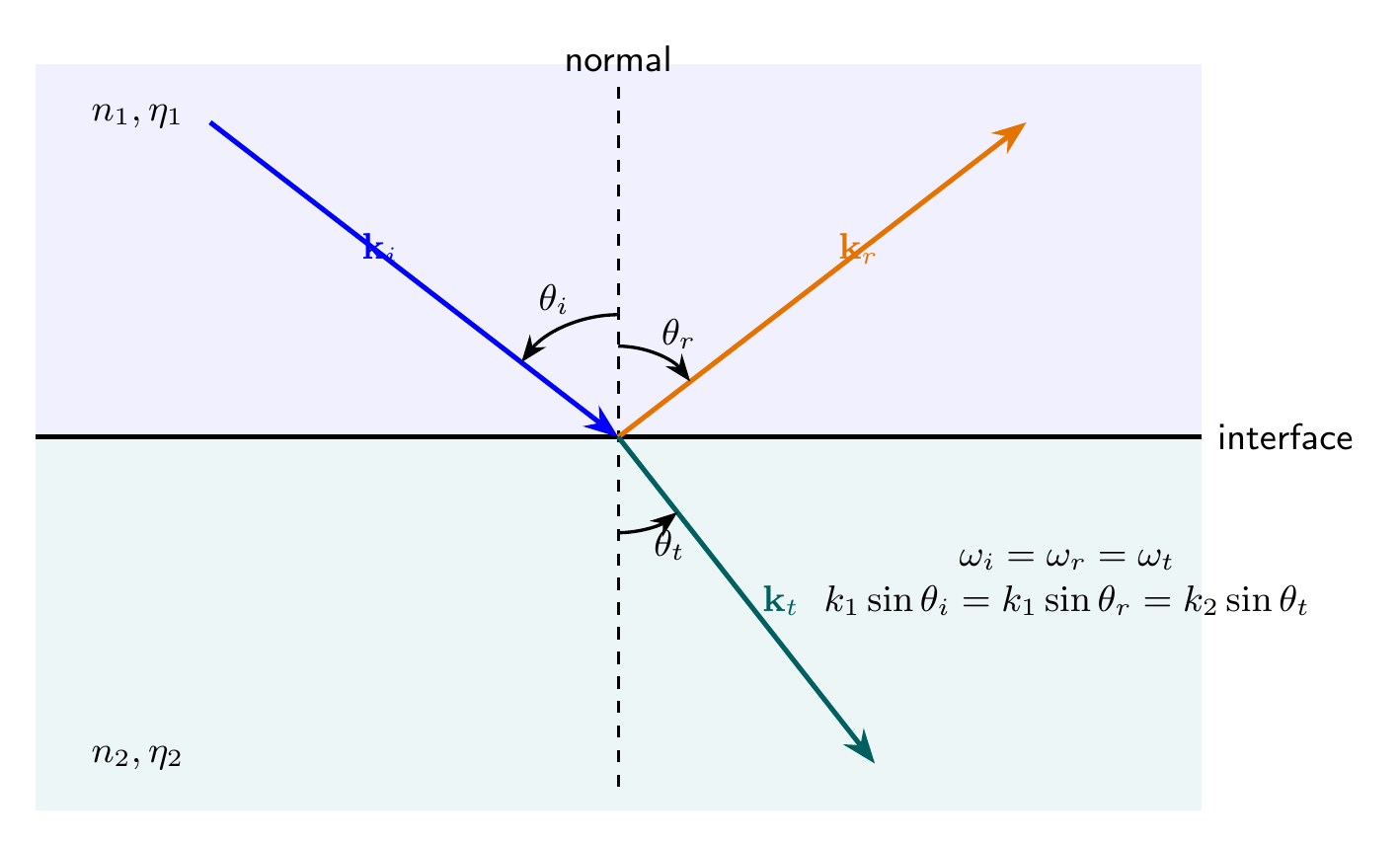
Let a plane interface at $z=0$ separate two lossless, isotropic, nonmagnetic dielectrics with refractive indices $n_1$ and $n_2$. The plane containing the incident wave vector and the interface normal is the plane of incidence.
Laws from phase matching
At every point of the stationary interface and at every time, the tangential fields must match. Their phase factors must therefore agree:
\[\omega_i=\omega_r=\omega_t, \qquad (\mathbf k_i)_\parallel=(\mathbf k_r)_\parallel=(\mathbf k_t)_\parallel.\]Since $k_j=n_j\omega/c$,
\[k_1\sin\theta_i=k_1\sin\theta_r=k_2\sin\theta_t.\]The first equality gives the law of reflection,
\[\boxed{\theta_r=\theta_i},\]and the second gives Snell’s law,
\[\boxed{n_1\sin\theta_i=n_2\sin\theta_t}.\]The frequency is unchanged; the wavelength changes because $k$ changes.
Boundary equations for amplitudes
With no free surface charge or current,
\[\hat{\mathbf n}\times(\mathbf E_2-\mathbf E_1)=\mathbf0, \qquad \hat{\mathbf n}\times(\mathbf H_2-\mathbf H_1)=\mathbf0.\]Write $r=E_{0r}/E_{0i}$ and $t=E_{0t}/E_{0i}$ using polarization unit vectors tied to each propagation direction. For nonmagnetic dielectrics, $\eta_j=\eta_0/n_j$.
Perpendicular or s polarization
For s polarization, $\mathbf E$ is perpendicular to the plane of incidence. Tangential-$E$ continuity gives
\[E_{0i}+E_{0r}=E_{0t}.\]The tangential magnetic components are $E\cos\theta/\eta$, with the reflected contribution carrying the opposite propagation sign:
\[\frac{E_{0i}-E_{0r}}{\eta_1}\cos\theta_i =\frac{E_{0t}}{\eta_2}\cos\theta_t.\]Solving the two simultaneous equations,
\[\boxed{r_s=\frac{n_1\cos\theta_i-n_2\cos\theta_t} {n_1\cos\theta_i+n_2\cos\theta_t}},\] \[\boxed{t_s=\frac{2n_1\cos\theta_i} {n_1\cos\theta_i+n_2\cos\theta_t}}.\]Parallel or p polarization
For p polarization, $\mathbf E$ lies in the plane of incidence. Applying the same two tangential conditions gives
\[\boxed{r_p=\frac{n_2\cos\theta_i-n_1\cos\theta_t} {n_2\cos\theta_i+n_1\cos\theta_t}},\] \[\boxed{t_p=\frac{2n_1\cos\theta_i} {n_2\cos\theta_i+n_1\cos\theta_t}}.\]With the conventional p-polarization unit vectors, $r_p$ and $r_s$ have opposite signs at normal incidence. This is a basis-orientation sign; the measurable reflected fraction depends on $\lvert r\rvert^2$.
Reflection and transmission coefficients
The normal component of average Poynting flux is
\[\langle S_n\rangle=\frac{\lvert E_0\rvert^2}{2\eta}\cos\theta.\]Therefore the power reflection and transmission coefficients are
\[\boxed{R_s=\lvert r_s\rvert^2,\qquad R_p=\lvert r_p\rvert^2},\] \[\boxed{T_s=\frac{n_2\cos\theta_t}{n_1\cos\theta_i}\lvert t_s\rvert^2, \qquad T_p=\frac{n_2\cos\theta_t}{n_1\cos\theta_i}\lvert t_p\rvert^2}.\]For lossless media,
\[\boxed{R_s+T_s=1,\qquad R_p+T_p=1}.\]At normal incidence,
\[R=\left(\frac{n_1-n_2}{n_1+n_2}\right)^2, \qquad T=\frac{4n_1n_2}{(n_1+n_2)^2}.\]These are power fractions and hence dimensionless.
Brewster’s law
The p-polarized reflection vanishes when the numerator of $r_p$ is zero:
\[n_2\cos\theta_B=n_1\cos\theta_t.\]Combine this with Snell’s law $n_1\sin\theta_B=n_2\sin\theta_t$. Division gives
\[\frac{\sin\theta_B}{\sin\theta_t} =\frac{\cos\theta_t}{\cos\theta_B}.\]Hence $\sin(2\theta_B)=\sin(2\theta_t)$. For unequal media the physical solution is $\theta_B+\theta_t=90^\circ$. Snell’s law then becomes
\[n_1\sin\theta_B=n_2\cos\theta_B,\]and hence
\[\boxed{\tan\theta_B=\frac{n_2}{n_1}}.\]At Brewster incidence the reflected and refracted rays are perpendicular, and the reflected beam contains only s polarization.
Solved Problems
1. Normal-incidence fields and power balance
A plane wave in air is normally incident on lossless glass of refractive index $1.50$. Its incident peak electric field is $200\ \mathrm{V\,m^{-1}}$. Find the reflected and transmitted field amplitudes and the two power fractions.
Solution. Choose each polarization unit vector so that its electric-field sign is compared along the same laboratory axis. At normal incidence,
\[r=\frac{n_1-n_2}{n_1+n_2} =\frac{1-1.5}{1+1.5}=-0.200,\] \[t=\frac{2n_1}{n_1+n_2}=0.800.\]Therefore
\[E_{0r}=rE_{0i}=-40.0\ \mathrm{V\,m^{-1}}, \qquad E_{0t}=tE_{0i}=160\ \mathrm{V\,m^{-1}}.\]The negative reflected amplitude means a $\pi$ phase reversal relative to the chosen incident electric axis. The power coefficients are
\[R=r^2=0.0400,\] \[T=\frac{n_2}{n_1}t^2=1.5(0.8)^2=0.960.\]Hence
\[\boxed{E_{0r}=-40.0\ \mathrm{V\,m^{-1}},\quad E_{0t}=160\ \mathrm{V\,m^{-1}},\quad R=4.00\%,\quad T=96.0\%}.\]$R+T=1$ supplies the lossless energy check. Amplitude coefficients are dimensionless, while the Poynting-flux factor $n_2/n_1$ is essential because transmitted field amplitude alone does not measure transmitted power. In the matched-index limit $n_2\to n_1$, $r\to0$ and $T\to1$.
2. Brewster incidence from air to glass
For the same air-glass interface, find the Brewster angle, the refracted angle, and the s-polarized reflectance at that incidence.
Solution. The angles are measured from the interface normal. Brewster’s law gives
\[\theta_B=\tan^{-1}\!\left(\frac{1.50}{1.00}\right)=56.31^\circ.\]At Brewster incidence the rays are perpendicular, so
\[\theta_t=90^\circ-\theta_B=33.69^\circ.\]For p polarization, $r_p=0$. The s coefficient at the same geometry is
\[r_s=\frac{\cos\theta_B-1.5\cos\theta_t} {\cos\theta_B+1.5\cos\theta_t} =-0.3846,\]and hence
\[R_s=\lvert r_s\rvert^2=0.1479.\]Thus
\[\boxed{\theta_B=56.31^\circ,\quad \theta_t=33.69^\circ,\quad R_p=0,\quad R_s=14.79\%}.\]The reflected beam is therefore purely s polarized. All angles are dimensionless in the trigonometric equations, and $\theta_B+\theta_t=90^\circ$ checks the geometry. If $n_2/n_1\to1$, the interface contrast and both reflectances vanish.
Descriptive Questions
- Derive the laws of reflection and refraction from phase matching along a stationary plane interface.
- Why do the s- and p-polarized Fresnel coefficients differ even though both obey the same Snell law?
- Explain the distinction between field-amplitude transmission coefficient and power transmission coefficient at oblique incidence.
- Give a physical interpretation of zero p-polarized reflection at Brewster incidence.
Numerical Problems
- Light passes from air into water of index $4/3$ at $30.0^\circ$ incidence. Find the refracted angle. Final answer: $\boxed{\theta_t=22.02^\circ}$.
- Find the normal-incidence power reflectance between media of indices $1.33$ and $1.50$. Final answer: $\boxed{R=3.608\times10^{-3}=0.3608\%}$.
- At $45.0^\circ$ incidence from air to glass of index $1.50$, find the s- and p-polarized reflectances. Final answer: $\boxed{R_s=9.201\%,\qquad R_p=0.8466\%}$.
The symbolic energy balances and Brewster zero are checked in the Unit II Maxima worksheet, and every worked and numerical value above is checked in the MJ-8 problem-verification worksheet; every printed residual and check is zero.


Discussion