

19 Jun 2025
Optical Fibres: Numerical Aperture, Index Profiles, and Modes
Acceptance cone, numerical aperture, step and graded indices, and single- and multimode fibres.
An optical fibre is a cylindrical dielectric waveguide. Its core index $n_1$ exceeds its cladding index $n_2$, so a suitable field is confined by total internal reflection and by the corresponding evanescent cladding field.
Acceptance angle and numerical aperture
Let the external medium have index $n_0$, and let the largest accepted meridional ray enter at half-angle $\theta_a$ to the fibre axis. Refraction at the flat input face gives
\[n_0\sin\theta_a=n_1\sin r,\]where $r$ is the ray angle inside the core relative to the axis. At the core-cladding boundary the incidence angle to the normal is $90^\circ-r$. At the limiting accepted ray this equals the critical angle $\theta_c$:
\[\sin\theta_c=\frac{n_2}{n_1}.\]Therefore
\[\sin r_{\max}=\cos\theta_c =\sqrt{1-\frac{n_2^2}{n_1^2}}.\]Substitution at the input face gives
\[n_0\sin\theta_a =n_1\sqrt{1-\frac{n_2^2}{n_1^2}} =\sqrt{n_1^2-n_2^2}.\]The numerical aperture is
\[\boxed{\mathrm{NA}\equiv n_0\sin\theta_a =\sqrt{n_1^2-n_2^2}}.\]NA is dimensionless. In air, $n_0\simeq1$, so $\theta_a=\sin^{-1}(\mathrm{NA})$.
Define the exact relative index parameter
\[\boxed{\Delta=\frac{n_1^2-n_2^2}{2n_1^2}} \simeq\frac{n_1-n_2}{n_1}\qquad(\Delta\ll1).\]It follows exactly from this definition that
\[\boxed{\mathrm{NA}=n_1\sqrt{2\Delta}}.\]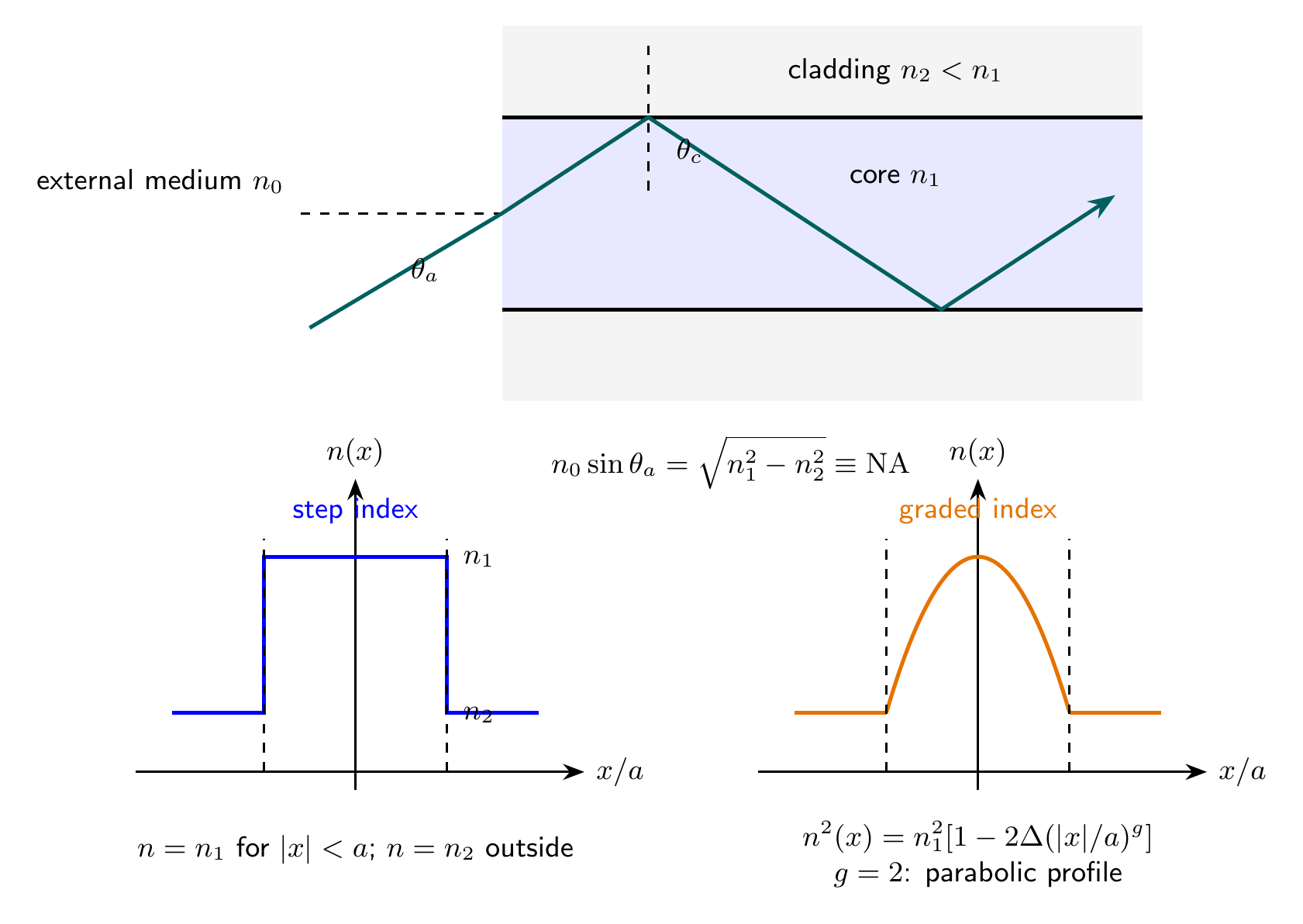
Step-index fibre
For core radius $a$, an ideal step-index profile is
\[\boxed{n(r)=\begin{cases} n_1,&0\le r<a,\\ n_2,&r\ge a. \end{cases}}\]The abrupt boundary produces total internal reflection in the ray picture. In the wave picture, core solutions are oscillatory Bessel functions and cladding solutions decay exponentially; continuity of tangential $\mathbf E$ and $\mathbf H$ selects the allowed propagation constants.
Graded-index fibre
In a graded-index fibre the core index decreases continuously away from the axis. A common model is
\[\boxed{n^2(r)=n_1^2\left[1-2\Delta\left(\frac ra\right)^g\right], \quad 0\le r<a},\]with $n(r)=n_2$ in the cladding. The exact definition above ensures $n^2(a)=n_1^2(1-2\Delta)=n_2^2$, so the ideal profile joins continuously at the core boundary. The exponent $g$ fixes the profile; $g=2$ is approximately parabolic. Rays bend continuously toward the high-index axis. The parabolic profile reduces intermodal transit-time differences because rays travelling farther from the axis also travel through lower-index, higher-speed regions.
Normalized frequency and guided modes
The fibre normalized frequency is
\[\boxed{V=\frac{2\pi a}{\lambda_0}\mathrm{NA} =\frac{2\pi a}{\lambda_0}\sqrt{n_1^2-n_2^2}}.\]$V$ is dimensionless. It combines core size, vacuum wavelength, and index contrast.
A weakly guiding step-index fibre is single mode when
\[\boxed{V<2.405}.\]The fundamental $\mathrm{LP}_{01}$ mode then propagates, while the next mode is below cutoff. A fibre with $V>2.405$ can support several modes and is called multimode. For large $V$, the approximate number of guided modes including polarization degeneracy is
\[\boxed{M\simeq\frac{V^2}{2}\quad\text{(step index)}}.\]For an approximately parabolic graded-index fibre,
\[\boxed{M\simeq\frac{V^2}{4}\quad\text{(graded index)}}.\]Single-mode fibres avoid intermodal dispersion; multimode fibres accept a larger family of spatial field patterns. These classifications concern transverse guided modes, not optical frequency components.
Solved Problems
1. Acceptance, normalized frequency, and mode classification
A step-index fibre in air has $n_1=1.48$, $n_2=1.46$, core radius $a=4.00\ \mathrm{\mu m}$, and vacuum wavelength $\lambda_0=1.30\ \mathrm{\mu m}$. Find its NA, acceptance half-angle, $V$-number, and large-$V$ mode-count estimate.
Solution. The numerical aperture is
\[\mathrm{NA}=\sqrt{n_1^2-n_2^2} =\sqrt{1.48^2-1.46^2}=0.2425.\]In air, $n_0\simeq1$, so
\[\theta_a=\sin^{-1}(\mathrm{NA})=14.03^\circ.\]The normalized frequency is
\[V=\frac{2\pi a}{\lambda_0}\mathrm{NA} =4.688.\]Because $V>2.405$, the fibre is multimode. The large-$V$ step-index estimate is
\[M\simeq\frac{V^2}{2}=10.99\approx11.\]Thus
\[\boxed{\mathrm{NA}=0.2425,\quad \theta_a=14.03^\circ,\quad V=4.688,\quad M\approx11}.\]NA, $V$, and $M$ are dimensionless; only the angle carries an angular unit. The positive square root is chosen because NA is an acceptance magnitude. As $n_2\to n_1$, NA and $V$ tend to zero and index guidance disappears.
2. Largest core that remains single mode
Design a weakly guiding step-index fibre with $\mathrm{NA}=0.120$ to remain single mode at $\lambda_0=1.55\ \mathrm{\mu m}$. Find the largest allowed core radius and diameter.
Solution. Single-mode operation requires $V<2.405$. At the cutoff boundary,
\[2.405=\frac{2\pi a_{\max}}{\lambda_0}\mathrm{NA}.\]Solving for radius,
\[a_{\max}=\frac{2.405\lambda_0}{2\pi\mathrm{NA}} =4.944\ \mathrm{\mu m}.\]Therefore
\[\boxed{a<4.94\ \mathrm{\mu m},\qquad 2a<9.89\ \mathrm{\mu m}}.\]The inequality, rather than equality, keeps the next mode below cutoff. The factor $\lambda_0/\mathrm{NA}$ has unit length, providing the dimensional check. A smaller NA permits a larger single-mode core, while the limit $\mathrm{NA}\to0$ also removes practical confinement, so the algebraic trend must be interpreted together with guidance.
Descriptive Questions
- Derive the numerical-aperture formula from refraction at the input face and total internal reflection at the core-cladding boundary.
- Contrast step-index and graded-index profiles, explaining why an approximately parabolic profile reduces intermodal delay.
- What physical information is combined in the normalized frequency $V$, and why is $2.405$ important?
- Distinguish single-mode and multimode fibres from monochromatic and polychromatic light.
Numerical Problems
- Find the exact relative index parameter for $n_1=1.50$ and $n_2=1.47$. Final answer: $\boxed{\Delta=0.0198=1.98\%}$.
- A fibre has $\mathrm{NA}=0.200$ and is immersed in water of index $1.33$. Find its acceptance half-angle in the water. Final answer: $\boxed{\theta_a=8.649^\circ}$.
- Estimate the number of guided modes in an approximately parabolic graded-index fibre with $V=20.0$. Final answer: $\boxed{M\simeq100}$.
- A step-index fibre has $a=4.50\ \mathrm{\mu m}$ and $\mathrm{NA}=0.130$. Find the cutoff wavelength corresponding to $V=2.405$. Final answer: $\boxed{\lambda_c=1.528\ \mathrm{\mu m}}$.
The numerical-aperture identities are checked in the Unit II Maxima worksheet, and every worked and numerical value above is checked in the MJ-8 problem-verification worksheet; every printed residual and check is zero.


Discussion