

18 Jun 2025
Planar Dielectric Waveguides and Guided-Wave Power
Total-reflection phase, slab continuity conditions, eigenvalue equations, velocities, field energy, and power.
A symmetric planar dielectric guide has a core of refractive index $n_1$ in $\lvert x\rvert<a$, cladding of index $n_2<n_1$ in $\lvert x\rvert>a$, and is uniform along $y$ and the propagation direction $z$. A guided field must oscillate in the core and decay in the cladding.
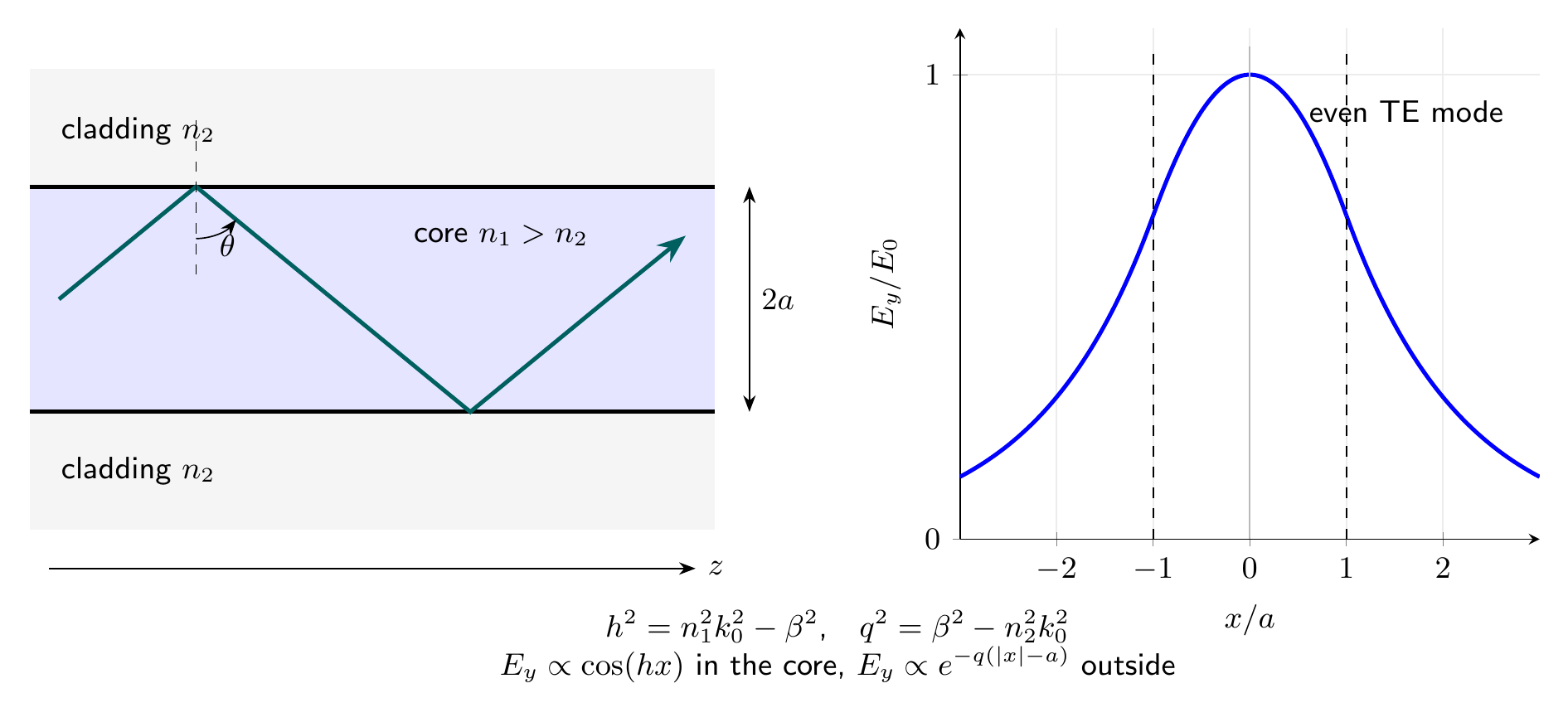
Total internal reflection and its phase
Consider a core ray incident on a core-cladding interface at angle $\theta$ to the normal. Snell’s law is
\[n_1\sin\theta=n_2\sin\theta_t.\]When $\theta>\theta_c$, where
\[\boxed{\sin\theta_c=\frac{n_2}{n_1}},\]$\sin\theta_t>1$ and the cladding field is evanescent. Define
\[\gamma=\sqrt{\sin^2\theta-\left(\frac{n_2}{n_1}\right)^2}.\]The Fresnel reflection coefficients have unit magnitude but a nonzero phase. They may be written
\[r_s=\exp(i\phi_s), \qquad \boxed{\phi_s=-2\tan^{-1}\!\left(\frac{\gamma}{\cos\theta}\right)},\] \[r_p=\exp(i\phi_p), \qquad \boxed{\phi_p=-2\tan^{-1}\!\left(\frac{n_1^2\gamma}{n_2^2\cos\theta}\right)}.\]The reflected power is unity, but the phase shift is essential in the guided-mode condition.
Wave equation across the slab
For a TE mode choose
\[\mathbf E=\hat{\mathbf y}\,\psi(x)e^{i(\beta z-\omega t)}, \qquad k_0=\frac{\omega}{c}.\]The Helmholtz equation becomes
\[\boxed{\frac{d^2\psi}{dx^2}+[n^2(x)k_0^2-\beta^2]\psi=0}.\]Define the real positive transverse constants
\[\boxed{h=\sqrt{n_1^2k_0^2-\beta^2}}, \qquad \boxed{q=\sqrt{\beta^2-n_2^2k_0^2}}.\]Both are real only when
\[\boxed{n_2k_0<\beta<n_1k_0}.\]This inequality is the guided-wave condition. It is often written $n_2<n_{\mathrm{eff}}<n_1$, where
\[\boxed{n_{\mathrm{eff}}=\frac{\beta}{k_0}}.\]Continuity and TE eigenvalue equations
For the convention $e^{i(\beta z-\omega t)}$, Faraday’s law gives
\[H_z=\frac{1}{i\omega\mu}\frac{dE_y}{dx} =-\frac{i}{\omega\mu}\frac{dE_y}{dx}.\]For equal magnetic permeabilities, tangential $E_y$ and $H_z$ are continuous. Hence both $\psi$ and $d\psi/dx$ are continuous at $x=\pm a$; the common factor $-i/(\omega\mu)$ does not alter the eigenvalue equation.
For an even mode,
\[\psi(x)=\begin{cases} A\cos(hx),&\lvert x\rvert\le a,\\ A\cos(ha)e^{-q(\lvert x\rvert-a)},&\lvert x\rvert\ge a. \end{cases}\]Derivative continuity at $x=a$ gives
\[-Ah\sin(ha)=-qA\cos(ha),\]so
\[\boxed{h\tan(ha)=q\qquad\text{(even TE)}}.\]For an odd core field $A\sin(hx)$, the same boundary condition gives
\[\boxed{-h\cot(ha)=q\qquad\text{(odd TE)}}.\]These transcendental eigenvalue equations select discrete $\beta$ values at a fixed frequency.
For TM modes it is convenient to use $H_y=\psi(x)e^{i(\beta z-\omega t)}$. Tangential $H_y$ and tangential $E_z\propto(1/\epsilon)dH_y/dx$ are continuous. Therefore
\[\boxed{h\tan(ha)=\frac{\epsilon_1}{\epsilon_2}q \qquad\text{(even TM)}},\] \[\boxed{-h\cot(ha)=\frac{\epsilon_1}{\epsilon_2}q \qquad\text{(odd TM)}}.\]With normalized variables
\[u=ha,\qquad w=qa,\]the definitions give
\[\boxed{u^2+w^2=V^2}, \qquad \boxed{V=k_0a\sqrt{n_1^2-n_2^2}}.\]$V$ is dimensionless and controls how many slab modes can exist.
Phase and group velocities
The longitudinal phase is $\beta z-\omega t$. Therefore
\[\boxed{v_p=\frac{\omega}{\beta}=\frac{c}{n_{\mathrm{eff}}}}.\]The envelope of a narrow frequency band travels at
\[\boxed{v_g=\frac{d\omega}{d\beta}=\left(\frac{d\beta}{d\omega}\right)^{-1}}.\]Both material dispersion $n_j(\omega)$ and waveguide dispersion through the eigenvalue equation contribute to $d\beta/d\omega$. In the simpler nondispersive relation $\beta^2+\kappa^2=n^2\omega^2/c^2$ with fixed transverse eigenvalue $\kappa$,
\[\boxed{v_pv_g=\left(\frac cn\right)^2}.\]Field energy and transmitted power
For peak phasors in a lossless, nondispersive guide, the cycle-averaged energy density is
\[\boxed{\overline u=\frac14\left(\epsilon\lvert\mathbf E\rvert^2+\mu\lvert\mathbf H\rvert^2\right)} \quad[\mathrm{J\,m^{-3}}].\]The time-averaged longitudinal power per unit width in $y$ is
\[\boxed{P^{\prime}=\frac12\Re\int_{-\infty}^{\infty} (\mathbf E\times\mathbf H^{\ast})\cdot\hat{\mathbf z}\,dx} \quad[\mathrm{W\,m^{-1}}].\]For the TE field above, Faraday’s law gives $H_x=-\beta E_y/(\omega\mu)$. Consequently,
\[\boxed{P^{\prime}=\frac{\beta}{2\omega\mu} \int_{-\infty}^{\infty}\lvert\psi(x)\rvert^2dx}.\]The energy stored per unit guide length and per unit width is
\[U^{\prime}=\int_{-\infty}^{\infty}\overline u\,dx \quad[\mathrm{J\,m^{-2}}].\]Their ratio has units of speed. For a lossless guide it equals the group velocity:
\[\boxed{\frac{P^{\prime}}{U^{\prime}}=v_g}.\]Solved Problems
1. Testing a proposed guided mode
A symmetric slab has $n_1=1.50$, $n_2=1.45$, half-thickness $a=2.00\ \mathrm{\mu m}$, and vacuum wavelength $\lambda_0=1.30\ \mathrm{\mu m}$. A proposed mode has $n_{\mathrm{eff}}=1.475$. Find $\beta$, $h$, $q$, $u$, $w$, $V$, and the cladding $1/e$ amplitude distance.
Solution. The propagation convention is $e^{i(\beta z-\omega t)}$ with $\beta>0$ for $+z$ phase propagation. Since
\[n_2<n_{\mathrm{eff}}<n_1,\]the field can oscillate in the core and decay in the cladding. With $k_0=2\pi/\lambda_0$,
\[\beta=n_{\mathrm{eff}}k_0=7.129\times10^6\ \mathrm{rad\,m^{-1}},\] \[h=\sqrt{n_1^2k_0^2-\beta^2} =1.318\times10^6\ \mathrm{m^{-1}},\] \[q=\sqrt{\beta^2-n_2^2k_0^2} =1.307\times10^6\ \mathrm{m^{-1}}.\]The normalized variables are
\[u=ha=2.636, \qquad w=qa=2.614,\] \[V=k_0a\sqrt{n_1^2-n_2^2}=3.712.\]They obey $u^2+w^2=V^2$. The exterior field is proportional to $e^{-q(x-a)}$, so its $1/e$ amplitude distance is
\[q^{-1}=7.651\times10^{-7}\ \mathrm m=0.765\ \mathrm{\mu m}.\]Thus
\[\boxed{\beta=7.129\times10^6\ \mathrm{rad\,m^{-1}},\quad h=1.318\times10^6\ \mathrm{m^{-1}},\quad q=1.307\times10^6\ \mathrm{m^{-1}},\quad q^{-1}=0.765\ \mathrm{\mu m}}.\]$u$, $w$, and $V$ are dimensionless; $h$, $q$, and $\beta$ are inverse lengths. As $n_{\mathrm{eff}}\to n_2^+$, $q\to0$ and the cladding tail becomes unconfined, which is the cutoff limit.
2. Phase and group velocities for a fixed transverse eigenvalue
In a nondispersive medium of index $n=1.50$, a guided mode satisfies
\[\beta^2+\kappa^2=\frac{n^2\omega^2}{c^2},\]with a fixed transverse eigenvalue whose value at the frequency considered is $\kappa=0.60n\omega/c$. Find $v_p$ and $v_g$.
Solution. The positive-$\beta$ branch gives
\[\beta=\frac{n\omega}{c}\sqrt{1-0.60^2} =0.80\frac{n\omega}{c}.\]Hence
\[v_p=\frac{\omega}{\beta} =\frac{c}{0.80n}=2.498\times10^8\ \mathrm{m\,s^{-1}}.\]Differentiating the dispersion relation at fixed $\kappa$ gives
\[v_g=\frac{d\omega}{d\beta} =\frac{c^2\beta}{n^2\omega} =0.80\frac cn =1.599\times10^8\ \mathrm{m\,s^{-1}}.\]Therefore
\[\boxed{v_p=2.498\times10^8\ \mathrm{m\,s^{-1}},\qquad v_g=1.599\times10^8\ \mathrm{m\,s^{-1}}}.\]The phase velocity exceeds the plane-wave speed $c/n$, while the group and energy velocity is smaller; no information travels at $v_p$. The check $v_pv_g=(c/n)^2$ is dimensionally a squared speed. In the limit $\kappa\to0$, both velocities approach $c/n$.
Descriptive Questions
- Explain why a guided slab mode must satisfy $n_2k_0<\beta<n_1k_0$.
- Derive the even and odd TE eigenvalue equations from tangential-field continuity at the two interfaces.
- How does the phase shift on total internal reflection enter a ray description of the discrete guided-mode condition?
- Explain why $P^{\prime}/U^{\prime}$ equals group velocity in a lossless guide and state the units of both $P^{\prime}$ and $U^{\prime}$.
Numerical Problems
- Find the critical angle for a core-cladding interface with $n_1=1.52$ and $n_2=1.46$. Final answer: $\boxed{\theta_c=73.85^\circ}$.
- A cladding field has $q=2.00\times10^5\ \mathrm{m^{-1}}$. Find its amplitude fraction $10.0\ \mathrm{\mu m}$ beyond the interface. Final answer: $\boxed{e^{-q x}=e^{-2}=0.1353}$.
- For s polarization at $80.0^\circ$ internal incidence from $n_1=1.50$ to $n_2=1.45$, find the total-reflection phase in the convention $r_s=e^{i\phi_s}$. Final answer: $\boxed{\phi_s=-94.59^\circ}$.
The normalized-frequency and velocity identities are checked in the Unit II Maxima worksheet, and every worked and numerical value above is checked in the MJ-8 problem-verification worksheet; every printed residual and check is zero.


Discussion