

16 Jul 2025
Anisotropic Crystals, Double Refraction, and the Nicol Prism
Uniaxial and biaxial crystals, ordinary and extraordinary waves, double refraction, and Nicol-prism operation.
In an isotropic dielectric, $\mathbf D=\epsilon\mathbf E$ with one scalar $\epsilon$. In an anisotropic crystal the permittivity is a tensor. Along its principal axes,
\[\begin{pmatrix}D_x\\D_y\\D_z\end{pmatrix} =\begin{pmatrix} \epsilon_x&0&0\\0&\epsilon_y&0\\0&0&\epsilon_z \end{pmatrix} \begin{pmatrix}E_x\\E_y\\E_z\end{pmatrix}.\]Different field directions can therefore experience different refractive indices.
Uniaxial and biaxial crystals
A uniaxial crystal has two equal principal indices:
\[n_x=n_y=n_o,\qquad n_z=n_e.\]The $z$ direction is the optic axis. The optical indicatrix is
\[\boxed{\frac{x^2+y^2}{n_o^2}+\frac{z^2}{n_e^2}=1}.\]$n_o$ is the ordinary refractive index and $n_e$ is the principal extraordinary refractive index. A positive uniaxial crystal has $n_e>n_o$; a negative uniaxial crystal has $n_e<n_o$.
A biaxial crystal has three unequal principal indices,
\[n_x\ne n_y\ne n_z,\]and two optic-axis directions along which the two permitted refractive indices coincide.
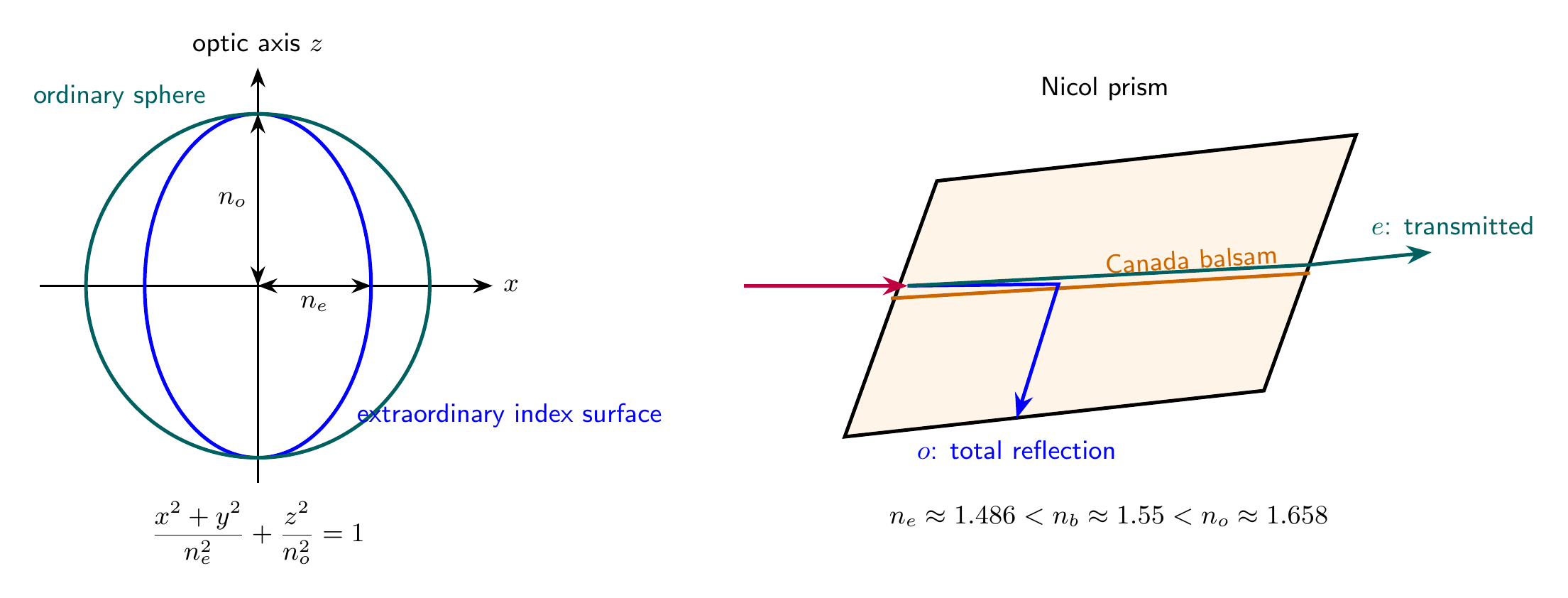
The indicatrix and the directional index surface are different geometric constructions. If the radial distance is chosen to equal the extraordinary index for a wave-normal direction, the latter obeys
\[\frac{x^2+y^2}{n_e^2}+\frac{z^2}{n_o^2}=1.\]It touches the ordinary sphere of radius $n_o$ along the optic axis, where the two indices coincide, as shown in the figure.
Light propagation in a uniaxial crystal
Let the wave normal $\mathbf k$ make angle $\vartheta$ with the optic axis. Maxwell’s equations and the anisotropic constitutive relation admit two transverse displacement eigenvectors.
For the ordinary wave, $\mathbf D_o$ is perpendicular to the principal section, the plane containing $\mathbf k$ and the optic axis. Its index is independent of direction:
\[\boxed{n_o(\vartheta)=n_o}.\]For the extraordinary wave, $\mathbf D_e$ lies in the principal section. Its direction-dependent index follows from the indicatrix:
\[\boxed{\frac1{n_e^2(\vartheta)} =\frac{\cos^2\vartheta}{n_o^2} +\frac{\sin^2\vartheta}{n_e^2}}.\]At $\vartheta=0$, both waves see $n_o$ and no angular splitting occurs. At $\vartheta=90^\circ$, the extraordinary wave sees the principal value $n_e$.
For the ordinary wave, the energy-flow direction $\mathbf S$ is parallel to the wave normal in the usual construction. For the extraordinary wave, anisotropy generally makes $\mathbf S$ nonparallel to $\mathbf k$; this walk-off contributes to spatial ray separation.
Double refraction and polarization
At an interface, the tangential component of $\mathbf k$ is common to both allowed transmitted eigenwaves. Because their refractive indices differ, they generally have different wave-normal and energy-flow directions. An incident beam therefore separates into
- an ordinary ray obeying Snell’s law with constant $n_o$, polarized perpendicular to the principal section; and
- an extraordinary ray with direction-dependent $n_e(\vartheta)$, polarized in the principal section.
The two polarizations are orthogonal. Isolating either separated ray produces plane-polarized light; this is polarization by double refraction.
Nicol prism: construction
A Nicol prism is made from a calcite rhombohedron cut diagonally through a principal section. The cut faces are polished and cemented with a thin layer of Canada balsam. The end faces admit and transmit the beam, while a side face is arranged to absorb the rejected ray.
Near the sodium D line, representative indices are
\[n_e\approx1.486, \qquad n_b\approx1.55, \qquad n_o\approx1.658,\]where $n_b$ is the Canada-balsam index. Calcite is negative uniaxial because $n_e<n_o$.
Nicol prism: working
The ordinary ray travels from effective index $n_o$ toward the lower balsam index $n_b$. Its critical angle is
\[\boxed{\theta_{c,o}=\sin^{-1}\!\left(\frac{n_b}{n_o}\right) \approx\sin^{-1}\!\left(\frac{1.55}{1.658}\right) \approx69.2^\circ}.\]The prism cut makes the ordinary-ray incidence exceed this value, so the ordinary ray is totally internally reflected toward the side and removed.
The extraordinary ray has an effective index near $n_e<n_b$ for the intended geometry. It passes into the balsam rather than undergoing total internal reflection, crosses the second calcite half, and emerges. The output contains one extraordinary eigenpolarization and is therefore plane polarized.
Solved Problems
1. Direction-dependent extraordinary index of calcite
For calcite, take $n_o=1.658$ and principal $n_e=1.486$. Find the extraordinary-wave index when the wave normal makes $45.0^\circ$ with the optic axis, and interpret the result.
Solution. With $\vartheta$ measured from the optic axis,
\[\frac1{n_e^2(\vartheta)} =\frac{\cos^2\vartheta}{n_o^2} +\frac{\sin^2\vartheta}{n_e^2}.\]At $45.0^\circ$,
\[n_e(45^\circ)= \left[\frac{1/2}{1.658^2}+\frac{1/2}{1.486^2}\right]^{-1/2} =1.565.\]Therefore
\[\boxed{n_e(45^\circ)=1.565}.\]The value lies between the two principal indices, as it must. Because $n_e<n_o$, calcite is negative uniaxial. Refractive index is dimensionless. The limiting checks are $n_e(0)=n_o$ (no splitting along the optic axis) and $n_e(90^\circ)=n_e$.
2. Index window for selective removal in a Nicol-type interface
At a calcite-cement interface, let both rays strike at $i=75.0^\circ$. Use $n_o=1.658$ and an effective extraordinary index $n_e=1.486$. Determine the range of cement index $n_b$ for which the ordinary ray is totally internally reflected while the extraordinary ray is transmitted. Test $n_b=1.55$.
Solution. For incidence from an index $n$ toward $n_b$, total internal reflection occurs when
\[n\sin i>n_b.\]Selective operation therefore requires
\[n_e\sin i<n_b<n_o\sin i.\]At $75.0^\circ$,
\[n_e\sin i=1.486\sin75^\circ=1.435,\] \[n_o\sin i=1.658\sin75^\circ=1.602.\]Hence
\[\boxed{1.435<n_b<1.602}.\]The value $n_b=1.55$ lies inside this interval: the ordinary ray meets the TIR condition, while the extraordinary ray does not. All quantities in the inequality are dimensionless, and the sign convention only labels which ray is rejected. If birefringence vanished so that $n_o=n_e$, the interval would collapse and selective removal would be impossible.
Descriptive Questions
- Distinguish the optical indicatrix from the wave-normal index surface for a uniaxial crystal.
- Explain why the extraordinary ray can have nonparallel wave-normal and energy-flow directions.
- How does double refraction produce two orthogonally polarized rays from one incident beam?
- Describe the construction and working of a Nicol prism, including the role of the Canada-balsam layer.
Numerical Problems
- A positive uniaxial crystal has $n_o=1.544$ and $n_e=1.553$. Find the extraordinary index at $\vartheta=30.0^\circ$. Final answer: $\boxed{n_e(30^\circ)=1.54624}$.
- Principal indices are $1.60$, $1.60$, and $1.65$. Classify the crystal. Final answer: $\boxed{\text{positive uniaxial, with }n_e-n_o=0.050}$.
- Find the critical angle for light incident from a crystal of index $1.62$ onto cement of index $1.50$. Final answer: $\boxed{\theta_c=67.81^\circ}$.
Every worked and numerical result is checked in the MJ-8 problem-verification worksheet; every printed check is zero.
References
- Birefringence - Wikipedia
- RP Photonics Encyclopedia, Birefringence
- Eugene Hecht, Optics, 5th ed., Chapter 8, “Polarization,” sections on birefringence and polarizing prisms.


Discussion