

15 Jul 2025
Linear, Circular, and Elliptical Polarization
Polarization ellipse derived from orthogonal field components, with linear and circular limits.
For a monochromatic wave travelling along $+z$, the transverse electric field can have two orthogonal components:
\[E_x=A\cos\psi, \qquad E_y=B\cos(\psi+\delta), \qquad \psi=kz-\omega t.\]$A$ and $B$ are nonnegative peak amplitudes in $\mathrm{V\,m^{-1}}$, and $\delta$ is their phase difference. At a fixed point in space, the tip of $\mathbf E$ traces the polarization curve as time advances.
Derivation of the polarization ellipse
Expand the second component:
\[\frac{E_y}{B}=\cos\psi\cos\delta-\sin\psi\sin\delta.\]Since $E_x/A=\cos\psi$,
\[\sin\psi\sin\delta =\frac{E_x}{A}\cos\delta-\frac{E_y}{B}.\]Square this equation and use $\sin^2\psi=1-\cos^2\psi=1-(E_x/A)^2$. After collecting terms,
\[\boxed{\left(\frac{E_x}{A}\right)^2 +\left(\frac{E_y}{B}\right)^2 -2\frac{E_xE_y}{AB}\cos\delta =\sin^2\delta}.\]This is the equation of an ellipse in the transverse plane. Linear and circular polarization are special limiting forms.
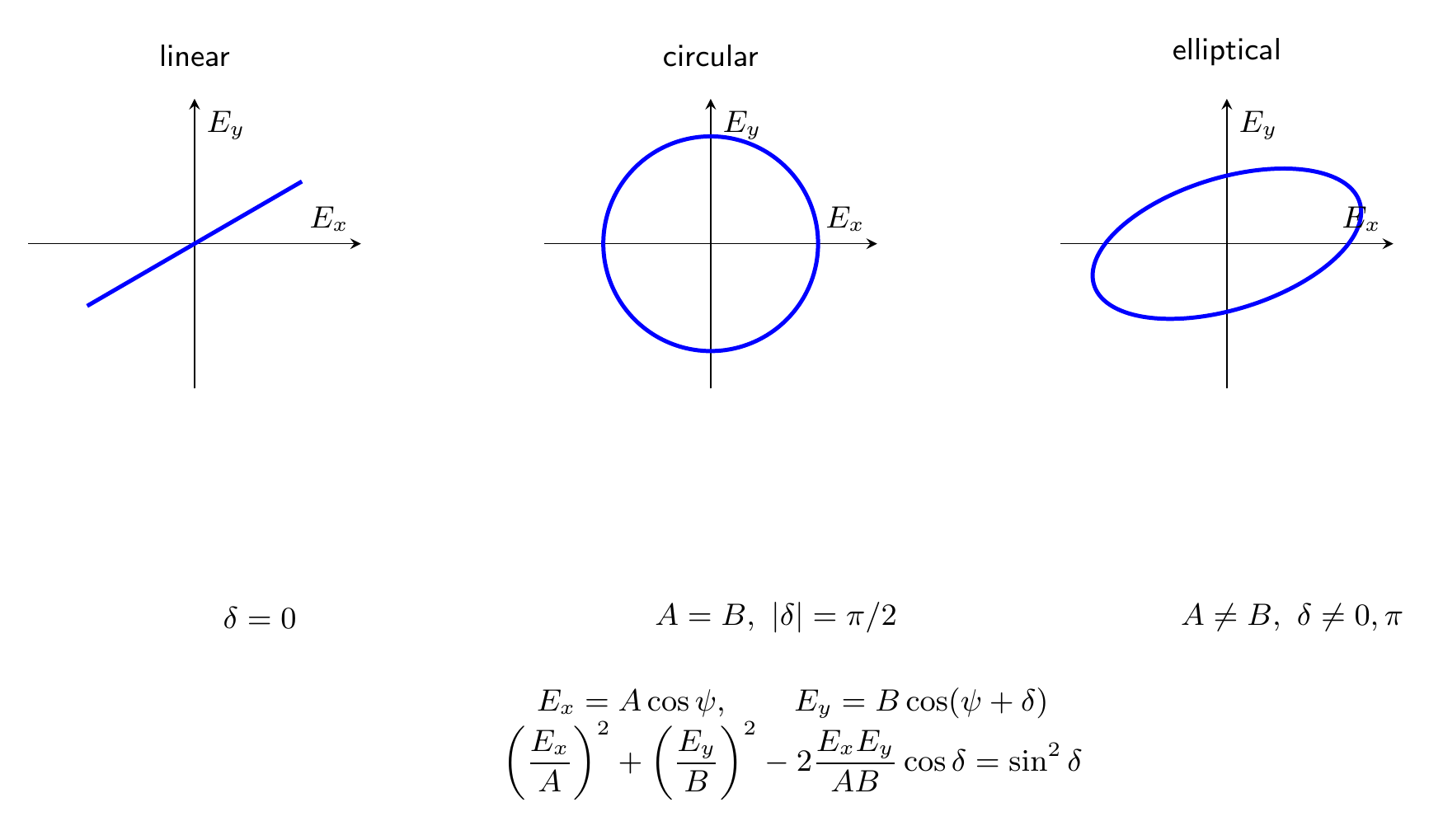
Linear polarization
If $\delta=0$ or $\pi$, the right-hand side of the ellipse equation vanishes and the two components are proportional:
\[\delta=0:\quad E_y=\frac BA E_x,\] \[\delta=\pi:\quad E_y=-\frac BA E_x.\]The field oscillates along a fixed straight line. Linear polarization also results if either $A=0$ or $B=0$, regardless of phase.
Circular polarization
If the components have equal amplitude and differ in phase by a quarter cycle,
\[A=B=E_0, \qquad \delta=\pm\frac\pi2,\]then
\[E_x^2+E_y^2=E_0^2.\]The field magnitude is constant and its direction rotates uniformly. The signs $+\pi/2$ and $-\pi/2$ give opposite handedness. A handedness label must always be accompanied by the viewing or propagation convention; here the sign of $\delta$ unambiguously records the state.
Elliptical polarization
All other fully polarized combinations with both components present produce an ellipse. The orientation angle $\theta$ of its principal axis relative to $x$ follows by eliminating the mixed term through a rotation of coordinates:
\[\boxed{\tan2\theta=\frac{2AB\cos\delta}{A^2-B^2}}.\]Define the ellipticity angle $\chi$ by $\tan\chi=b/a$, where $a\ge b$ are the semi-major and semi-minor axes and the sign carries the rotation sense. Then
\[\boxed{\sin2\chi=\frac{2AB\sin\delta}{A^2+B^2}}, \qquad -45^\circ\le\chi\le45^\circ.\]$\chi=0$ is linear, while $\lvert\chi\rvert=45^\circ$ is circular. Elliptical polarization is therefore the general state, with linear and circular states obtained by particular amplitude and phase relations.
Solved Problems
1. Orientation and ellipticity from component data
A fully polarized wave has $A=4.00\ \mathrm{V\,m^{-1}}$, $B=3.00\ \mathrm{V\,m^{-1}}$, and phase difference $\delta=60.0^\circ$. Find the polarization-ellipse azimuth $\theta$ and ellipticity angle $\chi$ in the conventions used above.
Solution. The azimuth must be evaluated with the signs of both numerator and denominator retained:
\[2\theta=\operatorname{atan2} \!\left(2AB\cos\delta,A^2-B^2\right).\]Here
\[2AB\cos\delta=12.0\ \mathrm{(V\,m^{-1})^2}, \qquad A^2-B^2=7.00\ \mathrm{(V\,m^{-1})^2},\]so
\[\theta=\frac12\operatorname{atan2}(12,7)=29.87^\circ.\]For the ellipticity,
\[\sin2\chi=\frac{2AB\sin\delta}{A^2+B^2} =\frac{24\sin60^\circ}{25}=0.8314,\]and therefore
\[\chi=28.12^\circ.\]Thus
\[\boxed{\theta=29.87^\circ,\qquad \chi=+28.12^\circ}.\]The positive sign of $\chi$ follows the stated algebraic phase convention; a verbal handedness label would additionally require a viewing convention. The amplitude-squared units cancel in both ratios, so the angles are dimensionless. Since $0<\lvert\chi\rvert<45^\circ$, the state is elliptical, with $b/a=\tan\lvert\chi\rvert\approx0.535$. Letting $\delta\to0$ makes $\chi\to0$, the linear limit.
2. Identifying a constant-magnitude rotating field
At a fixed plane, a wave is described by
\[E_x=E_0\cos\psi, \qquad E_y=E_0\sin\psi.\]Classify the polarization, determine the relative phase in the article’s cosine convention, and state the rotation sense at $z=0$ as time increases.
Solution. Write
\[E_y=E_0\cos\!\left(\psi-\frac\pi2\right),\]so $A=B=E_0$ and $\delta=-\pi/2$. The magnitude is
\[E_x^2+E_y^2=E_0^2(\cos^2\psi+\sin^2\psi)=E_0^2,\]which is constant. The state is therefore circular:
\[\boxed{A=B=E_0,\qquad \delta=-\frac\pi2,\qquad E_x^2+E_y^2=E_0^2}.\]At $z=0$, $\psi=-\omega t$; just after $t=0$, the field turns from $+x$ toward $-y$. This explicit statement avoids an ambiguous handedness word. Both components have unit $\mathrm{V\,m^{-1}}$, and their squared sum has unit $\mathrm{V^2\,m^{-2}}$. If either amplitude tends to zero, the circle collapses to a line.
Descriptive Questions
- Derive the polarization ellipse by eliminating the common phase between two orthogonal field components.
- State all amplitude and phase conditions that produce linear or circular polarization.
- Why is a handedness label incomplete unless the propagation direction and viewing convention are specified?
- Explain the geometrical meanings and allowed ranges of the azimuth $\theta$ and ellipticity angle $\chi$.
Numerical Problems
- For $A=B=5.00\ \mathrm{V\,m^{-1}}$ and $\delta=\pi$, find the polarization line. Final answer: $\boxed{E_y=-E_x}$, linear polarization at $-45^\circ$ to $+x$.
- For $A=6.00\ \mathrm{V\,m^{-1}}$, $B=2.00\ \mathrm{V\,m^{-1}}$, and $\delta=\pi/2$, find the minor-to-major axis ratio. Final answer: $\boxed{b/a=1/3}$.
- For $A=5.00\ \mathrm{V\,m^{-1}}$, $B=2.00\ \mathrm{V\,m^{-1}}$, and $\delta=45.0^\circ$, find $\theta$ and $\chi$. Final answer: $\boxed{\theta=16.98^\circ,\qquad \chi=14.59^\circ}$.
The general ellipse identity is checked in the Unit III Maxima worksheet, and every worked and numerical value above is checked in the MJ-8 problem-verification worksheet; every printed residual and check is zero.
References
- Polarization (waves) - Wikipedia
- RP Photonics Encyclopedia, Polarization of Light
- Eugene Hecht, Optics, 5th ed., Chapter 8, “Polarization.”


Discussion