

17 Jul 2025
Retardation Plates, Babinet Compensator, and Polarization Analysis
Production and detection of polarization, quarter- and half-wave plates, Babinet compensation, and Stokes analysis.
A phase-retardation plate is a uniform birefringent plate cut so that two orthogonal linear eigenpolarizations travel with refractive indices $n_f$ and $n_s$, where $n_s>n_f$. The corresponding fast and slow components emerge with a controlled relative phase.
Retardation from optical path difference
For plate thickness $d$, the two phase advances are
\[\varphi_f=\frac{2\pi}{\lambda_0}n_fd, \qquad \varphi_s=\frac{2\pi}{\lambda_0}n_sd.\]The slow-minus-fast retardation is
\[\boxed{\delta=\varphi_s-\varphi_f =\frac{2\pi}{\lambda_0}(n_s-n_f)d}.\]$\delta$ is dimensionless and is normally quoted in radians or degrees.
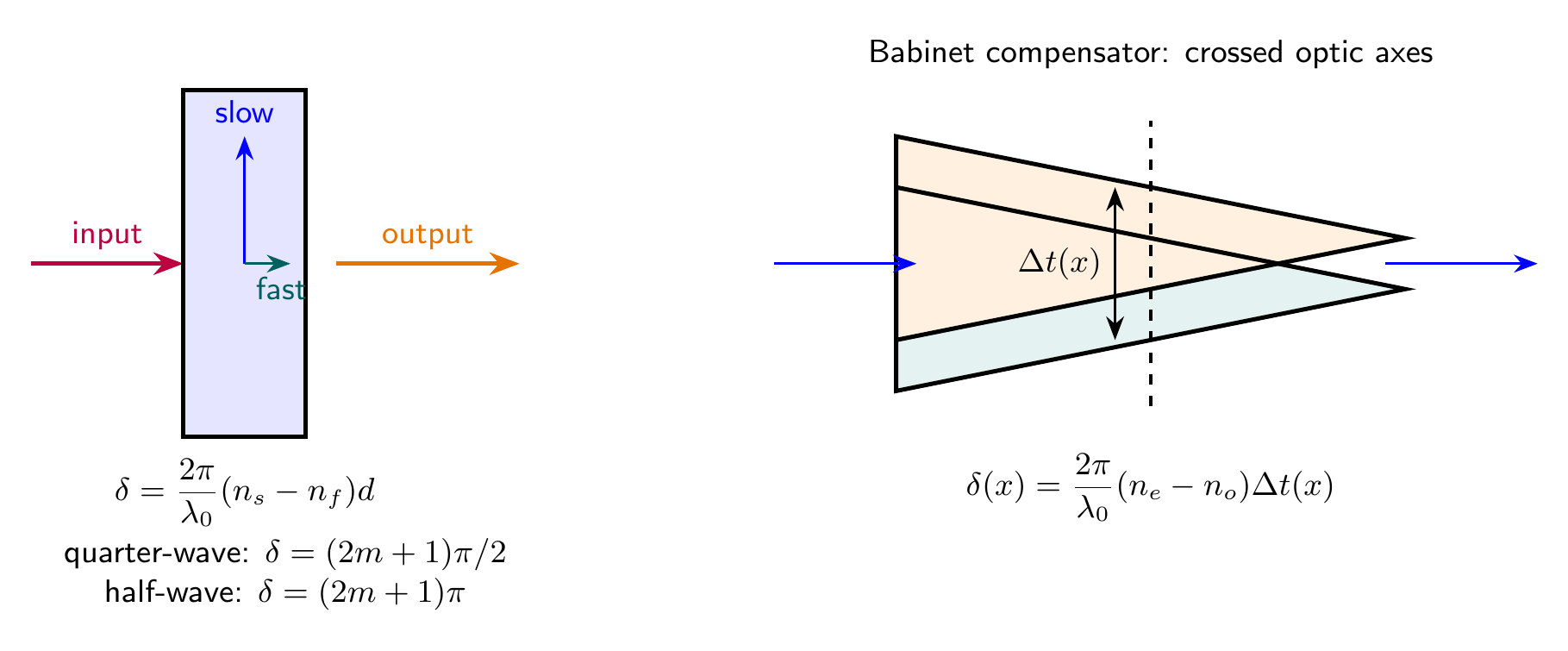
Quarter-wave plate
A quarter-wave plate requires
\[\delta=(2m+1)\frac\pi2,\]so its allowed thicknesses are
\[\boxed{d_{\lambda/4}=\frac{(2m+1)\lambda_0}{4\lvert n_s-n_f\rvert}}, \qquad m=0,1,2,\ldots\]If linearly polarized light enters at $45^\circ$ to the plate axes, its two components have equal amplitudes. The plate introduces a $\pm\pi/2$ phase difference, producing circular polarization. If both components are nonzero but unequal, the output is elliptical; input exactly along either plate axis remains linear.
Half-wave plate
A half-wave plate requires
\[\delta=(2m+1)\pi,\]and therefore
\[\boxed{d_{\lambda/2}=\frac{(2m+1)\lambda_0}{2\lvert n_s-n_f\rvert}}.\]Let an incident linear field make angle $\theta$ with the fast axis. Its Jones vector is proportional to $(\cos\theta,\sin\theta)$. Apart from an overall phase, the half-wave plate changes it to
\[\begin{pmatrix}\cos\theta\\-\sin\theta\end{pmatrix},\]which is linear at angle $-\theta$. The plane of polarization is therefore rotated through magnitude $2\theta$ about the plate axis. A half-wave plate also reverses the handedness of elliptical or circular polarization.
Production of polarized light
Plane-polarized light is produced by transmitting an unpolarized beam through a Nicol prism or another linear polarizer. If its transmission axis is $\hat{\mathbf a}$, only the field projection $(\mathbf E\cdot\hat{\mathbf a})\hat{\mathbf a}$ is transmitted.
Circularly polarized light is produced by sending plane-polarized light through a quarter-wave plate with the incident plane at $45^\circ$ to the fast and slow axes. Elliptically polarized light is produced when both orthogonal components are nonzero, their phase difference is not an integer multiple of $\pi$, and the equal-amplitude quarter-cycle special case that gives circular polarization is avoided.
Detection with an analyzer
For a linear analyzer whose axis makes angle $\theta$ with a linearly polarized input, the transmitted field is $E_0\cos\theta$. Hence Malus’s law is
\[\boxed{I=I_0\cos^2\theta}.\]On rotating the analyzer:
- linear polarization gives complete extinction twice per revolution;
- circular polarization gives angle-independent transmitted intensity; and
- elliptical polarization gives alternating nonzero maximum and minimum intensity.
A quarter-wave plate followed by a linear analyzer distinguishes circular from unpolarized light: a correctly oriented quarter-wave plate converts circular light to linear light, which can be extinguished, whereas unpolarized light cannot be completely extinguished.
Babinet compensator
An ideal Babinet compensator uses two wedges of the same birefringent material with crossed optic axes. At transverse position $x$, their thickness difference is $\Delta t(x)=t_1(x)-t_2(x)$. Because the fast direction of one wedge is the slow direction of the other, the common thickness cancels and the net retardation is
\[\boxed{\delta(x)=\frac{2\pi}{\lambda_0}(n_e-n_o)\Delta t(x)}.\]Translating a wedge changes $\Delta t$ continuously. A zero-order line occurs where $\Delta t=0$; successive equal-retardation lines differ by an optical path of one wavelength. The compensator is used to measure small phase differences, determine birefringence or wavelength, compensate an unknown retardation, and reduce an elliptically polarized state to a linear state for analysis.
Quantitative analysis with Stokes parameters
Let $E_x$ and $E_y$ be complex peak amplitudes. Choose the convention
\[\boxed{\begin{aligned} S_0&=\lvert E_x\rvert^2+\lvert E_y\rvert^2,\\ S_1&=\lvert E_x\rvert^2-\lvert E_y\rvert^2,\\ S_2&=2\Re(E_xE_y^{\ast}),\\ S_3&=-2\Im(E_xE_y^{\ast}). \end{aligned}}\]$S_0$ is proportional to total intensity. $S_1$ is obtained from horizontal and vertical analyzer readings, $S_2$ from $+45^\circ$ and $-45^\circ$ readings, and $S_3$ from a quarter-wave plate followed by the analyzer. For completely polarized light,
\[\boxed{S_0^2=S_1^2+S_2^2+S_3^2}.\]The polarization-ellipse azimuth and ellipticity are
\[\boxed{\theta=\frac12\tan^{-1}\!\left(\frac{S_2}{S_1}\right)}, \qquad \boxed{\chi=\frac12\sin^{-1}\!\left(\frac{S_3}{S_0}\right)}.\]The quadrant of the azimuth is fixed by the signs of both $S_1$ and $S_2$.
Solved Problems
1. Zero-order quarter- and half-wave plate thicknesses
Quartz has $\lvert n_s-n_f\rvert=0.00900$ at $\lambda_0=589\ \mathrm{nm}$. Find the least positive thicknesses that act as a quarter-wave plate and a half-wave plate.
Solution. Retardation is defined as slow phase minus fast phase, so its magnitude is
\[\lvert\delta\rvert=\frac{2\pi}{\lambda_0}\lvert n_s-n_f\rvert d.\]For the zero-order quarter-wave plate, $\lvert\delta\rvert=\pi/2$:
\[d_{\lambda/4}=\frac{\lambda_0}{4\lvert n_s-n_f\rvert} =\frac{589\ \mathrm{nm}}{4(0.00900)} =16.36\ \mathrm{\mu m}.\]For the zero-order half-wave plate, $\lvert\delta\rvert=\pi$:
\[d_{\lambda/2}=\frac{\lambda_0}{2\lvert n_s-n_f\rvert} =32.72\ \mathrm{\mu m}.\]Thus
\[\boxed{d_{\lambda/4}=16.36\ \mathrm{\mu m},\qquad d_{\lambda/2}=32.72\ \mathrm{\mu m}}.\]The half-wave thickness is twice the quarter-wave thickness at the same wavelength. Refractive-index difference and retardation are dimensionless, so $d$ inherits the wavelength unit. If $\lvert n_s-n_f\rvert\to0$, the required thickness diverges because an isotropic plate cannot accumulate differential phase.
2. Reconstructing a polarized state from analyzer intensities
In consistent intensity units, a complete analyzer set gives
\[I_H=9,\quad I_V=1,\quad I_{+45}=5,\quad I_{-45}=5,\]and calibrated circular channels give $I_R=8$, $I_L=2$, with $S_3=I_R-I_L$ in the stated convention. Find the Stokes parameters, check whether the light is completely polarized, and obtain $\theta$ and $\chi$.
Solution. The measured differences give
\[S_0=I_H+I_V=10,\] \[S_1=I_H-I_V=8,\qquad S_2=I_{+45}-I_{-45}=0,\qquad S_3=I_R-I_L=6.\]The polarization identity is satisfied:
\[S_1^2+S_2^2+S_3^2=8^2+0^2+6^2=100=S_0^2.\]Thus the state is completely polarized. Its ellipse parameters are
\[\theta=\frac12\operatorname{atan2}(0,8)=0^\circ,\] \[\chi=\frac12\sin^{-1}\!\left(\frac6{10}\right)=18.43^\circ.\]Therefore
\[\boxed{(S_0,S_1,S_2,S_3)=(10,8,0,6),\quad \theta=0^\circ,\quad \chi=18.43^\circ}.\]The major axis lies along $x$; the sign of $\chi$ follows the calibrated $S_3$ convention. Stokes parameters here share the same intensity unit, so all ratios used for angles are dimensionless. If $S_3\to0$ with these other readings fixed consistently, $\chi\to0$ and the state becomes linear.
Descriptive Questions
- Derive the thickness conditions for zero-order quarter- and half-wave plates from optical path difference.
- Explain how a quarter-wave plate and analyzer distinguish circularly polarized light from unpolarized light.
- Describe how a Babinet compensator produces continuously variable retardation and list its principal uses.
- How are the four Stokes parameters obtained from intensity measurements, and what identity characterizes completely polarized light?
Numerical Problems
- A plate has $\lvert\Delta n\rvert=0.0120$, thickness $24.5\ \mathrm{\mu m}$, and is used at $588\ \mathrm{nm}$. Classify its zero-order retardance. Final answer: $\boxed{\delta=\pi}$, so it is a half-wave plate.
- Linear input makes $17.0^\circ$ with a half-wave plate’s fast axis. Using the article’s axis convention, find the output azimuth and signed rotation. Final answer: $\boxed{\theta_{\rm out}=-17.0^\circ,\quad \Delta\theta=-34.0^\circ}$.
- A Babinet compensator has $\Delta n=0.00900$, local thickness difference $10.0\ \mathrm{\mu m}$, and $\lambda_0=600\ \mathrm{nm}$. Find its retardance magnitude. Final answer: $\boxed{\lvert\delta\rvert=0.300\pi=54.0^\circ}$.
- Linearly polarized light of intensity $80.0\ \mathrm{W\,m^{-2}}$ meets an analyzer at $30.0^\circ$. Find the transmitted intensity. Final answer: $\boxed{I=60.0\ \mathrm{W\,m^{-2}}}$.
The quarter- and half-wave Jones identities are checked in the Unit III Maxima worksheet, and every worked and numerical value above is checked in the MJ-8 problem-verification worksheet; every printed residual and check is zero.


Discussion