

18 May 2025
Bisection, Newton, Fixed-Point Iteration, and Convergence
A numerical root of $f(x)=0$ is an approximation to a value $\alpha$ for which $f(\alpha)=0$. Bracketing methods preserve an interval containing a root; open methods update a point and can converge much faster when the starting value is suitable.
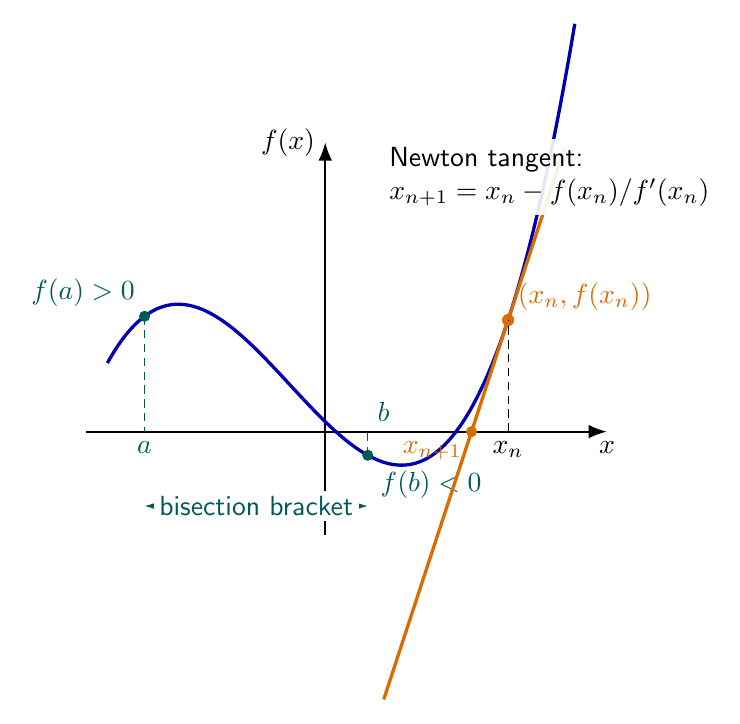
The diagram is reproducible from its editable TikZ source.
Bisection
If $f$ is continuous on $[a_0,b_0]$ and
\[f(a_0)f(b_0)<0,\]the intermediate value theorem guarantees at least one root in the interval. Let
\[c=\frac{a+b}{2}.\]If $f(c)=0$, then $c$ is the exact root and the iteration stops. Otherwise, keep $[a,c]$ when $f(a)f(c)<0$, and keep $[c,b]$ when $f(c)f(b)<0$. The strict sign change is preserved at every step.
After $n$ bisections the interval width is
\[b_n-a_n=\frac{b_0-a_0}{2^n}.\]If $m_n=(a_n+b_n)/2$ is the midpoint of the retained interval, it therefore gives the rigorous bound
\[\boxed{\lvert\alpha-m_n\rvert\le\frac{b_0-a_0}{2^{n+1}}}.\]To ensure an error no larger than $\varepsilon$, it is sufficient to take
\[n\ge\log_2\!\left(\frac{b_0-a_0}{2\varepsilon}\right).\]Newton-Raphson method
At $x_n$, replace the curve by its tangent:
\[y-f(x_n)=f^{\prime}(x_n)(x-x_n).\]The tangent crosses the $x$-axis at $x_{n+1}$. Setting $y=0$ gives
\[\boxed{x_{n+1}=x_n-\frac{f(x_n)}{f^{\prime}(x_n)}}.\]Near a simple root, expand $f(x_n)$ around $\alpha$. With $e_n=x_n-\alpha$,
\[f(x_n)=f^{\prime}(\alpha)e_n+\frac12f^{\prime\prime}(\alpha)e_n^2+\cdots.\]Substitution in the Newton update gives
\[e_{n+1}\approx\frac{f^{\prime\prime}(\alpha)}{2f^{\prime}(\alpha)}e_n^2.\]The squared error explains quadratic convergence. A zero or very small derivative, a poor starting point, or a multiple root can destroy this behavior.
Fixed-point iteration
Rewrite $f(x)=0$ as
\[x=g(x)\]and iterate
\[\boxed{x_{n+1}=g(x_n)}.\]If $g(\alpha)=\alpha$, the mean value theorem gives
\[e_{n+1}=g(x_n)-g(\alpha)=g^{\prime}(\xi_n)e_n.\]Hence a sufficient local convergence condition is
\[\lvert g^{\prime}(x)\rvert\le q<1\]throughout a neighborhood that maps into itself. Then
\[\lvert e_{n+1}\rvert\le q\lvert e_n\rvert,\]so fixed-point iteration is generally linearly convergent. Different rearrangements of the same equation can have different values of $q$, and some will diverge.
One equation, three viewpoints
For
\[f(x)=x^3-x-2,\]$f(1)=-2$ and $f(2)=4$, so bisection starts on $[1,2]$. The first midpoints are
| step | midpoint | $f(\text{midpoint})$ | retained bracket |
|---|---|---|---|
| 1 | 1.500000 | -0.125000 | $[1.5,2]$ |
| 2 | 1.750000 | 1.609375 | $[1.5,1.75]$ |
| 3 | 1.625000 | 0.666016 | $[1.5,1.625]$ |
| 4 | 1.562500 | 0.252197 | $[1.5,1.5625]$ |
Newton’s method has $f^{\prime}(x)=3x^2-1$. Starting from $x_0=1.5$,
\[x_1=1.5-\frac{-0.125}{5.75}=1.52173913,\] \[x_2=1.52137981.\]A convergent fixed-point form is
\[x_{n+1}=(x_n+2)^{1/3},\]because at the root $\lvert g^{\prime}(\alpha)\rvert=1/(3\alpha^2)\approx0.144<1$. All three approaches lead to
\[\alpha\approx1.52137971.\]An iteration should normally stop only when both
\[\lvert x_{n+1}-x_n\rvert<\varepsilon_x \quad\text{and}\quad \lvert f(x_{n+1})\rvert<\varepsilon_f.\]For bisection, the bracket-width bound remains the strongest error certificate.
Solved Problems
1. A certified bisection approximation to $\sqrt5$
For $f(x)=x^2-5$, $f(2)=-1$ and $f(3)=4$, so continuity guarantees a root in $[2,3]$. To make the midpoint error no larger than $10^{-3}$, require
\[\frac{3-2}{2^{n+1}}\le10^{-3}.\]Taking logarithms,
\[n\ge\log_2(500)=8.965\ldots,\]so nine bisections are sufficient. Repeated sign tests give the final bracket
\[\left[2.234375,\,2.236328125\right] =\left[\frac{143}{64},\,\frac{1145}{512}\right].\]Its midpoint is
\[m_9=\frac{2289}{1024}=2.2353515625,\]with the rigorous bound
\[\lvert\sqrt5-m_9\rvert\le\frac{1}{1024} =9.765625\times10^{-4}.\]The approximation is dimensionless because the equation itself is dimensionless.
2. Newton iteration at a double root
Let $f(x)=(x-1)^2$. Since $f^{\prime}(x)=2(x-1)$, ordinary Newton iteration gives
\[\begin{aligned} x_{n+1} &=x_n-\frac{(x_n-1)^2}{2(x_n-1)}\\ &=x_n-\frac{x_n-1}{2} =\frac{x_n+1}{2}. \end{aligned}\]Hence
\[e_{n+1}=x_{n+1}-1=\frac12(x_n-1)=\frac12e_n,\]so the convergence is only linear. If the multiplicity $m=2$ is known, the modified update is
\[x_{n+1}=x_n-m\frac{f(x_n)}{f^{\prime}(x_n)} =x_n-2\frac{(x_n-1)^2}{2(x_n-1)}=1.\]It reaches the root in one step for every $x_n\ne1$. The loss of quadratic convergence is therefore caused by the repeated zero of $f^{\prime}$ at the root, not by a sign mistake in Newton’s formula.
Descriptive Questions
- Prove the bisection midpoint-error bound and explain the role of continuity and a strict sign change.
- Derive Newton’s method geometrically and obtain its local quadratic error relation for a simple root.
- State a sufficient contraction condition for fixed-point iteration and derive the corresponding error inequality.
- Explain why a multiple root changes the convergence order of ordinary Newton iteration.
Numerical Problems
-
How many bisections guarantee midpoint error at most $10^{-5}$ for a root initially bracketed in $[1,2]$? Answer: $n\ge\lceil\log_2(1/(2\times10^{-5}))\rceil=16$ bisections.
-
Apply one Newton step to $f(x)=x^2-3$ from $x_0=2$, and calculate the equation residual. Answer: $x_1=7/4=1.75$ and $f(x_1)=1/16=0.0625$.
-
For $x_{n+1}=(x_n+2)^{1/3}$ with $x_0=1.5$, calculate two iterates. Answer: $x_1\approx1.518294486$, $x_2\approx1.520935263$.
-
Decide whether $x_{n+1}=\cos x_n$ is a contraction on $[0,1]$. Answer: yes; $\max_{[0,1]}\lvert-\sin x\rvert=\sin1\approx0.84147<1$.
The bisection, Newton, multiplicity, and fixed-point calculations are checked in the Unit I Maxima worksheet; every displayed residual is zero.
References
- Root-finding algorithm — Wikipedia.
- Richard L. Burden, J. Douglas Faires, and Annette M. Burden, Numerical Analysis, 10th ed., Chapter 2, “Solutions of Equations in One Variable.”
- Steven C. Chapra and Raymond P. Canale, Numerical Methods for Engineers, 8th ed., Chapters 5–6, “Bracketing Methods” and “Open Methods.”


Discussion