

27 May 2025
Atomic Spectra
Atomic models, hydrogen wavefunctions, angular momentum, coupling schemes, field splittings, periodic structure, and characteristic X-rays.
Atomic spectra are discrete because bound atomic states have discrete energies. The route from Rutherford scattering to the hydrogen Schrödinger equation also shows why an orbit is not a quantum state.
Rutherford scattering and the nuclear atom
For a projectile of charge $ze$ scattered by a nucleus of charge $Ze$, the repulsive Coulomb potential is
\[V(r)=\frac{Zze^2}{4\pi\epsilon_0r}\equiv\frac{K}{r}.\]Conservation of angular momentum gives $L=\mu vb$, where $b$ is the impact parameter and $\mu$ is the projectile-nucleus reduced mass. With $u=1/r$, Binet’s equation for the outward force $K/r^2$ is
\[\frac{d^2u}{d\phi^2}+u=-\frac{\mu K}{L^2}.\]Its hyperbolic solution can be written
\[r=\frac{p}{e\cos\phi-1},\qquad p=\frac{L^2}{\mu K},\qquad e^2=1+\frac{2EL^2}{\mu K^2}.\]The asymptotes satisfy $\cos\phi_\infty=1/e$. Their geometry gives $\theta=\pi-2\phi_\infty$, so
\[\cot\frac{\theta}{2}=\tan\phi_\infty =\sqrt{e^2-1} =\frac{2Eb}{K},\]where $E=\mu v^2/2$ and $L=\mu vb$ were used in the last step. Therefore
\[b=\frac{K}{2E}\cot\frac{\theta}{2},\qquad E=\frac12\mu v^2.\]Particles incident in the annulus $2\pi b\,db$ enter the solid angle $d\Omega=2\pi\sin\theta\,d\theta$. Hence
\[\frac{d\sigma}{d\Omega} =\frac{b}{\sin\theta}\left\lvert\frac{db}{d\theta}\right\rvert =\left(\frac{K}{4E}\right)^2\csc^4\frac{\theta}{2}.\]The observed large-angle events require charge and most of the mass to occupy a region far smaller than the atom; this is the nuclear model inferred from Rutherford’s experiment.
Bohr hydrogen atom and reduced mass
For a circular orbit, Coulomb attraction supplies centripetal force:
\[\frac{\mu v^2}{r}=\frac{e^2}{4\pi\epsilon_0r^2},\]where nuclear motion is included through the reduced mass
\[\mu=\frac{m_eM}{m_e+M}.\]Bohr quantization, or equivalently the standing-wave condition $2\pi r=n\lambda$ with $\lambda=h/(\mu v)$, gives
\[\mu vr=n\hbar.\]Eliminating $v$ produces
\[r_n=\frac{4\pi\epsilon_0\hbar^2}{\mu e^2}n^2,\]and the total energy is
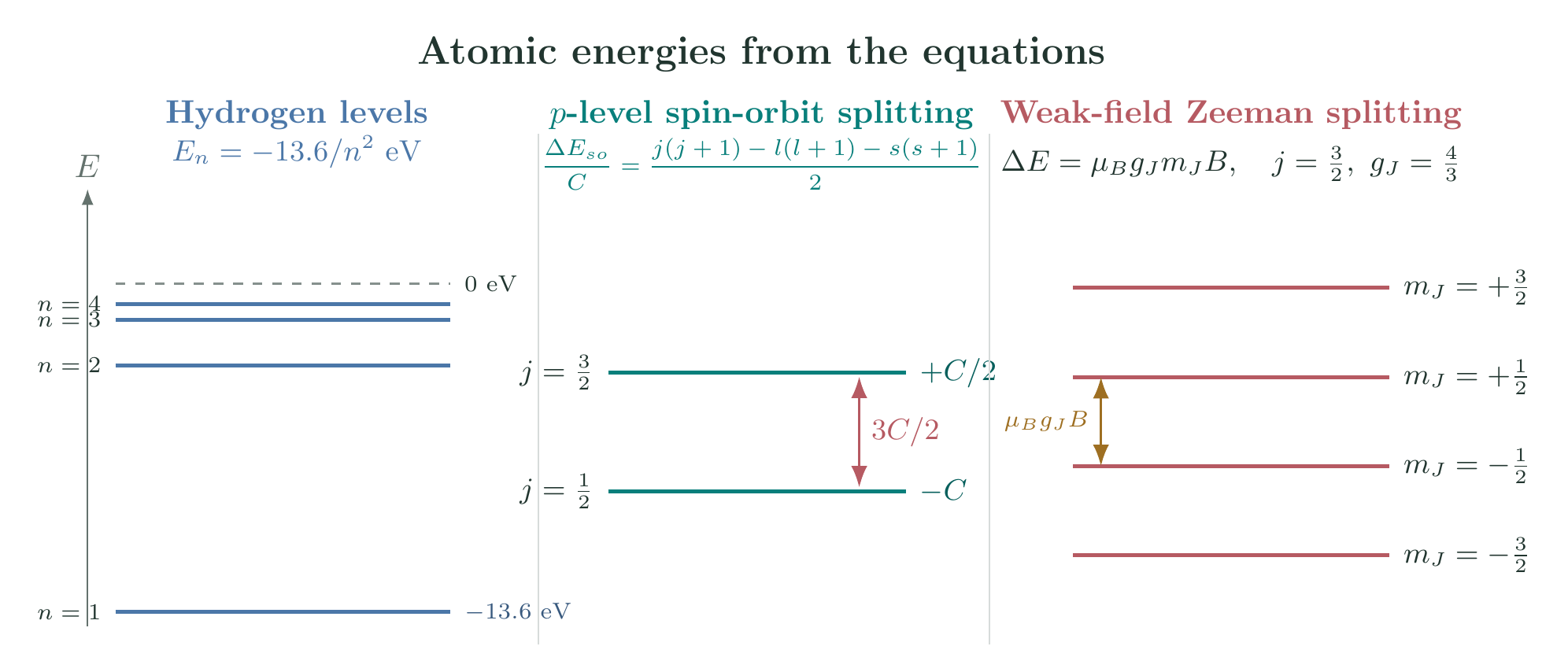
\[E_n=\frac12\mu v^2-\frac{e^2}{4\pi\epsilon_0r_n} =-\frac{\mu e^4}{2(4\pi\epsilon_0)^2\hbar^2}\frac1{n^2}.\]The same quantization condition is the de Broglie standing-wave relation because $\lambda_{dB}=h/(\mu v)$ and $2\pi r=n\lambda_{dB}$. For emission $n_i\to n_f<n_i$,
\[\frac1\lambda=R_M\left(\frac1{n_f^2}-\frac1{n_i^2}\right),\qquad R_M=R_\infty\frac{\mu}{m_e}.\]Thus isotope spectra differ slightly because $\mu$ depends on nuclear mass. The Ritz combination principle follows immediately: if $\tilde\nu_{ab}=T_a-T_b$, then $\tilde\nu_{ac}=\tilde\nu_{ab}+\tilde\nu_{bc}$. Bohr’s model explains hydrogenic energies, radii, and the Rydberg law, but not line intensities, fine structure, multielectron atoms, or why an accelerating charge in a stationary orbit does not radiate.
Hydrogen Schrödinger equation
With $V(r)=-e^2/(4\pi\epsilon_0r)$, the time-independent equation is
\[\left[-\frac{\hbar^2}{2\mu}\nabla^2-\frac{e^2}{4\pi\epsilon_0r}\right]\psi=E\psi.\]In spherical coordinates,
\[\nabla^2=\frac1{r^2}\frac{\partial}{\partial r}\left(r^2\frac{\partial}{\partial r}\right) +\frac1{r^2\sin\theta}\frac{\partial}{\partial\theta}\left(\sin\theta\frac{\partial}{\partial\theta}\right) +\frac1{r^2\sin^2\theta}\frac{\partial^2}{\partial\phi^2}.\]Put $\psi=R(r)\Theta(\theta)\Phi(\phi)$. Separation of $\phi$ gives
\[\frac{d^2\Phi}{d\phi^2}+m_l^2\Phi=0,\qquad \Phi(\phi+2\pi)=\Phi(\phi),\]so $m_l$ is an integer. The polar equation is
\[\frac1{\sin\theta}\frac{d}{d\theta}\left(\sin\theta\frac{d\Theta}{d\theta}\right) +\left[l(l+1)-\frac{m_l^2}{\sin^2\theta}\right]\Theta=0,\]whose regular solutions require $l=0,1,2,\ldots$ and $m_l=-l,\ldots,l$. The angular functions combine into $Y_l^{m_l}$. The radial equation is
\[\frac1{r^2}\frac{d}{dr}\left(r^2\frac{dR}{dr}\right) +\left[\frac{2\mu}{\hbar^2}\left(E+\frac{e^2}{4\pi\epsilon_0r}\right)-\frac{l(l+1)}{r^2}\right]R=0.\]Writing $u=rR$ removes the first derivative:
\[-\frac{\hbar^2}{2\mu}\frac{d^2u}{dr^2} +\left[-\frac{e^2}{4\pi\epsilon_0r}+\frac{\hbar^2l(l+1)}{2\mu r^2}\right]u=Eu.\]For a bound state define
\[\kappa=\frac{\sqrt{-2\mu E}}{\hbar},\qquad \rho=2\kappa r,\]and set $u(\rho)=\rho^{l+1}e^{-\rho/2}v(\rho)$. The factor $\rho^{l+1}$ enforces $u(0)=0$, while $e^{-\rho/2}$ enforces decay as $r\to\infty$. Substitution gives
\[\rho v^{\prime\prime}+[2(l+1)-\rho]v^{\prime} +\left[\frac{\mu e^2}{4\pi\epsilon_0\hbar^2\kappa}-(l+1)\right]v=0.\]The series for $v$ must terminate; otherwise its $e^\rho$ growth defeats the decaying prefactor. Therefore
\[\frac{\mu e^2}{4\pi\epsilon_0\hbar^2\kappa}=n_r+l+1\equiv n,\]giving $n=1,2,\ldots$, $l=0,\ldots,n-1$, and the same $E_n$ as the Bohr result. The normalized ground state is
\[\psi_{100}(r)=\frac{e^{-r/a_\mu}}{\sqrt{\pi a_\mu^3}},\qquad a_\mu=\frac{4\pi\epsilon_0\hbar^2}{\mu e^2}.\]The electric-dipole matrix element $\langle n^{\prime}l^{\prime}m_l^{\prime}\rvert\mathbf r\lvert nlm_l\rangle$ and the angular properties of $\mathbf r$ give the selection rules
\[\boxed{\Delta l=\pm1,\qquad \Delta m_l=0,\pm1},\]with parity changing between the two states.
Orbital and spin angular momentum
The vector model represents
\[L^2=l(l+1)\hbar^2,\quad L_z=m_l\hbar, \qquad S^2=s(s+1)\hbar^2,\quad S_z=m_s\hbar.\]For an electron $s=1/2$ and $m_s=\pm1/2$. Its magnetic moments are
\[\boldsymbol\mu_L=-\frac{e}{2m_e}\mathbf L=-\frac{\mu_B}{\hbar}\mathbf L,\] \[\boldsymbol\mu_S=-g_s\frac{\mu_B}{\hbar}\mathbf S,\qquad \mu_B=\frac{e\hbar}{2m_e},\quad g_s\simeq2.\]The constant $\mu_B=e\hbar/(2m_e)$ is the Bohr magneton. The Stern-Gerlach force $F_z=\mu_z\,dB_z/dz$ separates an atomic beam into discrete components, demonstrating space quantization. In a uniform field, $d\mathbf L/dt=\boldsymbol\mu_L\times\mathbf B$ gives Larmor precession with
\[\omega_L=\frac{eB}{2m_e}.\]Adding angular momenta gives $\mathbf J=\mathbf L+\mathbf S$ and
\[j=\lvert l-s\rvert,\lvert l-s\rvert+1,\ldots,l+s.\]Since $2\mathbf L\cdot\mathbf S=J^2-L^2-S^2$, a spin-orbit Hamiltonian $H_{so}=\xi(r)\mathbf L\cdot\mathbf S$ shifts a level by
\[\Delta E_{so}=\frac{\xi}{2}\hbar^2[j(j+1)-l(l+1)-s(s+1)].\]For weak residual interactions in light atoms, individual orbital momenta form $\mathbf L=\sum_i\mathbf l_i$, spins form $\mathbf S=\sum_i\mathbf s_i$, and then $\mathbf J=\mathbf L+\mathbf S$: this is LS coupling. In heavy atoms, each $\mathbf j_i=\mathbf l_i+\mathbf s_i$ forms first and $\mathbf J=\sum_i\mathbf j_i$: this is jj coupling.
An LS-coupled level is written $^{2S+1}L_J$, where $2S+1$ is the spin multiplicity and $L=0,1,2,\ldots$ is denoted by $S,P,D,\ldots$. For an electric-dipole line, the many-electron rules include $\Delta S=0$, $\Delta L=0,\pm1$ (but not $L=0\leftrightarrow0$), and $\Delta J=0,\pm1$ (but not $J=0\leftrightarrow0$), together with a parity change. These are consequences of angular-momentum and parity matrix elements, not independent empirical restrictions.
Exchange symmetry, Pauli principle, and periodic structure
For identical particles, exchange cannot produce a physically distinguishable state:
\[\Psi(1,2)=\pm\Psi(2,1).\]Integer-spin particles use the symmetric sign; electrons are fermions and require the antisymmetric sign. If two electrons occupied the same one-particle state $a$,
\[\Psi=\frac1{\sqrt2}[\psi_a(1)\psi_a(2)-\psi_a(2)\psi_a(1)]=0.\]This is Pauli exclusion: no two electrons in an atom share all four quantum numbers. Shell capacity follows by counting $m_l$ and spin states:
\[N_n=2\sum_{l=0}^{n-1}(2l+1)=2n^2.\]Successive filling of subshells, modified by their energies and exchange, produces the periodic table.
Zeeman, Paschen-Back, and Stark effects
In a weak magnetic field, $J$ remains coupled and
\[\Delta E_Z=\mu_Bg_Jm_JB,\]where
\[g_J=1+\frac{j(j+1)+s(s+1)-l(l+1)}{2j(j+1)}.\]In a strong field the spin-orbit coupling is overcome. The Paschen-Back shift approaches
\[\Delta E_{PB}=\mu_BB(m_l+g_sm_s).\]An electric field $\mathbf E=E\hat z$ adds $H^{\prime}=eEz$ for an electron in the nuclear potential. The first-order shift is $\Delta E^{(1)}=eE\langle z\rangle$. It vanishes for a nondegenerate parity eigenstate, but hydrogen states with the same $n$ are degenerate and mix, producing a linear Stark effect. Nondegenerate states begin with the quadratic shift
\[\Delta E^{(2)}=-\frac12\alpha E^2,\]where $\alpha$ is the static polarizability.
Characteristic X-ray spectra
An incident electron can remove an inner-shell electron. When an outer electron fills the vacancy, a photon carries the energy difference:
\[h\nu=E_{n_i}-E_{n_f}.\]Screening replaces $Z$ by $Z-\sigma$, so the hydrogenic approximation gives Moseley’s form
\[\sqrt\nu=C(Z-\sigma).\]The $K_\alpha$ line is predominantly a $2p\to1s$ transition and the $K_\beta$ line a $3p\to1s$ transition, consistent with $\Delta l=\pm1$. These discrete characteristic lines lie on the continuous bremsstrahlung spectrum.
Solved Problems
1. Balmer-$\alpha$ wavelength and photon energy
Find the wavelength and photon energy for the hydrogen transition $n_i=3\to n_f=2$. Use $R_H=1.0967758\times10^7\ \mathrm{m^{-1}}$.
The wavenumber is positive for emission when the lower level is written first:
\[\frac1\lambda=R_H\left(\frac1{2^2}-\frac1{3^2}\right) =R_H\frac5{36}.\]Hence
\[\lambda=\frac{36}{5R_H}=6.56470\times10^{-7}\ \mathrm m =656.470\ \mathrm{nm}.\]The photon carries the decrease in atomic energy,
\[E_\gamma=\frac{hc}{\lambda}=3.02595\times10^{-19}\ \mathrm J =1.88865\ \mathrm{eV}.\]The sign of the atomic energy change is $\Delta E_{atom}=-E_\gamma$; the emitted photon energy is positive. The dimensions follow from $R_H^{-1}$ for length and $hc/\lambda$ for energy.
2. Landé factor and weak-field Zeeman shift
For a $2p_{3/2}$ level in a field $B=0.800\ \mathrm T$, find the shift of the $m_J=3/2$ component.
Here $l=1$, $s=1/2$, and $j=3/2$, so
\[g_J=1+\frac{j(j+1)+s(s+1)-l(l+1)}{2j(j+1)} =1+\frac{15/4+3/4-2}{2(15/4)}=\frac43.\]Taking the zero-field level as the energy origin,
\[\Delta E_Z=\mu_Bg_Jm_JB =(5.7883818\times10^{-5}\ \mathrm{eV\,T^{-1}}) \left(\frac43\right)\left(\frac32\right)(0.800\ \mathrm T) =9.26141\times10^{-5}\ \mathrm{eV}.\]The shift is upward because $g_Jm_JB>0$; the $m_J=-3/2$ component shifts downward by the same magnitude. The linear result requires $\mu_BB$ to remain small compared with the spin-orbit splitting.
Descriptive Questions
- Starting from the separated hydrogen radial equation, explain why regularity at the origin, decay at infinity, and termination of the confluent-hypergeometric series quantize the energy.
- Derive the shell capacity $2n^2$ from the allowed orbital and spin quantum numbers, and connect the counting to Pauli exclusion.
- Contrast LS and jj coupling by stating the order in which angular momenta combine and the interaction regime in which each scheme is appropriate.
- Explain why a nondegenerate parity eigenstate has no first-order Stark shift, whereas degenerate hydrogen levels can show a linear Stark effect.
Numerical Problems
-
A $5.00\ \mathrm{MeV}$ alpha particle approaches a gold nucleus ($Z=79$) head-on. Neglect recoil and use $e^2/(4\pi\epsilon_0)=1.43996448\ \mathrm{MeV\,fm}$. Find the distance of closest approach.
Answer: $r_{min}=45.5029\ \mathrm{fm}$.
-
For a $2p$ electron, suppose $\xi\hbar^2=2.00\times10^{-5}\ \mathrm{eV}$. Calculate the $j=3/2$ and $j=1/2$ spin-orbit shifts and their separation.
Answer: $\Delta E_{3/2}=+1.00\times10^{-5}\ \mathrm{eV}$, $\Delta E_{1/2}=-2.00\times10^{-5}\ \mathrm{eV}$; separation $=3.00\times10^{-5}\ \mathrm{eV}$.
-
A spin component with magnetic-moment projection $\mu_z=\mu_B$ traverses a Stern-Gerlach field gradient $dB_z/dz=20.0\ \mathrm{T\,m^{-1}}$. Find the force magnitude.
Answer: $\lvert F_z\rvert=1.85480\times10^{-22}\ \mathrm N$.
-
Estimate the copper $K_\alpha$ photon energy with $Z=29$, screening constant $\sigma=1$, and the hydrogenic value $13.6\ \mathrm{eV}$. Use the $2p\to1s$ energy difference.
Answer: $E_{K_\alpha}=7.9968\ \mathrm{keV}$.
References
- Atomic spectroscopy — Wikipedia
- NIST Atomic Spectra Database
- B. H. Bransden and C. J. Joachain, Physics of Atoms and Molecules, 2nd ed., chapters on one-electron atoms, angular momentum, and external-field effects.
- C. J. Foot, Atomic Physics, 2nd ed., chapters 2–5 on hydrogen, helium, fine structure, and atoms in external fields.


Discussion