

25 Jul 2025
Laser Physics
Einstein coefficients, laser rate equations, population inversion, three- and four-level lasers, Ruby and He-Ne systems, pulses, and Q-switching.
Einstein coefficients
For two levels $E_2-E_1=h\nu$ in radiation of spectral energy density $\rho(\nu)$, absorption, stimulated emission, and spontaneous emission occur at rates
\[R_{12}=N_1B_{12}\rho,\qquad R_{21}^{st}=N_2B_{21}\rho,\qquad R_{21}^{sp}=N_2A_{21}.\]Thermal equilibrium requires
\[N_1B_{12}\rho=N_2B_{21}\rho+N_2A_{21}.\]With $N_2/N_1=(g_2/g_1)e^{-h\nu/k_BT}$,
\[\rho=\frac{A_{21}/B_{21}}{(g_2B_{12}/g_1B_{21})e^{h\nu/k_BT}-1}.\]Comparison with Planck’s law gives
\[g_1B_{12}=g_2B_{21},\qquad \frac{A_{21}}{B_{21}}=\frac{8\pi h\nu^3}{c^3}.\]Stimulated emission duplicates the incident photon’s frequency, phase, polarization, and direction. This coherence distinguishes laser amplification from ordinary spontaneous light.
Gain, inversion, and threshold
For equal degeneracies, the net stimulated rate is proportional to $N_2-N_1$. A medium amplifies only when
\[\Delta N=N_2-N_1>0,\]the population-inversion condition. Optical pumping transfers energy into the active medium. A metastable upper laser level is useful because its long lifetime permits population to accumulate.
If $I(z)$ is resonant intensity,
\[\frac{dI}{dz}=gI\quad\Rightarrow\quad I(z)=I(0)e^{gz}.\]For a resonator of length $L$, mirror reflectivities $R_1,R_2$, and distributed loss $\alpha$, one round trip multiplies intensity by $R_1R_2e^{2(g-\alpha)L}$. Threshold is therefore
\[g_{th}=\alpha+\frac1{2L}\ln\frac1{R_1R_2}.\]The longitudinal resonance condition is $2nL=q\lambda_q$, or
\[\nu_q=\frac{qc}{2nL},\qquad \Delta\nu_{long}=\frac{c}{2nL}.\]Only resonances lying inside the gain profile can oscillate. A narrow selected linewidth $\Delta\nu$ corresponds approximately to coherence time $\tau_c\sim1/\Delta\nu$ and coherence length $l_c\sim c\tau_c$; these relations state the Fourier limit and do not imply perfectly monochromatic light.
Two- and three-level rate equations
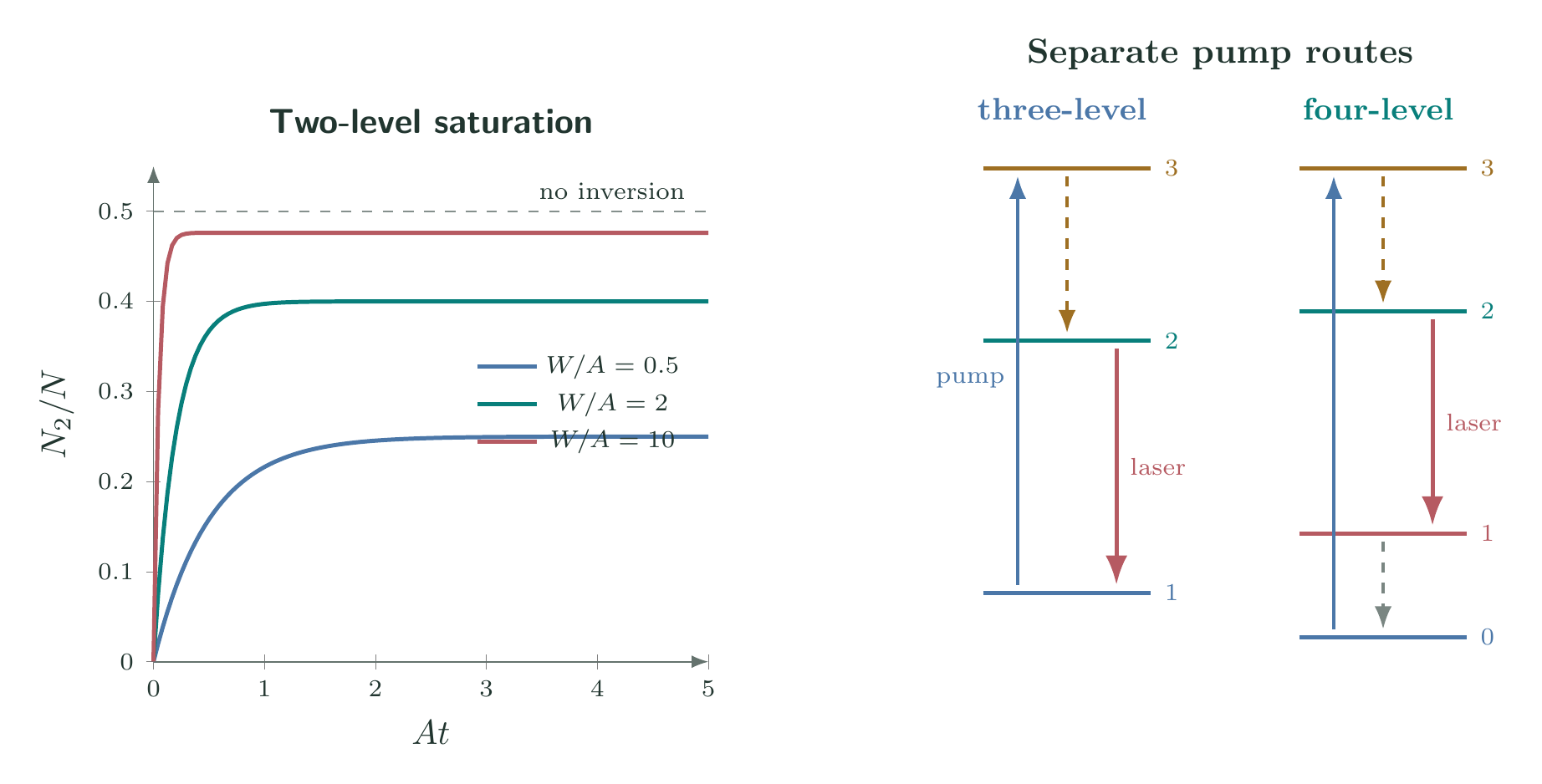
In a true two-level system the same resonant radiation drives absorption and stimulated emission at rate $W=B\rho$. With $A=1/\tau$ and $N=N_1+N_2$,
\[\frac{dN_2}{dt}=WN_1-WN_2-AN_2 =WN-(2W+A)N_2.\]For $N_2(0)=0$, separation or the integrating-factor method gives
\[N_2(t)=\frac{WN}{2W+A}\left[1-e^{-(2W+A)t}\right].\]Consequently
\[\frac{N_2(\infty)}N=\frac{W}{2W+A}<\frac12,\]and even infinitely strong resonant pumping only equalizes the populations. A separate pump route is needed for inversion.
For a three-level laser, pumping $1\to3$ is followed by rapid nonradiative decay $3\to2$, while $2\to1$ is the laser transition. A minimal set of rate equations is
\[\begin{aligned} \dot N_3&=W_pN_1-\frac{N_3}{\tau_{32}},\\ \dot N_2&=\frac{N_3}{\tau_{32}}-\frac{N_2}{\tau_{21}} -W_l(N_2-N_1),\\ \dot N_1&=\frac{N_2}{\tau_{21}}+W_l(N_2-N_1)-W_pN_1. \end{aligned}\]Adding them gives $d(N_1+N_2+N_3)/dt=0$. If $\tau_{32}\ll\tau_{21}$ and the laser field is initially absent, $N_3\simeq W_p\tau_{32}N_1$ and $N_2\simeq W_p\tau_{21}N_1$. Thus inversion requires $W_p\tau_{21}>1$, so more than half the active atoms must leave the ground state. A four-level laser terminates on a level 1 that rapidly empties to the ground level 0; since $N_1\simeq0$, inversion is easier.
Ruby and helium-neon lasers
Ruby is $\mathrm{Al_2O_3}$ doped with $\mathrm{Cr^{3+}}$. Broad optical pumping bands feed a metastable level by rapid nonradiative decay; the red $694.3\ \mathrm{nm}$ transition returns to the ground manifold. It is a three-level laser and therefore normally operates in pulses.
In a He-Ne discharge, electron collisions excite helium metastable states. Near-resonant collisions transfer energy to neon, producing inversion between neon levels. The common $632.8\ \mathrm{nm}$ line is a four-level transition; rapid depletion of the lower laser level enables continuous operation.
Pulsed operation and Q-switching
The resonator quality factor is
\[Q=\omega\frac{\text{stored energy}}{\text{power loss}}.\]In Q-switching the cavity is initially held at low $Q$, suppressing oscillation while pumping stores energy in the inversion. Switching rapidly to high $Q$ reduces loss below gain, and the stored inversion is released as a short, intense pulse. The pulse energy is supplied by the previously stored excitation; Q-switching compresses that energy in time rather than creating additional energy.
Solved Problems
1. Threshold gain of a lossy resonator
A laser has $L=0.400\ \mathrm m$, $R_1=0.990$, $R_2=0.950$, and distributed intensity loss $\alpha=0.0200\ \mathrm{m^{-1}}$. Find its threshold gain coefficient.
At threshold the round-trip intensity multiplier is unity:
\[R_1R_2e^{2(g_{th}-\alpha)L}=1.\]Taking a natural logarithm without changing the sign convention,
\[g_{th}=\alpha+\frac1{2L}\ln\left(\frac1{R_1R_2}\right).\]Substitution gives
\[g_{th}=0.0200+\frac1{0.800} \ln\left(\frac1{(0.990)(0.950)}\right) =0.0966795\ \mathrm{m^{-1}}.\]Both terms have units $\mathrm{m^{-1}}$. Increasing either reflectivity lowers the threshold, and the limiting case $R_1R_2\to1$ gives $g_{th}\to\alpha$.
2. Transient saturation of a two-level system
A two-level ensemble starts in its ground state. Let $W=4.00\times10^6\ \mathrm{s^{-1}}$, $A=1.00\times10^7\ \mathrm{s^{-1}}$, and $t=100\ \mathrm{ns}$. Find $N_2/N$ and compare it with the steady value.
The exact rate-equation solution gives
\[\frac{N_2(t)}N=\frac{W}{2W+A} \left[1-e^{-(2W+A)t}\right].\]Here $(2W+A)t=(1.80\times10^7)(1.00\times10^{-7})=1.80$, so
\[\frac{N_2}{N}=\frac4{18}(1-e^{-1.8})=0.185489.\]The steady fraction is
\[\left(\frac{N_2}{N}\right)_{ss}=\frac4{18}=0.222222.\]Both values are below $1/2$, so neither the transient nor steady resonant drive creates inversion. As $t\to\infty$ the exponential vanishes; as $t\to0$, the excited fraction tends to zero.
Descriptive Questions
- Derive the Einstein relations from detailed balance, explicitly including the level degeneracies, and state the physical distinction between stimulated and spontaneous emission.
- Compare the population-flow requirements and threshold behavior of three-level and four-level lasers.
- Trace the pumping, upper-laser-level population, laser transition, and lower-level depopulation in ruby and helium-neon lasers.
- Explain how stimulated emission produces temporal and spatial coherence, and why a real laser still has a finite linewidth.
Numerical Problems
-
Calculate the frequency and photon energy of the $632.8\ \mathrm{nm}$ helium-neon line.
Answer: $\nu=4.73755\times10^{14}\ \mathrm{Hz}$ and $E_\gamma=1.95930\ \mathrm{eV}$.
-
An air-filled linear resonator is $0.500\ \mathrm m$ long. Find its longitudinal-mode spacing and estimate the number of mode intervals in a $1.50\ \mathrm{GHz}$ gain bandwidth.
Answer: $\Delta\nu_{long}=2.99792\times10^8\ \mathrm{Hz}\approx300\ \mathrm{MHz}$; the bandwidth spans $5.00$ mode intervals.
-
A Q-switched laser releases $0.800\ \mathrm J$ in a nearly rectangular $8.00\ \mathrm{ns}$ pulse. Find the average power during the pulse.
Answer: $P=1.00\times10^8\ \mathrm W=100\ \mathrm{MW}$.
-
An upper laser state has spontaneous lifetime $\tau=230\ \mathrm{ns}$. Find $A_{21}$ and the lifetime-limited linewidth $\Delta\nu=1/(2\pi\tau)$.
Answer: $A_{21}=4.34783\times10^6\ \mathrm{s^{-1}}$ and $\Delta\nu=6.91978\times10^5\ \mathrm{Hz}$.
References
- Laser — Wikipedia
- O. Svelto, Principles of Lasers, 5th ed., chapters 1–3 and 6 on stimulated emission, resonators, pumping, and pulsed operation.
- A. E. Siegman, Lasers, chapters 7–13 and 25 on resonators, gain, rate equations, and Q-switching.
- W. T. Silfvast, Laser Fundamentals, 2nd ed., chapters 3–7 on laser transitions, optical cavities, and representative laser systems.


Discussion