

30 May 2025
Crystal Structure and X-ray Diffraction
Direct and reciprocal lattices, bases, unit cells, Miller indices, Brillouin zones, structure factors, and Bragg diffraction.
A crystal is specified by a periodic set of translation vectors and by the atoms attached to every translated point. This separation between lattice and basis is the organizing idea behind crystal geometry and diffraction.
Amorphous and crystalline solids
A crystalline solid has long-range translational order: its microscopic density satisfies
\[\rho(\mathbf r+\mathbf R)=\rho(\mathbf r)\]for every lattice translation $\mathbf R$. An amorphous solid has short-range bonding order but no translation that reproduces the structure throughout the sample. Consequently, a crystal gives sharp reciprocal-lattice diffraction peaks, whereas an amorphous solid gives broad maxima.
Translation vectors, basis, and unit cells
Choose three non-coplanar primitive vectors $\mathbf a_1,\mathbf a_2,\mathbf a_3$. Every lattice point is
\[\boxed{\mathbf R=n_1\mathbf a_1+n_2\mathbf a_2+n_3\mathbf a_3}, \qquad n_i\in\mathbb Z.\]The set is closed under translations because $\mathbf R-\mathbf R^{\prime}$ is another integer combination of the same vectors. If a basis contains atoms at positions $\boldsymbol\tau_s$ within one cell, all atomic positions are
\[\boxed{\mathbf r_{n_1n_2n_3,s}=\mathbf R+\boldsymbol\tau_s}.\]A primitive cell contains one lattice point after boundary sharing is counted. Its volume is
\[\boxed{v_c=\left\lvert\mathbf a_1\cdot(\mathbf a_2\times\mathbf a_3)\right\rvert}\]with SI unit $\mathrm{m^3}$. A conventional cell may contain several lattice points but displays the crystal symmetry more clearly. For example, the conventional cubic cells contain $1$, $2$, and $4$ lattice points for simple cubic (sc), body-centred cubic (bcc), and face-centred cubic (fcc), respectively.
A structure is centrosymmetric if an origin can be chosen such that every basis element at $\boldsymbol\tau$ has an equivalent element at $-\boldsymbol\tau$ modulo a lattice vector. If no such inversion centre exists, it is non-centrosymmetric. Translational periodicity alone does not decide this property; it depends on the basis as well as the lattice.
The seven crystal systems and their fourteen three-dimensional Bravais lattices are
| Crystal system | Bravais centring |
|---|---|
| triclinic | P |
| monoclinic | P, C |
| orthorhombic | P, C, I, F |
| tetragonal | P, I |
| trigonal | R |
| hexagonal | P |
| cubic | P, I, F |
Here P, C, I, F, and R denote primitive, base-centred, body-centred, face-centred, and rhombohedral lattices.
Miller indices
Suppose a plane intercepts the crystallographic axes at $p\mathbf a_1,q\mathbf a_2,r\mathbf a_3$. Take the reciprocals $1/p,1/q,1/r$ and clear fractions to the smallest integers. The result $(hkl)$ labels the family of parallel planes. An infinite intercept gives index zero; a negative index is written with a bar.
For a cubic crystal of side $a$, a plane through intercepts $a/h,a/k,a/l$ obeys
\[\frac{x}{a/h}+\frac{y}{a/k}+\frac{z}{a/l}=1,\]or
\[hx+ky+lz=a.\]Its normal is parallel to $(h,k,l)$. Adjacent parallel planes have equations $hx+ky+lz=ma$, so their perpendicular separation is
\[\boxed{d_{hkl}=\frac{a}{\sqrt{h^2+k^2+l^2}}} \qquad\text{(cubic lattice)}.\]Reciprocal lattice
Define reciprocal primitive vectors by
\[\boxed{ \mathbf b_1=2\pi\frac{\mathbf a_2\times\mathbf a_3}{\mathbf a_1\cdot(\mathbf a_2\times\mathbf a_3)} }\]and cyclic permutations. Direct substitution gives
\[\boxed{\mathbf a_i\cdot\mathbf b_j=2\pi\delta_{ij}}.\]Every reciprocal vector is
\[\mathbf G=h\mathbf b_1+k\mathbf b_2+l\mathbf b_3,\]and therefore
\[e^{i\mathbf G\cdot\mathbf R} =e^{i2\pi(hn_1+kn_2+ln_3)}=1.\]Thus $\mathbf k$ and $\mathbf k+\mathbf G$ produce the same phase at equivalent lattice points. The reciprocal primitive-cell volume is
\[\boxed{v_c^*=\mathbf b_1\cdot(\mathbf b_2\times\mathbf b_3)=\frac{(2\pi)^3}{v_c}},\]with unit $\mathrm{m^{-3}}$.
For the $(hkl)$ plane family, $\mathbf G_{hkl}$ is normal to the planes and its phase changes by $2\pi$ between neighbours. Hence
\[\boxed{d_{hkl}=\frac{2\pi}{\lvert\mathbf G_{hkl}\rvert}}.\]For conventional cubic side $a$:
\[\begin{array}{c|c|c} \text{direct lattice}&\text{reciprocal lattice}&\text{reciprocal conventional side}\\ \hline \text{sc}&\text{sc}&2\pi/a\\ \text{bcc}&\text{fcc}&4\pi/a\\ \text{fcc}&\text{bcc}&4\pi/a \end{array}\]For example, primitive bcc vectors may be chosen as
\[\mathbf a_1=\frac a2(-1,1,1),\quad \mathbf a_2=\frac a2(1,-1,1),\quad \mathbf a_3=\frac a2(1,1,-1).\]The reciprocal construction gives
\[\mathbf b_1=\frac{2\pi}{a}(0,1,1),\quad \mathbf b_2=\frac{2\pi}{a}(1,0,1),\quad \mathbf b_3=\frac{2\pi}{a}(1,1,0),\]which are primitive vectors of an fcc lattice.
Brillouin zones
The first Brillouin zone is the Wigner-Seitz cell of the reciprocal lattice. For each nonzero $\mathbf G$, the plane
\[\boxed{\mathbf k\cdot\mathbf G=\frac{G^2}{2}}\]is the perpendicular bisector between $\mathbf 0$ and $\mathbf G$. The nearest such planes enclose the first zone. Therefore the first zones of direct sc, bcc, and fcc lattices are respectively a cube, a rhombic dodecahedron, and a truncated octahedron, because their reciprocal lattices are sc, fcc, and bcc.
The same plane is a Bragg plane. Elastic scattering by $\mathbf G$ changes $\mathbf k$ to $\mathbf k^{\prime}=\mathbf k-\mathbf G$. Since $\lvert\mathbf k^{\prime}\rvert=\lvert\mathbf k\rvert$,
\[(\mathbf k-\mathbf G)^2=\mathbf k^2 \quad\Longrightarrow\quad \mathbf k\cdot\mathbf G=\frac{G^2}{2}.\]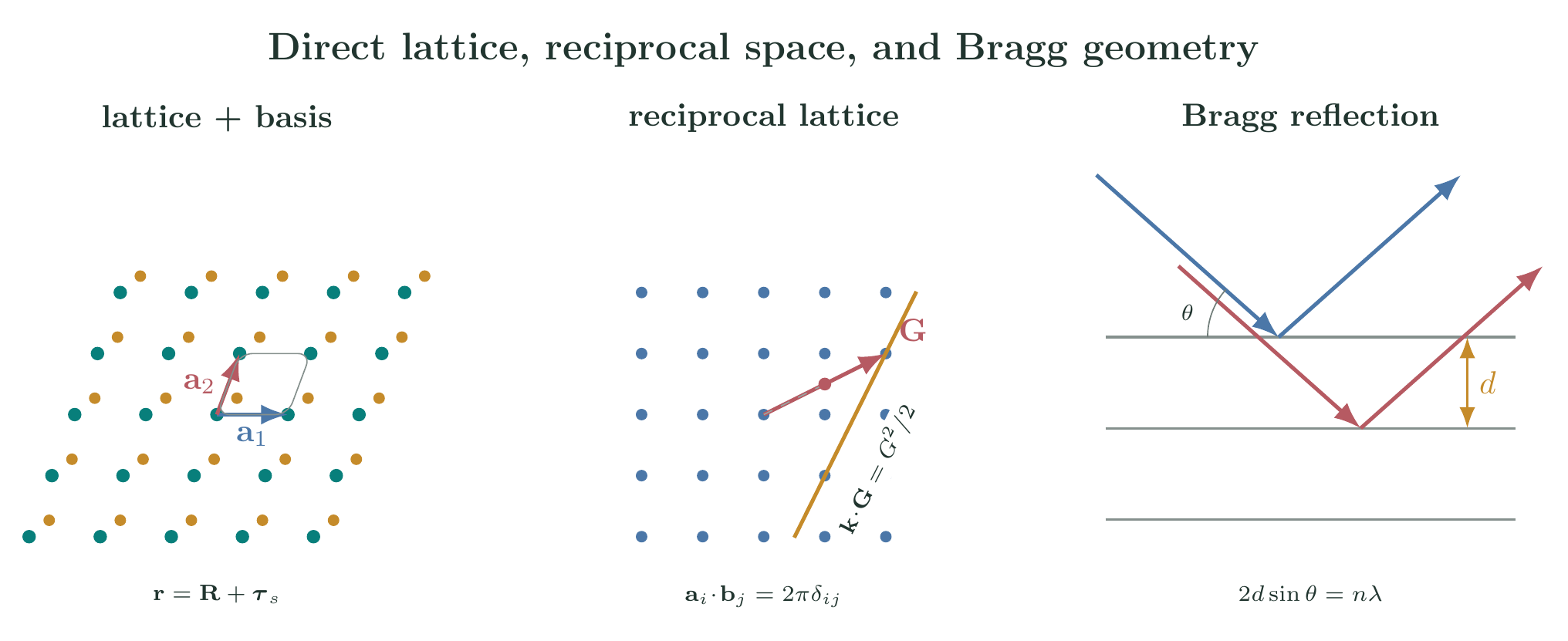
X-ray diffraction and Bragg’s law
X-ray wavelengths are comparable to interplanar spacings. Consider elastic scattering from two adjacent planes separated by $d$. If the glancing angle to the planes is $\theta$, the lower ray travels an extra distance $d\sin\theta$ before and after scattering. Constructive interference requires
\[2d\sin\theta=n\lambda,\]so
\[\boxed{2d_{hkl}\sin\theta=n\lambda}.\]This is Bragg’s law. The angle between incident and diffracted beams is $2\theta$. Because $\lvert\sin\theta\rvert\leq1$, a reflection exists only if $n\lambda\leq2d_{hkl}$.
The same result follows from the scattering vector
\[\mathbf Q=\mathbf k_f-\mathbf k_i, \qquad \lvert\mathbf k_i\rvert=\lvert\mathbf k_f\rvert=\frac{2\pi}{\lambda}.\]Translation through $\mathbf R$ multiplies the scattered amplitude by $e^{i\mathbf Q\cdot\mathbf R}$. All cells add in phase only when
\[\boxed{\mathbf Q=\mathbf G},\]the Laue condition. Its magnitude is $Q=2k\sin\theta=4\pi\sin\theta/\lambda$. Using $G=2\pi n/d$ gives Bragg’s law.
Atomic and geometrical factors
The amplitude from the electrons of one atom is its atomic form factor
\[\boxed{f_j(\mathbf Q)=\int \rho_j(\mathbf r)e^{i\mathbf Q\cdot\mathbf r}\,d^3r},\]where $\rho_j$ is the electron-number density and $f_j(0)=Z_j$. The basis atoms interfere through the geometrical or structure factor
\[\boxed{F_{hkl}=\sum_j f_j(\mathbf G_{hkl}) e^{i\mathbf G_{hkl}\cdot\boldsymbol\tau_j}}, \qquad I_{hkl}\propto\lvert F_{hkl}\rvert^2.\]For identical atoms in a conventional bcc cell at $(0,0,0)$ and $(a/2,a/2,a/2)$,
\[F_{hkl}=f\left[1+e^{i\pi(h+k+l)}\right].\]Therefore $F=2f$ if $h+k+l$ is even and $F=0$ if it is odd. For fcc positions $(0,0,0)$, $(0,a/2,a/2)$, $(a/2,0,a/2)$, and $(a/2,a/2,0)$,
\[F_{hkl}=f\left[1+e^{i\pi(k+l)}+e^{i\pi(h+l)}+e^{i\pi(h+k)}\right].\]It equals $4f$ when $h,k,l$ are all even or all odd, and vanishes otherwise. These systematic absences distinguish lattice geometries even when their conventional cells have the same cubic shape.
Solved Problems
1. Obtain density from an fcc unit cell
Copper is fcc with conventional lattice parameter $a=0.3615\ \mathrm{nm}$ and molar mass $M=63.546\ \mathrm{g\,mol^{-1}}$. Find its ideal mass density.
An fcc conventional cell contains
\[Z=8\left(\frac18\right)+6\left(\frac12\right)=4\]atoms after boundary sharing. Its mass is
\[m_c=\frac{ZM}{N_A} =\frac{4(63.546)}{6.02214076\times10^{23}} =4.2208\times10^{-22}\ \mathrm g.\]Since $a=3.615\times10^{-8}\ \mathrm{cm}$,
\[v_c=a^3=4.7242\times10^{-23}\ \mathrm{cm^3}.\]Therefore
\[\boxed{\rho=\frac{m_c}{v_c}=8.935\ \mathrm{g\,cm^{-3}}}.\]The units reduce to mass per volume, and the value is physically consistent with a densely packed metal. In the limiting formula, doubling $a$ at fixed $Z$ and $M$ would reduce $\rho$ by $2^3$, as required by volume scaling.
2. Index a cubic powder line from Bragg data
A simple cubic crystal has $a=0.352\ \mathrm{nm}$. With wavelength $\lambda=0.154\ \mathrm{nm}$, a first-order line occurs at $2\theta=51.89^\circ$. Identify the plane family.
The glancing angle is $\theta=25.945^\circ$. For $n=1$, Bragg’s law gives
\[d=\frac{\lambda}{2\sin\theta} =\frac{0.154}{2\sin25.945^\circ} \simeq0.1760\ \mathrm{nm}.\]For a cubic lattice,
\[h^2+k^2+l^2=\left(\frac ad\right)^2 \simeq4.000.\]The smallest integer triple with squared sum 4 is a permutation of $(2,0,0)$, so
\[\boxed{\{hkl\}=\{200\}}.\]Back-substitution gives $2\theta=51.889^\circ$. Both $a,d,$ and $\lambda$ use the same length unit, so the indexing ratio is dimensionless; the condition $\lambda<2d$ also confirms that the reflection is kinematically possible.
Descriptive Questions
- How are a Bravais lattice, a basis, a primitive cell, and a conventional cell distinguished using translation equations?
- How are the reciprocal primitive vectors derived, and how do they imply both $\mathbf a_i\cdot\mathbf b_j=2\pi\delta_{ij}$ and $v_c^*=(2\pi)^3/v_c$?
- Why are the Brillouin-zone boundary condition and the elastic Bragg-plane condition the same reciprocal-space equation?
- How are the bcc and fcc structure factors derived, and what systematic absences do they predict?
Numerical Problems
-
For primitive vectors $(0.30,0,0)$, $(0.10,0.40,0)$, and $(0,0.05,0.50)$ in nanometres, calculate the primitive-cell volume.
Answer: $v_c=0.0600\ \mathrm{nm^3}=6.00\times10^{-29}\ \mathrm{m^3}$.
-
Find the Miller indices of a plane with intercepts $2a$, $3a$, and $\infty$ along the crystallographic axes.
Answer: $(320)$.
-
A cubic crystal has $a=0.408\ \mathrm{nm}$. Find $\lvert\mathbf G_{111}\rvert$ and $d_{111}$.
Answer: $\lvert\mathbf G_{111}\rvert=26.674\ \mathrm{nm^{-1}}$; $d_{111}=0.2356\ \mathrm{nm}$.
-
Treat an fcc crystal of side $0.408\ \mathrm{nm}$ as touching hard spheres along a face diagonal. Find the atomic radius and packing fraction.
Answer: $r=a/\sqrt8=0.144\ \mathrm{nm}$; packing fraction $\pi/(3\sqrt2)=0.7405$.
-
For identical atoms on an fcc lattice, test the $(210)$ and $(311)$ reflections using the structure factor.
Answer: $F_{210}=0$ (extinct); $F_{311}=4f$ and $I_{311}\propto16\lvert f\rvert^2$.
-
A one-dimensional lattice has period $a=0.250\ \mathrm{nm}$. Give the first Brillouin-zone boundaries and its width.
Answer: $k=\pm12.566\ \mathrm{nm^{-1}}$; width $25.133\ \mathrm{nm^{-1}}$.
References
- Crystal structure.
- Charles Kittel, Introduction to Solid State Physics, 8th ed., Chapters 1–2, Wiley.
- Neil W. Ashcroft and N. David Mermin, Solid State Physics, Chapters 4–6, Holt, Rinehart and Winston.


Discussion