

30 Jun 2025
Energy Bands and the Kronig-Penney Model
Bloch bands, Brillouin-zone gaps, the Kronig-Penney dispersion, effective mass, and metal, semiconductor, and insulator band structures.
Isolated atoms have discrete levels. In a crystal, overlap between equivalent atomic states and the periodic ionic potential broaden those levels into allowed bands separated by forbidden energy gaps.
Bloch form and bands
For a one-dimensional lattice of period $a$,
\[V(x+a)=V(x).\]The translation operator by $a$ commutes with the Hamiltonian, so an energy eigenfunction may also be an eigenfunction of translation:
\[\psi_k(x+a)=e^{ika}\psi_k(x).\]Writing $u_k(x)=e^{-ikx}\psi_k(x)$ gives
\[\boxed{\psi_k(x)=e^{ikx}u_k(x)}, \qquad u_k(x+a)=u_k(x).\]This is Bloch’s form. Since $e^{i(k+G)na}=e^{ikna}$ for $G=2\pi m/a$, wave vectors differing by $G$ are equivalent; one may take $-\pi/a<k\leq\pi/a$.
For each $k$, the periodic boundary-value problem has a sequence $E_n(k)$. As $k$ varies continuously through the first Brillouin zone, each sequence forms an energy band.
Origin of a gap at a Brillouin-zone boundary
For a weak periodic potential
\[V(x)=\sum_GU_Ge^{iGx},\]the Fourier component $U_G$ couples free-electron waves $\lvert k\rangle$ and $\lvert k-G\rangle$. At the zone boundary $k=G/2$ their free energies are equal:
\[E_k^0=\frac{\hbar^2k^2}{2m} =\frac{\hbar^2(k-G)^2}{2m}=E_{k-G}^0.\]Within this degenerate pair the Schrödinger equation becomes
\[\begin{pmatrix} E_0-E&U_G\\ U_G^*&E_0-E \end{pmatrix} \begin{pmatrix}c_k\\c_{k-G}\end{pmatrix}=0.\]The determinant condition is
\[(E_0-E)^2-\lvert U_G\rvert^2=0,\]so
\[E_{\pm}=E_0\pm\lvert U_G\rvert, \qquad \boxed{E_g=E_+-E_-=2\lvert U_G\rvert}.\]The two combinations form standing waves with different probability densities relative to the ions and therefore different potential energies. Bragg reflection at $k=G/2$ is the reciprocal-space origin of the band gap.
Delta-barrier Kronig-Penney model
An exactly soluble periodic model uses barriers of strength $H$:
\[V(x)=H\sum_{n=-\infty}^{\infty}\delta(x-na),\]where $H$ has unit $\mathrm{J\,m}$. Between barriers, $V=0$ and
\[\frac{d^2\psi}{dx^2}+q^2\psi=0, \qquad q=\frac{\sqrt{2mE}}{\hbar}.\]Across a barrier at $x=0$, $\psi$ is continuous. Integrating the Schrödinger equation from $-\epsilon$ to $+\epsilon$ gives
\[-\frac{\hbar^2}{2m}\left[\psi^{\prime}(0^+)-\psi^{\prime}(0^-)\right] +H\psi(0)=0,\]so
\[\boxed{\psi^{\prime}(0^+)-\psi^{\prime}(0^-)=\frac{2mH}{\hbar^2}\psi(0)}.\]Represent the state by the column $(\psi,\psi^{\prime})^T$. Free propagation through distance $a$ gives
\[P_a= \begin{pmatrix} \cos qa&\sin qa/q\\ -q\sin qa&\cos qa \end{pmatrix},\]while crossing a delta barrier gives
\[D= \begin{pmatrix} 1&0\\ 2mH/\hbar^2&1 \end{pmatrix}.\]One cell has transfer matrix $M=DP_a$. Bloch’s condition requires its eigenvalues to be $e^{\pm ika}$. Since $\det M=1$, their sum equals the trace:
\[2\cos ka=\operatorname{Tr}M =2\cos qa+\frac{2mH}{\hbar^2q}\sin qa.\]Defining the dimensionless barrier strength
\[P=\frac{mHa}{\hbar^2}\]gives the Kronig-Penney relation
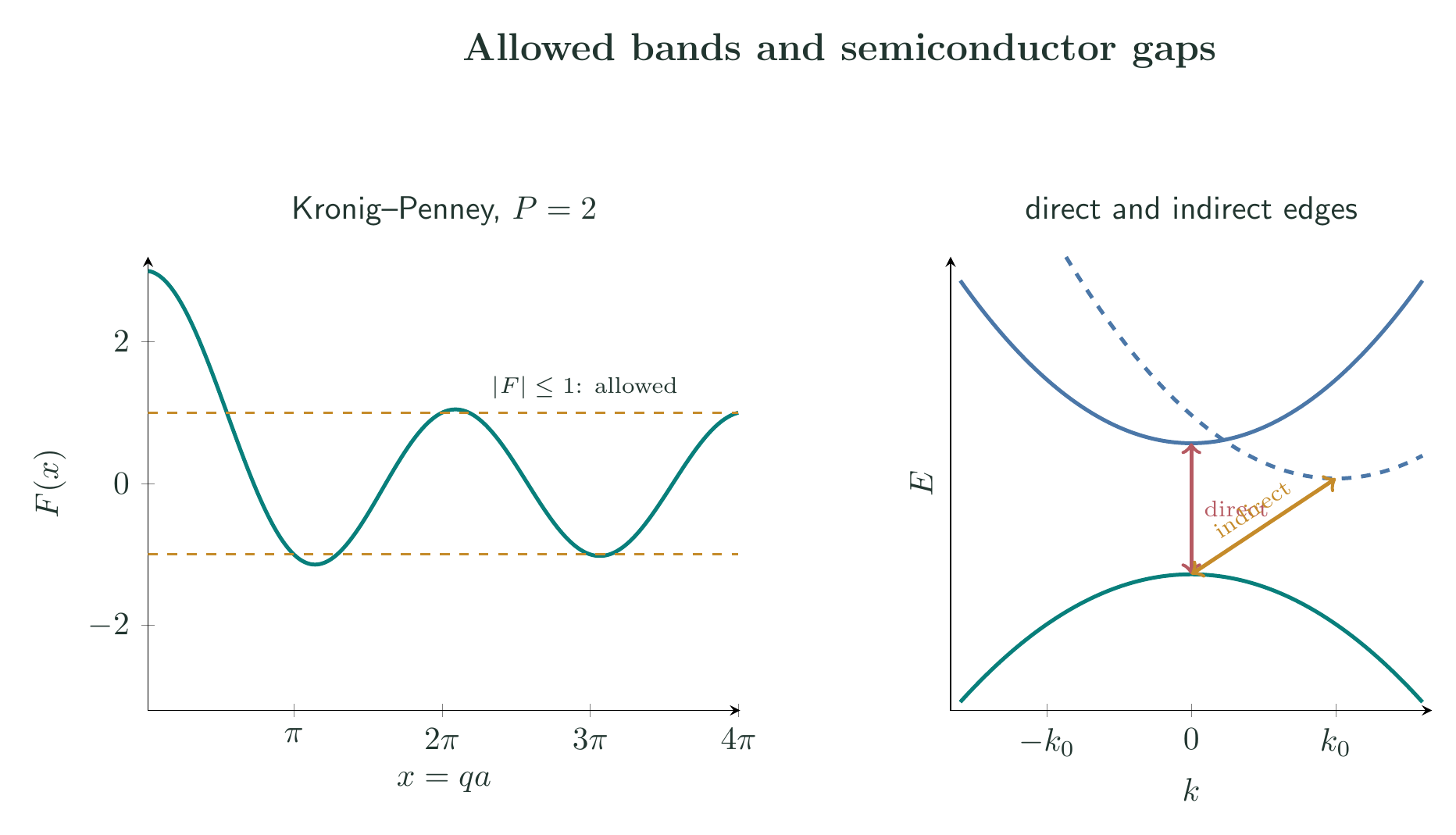
\[\boxed{\cos ka=\cos qa+P\frac{\sin qa}{qa}}.\]The left side must lie between $-1$ and $1$. Therefore an energy $E=\hbar^2q^2/(2m)$ is allowed only when
\[\boxed{\left\lvert\cos qa+P\frac{\sin qa}{qa}\right\rvert\leq1}.\]Intervals violating this condition are forbidden gaps. Increasing $P$ strengthens the periodic potential, narrows the allowed bands, and widens the gaps.
Effective mass
The group velocity of a wave packet in band $n$ is
\[v_n(k)=\frac1\hbar\frac{dE_n}{dk}.\]Under a slowly varying external force $F$, crystal momentum obeys
\[\hbar\frac{dk}{dt}=F.\]Therefore
\[\frac{dv}{dt} =\frac1\hbar\frac{d^2E}{dk^2}\frac{dk}{dt} =\frac{F}{\hbar^2}\frac{d^2E}{dk^2}.\]Writing this as $F=m^*dv/dt$ defines
\[\boxed{\frac1{m^*}=\frac1{\hbar^2}\frac{d^2E}{dk^2}}.\]Near an extremum $k_0$,
\[E(k)\simeq E(k_0)+\frac{\hbar^2(k-k_0)^2}{2m^*}.\]A band minimum has positive curvature and $m^*>0$; a band maximum has negative electron effective mass. Missing electrons near a nearly full band are more conveniently described as positively charged holes with positive effective mass.
Metals, semiconductors, and insulators
At zero temperature, electrons fill states up to the Fermi level.
- A metal has a partially filled band or overlapping bands. Empty states arbitrarily close in energy allow an electric field to change occupations and produce current.
- A semiconductor has a filled valence band and empty conduction band separated by a relatively small gap. Thermal or optical excitation produces mobile conduction electrons and valence-band holes.
- An insulator has the same filled-band arrangement but a sufficiently large gap that ordinary thermal excitation produces negligible carriers.
The classification depends on band filling and the gap, not simply on whether isolated atoms possess bound electrons.
Direct and indirect band gaps
Let $E_c(k)$ be the conduction band and $E_v(k)$ the valence band. If the conduction minimum and valence maximum occur at the same wave vector $k_0$, then
\[\boxed{E_g^{\rm dir}=E_c(k_0)-E_v(k_0)}.\]A photon carries negligible crystal momentum compared with a Brillouin-zone dimension, so a direct optical transition is approximately vertical in an $E$-$k$ diagram: $\Delta k\simeq0$.
For an indirect semiconductor, the extrema occur at $k_c\ne k_v$:
\[\boxed{E_g^{\rm ind}=E_c(k_c)-E_v(k_v)}.\]Momentum conservation then requires a phonon as well as a photon:
\[\mathbf k_c=\mathbf k_v\pm\mathbf q_{\rm ph}+\mathbf G.\]The reciprocal vector $\mathbf G$ allows crystal momentum to be conserved modulo the reciprocal lattice. This additional phonon requirement makes near-edge optical absorption and emission weaker than in a direct-gap material.
Solved Problems
1. Gap opened by a weak periodic potential
At a zone boundary the unperturbed energy is $E_0=5.00\ \mathrm{eV}$ and the relevant Fourier coefficient is $U_G=0.30\ \mathrm{eV}$. Find the split levels and the gap.
In the basis ${\lvert k\rangle,\lvert k-G\rangle}$, choose the phase of one basis state so that $U_G$ is real and positive. The secular equation is
\[(E_0-E)^2-U_G^2=0.\]Therefore
\[E-E_0=\pm U_G,\]and the two levels are
\[E_-=5.00-0.30=4.70\ \mathrm{eV}, \qquad E_+=5.00+0.30=5.30\ \mathrm{eV}.\]Hence
\[\boxed{E_g=E_+-E_-=0.60\ \mathrm{eV}}.\]The mean energy remains $E_0$, so the coupling only splits the degeneracy. The dimensional check is immediate: $U_G$ and $E_g$ are both energies. In the limiting case $U_G\to0$, the gap closes and both levels return to $E_0$.
2. Effective mass from a measured band curvature
Near a conduction-band minimum, the energy rises by $0.200\ \mathrm{eV}$ when $\lvert k-k_0\rvert=0.100\ \mathrm{\mathring A^{-1}}$. Treat the band as parabolic and find $m^*/m_e$.
For positive curvature,
\[\Delta E=\frac{\hbar^2(\Delta k)^2}{2m^*},\]so
\[\frac{m^*}{m_e} =\frac{\hbar^2(\Delta k)^2}{2m_e\Delta E}.\]Using $\hbar^2/(2m_e)=3.80998\ \mathrm{eV\,\mathring A^2}$,
\[\frac{m^*}{m_e} =\frac{(3.80998\ \mathrm{eV\,\mathring A^2}) (0.100\ \mathrm{\mathring A^{-1}})^2} {0.200\ \mathrm{eV}} =0.1905.\]Thus
\[\boxed{m^*=0.1905\,m_e}.\]The sign is positive because the point is a minimum. The factors $\mathrm{eV}$ and $\mathrm{\mathring A}$ cancel, leaving the required dimensionless ratio. A flatter band would have smaller curvature and hence a larger $m^*$.
3. Allowed and forbidden Kronig–Penney energies
For barrier strength $P=2$, decide whether $qa=\pi/2$ and $qa=\pi$ are allowed.
Write
\[F(x)=\cos x+P\frac{\sin x}{x}, \qquad x=qa.\]An energy is allowed only if $\lvert F(x)\rvert\leq1$. At $x=\pi/2$,
\[F\left(\frac{\pi}{2}\right) =0+2\frac{1}{\pi/2} =\frac{4}{\pi}=1.2732.\]Because $4/\pi>1$, this energy is forbidden. At $x=\pi$,
\[F(\pi)=\cos\pi+2\frac{\sin\pi}{\pi}=-1,\]so it is allowed exactly at a band edge. Thus
\[\boxed{qa=\pi/2\ \text{is forbidden},\qquad qa=\pi\ \text{is a band edge}.}\]$F$ is dimensionless, as is the allowed-band bound. If $P\to0$, $F(x)\to\cos x$ and every positive free-particle energy is recovered.
Descriptive Questions
- Starting from translation symmetry, derive Bloch’s form and explain why wave vectors differing by a reciprocal-lattice vector represent equivalent crystal states.
- Use degenerate perturbation theory to explain how Bragg reflection opens an energy gap at a Brillouin-zone boundary.
- Derive the effective-mass equation and explain why a nearly full valence band is described in terms of positively charged holes.
- Distinguish direct and indirect band gaps using conservation of energy and crystal momentum in an optical transition.
Numerical Problems
-
A Bloch state has $k=\pi/(3a)$. Find the phase factor acquired under translation through three lattice periods.
Answer: $e^{i3ka}=e^{i\pi}=-1$.
-
A one-dimensional band is $E(k)=E_0-2t\cos(ka)$, with $t=0.80\ \mathrm{eV}$ and $a=0.40\ \mathrm{nm}$. Find the group velocity at $k=\pi/(2a)$.
Answer: $v=(2ta/\hbar)\sin(ka)=9.72\times10^5\ \mathrm{m\,s^{-1}}$.
-
Neglecting exciton binding, find the longest wavelength that can excite a direct-gap semiconductor with $E_g=1.55\ \mathrm{eV}$.
Answer: $\lambda_{\max}=hc/E_g=8.00\times10^{-7}\ \mathrm{m}=800\ \mathrm{nm}$.
-
A crystal contains $2.0\times10^{22}$ primitive cells. How many electrons fill one nondegenerate band when spin is included?
Answer: $2N=4.0\times10^{22}$ electrons.
-
An electron wave packet experiences a constant force of magnitude $2.0\times10^{-15}\ \mathrm{N}$ for $0.50\ \mathrm{ps}$. Find the magnitude of its change in crystal wave vector.
Answer: $\lvert\Delta k\rvert=F\Delta t/\hbar=9.48\times10^6\ \mathrm{m^{-1}}$.
-
The first-zone boundary of a one-dimensional lattice with $a=0.32\ \mathrm{nm}$ is $k=\pi/a$. Find the corresponding de Broglie wavelength.
Answer: $\lambda=2\pi/k=2a=0.64\ \mathrm{nm}$.
References
- Particle in a one-dimensional lattice (Kronig–Penney model), Wikipedia
- Charles Kittel, Introduction to Solid State Physics, 8th ed., Chapters 7–8: “Energy Bands” and “Semiconductor Crystals.”
- MIT OpenCourseWare, 5.62 Physical Chemistry II, Lecture Summary 26: “Band Theory of Solids”
- R. de L. Kronig and W. G. Penney, “Quantum Mechanics of Electrons in Crystal Lattices,” Proceedings of the Royal Society A 130 (1931)


Discussion