

27 Jun 2025
Quantum Theory of Radiation
Blackbody modes, Planck's law, its classical and quantum limits, Stefan-Boltzmann law, and Wien displacement.
A blackbody is an ideal absorber in thermal equilibrium. Its spectral distribution is universal because cavity radiation repeatedly exchanges energy with the walls until only temperature remains as a thermodynamic parameter.
Electromagnetic mode density
In a large cubic cavity, one mode occupies volume $(\pi/L)^3$ in positive $k$-space. Including two polarizations, the number of modes between $k$ and $k+dk$ per volume is
\[g(k)dk=2\frac{4\pi k^2dk/8}{\pi^3}=\frac{k^2}{\pi^2}dk.\]Since $k=2\pi\nu/c$,
\[g(\nu)d\nu=\frac{8\pi\nu^2}{c^3}d\nu.\]Planck postulated oscillator energies $E_n=nh\nu$. For one mode,
\[z=\sum_{n=0}^{\infty}e^{-n\beta h\nu}=\frac1{1-e^{-\beta h\nu}}.\]Therefore
\[\bar E=-\frac{\partial\ln z}{\partial\beta} =\frac{h\nu}{e^{h\nu/k_BT}-1}.\]Multiplying by the mode density gives Planck’s law per unit frequency:
\[\boxed{u_\nu(T)=\frac{8\pi h\nu^3}{c^3}\frac1{e^{h\nu/k_BT}-1}}.\]Per unit wavelength, energy conservation $u_\lambda\lvert d\lambda\rvert=u_\nu\lvert d\nu\rvert$ with $\nu=c/\lambda$ gives
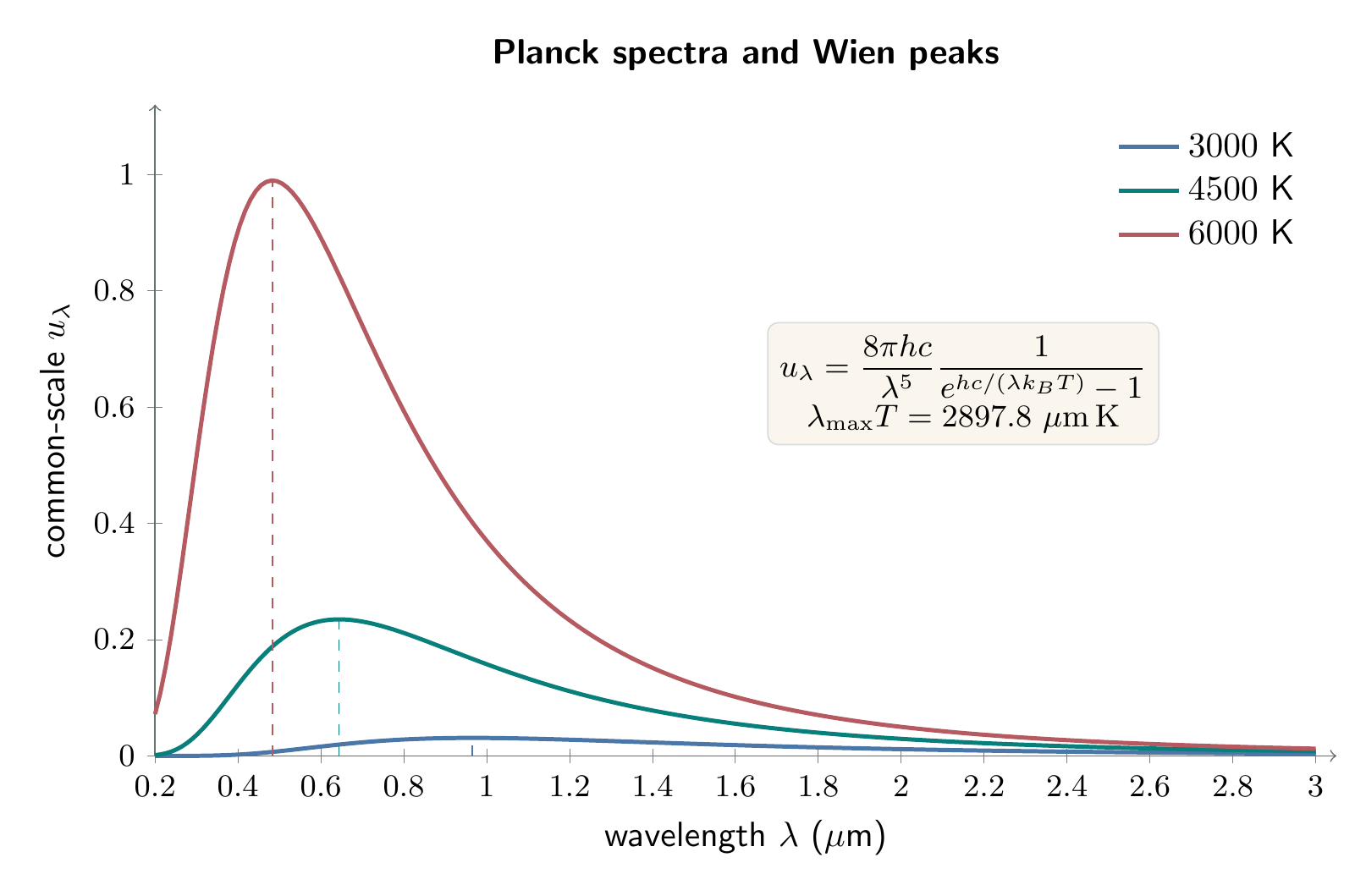
\[\boxed{u_\lambda(T)=\frac{8\pi hc}{\lambda^5}\frac1{e^{hc/\lambda k_BT}-1}}.\]The measured cavity spectrum rises from zero, has a finite maximum, and returns to zero. Planck’s expression reproduces all three features; the measured peak moves to shorter wavelength as $T$ rises and the integrated area grows as $T^4$. These are the experimental checks developed below.
Rayleigh-Jeans and Wien limits
Let $x=h\nu/(k_BT)$. For $x\ll1$, $e^x-1\simeq x$, so
\[u_\nu\simeq\frac{8\pi\nu^2}{c^3}k_BT,\]the Rayleigh-Jeans law. For $x\gg1$, $e^x-1\simeq e^x$, so
\[u_\nu\simeq\frac{8\pi h\nu^3}{c^3}e^{-h\nu/k_BT},\]the Wien distribution law in frequency form.
Stefan-Boltzmann law
Integrating Planck’s law and substituting $x=h\nu/(k_BT)$,
\[u(T)=\frac{8\pi(k_BT)^4}{h^3c^3}\int_0^\infty\frac{x^3}{e^x-1}dx.\]Since the integral is $\pi^4/15$,
\[u(T)=aT^4,\qquad a=\frac{8\pi^5k_B^4}{15h^3c^3}.\]Isotropic radiation carries outward flux $c/4$ times its energy density, hence
\[j^\star=\frac c4u=\sigma T^4,\qquad \sigma=\frac{2\pi^5k_B^4}{15h^3c^2}.\]The same angular average gives spectral radiance $B_\nu=cu_\nu/(4\pi)$ and spectral exitance $M_\nu=\pi B_\nu=cu_\nu/4$. Photon momentum transfer also produces the equilibrium radiation pressure
\[p_{rad}=\frac13u=\frac13aT^4.\]The factors $1/4$ and $1/3$ come from different angular averages: outward energy flux weights one direction cosine over a hemisphere, whereas isotropic pressure weights its square over the full sphere.
Wien displacement law
Maximize $u_\lambda$. Put $x=hc/(\lambda k_BT)$; apart from constants, $u_\lambda\propto x^5/(e^x-1)$. Setting its derivative to zero gives
\[5(1-e^{-x})=x.\]The positive root is $x=4.965114\ldots$, so
\[\lambda_{max}T=\frac{hc}{k_Bx}=2.8978\times10^{-3}\ \mathrm{m\,K}.\]Direct applications
For a surface of area $A$ and emissivity $\varepsilon$ surrounded by temperature $T_0$, the net radiative power follows from the Stefan-Boltzmann law:
\[P_{net}=\varepsilon\sigma A\left(T^4-T_0^4\right).\]The spectral peak gives a non-contact temperature measurement,
\[T=\frac{2.8978\times10^{-3}\ \mathrm{m\,K}}{\lambda_{max}},\]which is the basis of optical pyrometry and the first temperature estimate from a thermal spectrum.
Solved Problems
1. Temperature and radiant exitance from a spectral peak
A nearly black surface has wavelength peak $\lambda_{max}=500\ \mathrm{nm}$. Estimate its temperature and total radiant exitance.
Wien’s displacement law gives
\[T=\frac{2.897771955\times10^{-3}\ \mathrm{m\,K}} {500\times10^{-9}\ \mathrm m} =5.79554\times10^3\ \mathrm K.\]For a black surface,
\[j^\star=\sigma T^4 =(5.670374419\times10^{-8})(5795.54)^4 =6.39718\times10^7\ \mathrm{W\,m^{-2}}.\]The peak wavelength fixes a color temperature; the flux result assumes emissivity one at all wavelengths. Dimensional checks give kelvin from $b/\lambda$ and $\mathrm{W\,m^{-2}}$ from $\sigma T^4$.
2. Net radiative cooling in finite-temperature surroundings
A surface of area $0.0200\ \mathrm{m^2}$ and emissivity $0.800$ is at $800\ \mathrm K$ in surroundings at $300\ \mathrm K$. Neglect conduction and convection. Find the net radiative power leaving it.
Emission and absorption must both be retained:
\[P_{net}=\varepsilon\sigma A(T^4-T_0^4).\]Thus
\[P_{net}=(0.800)(5.670374419\times10^{-8})(0.0200) \left(800^4-300^4\right) =364.265\ \mathrm W.\]The positive sign denotes outward power because $T>T_0$. The expression vanishes in the equilibrium limit $T\to T_0$ and reverses sign if the surroundings are hotter.
Descriptive Questions
- Derive the electromagnetic mode density $g(\nu)=8\pi\nu^2/c^3$, including the octant and polarization factors.
- Obtain Planck’s mean oscillator energy from the single-mode partition function and explain the physical assumption behind the discrete energies.
- Derive the Rayleigh-Jeans and Wien limits of Planck’s law and identify why the classical result produces the ultraviolet catastrophe.
- Starting from Planck’s spectrum, derive the Stefan-Boltzmann law and explain the geometrical origin of the $c/4$ flux factor.
Numerical Problems
-
Find the total blackbody energy density in a cavity at $300\ \mathrm K$.
Answer: $u=aT^4=6.12824\times10^{-6}\ \mathrm{J\,m^{-3}}$.
-
Find the mean thermal energy of a $10.0\ \mathrm{THz}$ cavity mode at $300\ \mathrm K$, excluding the zero-point term.
Answer: $\bar E=1.67673\times10^{-21}\ \mathrm J$.
-
The frequency form of Planck’s law peaks at $x=h\nu/(k_BT)=2.821439$. At $3000\ \mathrm K$, calculate $\nu_{max}$ and $c/\nu_{max}$. Compare it with the wavelength-form peak.
Answer: $\nu_{max}=1.76368\times10^{14}\ \mathrm{Hz}$ and $c/\nu_{max}=1.69981\ \mu\mathrm m$, whereas $\lambda_{max}=0.965924\ \mu\mathrm m$; the two peaks are not related by direct inversion.
-
A cavity has volume $1.00\times10^{-3}\ \mathrm{m^3}$. How many electromagnetic modes lie between $5.00\times10^{14}$ and $5.10\times10^{14}\ \mathrm{Hz}$?
Answer: $N=2.37889\times10^{15}$ modes.
References
- Planck’s law — Wikipedia
- F. Reif, Fundamentals of Statistical and Thermal Physics, chapter 9 on blackbody radiation and the photon gas.
- R. K. Pathria and P. D. Beale, Statistical Mechanics, 3rd ed., chapter 7 sections on photons and blackbody radiation.
- R. Eisberg and R. Resnick, Quantum Physics of Atoms, Molecules, Solids, Nuclei, and Particles, 2nd ed., chapter 1 on thermal radiation and Planck’s hypothesis.


Discussion