

30 Jun 2025
Angular Momentum, Spin and Symmetry
Angular-momentum algebra, Pauli spinors, central fields, Clebsch-Gordan coupling, conservation laws, parity, identical particles, and spin-orbit coupling.
Angular momentum is the generator of rotations. Its components satisfy
\[[J_i,J_j]=i\hbar\epsilon_{ijk}J_k, \qquad [J^2,J_i]=0.\]Choose simultaneous eigenvectors of $J^2$ and $J_z$:
\[J^2\lvert jm\rangle=\hbar^2j(j+1)\lvert jm\rangle, \qquad J_z\lvert jm\rangle=\hbar m\lvert jm\rangle.\]Eigenvalues from ladder operators
Define $J_\pm=J_x\pm iJ_y$. The commutators give
\[[J_z,J_\pm]=\pm\hbar J_\pm,\]so $J_\pm\lvert jm\rangle$ has magnetic quantum number $m\pm1$. Also
\[J_-J_+=J^2-J_z^2-\hbar J_z, \qquad J_+J_-=J^2-J_z^2+\hbar J_z.\]Taking norms,
\[\left\lVert J_+\lvert jm\rangle\right\rVert^2 =\hbar^2[j(j+1)-m(m+1)]\ge0,\] \[\left\lVert J_-\lvert jm\rangle\right\rVert^2 =\hbar^2[j(j+1)-m(m-1)]\ge0.\]A finite ladder has a top $m_{\max}$ annihilated by $J_+$ and a bottom $m_{\min}$ annihilated by $J_-$. Hence
\[j(j+1)=m_{\max}(m_{\max}+1) =m_{\min}(m_{\min}-1),\]which gives $m_{\max}=j$, $m_{\min}=-j$, and $2j\in{0,1,2,\ldots}$. Therefore
\[\boxed{j=0,\frac12,1,\frac32,\ldots, \qquad m=-j,-j+1,\ldots,j,}\] \[\boxed{ J_\pm\lvert jm\rangle =\hbar\sqrt{j(j+1)-m(m\pm1)}\,\lvert j,m\pm1\rangle. }\]Electron spin and Pauli matrices
For spin $1/2$, $\mathbf S=(\hbar/2)\boldsymbol\sigma$, where
\[\sigma_x=\begin{pmatrix}0&1\\1&0\end{pmatrix},\quad \sigma_y=\begin{pmatrix}0&-i\\i&0\end{pmatrix},\quad \sigma_z=\begin{pmatrix}1&0\\0&-1\end{pmatrix}.\]They obey
\[\sigma_i\sigma_j=\delta_{ij}I+i\epsilon_{ijk}\sigma_k, \qquad [S_i,S_j]=i\hbar\epsilon_{ijk}S_k.\]The $S_z$ eigenvectors are
\[\lvert +z\rangle=\begin{pmatrix}1\\0\end{pmatrix}, \qquad \lvert -z\rangle=\begin{pmatrix}0\\1\end{pmatrix},\]with eigenvalues $\pm\hbar/2$. The normalized eigenvectors of $S_x$ are
\[\lvert\pm x\rangle=\frac1{\sqrt2} \begin{pmatrix}1\\\pm1\end{pmatrix},\]and those of $S_y$ are
\[\lvert\pm y\rangle=\frac1{\sqrt2} \begin{pmatrix}1\\\pm i\end{pmatrix}.\]Motion in a centrally symmetric field
For
\[H=\frac{\mathbf p^2}{2\mu}+V(r),\]rotational symmetry gives $[H,\mathbf L]=0$ and $[H,L^2]=0$. For $\psi(\mathbf r)=R_l(r)Y_l^m(\theta,\phi)$, the spherical Laplacian gives
\[\nabla^2(R_lY_l^m) =\left[ \frac1{r^2}\frac d{dr}\left(r^2\frac{dR_l}{dr}\right) -\frac{l(l+1)}{r^2}R_l \right]Y_l^m.\]Set $u_l=rR_l$. Since
\[r^2\frac{dR_l}{dr}=ru_l^{\prime}-u_l, \qquad \frac1{r^2}\frac d{dr}(ru_l^{\prime}-u_l)=\frac{u_l^{\prime\prime}}{r},\]division of the Schrödinger equation by $Y_l^m/r$ gives
\[\boxed{ -\frac{\hbar^2}{2\mu}\frac{d^2u_l}{dr^2} +\left[V(r)+\frac{\hbar^2l(l+1)}{2\mu r^2}\right]u_l=Eu_l. }\]For a nonsingular bound-state solution, $u_l(0)=0$; normalizability requires $u_l(r)\to0$ as $r\to\infty$. The central potential makes the energy independent of $m$.
Addition of angular momenta
For $\mathbf J=\mathbf J_1+\mathbf J_2$, the uncoupled and coupled bases are related by Clebsch-Gordan coefficients:
\[\lvert jm\rangle =\sum_{m_1,m_2} \lvert j_1m_1\rangle\lvert j_2m_2\rangle \langle j_1m_1;j_2m_2\mid jm\rangle.\]Since $J_z=J_{1z}+J_{2z}$, a coefficient can be nonzero only if $m=m_1+m_2$. Ladder termination gives the angular-momentum selection rule
\[\boxed{\lvert j_1-j_2\rvert\le j\le j_1+j_2}\]in integer steps. For two spin-$1/2$ particles,
\[\lvert1,1\rangle=\lvert++\rangle, \qquad \lvert1,0\rangle=\frac{\lvert+-\rangle+\lvert-+\rangle}{\sqrt2},\] \[\lvert1,-1\rangle=\lvert--\rangle, \qquad \lvert0,0\rangle=\frac{\lvert+-\rangle-\lvert-+\rangle}{\sqrt2}.\]The triplet is symmetric under particle exchange; the singlet is antisymmetric.
Space-time symmetries and conservation laws
An infinitesimal continuous transformation generated by $G$ is $U(\varepsilon)=I-i\varepsilon G/\hbar$. If the Hamiltonian is invariant, $UHU^\dagger=H$, then to first order
\[H-\frac{i\varepsilon}{\hbar}[G,H]=H \quad\Longrightarrow\quad [G,H]=0.\]The Heisenberg equation then gives $d\langle G\rangle/dt=0$. Spatial translations are generated by $\mathbf P$, rotations by $\mathbf J$, and time translations by $H$ itself. Their invariance therefore conserves linear momentum, angular momentum, and energy, respectively.
Parity is the discrete inversion
\[\Pi\psi(\mathbf r)=\psi(-\mathbf r), \qquad \Pi^2=I.\]Its eigenvalues are $\pm1$. For a parity-even Hamiltonian, $[H,\Pi]=0$, so parity is conserved. Central-field states have parity $(-1)^l$ because $Y_l^m(-\hat{\mathbf r})=(-1)^lY_l^m(\hat{\mathbf r})$.
Exclusion, exchange symmetry, and spin-orbit coupling
For identical particles, exchanging labels cannot change any observable. For distinct orthonormal one-particle orbitals $\phi_a$ and $\phi_b$, the normalized symmetric and antisymmetric combinations are
\[\Psi_\pm(1,2)=\frac1{\sqrt2} [\phi_a(1)\phi_b(2)\pm\phi_b(1)\phi_a(2)].\]Electrons are fermions, so the complete state must be antisymmetric. If the two orbital labels coincide, applying the antisymmetrizer gives zero rather than a normalizable state; the symmetric product is simply $\phi_a(1)\phi_a(2)$. Thus no two electrons may occupy the same complete one-particle state. A symmetric spin triplet must accompany an antisymmetric spatial state, while the antisymmetric spin singlet accompanies a symmetric spatial state.
With electron spin $s=1/2$, total angular momentum is $\mathbf J=\mathbf L+\mathbf S$. The identity
\[J^2=L^2+S^2+2\mathbf L\cdot\mathbf S\]gives
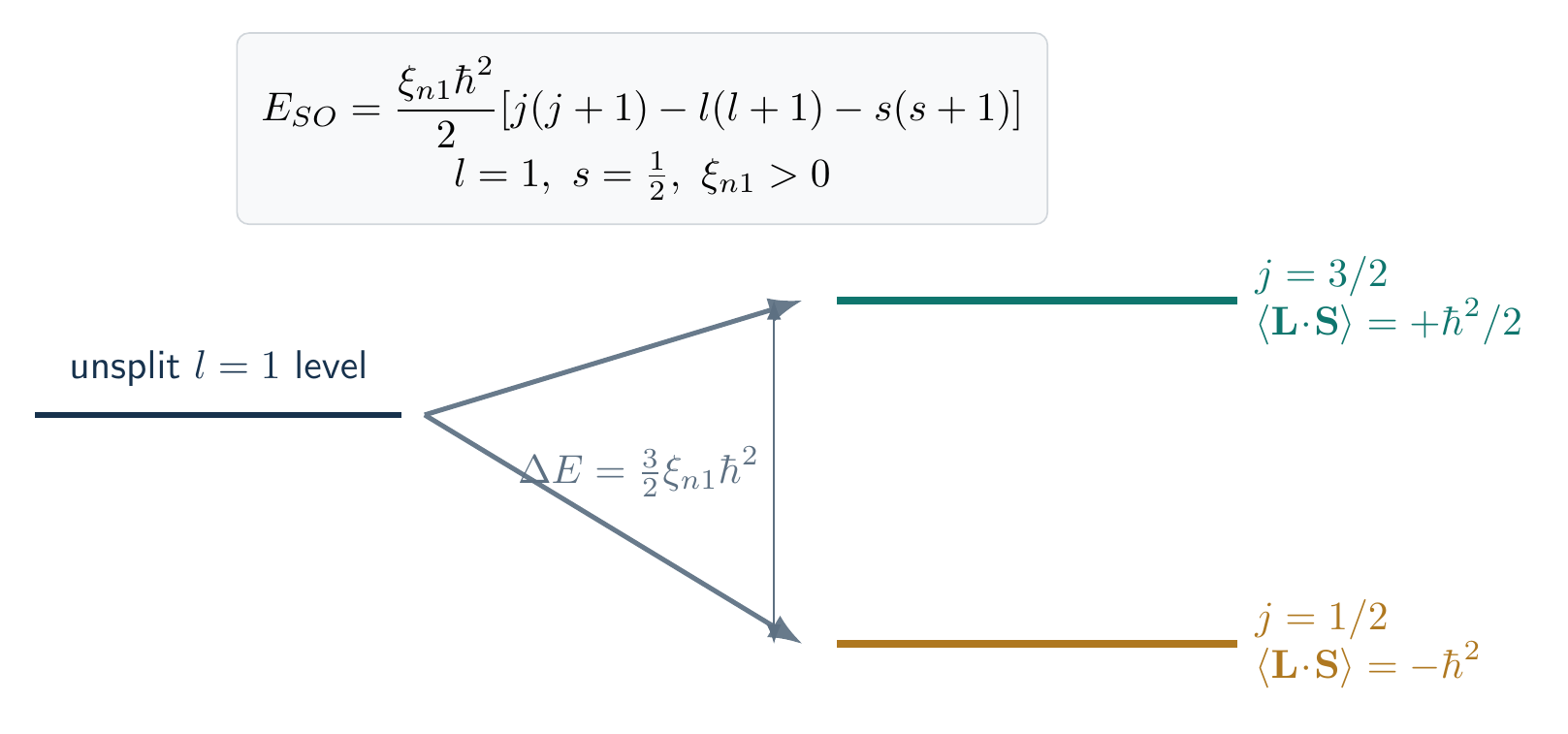
\[\boxed{ \mathbf L\cdot\mathbf S\,\lvert lsjm\rangle =\frac{\hbar^2}{2} [j(j+1)-l(l+1)-s(s+1)]\lvert lsjm\rangle. }\]For $l>0$, the allowed values are $j=l\pm1/2$. Therefore
\[\langle\mathbf L\cdot\mathbf S\rangle =\begin{cases} (\hbar^2/2)l,&j=l+1/2,\\ -(\hbar^2/2)(l+1),&j=l-1/2. \end{cases}\]For an electron moving in a central potential energy $V(r)$, the nonrelativistic spin-orbit interaction, including the Thomas factor, is
\[\boxed{ H_{SO}=\frac1{2m_e^2c^2r}\frac{dV}{dr}\, \mathbf L\cdot\mathbf S. }\]It consequently splits a fixed $l$ level into the two allowed total-angular-momentum levels $j=l\pm1/2$.
For a fixed radial state, define the radial expectation
\[\boxed{ \xi_{nl}=\left\langle nl\right\lvert \frac1{2m_e^2c^2r}\frac{dV}{dr} \left\lvert nl\right\rangle. }\]The first-order spin-orbit shift is therefore
\[\boxed{ \Delta E_{nlj} =\frac{\xi_{nl}\hbar^2}{2} [j(j+1)-l(l+1)-s(s+1)]. }\]The level ordering in the figure assumes $\xi_{n1}>0$; a negative radial expectation reverses the two levels.
Solved Problems
1. Spin components from a normalized Pauli spinor
For
\[\lvert\psi\rangle= \begin{pmatrix}\sqrt3/2\\i/2\end{pmatrix},\]normalization follows from $3/4+1/4=1$. A measurement of $S_z$ gives $+\hbar/2$ with probability $3/4$ and $-\hbar/2$ with probability $1/4$. Hence
\[\langle S_z\rangle =\frac\hbar2\left(\frac34-\frac14\right)=\frac\hbar4.\]For the other components,
\[\langle S_i\rangle=\frac\hbar2 \langle\psi\rvert\sigma_i\lvert\psi\rangle.\]Direct matrix multiplication gives
\[\langle\sigma_x\rangle=0, \qquad \langle\sigma_y\rangle=\frac{\sqrt3}{2}, \qquad \langle\sigma_z\rangle=\frac12,\]so
\[\boxed{ \langle\mathbf S\rangle =\left(0,\frac{\sqrt3\hbar}{4},\frac\hbar4\right), \qquad \left\lvert\langle\mathbf S\rangle\right\rvert=\frac\hbar2.}\]Every component has units of angular momentum. The maximal magnitude $\hbar/2$ shows that this pure spinor points along the unit direction $(0,\sqrt3/2,1/2)$.
2. Regular radial behavior at the origin
Suppose $V(r)$ remains finite at $r=0$. Near the origin the centrifugal term dominates the radial equation for $l>0$:
\[-\frac{\hbar^2}{2\mu}u_l^{\prime\prime} +\frac{\hbar^2l(l+1)}{2\mu r^2}u_l\simeq0.\]With $u_l\sim r^p$, cancellation of the common factor $r^{p-2}$ gives
\[p(p-1)-l(l+1)=0,\]whose roots are $p=l+1$ and $p=-l$. For $l=2$,
\[u_2(r)\sim C_1r^3+C_2r^{-2}.\]Because the radial norm is $\int_0^\infty\lvert u_l(r)\rvert^2dr$, the $r^{-2}$ branch produces a divergent integral at the origin. Therefore
\[\boxed{u_2(r)\propto r^3, \qquad R_2(r)=u_2(r)/r\propto r^2\quad(r\to0).}\]The coefficient carries the units needed by the normalization; the power law itself is independent of the particle mass and of the finite value $V(0)$.
3. Coupling $l=1$ to spin $1/2$
The unique state with maximum $m$ is
\[\left\lvert\frac32,\frac32\right\rangle =\lvert1,1\rangle\left\lvert\frac12,\frac12\right\rangle.\]Apply $J_-=L_-+S_-$. On the coupled state,
\[J_-\left\lvert\frac32,\frac32\right\rangle =\hbar\sqrt3\left\lvert\frac32,\frac12\right\rangle.\]On the uncoupled product,
\[(L_-+S_-)\lvert1,1\rangle\lvert+\rangle =\hbar\sqrt2\lvert1,0\rangle\lvert+\rangle +\hbar\lvert1,1\rangle\lvert-\rangle.\]Dividing by $\hbar\sqrt3$ gives
\[\boxed{ \left\lvert\frac32,\frac12\right\rangle =\sqrt{\frac23}\lvert1,0\rangle\lvert+\rangle +\sqrt{\frac13}\lvert1,1\rangle\lvert-\rangle.}\]The normalized orthogonal combination with the same total $m=1/2$ is
\[\boxed{ \left\lvert\frac12,\frac12\right\rangle =\sqrt{\frac13}\lvert1,0\rangle\lvert+\rangle -\sqrt{\frac23}\lvert1,1\rangle\lvert-\rangle.}\]The squared coefficients in either line add to one, and every product ket has $m_l+m_s=1/2$, providing normalization and selection-rule checks.
Descriptive Questions
- Starting from the angular-momentum commutators, derive the allowed values of $j$ and $m$ and the normalized action of $J_\pm$.
- Derive the radial Schrödinger equation for a central potential, stating both endpoint boundary conditions and the origin of the centrifugal term.
- Explain how translation, rotation, time-translation, and parity invariance lead to their corresponding conservation laws, noting why parity is a discrete symmetry.
- For two identical electrons, relate exchange symmetry of the spatial and spin factors to the exclusion principle and to the singlet-triplet classification.
Numerical Problems
- For $j=5/2$ and $m=-3/2$, find the eigenvalues of $J^2$ and $J_z$ and the magnitude $\sqrt{\langle J^2\rangle}$.
- Evaluate $J_+\lvert2,-1\rangle$, including its numerical coefficient and final magnetic quantum number.
- Find the centrifugal energy $\hbar^2l(l+1)/(2m_er^2)$ for an electron with $l=2$ at $r=0.200\,\mathrm{nm}$. Use $\hbar^2/(2m_e)=3.80998\,\mathrm{eV\,\mathring A^2}$.
- Couple $j_1=3/2$ and $j_2=1$. List all allowed $j$ values and verify the number of product states from the dimensions of the coupled multiplets.
- For $l=3$, $s=1/2$, and $\xi_{nl}\hbar^2=0.800\,\mathrm{meV}$, calculate both spin-orbit shifts and their separation.
- Two normalized one-particle orbitals have real overlap $S=1/3$. Find the normalization constants multiplying $\phi_a(1)\phi_b(2)\pm\phi_b(1)\phi_a(2)$.
Final answers: 1. $J^2=35\hbar^2/4$, $J_z=-3\hbar/2$, magnitude $\sqrt{35}\hbar/2$; 2. $J_+\lvert2,-1\rangle=\sqrt6\hbar\lvert2,0\rangle$; 3. $5.71497\,\mathrm{eV}$; 4. $j=1/2,3/2,5/2$ and $2+4+6=12=(2j_1+1)(2j_2+1)$; 5. $+1.200\,\mathrm{meV}$ for $j=7/2$, $-1.600\,\mathrm{meV}$ for $j=5/2$, separation $2.800\,\mathrm{meV}$; 6. $N_+=3/\sqrt{20}$ and $N_-=3/4$.
The core derivations and all problem answers are verified in the original Maxima worksheet and the problems worksheet; every printed residual is zero.
References
- Angular momentum operator.
- J. J. Sakurai and J. Napolitano, Modern Quantum Mechanics, 3rd ed., Chapters 3, 4, and 7.
- D. J. Griffiths and D. F. Schroeter, Introduction to Quantum Mechanics, 3rd ed., Chapters 4 and 5.


Discussion