

22 May 2025
Fourier Series and Periodic Waveforms
Orthogonality, real and complex Fourier coefficients, Dirichlet conditions, and the sawtooth, square, and triangular waveforms.
Let $f(x+L)=f(x)$ and put $k_0=2\pi/L$. The product-to-sum identities give, for positive integers $m,n$,
\[\cos(mk_0x)\cos(nk_0x) =\frac12\{\cos[(m-n)k_0x]+\cos[(m+n)k_0x]\},\] \[\sin(mk_0x)\sin(nk_0x) =\frac12\{\cos[(m-n)k_0x]-\cos[(m+n)k_0x]\}.\]Every nonconstant sine or cosine integrates to zero over a complete period. The constant term occurs only when $m=n$, so
\[\int_{-L/2}^{L/2}\cos(mk_0x)\cos(nk_0x)\,dx =\frac L2\delta_{mn},\] \[\int_{-L/2}^{L/2}\sin(mk_0x)\sin(nk_0x)\,dx =\frac L2\delta_{mn}, \qquad \int_{-L/2}^{L/2}\sin(mk_0x)\cos(nk_0x)\,dx=0.\]Dirichlet conditions and coefficients
The Dirichlet conditions are stated as follows: over one period, $f$ is absolutely integrable and has only finitely many finite discontinuities and finitely many maxima and minima. Under these conditions its Fourier series is
\[f(x)\sim\frac{a_0}{2}+\sum_{n=1}^{\infty} \left[a_n\cos(nk_0x)+b_n\sin(nk_0x)\right].\]Multiply by $\cos(mk_0x)$ and integrate over one period. Orthogonality removes every term except $a_m$:
\[\int_{-L/2}^{L/2}f(x)\cos(mk_0x)\,dx=\frac L2a_m.\]The three coefficients are therefore
\[\boxed{ a_0=\frac2L\int_{-L/2}^{L/2}f(x)\,dx, \quad a_n=\frac2L\int_{-L/2}^{L/2}f(x)\cos(nk_0x)\,dx, \quad b_n=\frac2L\int_{-L/2}^{L/2}f(x)\sin(nk_0x)\,dx. }\]Parity reduces these integrals without changing their normalization. If $f(-x)=f(x)$, then $f(x)\sin(nk_0x)$ is odd and
\[b_n=0,\qquad a_n=\frac4L\int_0^{L/2}f(x)\cos(nk_0x)\,dx.\]If $f(-x)=-f(x)$, then $a_0=a_n=0$ and
\[b_n=\frac4L\int_0^{L/2}f(x)\sin(nk_0x)\,dx.\]At a point of continuity the series converges to $f(x)$. At a jump it converges to the midpoint $[f(x^-)+f(x^+)]/2$.
Complex representation
Euler’s relations convert the real series to
\[f(x)\sim\sum_{n=-\infty}^{\infty}c_ne^{ink_0x}.\]Since $\int_{-L/2}^{L/2}e^{i(n-m)k_0x}dx=L\delta_{mn}$, multiplication by $e^{-imk_0x}$ gives
\[\boxed{c_n=\frac1L\int_{-L/2}^{L/2}f(x)e^{-ink_0x}\,dx.}\]Comparison with the real form yields
\[c_0=\frac{a_0}{2},\qquad c_n=\frac{a_n-ib_n}{2},\qquad c_{-n}=\frac{a_n+ib_n}{2}.\]For real $f$, $c_{-n}=c_n^{\ast}$.
Sawtooth waveform
Choose the $2\pi$-periodic function $f(x)=x$ for $-\pi<x<\pi$. It is odd, so $a_0=a_n=0$. Integration by parts gives
\[\begin{aligned} b_n&=\frac1\pi\int_{-\pi}^{\pi}x\sin(nx)\,dx =\frac2\pi\int_0^\pi x\sin(nx)\,dx\\ &=\frac2\pi\left[ -\frac{x\cos(nx)}n+\frac{\sin(nx)}{n^2} \right]_0^\pi =\frac{2(-1)^{n+1}}n. \end{aligned}\]Hence
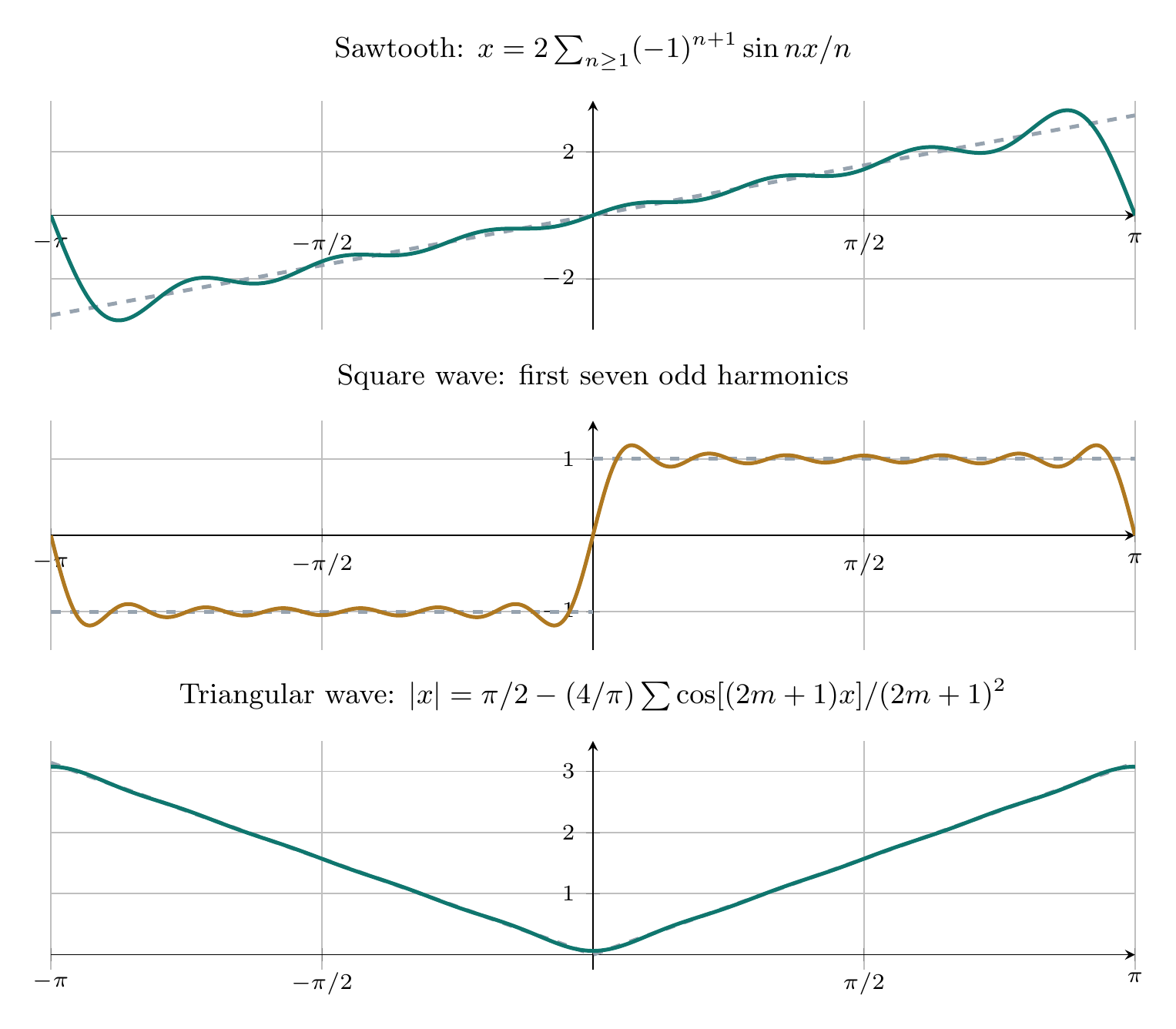
\[\boxed{x=2\sum_{n=1}^{\infty}\frac{(-1)^{n+1}}n\sin(nx), \qquad -\pi<x<\pi.}\]At $x=\pm\pi$ the periodic extension jumps between $\pi$ and $-\pi$, so the series converges there to zero.
Square waveform
Let $f(x)=1$ on $(0,\pi)$ and $f(x)=-1$ on $(-\pi,0)$. Again $f$ is odd:
\[\begin{aligned} b_n&=\frac2\pi\int_0^\pi\sin(nx)\,dx =\frac{2[1-(-1)^n]}{n\pi}\\ &=\begin{cases} 4/(n\pi),&n\text{ odd},\\ 0,&n\text{ even}. \end{cases} \end{aligned}\]Thus
\[\boxed{ f(x)=\frac4\pi\sum_{m=0}^{\infty} \frac{\sin[(2m+1)x]}{2m+1}. }\]Triangular waveform
Take $f(x)=\lvert x\rvert$ on $[-\pi,\pi]$ and extend it periodically. It is even, so $b_n=0$ and
\[a_0=\frac2\pi\int_0^\pi x\,dx=\pi.\]For $n\ge1$,
\[\begin{aligned} a_n&=\frac2\pi\int_0^\pi x\cos(nx)\,dx\\ &=\frac2\pi\left[ \frac{x\sin(nx)}n+\frac{\cos(nx)}{n^2} \right]_0^\pi =\frac{2[(-1)^n-1]}{\pi n^2}. \end{aligned}\]Only odd harmonics remain:
\[\boxed{ \lvert x\rvert=\frac\pi2-\frac4\pi\sum_{m=0}^{\infty} \frac{\cos[(2m+1)x]}{(2m+1)^2}. }\]The $n^{-2}$ coefficients decrease faster than the $n^{-1}$ coefficients of the discontinuous sawtooth and square waves.
Solved Problems
1. Fourier series of a periodic parabola
Find the Fourier series of $f(x)=x^2$ on $-\pi<x<\pi$, extended with period $2\pi$.
The function is even, so $b_n=0$. Its constant coefficient is
\[a_0=\frac2\pi\int_0^\pi x^2\,dx =\frac2\pi\left[\frac{x^3}{3}\right]_0^\pi =\frac{2\pi^2}{3}.\]For $n\ge1$, integrate twice by parts. First,
\[\begin{aligned} I_n&=\int_0^\pi x^2\cos(nx)\,dx\\ &=\left[\frac{x^2\sin(nx)}n\right]_0^\pi -\frac2n\int_0^\pi x\sin(nx)\,dx. \end{aligned}\]The boundary term vanishes, while
\[\int_0^\pi x\sin(nx)\,dx =\left[-\frac{x\cos(nx)}n+\frac{\sin(nx)}{n^2}\right]_0^\pi =-\frac{\pi(-1)^n}{n}.\]Therefore $I_n=2\pi(-1)^n/n^2$ and
\[\boxed{ x^2=\frac{\pi^2}{3} +4\sum_{n=1}^{\infty}\frac{(-1)^n}{n^2}\cos(nx), \qquad -\pi\le x\le\pi. }\]The periodic extension is continuous at $x=\pm\pi$, so the endpoint value is $\pi^2$. Substitution at $x=\pi$ gives $\pi^2=\pi^2/3+4\sum_{n=1}^{\infty}n^{-2}$, which is a consistency check. All terms have the same dimensions as $f$; here $x$ has been taken as a dimensionless angular variable.
2. A periodic function with neither even nor odd symmetry
Let $f(x)=e^x$ on $-\pi<x<\pi$ and extend it with period $2\pi$. Determine its real Fourier coefficients.
The mean coefficient is
\[a_0=\frac1\pi\int_{-\pi}^{\pi}e^x\,dx =\frac{e^\pi-e^{-\pi}}\pi =\frac{2\sinh\pi}{\pi}.\]The required antiderivatives are
\[\int e^x\cos(nx)\,dx =\frac{e^x[\cos(nx)+n\sin(nx)]}{1+n^2},\] \[\int e^x\sin(nx)\,dx =\frac{e^x[\sin(nx)-n\cos(nx)]}{1+n^2}.\]Using $\sin(n\pi)=0$ and $\cos(n\pi)=(-1)^n$ gives
\[a_n=\frac{2(-1)^n\sinh\pi}{\pi(1+n^2)}, \qquad b_n=\frac{2n(-1)^{n+1}\sinh\pi}{\pi(1+n^2)}.\]Hence
\[\boxed{ e^x\sim\frac{\sinh\pi}{\pi} +\frac{2\sinh\pi}{\pi}\sum_{n=1}^{\infty} \frac{(-1)^n\cos(nx)+n(-1)^{n+1}\sin(nx)}{1+n^2}. }\]At $x=\pm\pi$ the periodic extension jumps from $e^\pi$ to $e^{-\pi}$; there the series converges to their midpoint $\cosh\pi$. If the exponent represents a dimensional coordinate, it must instead be written as a dimensionless ratio such as $x/x_0$.
3. Half-wave rectified sine
For one period $0<\theta<2\pi$, let
\[f(\theta)= \begin{cases} A\sin\theta,&0<\theta<\pi,\\ 0,&\pi<\theta<2\pi, \end{cases}\]where $A$ has the units of the waveform. Its $2\pi$-periodic coefficients are obtained over this interval. First,
\[a_0=\frac1\pi\int_0^\pi A\sin\theta\,d\theta=\frac{2A}{\pi}.\]For $n\ge1$,
\[a_n=\frac A\pi\int_0^\pi\sin\theta\cos(n\theta)\,d\theta.\]The product-to-sum identity shows that the integral vanishes for odd $n$, including $n=1$, whereas for $n=2m$ it is $2/(1-4m^2)$. Thus
\[a_{2m}=-\frac{2A}{\pi(4m^2-1)},\qquad a_{2m-1}=0.\]Orthogonality on $(0,\pi)$ also gives
\[b_n=\frac A\pi\int_0^\pi\sin\theta\sin(n\theta)\,d\theta =\begin{cases}A/2,&n=1,\\0,&n\ne1.\end{cases}\]Therefore
\[\boxed{ f(\theta)=\frac A\pi+\frac A2\sin\theta -\frac{2A}{\pi}\sum_{m=1}^{\infty} \frac{\cos(2m\theta)}{4m^2-1}. }\]The positive mean $A/\pi$ has the units of $A$. The waveform is continuous but has slope discontinuities, consistent with the $m^{-2}$ decrease of its cosine coefficients.
Descriptive Questions
- How do the orthogonality relations determine the real Fourier coefficients, and what value does the series take at a finite jump?
- How are the real and complex Fourier representations related for a real periodic function?
- Why do the Fourier coefficients of the triangular waveform decrease faster than those of the square and sawtooth waveforms?
- How does shifting the origin mix the sine and cosine coefficients while leaving each harmonic amplitude unchanged?
Numerical Problems
-
For $f(x)=3+2\cos(2x)-4\sin(3x)$, list all nonzero real and complex Fourier coefficients.
Final answer: $a_0=6$, $a_2=2$, $b_3=-4$; $c_0=3$, $c_{\pm2}=1$, $c_3=2i$, and $c_{-3}=-2i$.
-
With $L=4$ and $k_0=\pi/2$, evaluate $\int_{-2}^{2}\cos(3k_0x)\cos(5k_0x)\,dx$ and $\int_{-2}^{2}\cos^2(3k_0x)\,dx$.
Final answer: $0$ and $2$, respectively.
-
The $2\pi$-periodic function is $f(x)=1+x/\pi$ on $-\pi<x<\pi$. Find $c_0$ and $c_1$.
Final answer: $c_0=1$ and $c_1=-i/\pi$.
-
Approximate the triangular waveform $f(x)=\lvert x\rvert$ at $x=0$ using only its first two nonzero cosine harmonics.
Final answer: $S_2(0)=\pi/2-40/(9\pi)$.
-
A $2\pi$-periodic function equals $2$ on $(-\pi,0)$ and $5$ on $(0,\pi)$. What values do its Fourier series take at $x=0$ and at the identified endpoints $x=\pm\pi$?
Final answer: $7/2$ at all three jump points.
-
Express $8\cos(4x-\pi/3)$ in real and complex Fourier coefficients.
Final answer: $a_4=4$, $b_4=4\sqrt3$, $c_4=2-2i\sqrt3$, and $c_{-4}=2+2i\sqrt3$; all other coefficients vanish.
Orthogonality, waveform coefficients, all solved results, and every final answer are checked symbolically in the Maxima worksheet; every printed residual is zero.
References
- Fourier series — Wikipedia
- NIST Digital Library of Mathematical Functions, §1.8: Fourier Series
- G. B. Arfken, H. J. Weber and F. E. Harris, Mathematical Methods for Physicists, 7th ed., chapter on Fourier series.
- K. F. Riley, M. P. Hobson and S. J. Bence, Mathematical Methods for Physics and Engineering, 3rd ed., chapter on Fourier series.


Discussion