

14 Jul 2025
Frobenius Method and Special Functions
Regular singular points and the Legendre, Bessel, Hermite, and Laguerre equations, generating functions, recurrence relations, and orthogonality.
Write a second-order linear equation as
\[y^{\prime\prime}+P(x)y^{\prime}+Q(x)y=0.\]A point $x_0$ is ordinary if $P$ and $Q$ are analytic there. It is a regular singular point if $(x-x_0)P(x)$ and $(x-x_0)^2Q(x)$ are analytic. Otherwise it is an irregular singular point. This classification matters because a power series is guaranteed at an ordinary point, while a regular singular point generally requires a noninteger leading power.
Frobenius method
Near a regular singular point, set $z=x-x_0$ and write
\[P(x)=\sum_{j=0}^{\infty}p_jz^{j-1}, \qquad Q(x)=\sum_{j=0}^{\infty}q_jz^{j-2},\] \[y=z^r\sum_{n=0}^{\infty}a_nz^n, \qquad a_0\ne0.\]Then
\[y^{\prime}=\sum_{n=0}^{\infty}(n+r)a_nz^{n+r-1}, \qquad y^{\prime\prime}=\sum_{n=0}^{\infty}(n+r)(n+r-1)a_nz^{n+r-2}.\]The coefficient of the lowest power $z^{r-2}$ is
\[a_0[r(r-1)+p_0r+q_0]=0.\]Since $a_0\ne0$, the indicial equation is
\[\boxed{r(r-1)+p_0r+q_0=0.}\]For $n\ge1$, the coefficient of $z^{n+r-2}$ gives the explicit recursion
\[\begin{aligned} &[(n+r)(n+r-1)+p_0(n+r)+q_0]a_n\\ &\qquad+ \sum_{j=1}^{n}[p_j(n-j+r)+q_j]a_{n-j}=0. \end{aligned}\]Thus the indicial root fixes the leading power and the higher equations fix $a_n$ successively. Equal roots, or roots differing by an integer, can require a logarithmic second solution.
Bessel equation as a Frobenius construction
For
\[x^2y^{\prime\prime}+xy^{\prime}+(x^2-\nu^2)y=0,\]$x=0$ is a regular singular point. Substitute $y=\sum_{n=0}^{\infty}a_nx^{n+r}$:
\[\sum_{n=0}^{\infty}[(n+r)^2-\nu^2]a_nx^{n+r} +\sum_{n=2}^{\infty}a_{n-2}x^{n+r}=0.\]The indicial equation is $r^2-\nu^2=0$. Choose the regular order $\nu\ge0$ and the root $r=\nu$. The $n=1$ equation is $(2\nu+1)a_1=0$, hence $a_1=0$, and for $n\ge2$,
\[a_n=-\frac{a_{n-2}}{(n+\nu)^2-\nu^2} =-\frac{a_{n-2}}{n(n+2\nu)}.\]Choosing $a_0=1/[2^\nu\Gamma(\nu+1)]$ gives
\[\boxed{ J_\nu(x)=\sum_{m=0}^{\infty} \frac{(-1)^m}{m!\Gamma(m+\nu+1)} \left(\frac x2\right)^{2m+\nu}. }\]For noninteger $\nu$, $J_\nu$ and $J_{-\nu}$ are independent. For integer order, the second independent solution is singular at the origin, while $J_n$ remains finite.
The integer-order generating function is
\[\boxed{ \exp\!\left[\frac x2\left(t-\frac1t\right)\right] =\sum_{n=-\infty}^{\infty}J_n(x)t^n. }\]Differentiating with respect to $t$ and $x$, then matching powers of $t$, gives
\[J_{n-1}(x)+J_{n+1}(x)=\frac{2n}{x}J_n(x),\] \[J_{n-1}(x)-J_{n+1}(x)=2J_n^{\prime}(x).\]For the regular order $\nu\ge0$, let $\alpha_{\nu m}$ be the $m$th positive zero of $J_\nu$. The Bessel equation in self-adjoint form,
\[\frac d{dx}\left(x\frac{dy}{dx}\right) +\left(\alpha^2x-\frac{\nu^2}{x}\right)y=0,\]gives, after multiplying two solutions by one another and subtracting,
\[(\alpha_m^2-\alpha_n^2) \int_0^1xJ_\nu(\alpha_mx)J_\nu(\alpha_nx)dx =\left[x(y_my_n^{\prime}-y_ny_m^{\prime})\right]_0^1=0.\]The regular behavior $J_\nu(\alpha x)\sim x^\nu$ makes the $x=0$ boundary term vanish, while both functions vanish at $x=1$. Thus distinct modes are orthogonal. Taking the coincident-root limit and using $J_\nu^{\prime}(\alpha_{\nu n})=-J_{\nu+1}(\alpha_{\nu n})$ gives
\[\boxed{ \int_0^1xJ_\nu(\alpha_{\nu m}x)J_\nu(\alpha_{\nu n}x)dx =\frac12J_{\nu+1}^2(\alpha_{\nu n})\delta_{mn}. }\]Legendre functions
Legendre’s equation is
\[\frac d{dx}\left[(1-x^2)y^{\prime}\right]+l(l+1)y=0, \qquad -1\le x\le1.\]Finiteness at both endpoints selects $l=0,1,2,\ldots$ and the Legendre polynomials $P_l(x)$. Their generating function is
\[\boxed{ \frac1{\sqrt{1-2xt+t^2}}=\sum_{l=0}^{\infty}P_l(x)t^l. }\]Differentiate with respect to $t$, multiply by $1-2xt+t^2$, and compare the coefficient of $t^l$ to obtain
\[\boxed{(l+1)P_{l+1}=(2l+1)xP_l-lP_{l-1}.}\]The first functions are
\[P_0=1,\quad P_1=x,\quad P_2=\frac12(3x^2-1),\quad P_3=\frac12(5x^3-3x).\]For $l\ne m$, subtracting the two self-adjoint equations and integrating gives
\[[l(l+1)-m(m+1)]\int_{-1}^{1}P_lP_mdx =\left[(1-x^2)(P_lP_m^{\prime}-P_mP_l^{\prime})\right]_{-1}^{1}=0.\]The norm follows from Rodrigues’ formula
\[P_l(x)=\frac1{2^ll!}\frac{d^l}{dx^l}(x^2-1)^l.\]Integrating by parts $l$ times, using $P_l^{(l)}=(2l)!/(2^ll!)$, and
\[\int_{-1}^{1}(1-x^2)^l dx =\frac{2^{2l+1}(l!)^2}{(2l+1)!},\]gives
\[\boxed{\int_{-1}^{1}P_l(x)P_m(x)dx =\frac2{2l+1}\delta_{lm}.}\]Hermite functions
Hermite’s equation is
\[y^{\prime\prime}-2xy^{\prime}+2ny=0.\]Its generating function
\[\boxed{e^{2xt-t^2}=\sum_{n=0}^{\infty}H_n(x)\frac{t^n}{n!}}\]gives, by differentiating with respect to $x$ and $t$,
\[H_n^{\prime}=2nH_{n-1}, \qquad H_{n+1}=2xH_n-2nH_{n-1}.\]The first functions are $H_0=1$, $H_1=2x$, $H_2=4x^2-2$, and $H_3=8x^3-12x$. To obtain their normalization, multiply two generating functions and integrate:
\[\int_{-\infty}^{\infty}e^{-x^2} e^{2xt-t^2}e^{2xu-u^2}dx =\sqrt\pi e^{2tu}.\]Comparison of the coefficient of $t^nu^m$ yields
\[\boxed{ \int_{-\infty}^{\infty}e^{-x^2}H_n(x)H_m(x)dx =\sqrt\pi\,2^nn!\,\delta_{nm}. }\]Laguerre functions
Laguerre’s equation is
\[xy^{\prime\prime}+(1-x)y^{\prime}+ny=0, \qquad 0\le x<\infty.\]Its generating function is
\[\boxed{ \frac1{1-t}\exp\!\left(-\frac{xt}{1-t}\right) =\sum_{n=0}^{\infty}L_n(x)t^n. }\]Differentiation and coefficient comparison give
\[\boxed{(n+1)L_{n+1}=(2n+1-x)L_n-nL_{n-1}.}\]The first functions are
\[L_0=1,\quad L_1=1-x,\quad L_2=1-2x+\frac{x^2}{2},\quad L_3=1-3x+\frac{3x^2}{2}-\frac{x^3}{6}.\]For the norm, let $G(x,t)$ denote the generating function. Direct integration gives
\[\int_0^\infty e^{-x}G(x,t)G(x,u)dx =\frac1{1-tu}=\sum_{n=0}^{\infty}(tu)^n.\]Equating coefficients gives
\[\boxed{\int_0^\infty e^{-x}L_n(x)L_m(x)dx=\delta_{nm}.}\]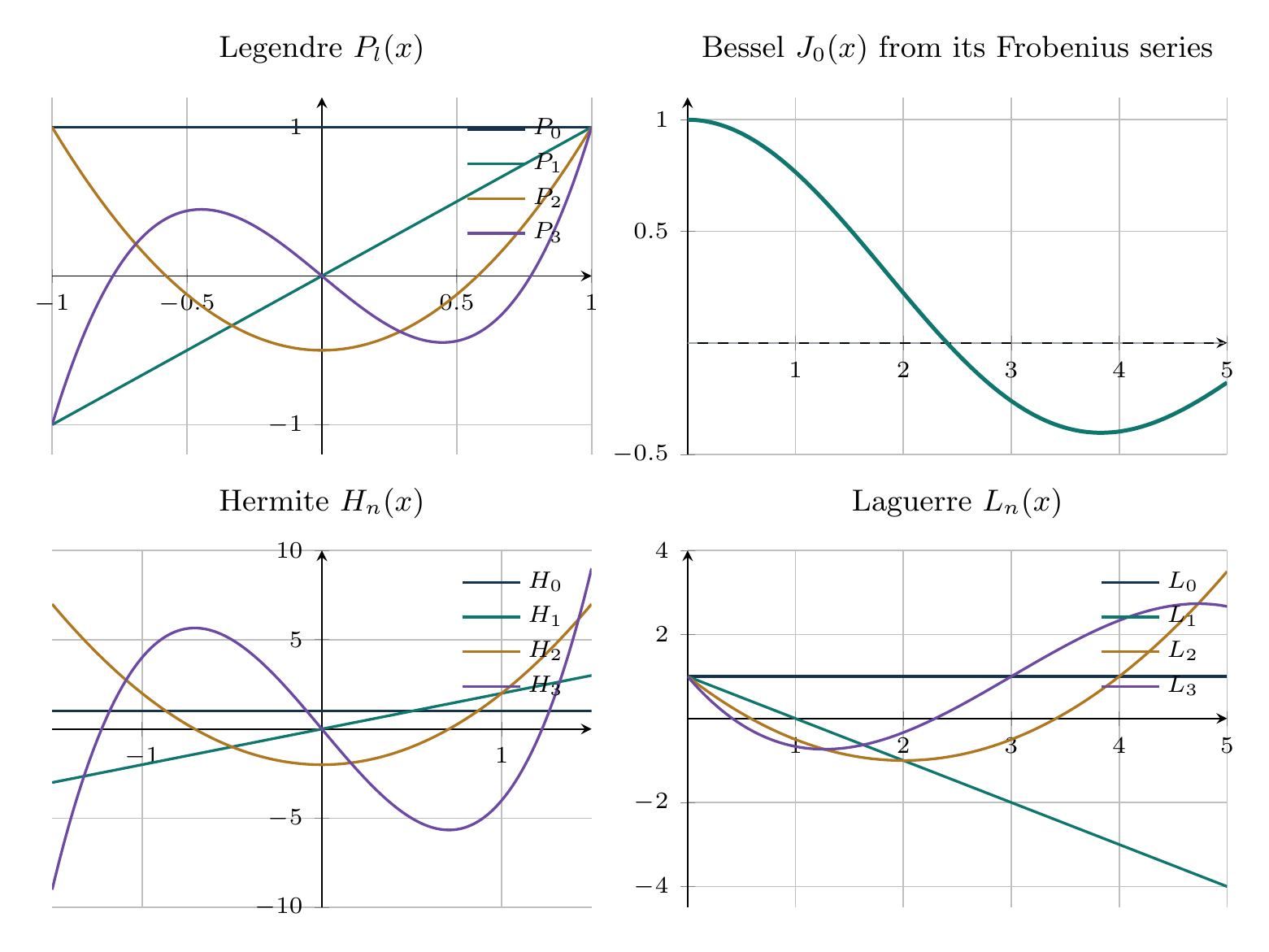
Solved Problems
1. A regular Frobenius solution
Find the solution of
\[x^2y^{\prime\prime}+2xy^{\prime}+x^2y=0\]that remains finite at $x=0$. In normalized form, $P(x)=2/x$ and $Q(x)=1$, so $xP=2$ and $x^2Q=x^2$ are analytic at the origin: $x=0$ is a regular singular point.
Insert $y=\sum_{n=0}^{\infty}a_nx^{n+r}$. After shifting the second sum,
\[\sum_{n=0}^{\infty}(n+r)(n+r+1)a_nx^{n+r} +\sum_{n=2}^{\infty}a_{n-2}x^{n+r}=0.\]The indicial equation is $r(r+1)=0$. The root $r=0$ gives the finite solution. The $n=1$ equation is $2a_1=0$, and for $n\ge2$,
\[a_n=-\frac{a_{n-2}}{n(n+1)}.\]Consequently all odd coefficients vanish and
\[a_2=-\frac{a_0}{3!},\qquad a_4=\frac{a_0}{5!},\qquad a_6=-\frac{a_0}{7!},\ldots\]Thus
\[\boxed{ y(x)=a_0\left(1-\frac{x^2}{3!}+\frac{x^4}{5!}-\cdots\right) =a_0\frac{\sin x}{x}. }\]Although the closed form contains $1/x$, the limit is $\lim_{x\to0}\sin x/x=1$, so $y(0)=a_0$ is finite. The independent solution associated with the other root is singular at the origin.
2. Expansion in Legendre polynomials
Expand $x^2$ in Legendre polynomials on $[-1,1]$. Orthogonality gives the coefficient of $P_l$ as
\[A_l=\frac{2l+1}{2}\int_{-1}^{1}x^2P_l(x)\,dx.\]Parity removes all odd $l$, and a polynomial of degree two requires only $P_0$ and $P_2$. Their coefficients are
\[A_0=\frac12\int_{-1}^{1}x^2dx=\frac13,\] \[\begin{aligned} A_2&=\frac52\int_{-1}^{1}x^2\frac{3x^2-1}{2}\,dx\\ &=\frac54\left(3\frac25-\frac23\right)=\frac23. \end{aligned}\]Therefore
\[\boxed{x^2=\frac13P_0(x)+\frac23P_2(x).}\]At $x=0$ the right side is $1/3-(2/3)(1/2)=0$, and at $x=\pm1$ it is $1$, so both the centre and endpoint limits agree with $x^2$.
3. Reducing a higher Bessel order
Express $J_3(x)$ using only $J_0(x)$ and $J_1(x)$. The recurrence $J_{n-1}+J_{n+1}=2nJ_n/x$ gives, for $n=1$,
\[J_2=\frac2xJ_1-J_0.\]For $n=2$,
\[\begin{aligned} J_3&=\frac4xJ_2-J_1\\ &=\boxed{\left(\frac8{x^2}-1\right)J_1-\frac4xJ_0}. \end{aligned}\]The apparent inverse powers cancel at the origin. Indeed,
\[J_0=1-\frac{x^2}{4}+\frac{x^4}{64}+O(x^6), \qquad J_1=\frac x2-\frac{x^3}{16}+\frac{x^5}{384}+O(x^7),\]so substitution gives $J_3=x^3/48+O(x^5)$, the regular behavior expected from the Frobenius leading power $x^3$.
Descriptive Questions
- How are ordinary, regular singular, and irregular points distinguished, and why can an integer difference between indicial roots introduce a logarithm?
- How does the Bessel generating function produce the two standard recurrence relations, and which boundary behavior selects the regular solution?
- How does self-adjoint form make the boundary term responsible for Legendre and Bessel orthogonality vanish?
- How do the generating functions, weight functions, domains, and normalization integrals differ for Hermite and Laguerre polynomials?
Numerical Problems
-
Classify $x=0$ for (a) $y^{\prime\prime}+xy^{\prime}+y=0$, (b) $y^{\prime\prime}+x^{-1}y^{\prime}+y=0$, and (c) $y^{\prime\prime}+x^{-3}y^{\prime}+y=0$.
Final answer: (a) ordinary, (b) regular singular, and (c) irregular singular.
-
For $x^2y^{\prime\prime}+3xy^{\prime}+(x^2-4)y=0$, find the indicial roots and the Frobenius coefficient recurrence.
Final answer: $r=-1\pm\sqrt5$, $a_1=0$, and $a_n=-a_{n-2}/[(n+r)^2+2(n+r)-4]$ for $n\ge2$.
-
Use $P_4(x)=(35x^4-30x^2+3)/8$ to evaluate $P_4(1/2)$.
Final answer: $-37/128$.
-
Use the first four terms of the Frobenius series for $J_0(x)$ to approximate $J_0(1)$.
Final answer: $1-1/4+1/64-1/2304=1763/2304$.
-
Generate $H_4(x)$ from the Hermite recurrence and evaluate it at the origin.
Final answer: $H_4(x)=16x^4-48x^2+12$ and $H_4(0)=12$.
-
Evaluate $L_3(2)$ from the polynomial stated above.
Final answer: $-1/3$.
The Frobenius recurrences, differential equations, orthogonality integrals, all solved results, and every final answer are checked in the Maxima worksheet; every printed residual is zero.
References
- Frobenius method — Wikipedia
- NIST Digital Library of Mathematical Functions, §2.7: Differential Equations and Fuchs–Frobenius Theory
- NIST Digital Library of Mathematical Functions: Chapter 10, Bessel Functions and Chapter 14, Legendre and Related Functions.
- NIST Digital Library of Mathematical Functions, Chapter 18: Orthogonal Polynomials
- G. B. Arfken, H. J. Weber and F. E. Harris, Mathematical Methods for Physicists, 7th ed., chapters on series solutions and special functions.


Discussion