

22 Jun 2025
Laplace Transforms and Applications
Elementary and inverse Laplace transforms, scaling and shifting, delta and periodic functions, derivatives, integrals, convolution, and differential equations.
For $t\ge0$, the Laplace transform is
\[\boxed{F(s)=\mathcal L\{f(t)\} =\int_0^\infty e^{-st}f(t)\,dt,}\]where $\operatorname{Re}s$ is large enough for the integral to converge.
Elementary functions
For $\operatorname{Re}s>0$,
\[\mathcal L\{1\}=\int_0^\infty e^{-st}dt=\frac1s.\]With $u=st$,
\[\mathcal L\{t^n\} =\frac1{s^{n+1}}\int_0^\infty u^ne^{-u}du =\boxed{\frac{n!}{s^{n+1}}}.\]Direct integration gives
\[\mathcal L\{e^{at}\}=\frac1{s-a}, \qquad \operatorname{Re}s>\operatorname{Re}a.\]Using $e^{i\omega t}=\cos\omega t+i\sin\omega t$,
\[\frac1{s-i\omega}=\frac{s+i\omega}{s^2+\omega^2},\]so comparison of real and imaginary parts gives
\[\boxed{ \mathcal L\{\cos\omega t\}=\frac{s}{s^2+\omega^2}, \qquad \mathcal L\{\sin\omega t\}=\frac{\omega}{s^2+\omega^2}. }\]Change of scale and shifting
For $a>0$, put $u=at$:
\[\boxed{ \mathcal L\{f(at)\}(s) =\frac1aF\!\left(\frac sa\right). }\]Multiplication by an exponential shifts $s$:
\[\boxed{\mathcal L\{e^{at}f(t)\}=F(s-a).}\]For a delay $a>0$, the Heaviside factor is essential. Substituting $u=t-a$ gives
\[\boxed{ \mathcal L\{H(t-a)f(t-a)\}=e^{-as}F(s). }\]Dirac delta and periodic functions
The sampling property gives, for $a\ge0$,
\[\boxed{\mathcal L\{\delta(t-a)\}=e^{-as}.}\]If $f(t+T)=f(t)$, split the transform into periods:
\[\begin{aligned} F(s)&=\sum_{n=0}^\infty \int_{nT}^{(n+1)T}e^{-st}f(t)dt\\ &=\sum_{n=0}^\infty e^{-nsT} \int_0^T e^{-su}f(u)du. \end{aligned}\]The geometric sum yields
\[\boxed{ F(s)=\frac{\int_0^T e^{-st}f(t)dt}{1-e^{-sT}}. }\]Derivatives and integrals
Integration by parts gives
\[\begin{aligned} \mathcal L\{f^{\prime}(t)\} &=\left[e^{-st}f(t)\right]_0^\infty +s\int_0^\infty e^{-st}f(t)dt\\ &=sF(s)-f(0^+), \end{aligned}\]assuming $e^{-st}f(t)\to0$ at infinity. Repetition gives
\[\boxed{ \mathcal L\{f^{(n)}\} =s^nF-s^{n-1}f(0^+)-s^{n-2}f^{\prime}(0^+)-\cdots-f^{(n-1)}(0^+). }\]Let $g(t)=\int_0^t f(u)du$. Then $g^{\prime}=f$ and $g(0)=0$, hence
\[\boxed{\mathcal L\left\{\int_0^t f(u)du\right\}=\frac{F(s)}s.}\]Convolution theorem
For the causal convolution
\[(f\ast g)(t)=\int_0^t f(u)g(t-u)du,\]change the order of integration over $0\le u\le t<\infty$ and put $v=t-u$:
\[\begin{aligned} \mathcal L\{f\ast g\} &=\int_0^\infty du\,f(u)e^{-su} \int_0^\infty dv\,g(v)e^{-sv}\\ &=\boxed{F(s)G(s)}. \end{aligned}\]Inverse transform and an application
The inverse transform may be found by decomposing $F(s)$ into known transform pairs. For example,
\[F(s)=\frac{2s+5}{(s+1)(s+2)} =\frac3{s+1}-\frac1{s+2},\]so
\[\mathcal L^{-1}\{F(s)\}=3e^{-t}-e^{-2t}.\]Now consider the initial-value equation
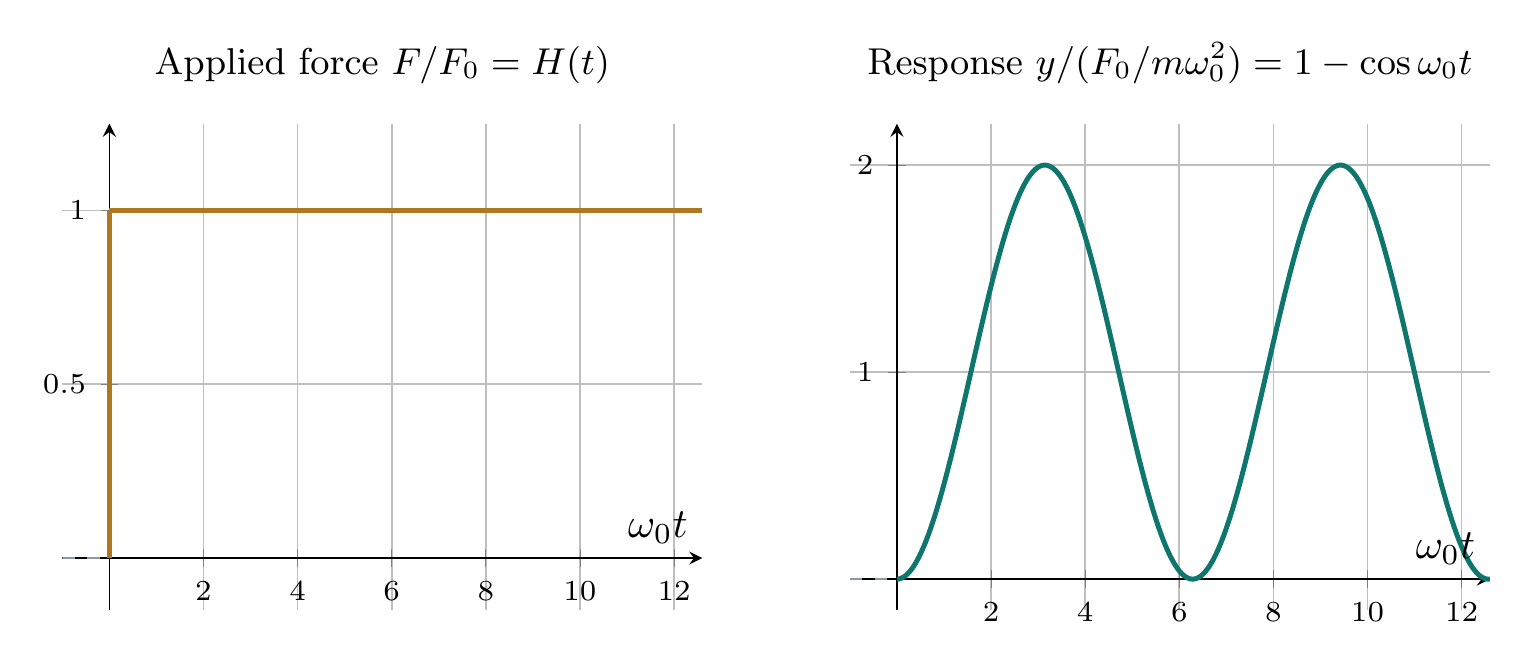
\[y^{\prime\prime}+\omega_0^2y=\frac{F_0}{m}H(t), \qquad y(0)=0,\quad y^{\prime}(0)=0.\]Transforming each derivative,
\[[s^2Y(s)-sy(0)-y^{\prime}(0)]+\omega_0^2Y(s) =\frac{F_0}{ms},\]and therefore
\[Y(s)=\frac{F_0}{m}\frac1{s(s^2+\omega_0^2)} =\frac{F_0}{m\omega_0^2} \left(\frac1s-\frac{s}{s^2+\omega_0^2}\right).\]Taking the inverse transform gives
\[\boxed{ y(t)=\frac{F_0}{m\omega_0^2}[1-\cos(\omega_0t)]H(t). }\]The displacement has units $[F_0/(m\omega_0^2)]=\mathrm m$. Direct substitution gives $y^{\prime\prime}+\omega_0^2y=F_0/m$ for $t>0$, and the initial conditions are satisfied.
Solved Problems
1. Transform of a periodic ramp
Let $f(t)=t$ for $0\le t<T$ and repeat this segment with period $T$. The periodic-function formula requires the one-period integral
\[\begin{aligned} I(s)&=\int_0^Tte^{-st}\,dt\\ &=\left[-\frac{te^{-st}}s-\frac{e^{-st}}{s^2}\right]_0^T\\ &=\frac{1-e^{-sT}(1+sT)}{s^2}. \end{aligned}\]Hence, for $\operatorname{Re}s>0$,
\[\begin{aligned} F(s)&=\frac{I(s)}{1-e^{-sT}}\\ &=\boxed{\frac1{s^2}-\frac{T}{s(e^{sT}-1)}}. \end{aligned}\]As $s\to\infty$, the second term is exponentially small and $F(s)\sim s^{-2}$, consistent with $f(t)\sim t$ immediately to the right of the origin. Since $f$ has units of time, its transform has units of time squared.
2. Inversion after completing the square
Find the inverse transform of
\[F(s)=\frac{2s+7}{s^2+4s+13}.\]Complete the square in the denominator and rearrange the numerator:
\[s^2+4s+13=(s+2)^2+3^2, \qquad 2s+7=2(s+2)+3.\]Therefore
\[F(s)=2\frac{s+2}{(s+2)^2+3^2} +\frac3{(s+2)^2+3^2}.\]The exponential-shift theorem gives
\[\boxed{ f(t)=e^{-2t}[2\cos(3t)+\sin(3t)]. }\]The initial-value limit $\lim_{s\to\infty}sF(s)=2$ agrees with $f(0^+)=2$. The numerical constants carry the reciprocal-time units required to make each exponential and trigonometric argument dimensionless.
3. Response to an impulsive force
A damped coordinate satisfies
\[y^{\prime\prime}+4\,\mathrm{s}^{-1}y^{\prime}+5\,\mathrm{s}^{-2}y =v_0\delta(t), \qquad y(0^-)=y^{\prime}(0^-)=0,\]with $v_0=0.30\,\mathrm{m\,s}^{-1}$. Transforming from $0^-$ includes the impulse on the right and gives
\[[s^2+4s+5]Y(s)=v_0.\]Since $s^2+4s+5=(s+2)^2+1$, inversion gives
\[\boxed{ y(t)=0.30e^{-2t}\sin t\,H(t)\ \mathrm m, }\]where numerical frequencies are in $\mathrm{s}^{-1}$. Integrating the differential equation across $t=0$ gives $y^{\prime}(0^+)-y^{\prime}(0^-)=v_0$; the solution indeed has $y^{\prime}(0^+)=0.30\,\mathrm{m\,s}^{-1}$. For $t>0$ direct differentiation leaves zero residual, and $y(t)\to0$ as required for positive damping.
Descriptive Questions
- How do the convergence half-plane and the boundary term at infinity enter the definition and derivative theorem of the Laplace transform?
- Why must a time delay be written with a Heaviside factor before applying the shifting theorem?
- How is the transform of a periodic function obtained by summing its contributions over successive periods?
- How do the derivative-transform rules turn a linear initial-value problem into an algebraic equation in the $s$-domain, and how is convolution then used to invert a resulting product of transforms?
Numerical Problems
-
If $f(t)=e^{-2t}$, use the change-of-scale theorem to find $\mathcal{L}[f(4t)]$.
Final answer: $1/(s+8)$.
-
Find the transform of $2\delta(t-1)-3\delta(t-4)$.
Final answer: $2e^{-s}-3e^{-4s}$.
-
A unit pulse equals $1$ on $0\le t<1$ and $0$ on $1\le t<3$, then repeats with period $3$. Find its Laplace transform.
Final answer: $(1-e^{-s})/[s(1-e^{-3s})]$.
-
Evaluate the causal convolution of $f(t)=1$ and $g(t)=t$, and check its transform by multiplication.
Final answer: $(f\ast g)(t)=t^2/2$ and $\mathcal{L}[f\ast g]=1/s^3=(1/s)(1/s^2)$.
-
Find the transform of $\int_0^t\sin(2u)\,du$.
Final answer: $2/[s(s^2+4)]$.
-
Solve $y^{\prime}+2y=6$ with $y(0)=1$.
Final answer: $y(t)=3-2e^{-2t}$.
The transform theorems, inversions, differential equations, all solved results, and every final answer are checked in the Maxima worksheet; every printed residual is zero.
References
- Laplace transform — Wikipedia
- NIST Digital Library of Mathematical Functions, §1.14: Integral Transforms
- MIT OpenCourseWare 18.03: Laplace-transform notes and exercises
- K. F. Riley, M. P. Hobson and S. J. Bence, Mathematical Methods for Physics and Engineering, 3rd ed., chapter on integral transforms.


Discussion