

30 May 2025
Linear Spaces, Dirac Notation and Quantum Operators
Linear vector spaces, bases, inner products, completeness, outer products, Hilbert space, coordinate representations, and operator algebra.
A complex linear vector space $V$ is closed under addition and complex scalar multiplication:
\[\lvert u\rangle,\lvert v\rangle\in V,\quad a,b\in\mathbb C \quad\Longrightarrow\quad a\lvert u\rangle+b\lvert v\rangle\in V.\]Addition is associative and commutative, a zero vector and additive inverses exist, and scalar multiplication is associative and distributive. Examples are $\mathbb C^N$, square-integrable wavefunctions, and the solution set of a homogeneous linear differential equation. The last example is a vector space because any linear combination of two solutions is again a solution.
Linear independence, basis, and dimension
The vectors $\lvert e_1\rangle,\ldots,\lvert e_N\rangle$ are linearly independent if
\[\sum_{j=1}^N c_j\lvert e_j\rangle=\lvert0\rangle \quad\Longrightarrow\quad c_j=0\quad\text{for every }j.\]A basis is an independent set that spans $V$. Hence every vector has one and only one expansion
\[\lvert\psi\rangle=\sum_{j=1}^N c_j\lvert e_j\rangle.\]If two distinct coefficient sets represented the same vector, their difference would be a nonzero linear combination equal to zero, contradicting independence. The number $N$ is the dimension. A function space can instead have a countably infinite basis, such as $e^{inx}/\sqrt{2\pi}$ on $[-\pi,\pi]$.
Bras, kets, and inner products
A state vector is a ket $\lvert\psi\rangle$. Its dual is the bra $\langle\psi\rvert$. Combining a bra and ket gives the complex number $\langle\phi\mid\psi\rangle$, subject to
\[\langle\phi\mid\psi\rangle=\langle\psi\mid\phi\rangle^*, \qquad \langle\psi\mid\psi\rangle\ge0,\] \[\langle\phi\rvert(a\lvert u\rangle+b\lvert v\rangle) =a\langle\phi\mid u\rangle+b\langle\phi\mid v\rangle.\]Positivity is strict: $\langle\psi\mid\psi\rangle=0$ only for the zero vector. Taking the adjoint conjugates scalars,
\[(a\lvert u\rangle+b\lvert v\rangle)^\dagger =a^*\langle u\rvert+b^*\langle v\rvert.\]An orthonormal basis obeys
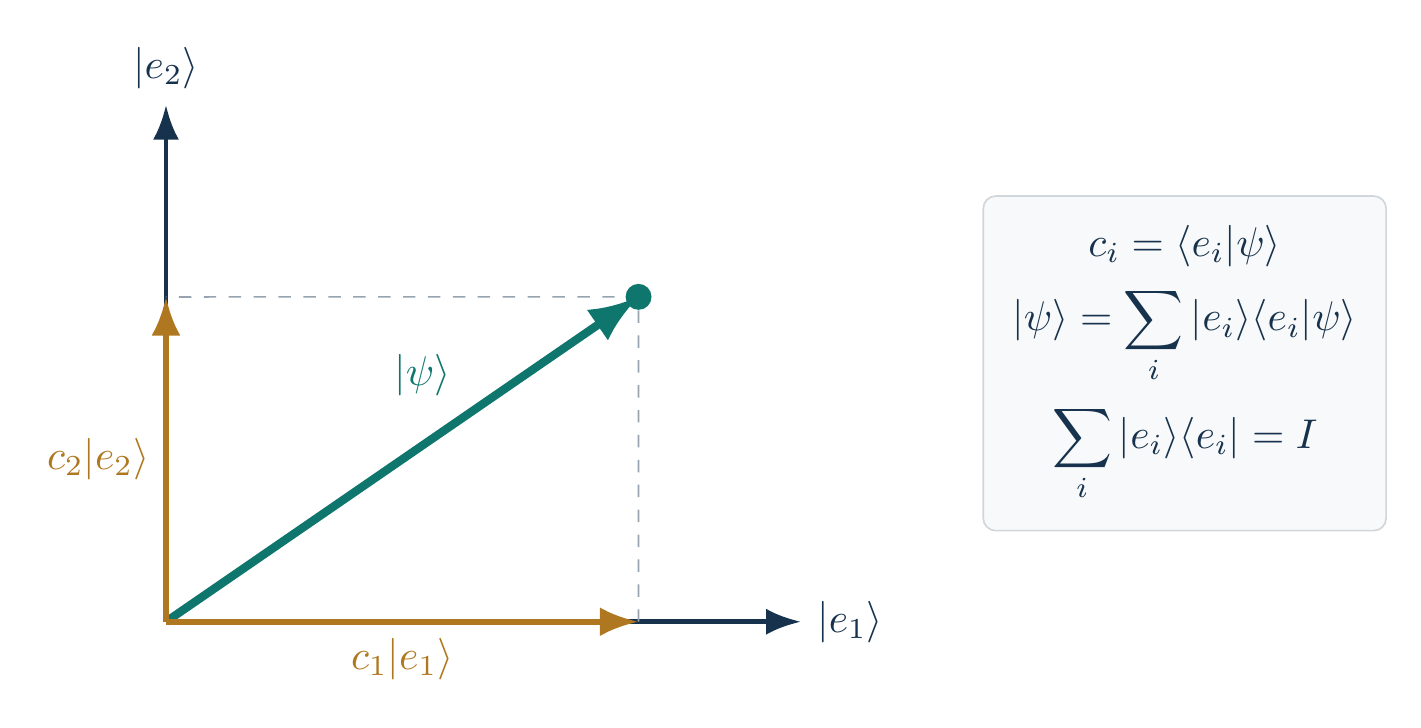
\[\langle e_i\mid e_j\rangle=\delta_{ij}.\]Multiplying the basis expansion by $\langle e_i\rvert$ determines the coordinate
\[c_i=\langle e_i\mid\psi\rangle,\]and substitution back gives
\[\lvert\psi\rangle=\sum_i\lvert e_i\rangle\langle e_i\mid\psi\rangle.\]Because this holds for every ket,
\[\boxed{\sum_i\lvert e_i\rangle\langle e_i\rvert=I,}\]the completeness relation.
Outer products and projectors
Combining a ket and bra produces an operator:
\[(\lvert u\rangle\langle v\rvert)\lvert\psi\rangle =\lvert u\rangle\langle v\mid\psi\rangle.\]For a normalized ket, $P_u=\lvert u\rangle\langle u\rvert$ is a projector because
\[P_u^2=\lvert u\rangle\langle u\mid u\rangle\langle u\rvert =\lvert u\rangle\langle u\rvert=P_u, \qquad P_u^\dagger=P_u.\]It extracts the component of a state along $\lvert u\rangle$.
Hilbert space and coordinate representation
An inner-product space is a Hilbert space when every Cauchy sequence of its vectors converges to a vector that remains in the space. This completeness is needed for limits of state expansions.
For a discrete orthonormal basis, the ket is represented by the column
\[\lvert\psi\rangle\longleftrightarrow \begin{pmatrix}c_1\\c_2\\\vdots\end{pmatrix}, \qquad c_i=\langle e_i\mid\psi\rangle,\]and the bra by its conjugate transpose. In the continuous position basis,
\[\psi(\mathbf r)=\langle\mathbf r\mid\psi\rangle, \qquad \langle\mathbf r\mid\mathbf r^{\prime}\rangle=\delta^3(\mathbf r-\mathbf r^{\prime}),\] \[\int\lvert\mathbf r\rangle\langle\mathbf r\rvert\,d^3r=I, \qquad \lvert\psi\rangle=\int\lvert\mathbf r\rangle\psi(\mathbf r)\,d^3r.\]Normalization becomes $\int\lvert\psi(\mathbf r)\rvert^2d^3r=1$; therefore a three-dimensional wavefunction has SI dimension $\mathrm{m}^{-3/2}$.
Linear operators and their algebra
An operator $A$ is linear when
\[A(a\lvert u\rangle+b\lvert v\rangle)=aA\lvert u\rangle+bA\lvert v\rangle.\]Its matrix elements in an orthonormal basis are $A_{ij}=\langle e_i\rvert A\lvert e_j\rangle$. Insert completeness on both sides:
\[A=IAI =\sum_{ij}\lvert e_i\rangle A_{ij}\langle e_j\rvert.\]The sum, product, commutator, and adjoint are defined by
\[(A+B)\lvert\psi\rangle=A\lvert\psi\rangle+B\lvert\psi\rangle, \qquad (AB)\lvert\psi\rangle=A(B\lvert\psi\rangle),\] \[[A,B]=AB-BA, \qquad \langle\phi\mid A\psi\rangle =\langle A^\dagger\phi\mid\psi\rangle.\]Consequently
\[(AB)^\dagger=B^\dagger A^\dagger, \qquad [A,B]^\dagger=-[A^\dagger,B^\dagger].\]A Hermitian operator satisfies $A^\dagger=A$. Its expectation value is real:
\[\langle A\rangle^* =\langle\psi\rvert A\lvert\psi\rangle^* =\langle\psi\rvert A^\dagger\lvert\psi\rangle =\langle A\rangle.\]A unitary operator satisfies $U^\dagger U=I$ and preserves inner products,
\[\langle U\phi\mid U\psi\rangle =\langle\phi\rvert U^\dagger U\lvert\psi\rangle =\langle\phi\mid\psi\rangle.\]Solved Problems
1. Independence and coordinates in an unnormalized basis
In $\mathbb C^3$, consider
\[\lvert b_1\rangle=\begin{pmatrix}1\\i\\0\end{pmatrix},\qquad \lvert b_2\rangle=\begin{pmatrix}1\\-i\\0\end{pmatrix},\qquad \lvert b_3\rangle=\begin{pmatrix}0\\0\\1\end{pmatrix}.\]The matrix with these vectors as columns is
\[B=\begin{pmatrix}1&1&0\\i&-i&0\\0&0&1\end{pmatrix}, \qquad \det B=-2i\ne0.\]The three vectors are therefore linearly independent and form a basis. To expand $\lvert\psi\rangle=(2,2i,3)^{\mathsf T}$, write $\lvert\psi\rangle=a\lvert b_1\rangle+b\lvert b_2\rangle+c\lvert b_3\rangle$. Component comparison gives
\[a+b=2,\qquad a-b=2,\qquad c=3,\]and hence
\[\boxed{\lvert\psi\rangle=2\lvert b_1\rangle+3\lvert b_3\rangle.}\]These coordinates are dimensionless. Because the basis is not orthonormal, they were obtained from $B^{-1}\psi$, not by taking simple inner products with the basis vectors.
2. A rank-one projector and its probability
Let
\[\lvert u\rangle=\frac1{\sqrt2}\begin{pmatrix}1\\i\end{pmatrix}, \qquad \lvert\psi\rangle=\frac1{\sqrt5}\begin{pmatrix}2\\i\end{pmatrix}.\]Both kets are normalized. The projector onto $\lvert u\rangle$ is
\[P_u=\lvert u\rangle\langle u\rvert =\frac12\begin{pmatrix}1&-i\\i&1\end{pmatrix}, \qquad P_u^2=P_u.\]The amplitude along $\lvert u\rangle$ is
\[\langle u\mid\psi\rangle =\frac{1}{\sqrt{10}}(1,-i) \begin{pmatrix}2\\i\end{pmatrix} =\frac3{\sqrt{10}},\]so
\[P_u\lvert\psi\rangle =\frac3{\sqrt{20}}\begin{pmatrix}1\\i\end{pmatrix}, \qquad \boxed{\langle\psi\rvert P_u\lvert\psi\rangle =\left\lvert\langle u\mid\psi\rangle\right\rvert^2=\frac9{10}.}\]The result is dimensionless and lies between zero and one; the orthogonal complement has probability $1/10$, so the two mutually exclusive outcomes sum to unity.
3. Spectrum and expectation value of a Hermitian operator
Let an observable be
\[A=E_0\begin{pmatrix}2&i\\-i&3\end{pmatrix}, \qquad E_0>0.\]The off-diagonal entries are complex conjugates, so $A^\dagger=A$. With $a=A/E_0$, the characteristic equation is
\[\det(a-\lambda I)=(2-\lambda)(3-\lambda)-1 =\lambda^2-5\lambda+5=0.\]Therefore
\[\boxed{A_\pm=\frac{5\pm\sqrt5}{2}E_0.}\]For $\lvert\psi\rangle=(1,i)^{\mathsf T}/\sqrt2$,
\[a\lvert\psi\rangle =\frac1{\sqrt2}\begin{pmatrix}1\\2i\end{pmatrix}, \qquad \boxed{\langle A\rangle =E_0\langle\psi\rvert a\lvert\psi\rangle=\frac32E_0.}\]The expectation has the units of the observable and satisfies $A_-<\langle A\rangle<A_+$, as required for a normalized state.
Descriptive Questions
- Distinguish algebraic completeness of a basis from metric completeness of an inner-product space, and explain why the latter defines a Hilbert space.
- Starting from a finite orthonormal basis, derive both the coordinate formula $c_i=\langle e_i\mid\psi\rangle$ and the completeness operator.
- Explain how an outer product acts on a ket, and state the additional conditions that make a rank-one outer product an orthogonal projector.
- Derive the adjoint rules for a product and a commutator, and explain why unitary operators preserve inner products.
Numerical Problems
- For $u=(1,i,-1)^{\mathsf T}$ and $v=(2,0,i)^{\mathsf T}$, evaluate $(1-i)u+2v$ and identify the vector space to which the result belongs.
- The normalized vectors are $\lvert\phi\rangle=(1,i,1)^{\mathsf T}/\sqrt3$ and $\lvert\chi\rangle=(1,-i,1)^{\mathsf T}/\sqrt3$. Find $\langle\phi\mid\chi\rangle$ and its squared magnitude.
- In the orthonormal basis $e_1=(1,1,0)^{\mathsf T}/\sqrt2$, $e_2=(1,-1,0)^{\mathsf T}/\sqrt2$, $e_3=(0,0,1)^{\mathsf T}$, find the coordinates of $\psi=(2,0,i)^{\mathsf T}/\sqrt5$ and verify its norm from those coordinates.
- Let $A=\lvert u\rangle\langle v\rvert$, where $u=(1,0)^{\mathsf T}$ and $v=(1,i)^{\mathsf T}/\sqrt2$. Find the matrix of $A$ and $A(2,-i)^{\mathsf T}$.
- For $A=\begin{pmatrix}0&1\1&0\end{pmatrix}$ and $B=\begin{pmatrix}1&0\0&-1\end{pmatrix}$, calculate $[A,B]$.
- Show numerically that $U=2^{-1/2}\begin{pmatrix}1&i\i&1\end{pmatrix}$ is unitary, and find the image and norm of $(1,0)^{\mathsf T}$.
Final answers: 1. $(5-i,1+i,-1+3i)^{\mathsf T}\in\mathbb C^3$; 2. $1/3$, $1/9$; 3. $(\sqrt{2/5},\sqrt{2/5},i/\sqrt5)^{\mathsf T}$, norm $1$; 4. $A=2^{-1/2}\begin{pmatrix}1&-i\0&0\end{pmatrix}$ and $A(2,-i)^{\mathsf T}=(1/\sqrt2,0)^{\mathsf T}$; 5. $\begin{pmatrix}0&-2\2&0\end{pmatrix}$; 6. $U^\dagger U=I$, image $(1,i)^{\mathsf T}/\sqrt2$, norm $1$.
The core identities and all problem answers are checked in the original Maxima worksheet and the problems worksheet; every printed residual is zero.
References
- Bra–ket notation.
- J. J. Sakurai and J. Napolitano, Modern Quantum Mechanics, 3rd ed., Chapter 1, “Fundamental Concepts.”
- R. Shankar, Principles of Quantum Mechanics, 2nd ed., Chapter 1, “Mathematical Introduction.”
- D. J. Griffiths and D. F. Schroeter, Introduction to Quantum Mechanics, 3rd ed., Chapter 3, “Formalism.”


Discussion