

06 Jul 2025
Plasma Physics and Hydromagnetic Waves
Kinetic moments, plasma oscillations, Debye shielding, magnetic confinement, magnetoplasma equations, and Alfvén and magnetosonic waves.
A plasma is an ionized many-particle medium in which collective electric and magnetic forces are important. On scales much larger than its shielding length it is approximately quasineutral,
\[\sum_s q_sn_s\simeq0,\]although small charge separations produce plasma oscillations and shielding.
Moments of the Boltzmann equation
For species $s$, let $f_s(\mathbf r,\mathbf v,t)$ be the number-density distribution in phase space. Its kinetic equation is
\[\frac{\partial f_s}{\partial t} +\mathbf v\cdot\nabla f_s +\frac{q_s}{m_s}(\mathbf E+\mathbf v\times\mathbf B) \cdot\nabla_{\mathbf v}f_s=C_s[f].\]Define the density, mean velocity, pressure tensor, and heat flux by
\[n_s=\int f_s\,d^3v, \qquad n_s\mathbf u_s=\int\mathbf v f_s\,d^3v,\] \[\mathsf P_s=m_s\int (\mathbf v-\mathbf u_s)(\mathbf v-\mathbf u_s)f_s\,d^3v,\] \[\mathbf q_s=\frac{m_s}{2}\int \lvert\mathbf v-\mathbf u_s\rvert^2(\mathbf v-\mathbf u_s)f_s\,d^3v.\]Assume $f_s$ decreases fast enough as $\lvert\mathbf v\rvert\to\infty$ that all velocity-space surface terms vanish.
Integrating the kinetic equation over velocity gives
\[\frac{\partial n_s}{\partial t} +\nabla\cdot(n_s\mathbf u_s) =\int C_s\,d^3v.\]Number-conserving collisions make the right side zero, so
\[\boxed{ \partial_t n_s+\nabla\cdot(n_s\mathbf u_s)=0. }\]For the first moment, multiply by $m_sv_i$ and integrate. The second velocity moment separates as
\[m_s\int v_iv_jf_s\,d^3v =m_sn_su_{si}u_{sj}+P_{s,ij}.\]Integration by parts in velocity gives
\[q_s\int v_i(\mathbf E+\mathbf v\times\mathbf B)_j \frac{\partial f_s}{\partial v_j}\,d^3v =-q_sn_s[\mathbf E+\mathbf u_s\times\mathbf B]_i.\]Moving this term to the right and using the continuity equation yields
\[\boxed{ m_sn_s(\partial_t+\mathbf u_s\cdot\nabla)\mathbf u_s =q_sn_s(\mathbf E+\mathbf u_s\times\mathbf B) -\nabla\cdot\mathsf P_s+\mathbf R_s, }\]where $\mathbf R_s=m_s\int\mathbf vC_s\,d^3v$ is collisional momentum transfer.
Multiplication by $m_sv^2/2$ gives the energy moment. For isotropic pressure $\mathsf P_s=p_s\mathsf I$ and internal-energy density $\varepsilon_s=3p_s/2$,
\[\boxed{ \partial_t\!\left(\frac12m_sn_su_s^2+\varepsilon_s\right) +\nabla\cdot\!\left[ \left(\frac12m_sn_su_s^2+\varepsilon_s+p_s\right)\mathbf u_s +\mathbf q_s\right] =q_sn_s\mathbf E\cdot\mathbf u_s+Q_s. }\]Here the collisional energy-transfer density is
\[\boxed{Q_s=\frac{m_s}{2}\int v^2C_s\,d^3v,}\]with units $\mathrm{J\,m^{-3}\,s^{-1}}$ under the stated convention for $C_s$. The heat flux $\mathbf q_s$ carries units $\mathrm{W\,m^{-2}}$. The magnetic force does no work because $\mathbf u_s\cdot(\mathbf u_s\times\mathbf B)=0$.
Plasma oscillation
Consider cold electrons of equilibrium density $n_0$ displaced by $\xi$ relative to stationary ions. The two exposed charge sheets produce
\[E=\frac{en_0}{\epsilon_0}\xi\]directed from the ion sheet to the electron sheet. The electron force is $-eE$, hence
\[m_e\ddot\xi=-\frac{n_0e^2}{\epsilon_0}\xi.\]Therefore
\[\boxed{ \ddot\xi+\omega_{pe}^2\xi=0, \qquad \omega_{pe}=\sqrt{\frac{n_0e^2}{m_e\epsilon_0}}. }\]$\omega_{pe}$ is in radians per second. Ion motion was neglected because $m_i\gg m_e$, and thermal pressure was neglected in this cold-plasma limit.
Debye shielding
Place a test charge $Q$ at the origin in an electron plasma with fixed ion background. Thermal equilibrium gives the electron density
\[n_e=n_0\exp\!\left(\frac{e\phi}{k_BT_e}\right) \simeq n_0\left(1+\frac{e\phi}{k_BT_e}\right),\]where the linearization requires $\lvert e\phi\rvert\ll k_BT_e$. Thus, away from the test charge,
\[\rho=e(n_i-n_e)\simeq-\frac{n_0e^2}{k_BT_e}\phi.\]Including the point source in Poisson’s equation gives
\[\nabla^2\phi-\frac{\phi}{\lambda_D^2} =-\frac{Q}{\epsilon_0}\delta^3(\mathbf r), \qquad \boxed{\lambda_D=\sqrt{\frac{\epsilon_0k_BT_e}{n_0e^2}}}.\]For $r>0$, spherical symmetry gives
\[\frac1{r^2}\frac d{dr}\left(r^2\frac{d\phi}{dr}\right) -\frac{\phi}{\lambda_D^2}=0.\]Writing $u=r\phi$ reduces this to $u^{\prime\prime}-u/\lambda_D^2=0$. The boundary condition $\phi\to0$ at infinity removes the growing exponential. Integrating Poisson’s equation over a vanishing sphere fixes $-4\pi r^2\epsilon_0\phi^{\prime}(r)\to Q$, so
\[\boxed{ \phi(r)=\frac{Q}{4\pi\epsilon_0r}e^{-r/\lambda_D}. }\]Shielding is collective when a Debye sphere contains many particles, $N_D=(4\pi/3)n_0\lambda_D^3\gg1$.
The shielding and oscillation scales are linked. With the explicitly defined electron thermal speed $v_{Te}=\sqrt{k_BT_e/m_e}$,
\[\lambda_D\omega_{pe} =\sqrt{\frac{\epsilon_0k_BT_e}{n_0e^2}} \sqrt{\frac{n_0e^2}{m_e\epsilon_0}} =\boxed{v_{Te}}.\]Thus an electron moving at the thermal-speed scale crosses one Debye length in approximately one inverse plasma frequency. Both sides have SI units of metres per second.
Magnetic confinement and magnetoplasma motion
For a uniform field $\mathbf B=B_0\hat{\mathbf z}$ and no electric field,
\[m_s\dot{\mathbf v}=q_s\mathbf v\times\mathbf B\]gives
\[\dot v_x=\Omega_sv_y, \qquad \dot v_y=-\Omega_sv_x, \qquad \dot v_z=0, \qquad \Omega_s=\frac{q_sB_0}{m_s}.\]Hence $v_x^2+v_y^2$ is constant and the orbit is circular with
\[\boxed{ \omega_{cs}=\frac{\lvert q_s\rvert B_0}{m_s}, \qquad r_{Ls}=\frac{v_\perp}{\omega_{cs}}. }\]The sign of $q_s$ fixes the sense of rotation. A uniform magnetic field confines perpendicular motion but not motion parallel to the field. In a slowly varying field, $r_L\ll B/\lvert\nabla B\rvert$, the magnetic moment
\[\mu_m=\frac{m_sv_\perp^2}{2B}\]is approximately conserved. With total kinetic energy also constant, a particle entering a stronger field is reflected when its parallel velocity reaches zero. If $B_0$ and pitch angle $\alpha_0$ are specified at entry and $B_m$ at the mirror,
\[\boxed{\sin^2\alpha_0\ge\frac{B_0}{B_m}}\]is the mirror-confinement condition.
Fundamental magnetohydrodynamic equations
On scales long compared with kinetic lengths, a conducting plasma may be described by mass density $\rho_m$, bulk velocity $\mathbf u$, pressure $p$, and magnetic field $\mathbf B$. Ideal magnetohydrodynamics uses
\[\partial_t\rho_m+\nabla\cdot(\rho_m\mathbf u)=0,\] \[\rho_m(\partial_t+\mathbf u\cdot\nabla)\mathbf u =-\nabla p+\frac1{\mu_0}(\nabla\times\mathbf B)\times\mathbf B,\] \[\partial_t\mathbf B=\nabla\times(\mathbf u\times\mathbf B), \qquad \nabla\cdot\mathbf B=0,\] \[\mathbf E+\mathbf u\times\mathbf B=0, \qquad (\partial_t+\mathbf u\cdot\nabla) \left(\frac{p}{\rho_m^{\Gamma}}\right)=0.\]These equations assume high conductivity, negligible displacement current, and a fluid scale much larger than particle gyro-radii.
Alfvén and magnetosonic waves
Linearize about a uniform static state $(\rho_0,p_0,\mathbf u_0=0,\mathbf B_0)$ and take every perturbation proportional to $e^{i(\mathbf k\cdot\mathbf r-\omega t)}$. Put
\[v_A=\frac{B_0}{\sqrt{\mu_0\rho_0}}, \qquad c_s=\sqrt{\frac{\Gamma p_0}{\rho_0}}, \qquad \cos\theta=\frac{\mathbf k\cdot\mathbf B_0}{kB_0}.\]The linearized continuity and pressure equations give
\[\rho_1=\frac{\rho_0}{\omega}\mathbf k\cdot\mathbf u_1, \qquad p_1=c_s^2\rho_1.\]The induction equation gives
\[\mathbf B_1=-\frac1\omega \mathbf k\times(\mathbf u_1\times\mathbf B_0) =\frac1\omega [\mathbf B_0(\mathbf k\cdot\mathbf u_1) -\mathbf u_1(\mathbf k\cdot\mathbf B_0)].\]Choose $\mathbf B_0=B_0\hat{\mathbf z}$ and put $\mathbf k$ in the $xz$- plane. The $y$ component decouples from compression. The linearized momentum equation becomes
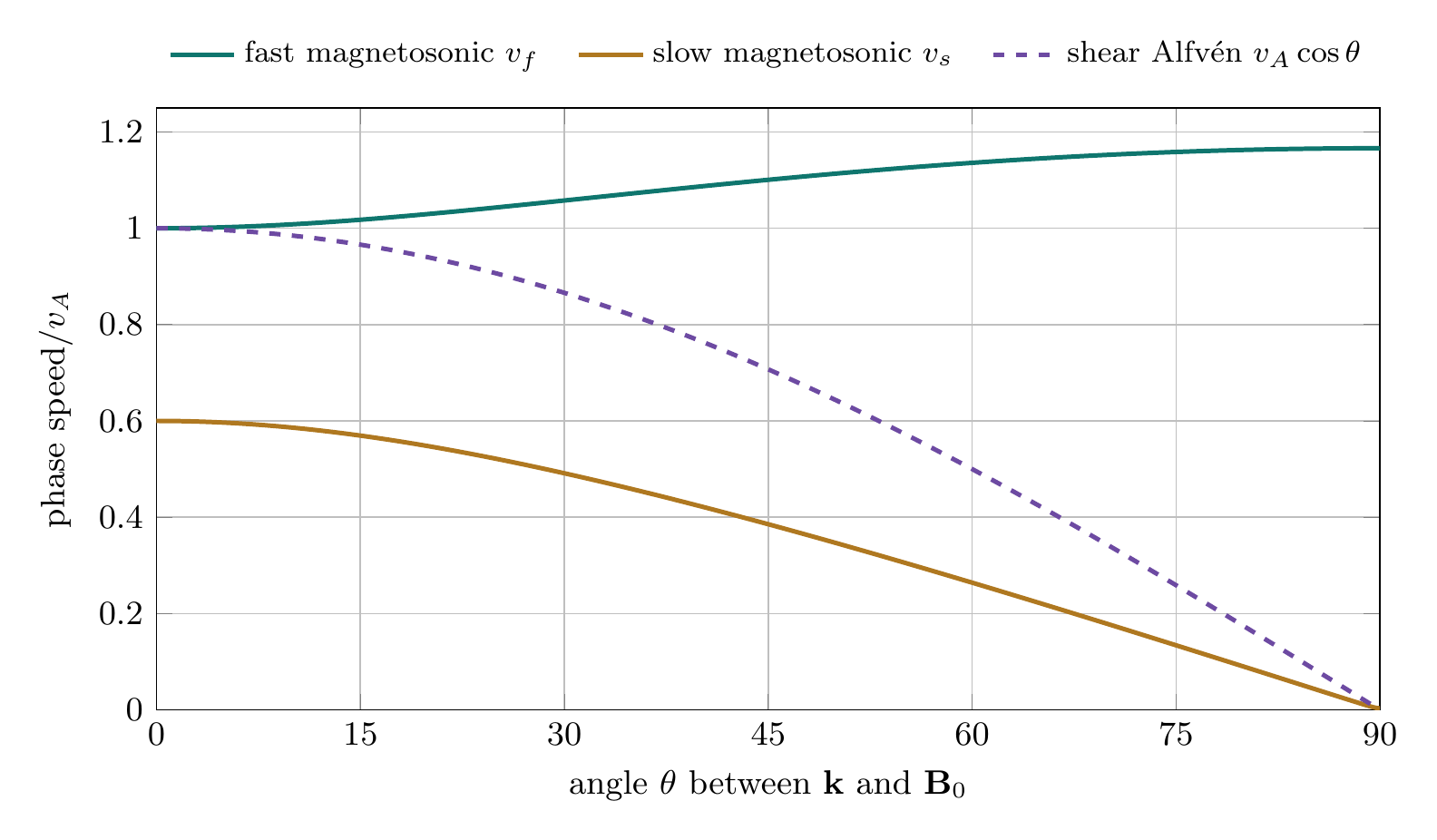
\[(\omega^2-k^2v_A^2\cos^2\theta)u_y=0,\]so the shear Alfvén wave has
\[\boxed{\omega^2=k^2v_A^2\cos^2\theta.}\]The coupled $x,z$ components are
\[\begin{pmatrix} \omega^2-k^2v_A^2-k^2c_s^2\sin^2\theta &-k^2c_s^2\sin\theta\cos\theta\\ -k^2c_s^2\sin\theta\cos\theta &\omega^2-k^2c_s^2\cos^2\theta \end{pmatrix} \begin{pmatrix}u_x\\u_z\end{pmatrix}=0.\]A nonzero displacement requires the determinant to vanish:
\[\boxed{ \omega^4-k^2(v_A^2+c_s^2)\omega^2 +k^4v_A^2c_s^2\cos^2\theta=0. }\]The fast and slow magnetosonic phase speeds are therefore
\[\boxed{ v_{f,s}^2=\frac12\left[ v_A^2+c_s^2 \pm\sqrt{(v_A^2+c_s^2)^2-4v_A^2c_s^2\cos^2\theta} \right]. }\]For propagation parallel to $\mathbf B_0$, the two compressive speeds reduce to $v_A$ and $c_s$, while the shear Alfvén speed is $v_A$. For perpendicular propagation, the fast speed is $\sqrt{v_A^2+c_s^2}$; both the slow and shear Alfvén frequencies vanish in ideal MHD.
Solved Problems
1. Debye length and the collective-plasma test
An electron plasma has $n_0=1.00\times10^{18}\ \mathrm{m^{-3}}$ and $k_BT_e=2.00\ \mathrm{eV}$. Find $\lambda_D$, the number of electrons in a Debye sphere, and the screened-to-unscreened potential ratio at $r=3\lambda_D$.
Convert the thermal energy before using SI units:
\[k_BT_e=(2.00)(1.602176634\times10^{-19}) =3.20435\times10^{-19}\ \mathrm J.\]Then
\[\begin{aligned} \lambda_D &=\sqrt{\frac{\epsilon_0k_BT_e}{n_0e^2}}\\ &=\sqrt{\frac{(8.85419\times10^{-12})(3.20435\times10^{-19})} {(1.00\times10^{18})(1.60218\times10^{-19})^2}}\\ &=1.0513\times10^{-5}\ \mathrm m=10.513\ \mathrm{\mu m}. \end{aligned}\]The argument of the square root has units $\mathrm{m^2}$. The Debye-sphere population is
\[N_D=\frac{4\pi}{3}n_0\lambda_D^3 =4.867\times10^3\gg1,\]so the collective description is self-consistent. At $r=3\lambda_D$,
\[\frac{\phi_{\rm screened}}{\phi_{\rm Coulomb}} =e^{-r/\lambda_D}=e^{-3}=0.04979.\]Screening has reduced the potential to about five per cent of its Coulomb value, while the linearized Boltzmann treatment still additionally requires $\lvert e\phi\rvert\ll k_BT_e$.
2. Oblique magnetohydrodynamic wave speeds
For $v_A=200\ \mathrm{km\,s^{-1}}$, $c_s=100\ \mathrm{km\,s^{-1}}$, and $\theta=60.0^\circ$, calculate the fast, slow, and shear-Alfvén phase speeds.
Here $\cos\theta=1/2$. The discriminant in the magnetosonic formula is
\[\begin{aligned} D&=\sqrt{(v_A^2+c_s^2)^2 -4v_A^2c_s^2\cos^2\theta}\\ &=\sqrt{(50000)^2-4(200^2)(100^2)\left(\frac12\right)^2}\\ &=45825.8\ \mathrm{(km\,s^{-1})^2}. \end{aligned}\]Therefore
\[v_f=\sqrt{\frac{50000+45825.8}{2}} =218.890\ \mathrm{km\,s^{-1}},\] \[v_s=\sqrt{\frac{50000-45825.8}{2}} =45.685\ \mathrm{km\,s^{-1}}.\]The shear mode has
\[v_{\rm shear}=v_A\lvert\cos\theta\rvert =100.000\ \mathrm{km\,s^{-1}}.\]All three speeds are real because the equilibrium is ideal and the discriminant is nonnegative. The results approach the stated parallel and perpendicular limits as $\theta$ tends to $0$ and $\pi/2$.
Descriptive Questions
- Obtain the continuity, momentum, and energy equations as successive velocity moments of the Boltzmann equation, identifying every vanishing surface term and collisional moment.
- Derive the cold electron plasma frequency from a small charge displacement and state precisely why thermal pressure and ion motion may be neglected.
- Derive the Debye-screened potential from the linearized Boltzmann density, including the boundary condition at infinity and the point-charge condition at the origin.
- Linearize the ideal magnetohydrodynamic equations about a uniform equilibrium and distinguish the polarization and propagation limits of shear-Alfvén, fast, and slow waves.
Numerical Problems
- Find $\omega_{pe}$ and $f_{pe}$ for an electron plasma with $n_e=5.00\times10^{17}\ \mathrm{m^{-3}}$.
- A proton with $v_\perp=3.00\times10^5\ \mathrm{m\,s^{-1}}$ moves in $B_0=0.200\ \mathrm T$. Find its angular gyrofrequency and Larmor radius.
- A magnetic mirror has $B_0=0.200\ \mathrm T$ and $B_m=1.80\ \mathrm T$. Find the minimum entry pitch angle for confinement.
- In an ideal plasma, $\mathbf u=2.00\times10^4\hat{\mathbf x}\ \mathrm{m\,s^{-1}}$ and $\mathbf B=5.00\times10^{-2}\hat{\mathbf z}\ \mathrm T$. Find $\mathbf E$.
- A proton plasma has $n_i=1.00\times10^{18}\ \mathrm{m^{-3}}$ and $B_0=1.00\times10^{-2}\ \mathrm T$. Find $v_A$ and the frequency of a parallel shear-Alfvén wave of wavelength $10.0\ \mathrm m$.
- Isotropic electrons have $n_e=1.00\times10^{19}\ \mathrm{m^{-3}}$ and $k_BT_e=5.00\ \mathrm{eV}$. Find their scalar pressure and internal-energy density.
Answers: 1. $\omega_{pe}=3.989\times10^{10}\ \mathrm{rad\,s^{-1}}$, $f_{pe}=6.349\ \mathrm{GHz}$; 2. $\omega_{cp}=1.916\times10^7\ \mathrm{rad\,s^{-1}}$, $r_{Lp}=1.566\times10^{-2}\ \mathrm m$; 3. $\alpha_{0,\min}=19.471^\circ$; 4. $\mathbf E=+1.00\times10^3\hat{\mathbf y}\ \mathrm{V\,m^{-1}}$; 5. $v_A=2.181\times10^5\ \mathrm{m\,s^{-1}}$, $f=2.181\times10^4\ \mathrm{Hz}$; 6. $p_e=8.011\ \mathrm{Pa}$, $\varepsilon_e=12.016\ \mathrm{J\,m^{-3}}$.
The plasma-frequency relation, shielding equation, thermal-scale identity, gyro-speed conservation, mirror condition, MHD dispersion determinant, and all printed numerical answers are checked in the Maxima worksheet; every printed residual is zero.
References
- Plasma (physics)
- Francis F. Chen, Introduction to Plasma Physics and Controlled Fusion, 3rd ed., Chapters 1–4.
- Dwight R. Nicholson, Introduction to Plasma Theory, Chapters 1–4.
- Richard Fitzpatrick, Plasma Physics, University of Texas at Austin


Discussion