

06 Jun 2025
Relativistic Electrodynamics
Four-current, four-potential, field tensor, Lorentz transformations of fields, covariant Maxwell equations, and the Lorentz four-force.
Use coordinates $x^\mu=(ct,x,y,z)$ and metric $g_{\mu\nu}=\operatorname{diag}(1,-1,-1,-1)$. Let frame $S^{\prime}$ move with speed $v$ along $+x$ relative to $S$. With $\beta=v/c$ and $\gamma=(1-\beta^2)^{-1/2}$,
\[\begin{pmatrix}ct^{\prime}\\x^{\prime}\\y^{\prime}\\z^{\prime}\end{pmatrix} =\underbrace{\begin{pmatrix} \gamma&-\beta\gamma&0&0\\ -\beta\gamma&\gamma&0&0\\ 0&0&1&0\\0&0&0&1 \end{pmatrix}}_{\Lambda} \begin{pmatrix}ct\\x\\y\\z\end{pmatrix}.\]Every contravariant four-vector transforms by the same matrix.
Charge density and current density
Local charge conservation is
\[\frac{\partial\rho}{\partial t}+\nabla\cdot\mathbf J=0.\]Define the four-current
\[J^\mu=(c\rho,J_x,J_y,J_z), \qquad \partial_\mu=\left(\frac1c\partial_t,\partial_x,\partial_y,\partial_z\right).\]Then $\partial_\mu J^\mu=0$. Applying $J^{\prime \mu}=\Lambda^\mu{}_{\nu}J^\nu$ gives
\[\boxed{ \rho^{\prime}=\gamma\left(\rho-\frac{vJ_x}{c^2}\right), \qquad J^{\prime}_x=\gamma(J_x-v\rho), \qquad J^{\prime}_y=J_y,\quad J^{\prime}_z=J_z. }\]The mixture of $\rho$ and $J_x$ is required because charge density depends on the simultaneity slice used to measure volume, although the total charge of an isolated system is invariant.
Scalar and vector potentials
The scalar and vector potentials form
\[A^\mu=\left(\frac\phi c,A_x,A_y,A_z\right).\]Therefore
\[\boxed{ \phi^{\prime}=\gamma(\phi-vA_x), \qquad A^{\prime}_x=\gamma\left(A_x-\frac{v\phi}{c^2}\right), \qquad A^{\prime}_y=A_y,\quad A^{\prime}_z=A_z. }\]The Lorenz gauge becomes the Lorentz scalar condition $\partial_\mu A^\mu=0$. In that gauge the potential equations combine as
\[\partial_\mu\partial^\mu A^\nu=\mu_0J^\nu, \qquad \partial_\mu\partial^\mu =\frac1{c^2}\partial_t^2-\nabla^2.\]Electromagnetic field tensor
Define
\[F^{\mu\nu}=\partial^\mu A^\nu-\partial^\nu A^\mu.\]With the stated metric and potential convention,
\[F^{\mu\nu}= \begin{pmatrix} 0&-E_x/c&-E_y/c&-E_z/c\\ E_x/c&0&-B_z&B_y\\ E_y/c&B_z&0&-B_x\\ E_z/c&-B_y&B_x&0 \end{pmatrix}, \qquad F^{\mu\nu}=-F^{\nu\mu}.\]The tensor transformation law is
\[F^{\prime \mu\nu}=\Lambda^\mu{}_{\alpha} \Lambda^\nu{}_{\beta}F^{\alpha\beta}.\]The six independent contractions are
\[\begin{aligned} F^{\prime 01} &=\gamma^2F^{01}+\beta^2\gamma^2F^{10} =\gamma^2(1-\beta^2)F^{01} =-\frac{E_x}{c},\\ F^{\prime 02} &=\Lambda^0{}_{\alpha}\Lambda^2{}_{\beta}F^{\alpha\beta} =\gamma F^{02}-\beta\gamma F^{12}\\ &=-\frac\gamma c(E_y-vB_z) =-\frac{E^{\prime}_y}{c},\\ F^{\prime 03} &=\gamma F^{03}-\beta\gamma F^{13} =-\frac\gamma c(E_z+vB_y),\\ F^{\prime 23}&=F^{23}=-B_x,\\ F^{\prime 13} &=-\beta\gamma F^{03}+\gamma F^{13} =\gamma\left(B_y+\frac{vE_z}{c^2}\right),\\ F^{\prime 12} &=-\beta\gamma F^{02}+\gamma F^{12} =-\gamma\left(B_z-\frac{vE_y}{c^2}\right). \end{aligned}\]Using $F^{\prime 0i}=-E^{\prime}_i/c$, $F^{\prime 23}=-B^{\prime}_x$, $F^{\prime 13}=B^{\prime}_y$, and $F^{\prime 12}=-B^{\prime}_z$ gives
\[\boxed{ \begin{aligned} E^{\prime}_x&=E_x, &E^{\prime}_y&=\gamma(E_y-vB_z), &E^{\prime}_z&=\gamma(E_z+vB_y),\\ B^{\prime}_x&=B_x, &B^{\prime}_y&=\gamma\left(B_y+\frac{vE_z}{c^2}\right), &B^{\prime}_z&=\gamma\left(B_z-\frac{vE_y}{c^2}\right). \end{aligned}}\]The signs follow from the declared boost direction. Reversing the frame transformation means replacing $v$ by $-v$.
Field invariants
Two combinations of the fields are the same in every inertial frame. Direct substitution of the transverse transformation laws gives
\[\begin{aligned} E^{\prime 2}-c^2B^{\prime 2} ={}&E_x^2-c^2B_x^2\\ &+\gamma^2\Big\{(E_y-vB_z)^2+(E_z+vB_y)^2\\ &\qquad-c^2\left[\left(B_y+\frac{vE_z}{c^2}\right)^2 +\left(B_z-\frac{vE_y}{c^2}\right)^2\right]\Big\}. \end{aligned}\]The mixed terms cancel, and the braces reduce to $(1-\beta^2)(E_y^2+E_z^2-c^2B_y^2-c^2B_z^2)$. Since $\gamma^2(1-\beta^2)=1$,
\[E^{\prime 2}-c^2B^{\prime 2}=E^2-c^2B^2.\]Likewise,
\[\begin{aligned} \mathbf E^{\prime}\cdot\mathbf B^{\prime} &=E_xB_x+\gamma^2(1-\beta^2)(E_yB_y+E_zB_z)\\ &=\mathbf E\cdot\mathbf B. \end{aligned}\]Thus
\[\boxed{E^2-c^2B^2\ \text{and}\ \mathbf E\cdot\mathbf B \quad\text{are Lorentz invariants}.}\]Their SI units are $\mathrm{V^2\,m^{-2}}$ and $\mathrm{V\,T\,m^{-1}}$, respectively. These invariants test any computed field transformation without selecting another sign convention.
Maxwell equations in covariant form
The inhomogeneous Maxwell equations are the four components of
\[\boxed{\partial_\mu F^{\mu\nu}=\mu_0J^\nu.}\]For $\nu=0$,
\[\partial_iF^{i0}=\frac1c\nabla\cdot\mathbf E =\mu_0c\rho \quad\Longrightarrow\quad \nabla\cdot\mathbf E=\frac\rho{\epsilon_0}.\]For a spatial index $\nu=i$,
\[\partial_0F^{0i}+\partial_jF^{ji}=\mu_0J^i\]is precisely $\nabla\times\mathbf B-\partial_t\mathbf E/c^2=\mu_0\mathbf J$. The homogeneous equations are
\[\boxed{ \partial_\lambda F_{\mu\nu} +\partial_\mu F_{\nu\lambda} +\partial_\nu F_{\lambda\mu}=0, }\]which contain $\nabla\cdot\mathbf B=0$ and $\nabla\times\mathbf E+\partial_t\mathbf B=0$.
Under a Lorentz transformation,
\[\partial^{\prime}_\mu=(\Lambda^{-1})^\alpha{}_{\mu}\partial_\alpha, \qquad F^{\prime \mu\nu}=\Lambda^\mu{}_{\rho}\Lambda^\nu{}_{\sigma}F^{\rho\sigma}, \qquad J^{\prime \nu}=\Lambda^\nu{}_{\sigma}J^\sigma.\]Contracting the first two relations cancels one pair of inverse matrices, leaving
\[\partial^{\prime}_\mu F^{\prime \mu\nu}=\mu_0J^{\prime \nu}.\]This establishes the covariance of Maxwell’s equations.
Lorentz force and its transformation
For four-velocity $U^\mu=\gamma_u(c,\mathbf u)$ and four-momentum $p^\mu=(E/c,\mathbf p)$, define the four-force
\[\boxed{K^\mu=\frac{dp^\mu}{d\tau}=qF^{\mu\nu}U_\nu.}\]Since $U_\nu=\gamma_u(c,-\mathbf u)$, its time component is
\[K^0=\gamma_u\frac q c\mathbf E\cdot\mathbf u =\gamma_u\frac1c\frac{dE}{dt},\]and the spatial components are
\[\mathbf K=\gamma_uq(\mathbf E+\mathbf u\times\mathbf B) =\gamma_u\frac{d\mathbf p}{dt}.\]Hence the ordinary force law is
\[\boxed{\frac{d\mathbf p}{dt}=q(\mathbf E+\mathbf u\times\mathbf B).}\]Because $F^{\mu\nu}$ and $U_\nu$ are tensors of complementary rank, $K^{\prime \mu}=\Lambda^\mu{}_{\nu}K^\nu$. The Lorentz force therefore transforms covariantly with the same field transformations derived above.
Solved Problems
1. Transforming a purely electric transverse field
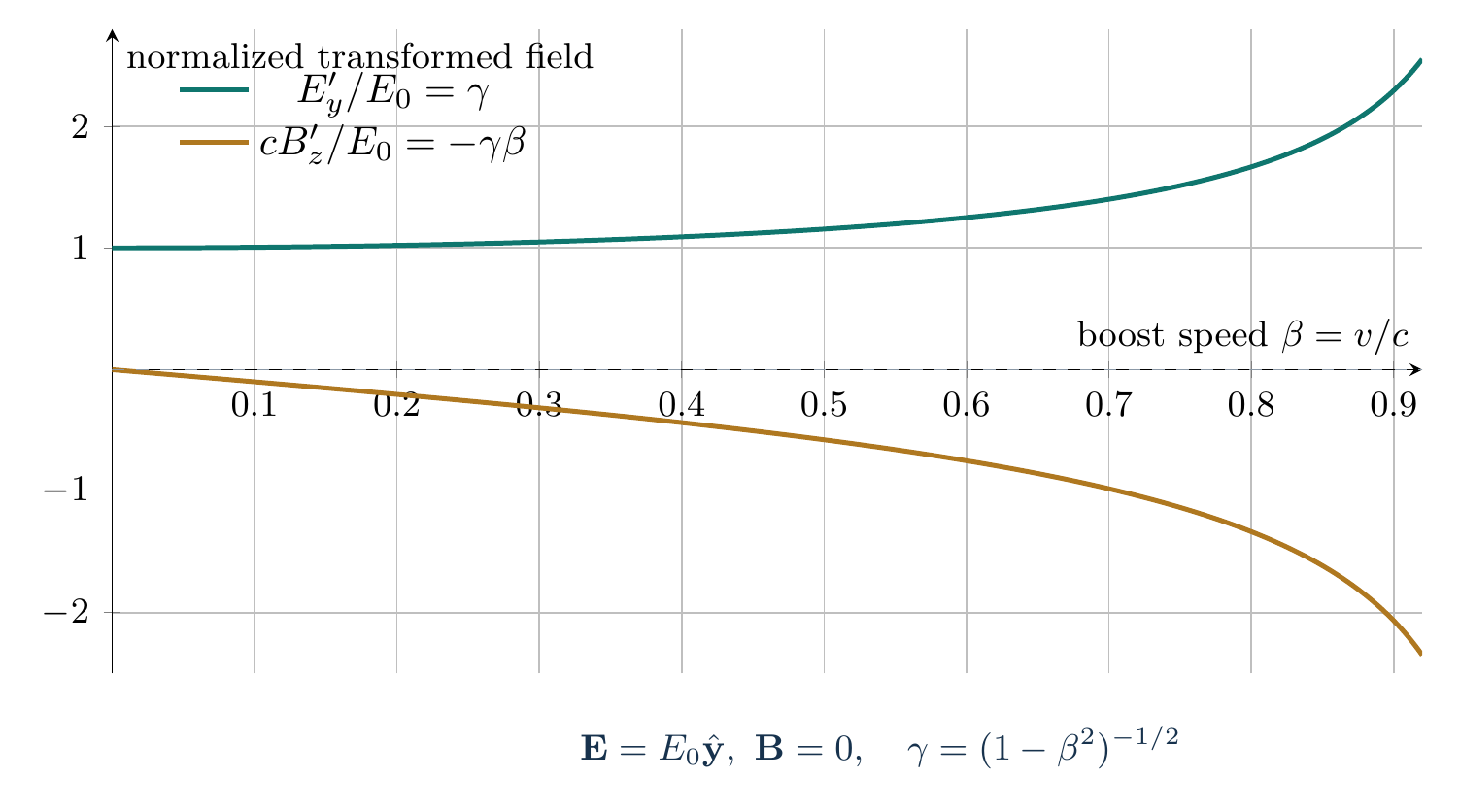
In $S$, let $\mathbf E=3.00\times10^6\hat{\mathbf y}\ \mathrm{V\,m^{-1}}$ and $\mathbf B=0$. Find the fields in a frame moving at $v=0.600c$ along $+x$, and verify both field invariants.
Here $\gamma=(1-0.600^2)^{-1/2}=1.250$. The transformation laws give
\[E^{\prime}_y=\gamma E_y=(1.250)(3.00\times10^6) =3.750\times10^6\ \mathrm{V\,m^{-1}},\] \[B^{\prime}_z=-\gamma\frac{vE_y}{c^2} =-\gamma\beta\frac{E_y}{c} =-7.505\times10^{-3}\ \mathrm T.\]All other components vanish. The minus sign follows from the declared $S\to S^{\prime}$ boost and agrees with $\mathbf v\times\mathbf E$ pointing along $+z$ in the term subtracted from $\mathbf B$.
The transformed fields are perpendicular, so $\mathbf E^{\prime}\cdot\mathbf B^{\prime}=0=\mathbf E\cdot\mathbf B$. For the other invariant,
\[E^{\prime 2}-c^2B^{\prime 2} =\gamma^2E^2(1-\beta^2)=E^2 =9.00\times10^{12}\ \mathrm{V^2\,m^{-2}}.\]As $v\to0$, $\gamma\to1$ and the induced magnetic field vanishes.
2. Four-current of a neutral current in a boosted frame
A medium is neutral in $S$, so $\rho=0$, but carries $J_x=2.00\times10^6\ \mathrm{A\,m^{-2}}$. Find $\rho^{\prime}$ and $J^{\prime}_x$ for a boost $v=0.800c$ along $+x$.
With $\gamma=5/3$,
\[\rho^{\prime}=\gamma\left(0-\frac{vJ_x}{c^2}\right) =-\gamma\beta\frac{J_x}{c} =-8.895\times10^{-3}\ \mathrm{C\,m^{-3}},\] \[J^{\prime}_x=\gamma(J_x-v\rho)=\gamma J_x =3.333\times10^6\ \mathrm{A\,m^{-2}}.\]The density units follow because $(\mathrm{A\,m^{-2}})/(\mathrm{m\,s^{-1}})=\mathrm{C\,m^{-3}}$. The current invariant is preserved:
\[c^2\rho^{\prime 2}-J_x^{\prime 2} =\gamma^2(\beta^2-1)J_x^2=-J_x^2 =c^2\rho^2-J_x^2.\]Neutrality is therefore frame-dependent even though four-current covariance and charge conservation are not.
Descriptive Questions
- Derive the transformations of charge density and current density from the four-current, and explain why a neutral current need not remain neutral.
- Construct $F^{\mu\nu}$ from the four-potential and obtain all six electric- and magnetic-field transformation laws for an $x$-directed boost.
- Show component by component how the covariant Maxwell equations reproduce the four three-vector Maxwell equations.
- Derive the temporal and spatial components of $K^\mu=qF^{\mu\nu}U_\nu$ and recover both electromagnetic power and the ordinary Lorentz force.
Numerical Problems
- In $S$, $\phi=120\ \mathrm V$ and $A_x=1.00\times10^{-7}\ \mathrm{V\,s\,m^{-1}}$. Find $\phi^{\prime}$ and $A^{\prime}_x$ for a boost $v=0.500c$ along $+x$.
- A frame contains $\mathbf E=0$ and $\mathbf B=0.250\hat{\mathbf z}\ \mathrm T$. Find $E^{\prime}_y$ and $B^{\prime}_z$ for a boost $v=0.400c$ along $+x$.
- For $\rho=5.00\times10^{-6}\ \mathrm{C\,m^{-3}}$ and $J_x=1.00\times10^3\ \mathrm{A\,m^{-2}}$, find $\rho^{\prime}$ and $J^{\prime}_x$ at $v=0.300c$.
- A charge $q=2.00\ \mathrm{nC}$ moves with $\mathbf u=(2.00\hat{\mathbf x}+1.00\hat{\mathbf y})\times10^6\ \mathrm{m\,s^{-1}}$ through $\mathbf E=1.00\times10^3\hat{\mathbf y}\ \mathrm{V\,m^{-1}}$ and $\mathbf B=0.200\hat{\mathbf z}\ \mathrm T$. Find the Lorentz force and electromagnetic power.
- In $S$, $\mathbf E=6.00\times10^6\hat{\mathbf y}\ \mathrm{V\,m^{-1}}$ and $\mathbf B=1.00\times10^{-2}\hat{\mathbf z}\ \mathrm T$. Find the $+x$ boost that makes $\mathbf B^{\prime}=0$ and determine $E^{\prime}$.
Answers: 1. $\phi^{\prime}=121.26\ \mathrm V$, $A^{\prime}_x=-1.156\times10^{-7}\ \mathrm{V\,s\,m^{-1}}$; 2. $E^{\prime}_y=-3.271\times10^7\ \mathrm{V\,m^{-1}}$, $B^{\prime}_z=0.2728\ \mathrm T$; 3. $\rho^{\prime}=4.192\times10^{-6}\ \mathrm{C\,m^{-3}}$, $J^{\prime}_x=576.9\ \mathrm{A\,m^{-2}}$; 4. $\mathbf F=(4.00\times10^{-4}\hat{\mathbf x}-7.98\times10^{-4}\hat{\mathbf y})\ \mathrm N$, $dE/dt=2.00\ \mathrm W$; 5. $v=c^2B/E=0.49965c$, $E^{\prime}=5.197\times10^6\ \mathrm{V\,m^{-1}}$.
The boost-matrix multiplication, field invariants, all six field transformations, four-force components, and all printed numerical answers are verified in the Maxima worksheet; every printed residual is zero.
References
- Covariant formulation of classical electromagnetism
- David J. Griffiths, Introduction to Electrodynamics, 4th ed., Chapter 12, “Electrodynamics and Relativity.”
- John D. Jackson, Classical Electrodynamics, 3rd ed., Chapter 11, “Special Theory of Relativity.”
- The Feynman Lectures on Physics, Vol. II, Chapter 26, “Lorentz Transformations of the Fields”


Discussion