

Chapter 13
13SIP Discipline
SIP discipline converts income rhythm into investment rhythm. This chapter explains monthly investing, rupee-cost averaging, fixed-date automation, the problem of market timing, and why SIPs should usually continue during market falls.
Monthly investing
Example: a monthly SIP aligned with salary day converts investing into a recurring bill owed to the future self. The habit matters because it removes the need to decide afresh every month.
Monthly SIP investing means investing a fixed or planned amount at a regular monthly frequency.
It converts Indian income flow into asset accumulation. The main benefit is behavior: money is invested before it is casually spent.
Invest after income arrives.
- Invest soon after income arrives.
- Increase SIP when income rises.
- Keep SIP aligned with goal amounts.
Rupee-cost averaging
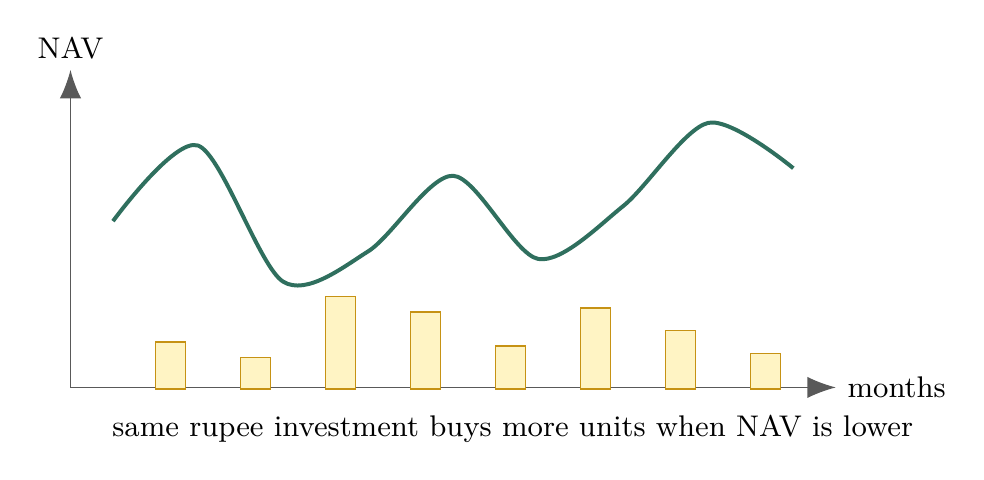
Example: when an index fund NAV falls, the same SIP amount buys more units; when NAV rises, it buys fewer. The process averages entry price without requiring market prediction.
Rupee-cost averaging buys more units when NAV is low and fewer units when NAV is high for the same investment amount.
It does not guarantee profit, but it reduces dependence on one purchase date.
Use averaging for volatile assets.
- Use averaging for volatile long-term assets.
- Do not stop SIP during temporary falls.
- Remember that asset selection still matters.
Fixed-date investment
Example: choosing the fifth of every month after salary credit prevents waiting for the perfect market level. Fixed date investing turns discipline into a calendar rule.
Fixed-date investment means the SIP is scheduled on a chosen date each month.
Automation protects the plan from mood and market headlines.
Automate decision timing.
- Choose a date just after salary credit.
- Maintain enough bank balance before SIP date.
- Review date only if cash-flow timing changes.
Avoiding market timing
Example: many investors stopped SIPs during sharp falls and restarted only after recovery, buying fewer cheap units. Avoiding timing means the plan survives uncomfortable headlines.
Market timing requires predicting both exit and re-entry. Getting one right is not enough.
Two correct predictions
For most investors, time in the market beats repeated attempts to outguess the market because each timing decision creates two errors to avoid.
Use allocation, not prediction.
- Use allocation, not prediction, to manage risk.
- Invest according to goal schedule.
- Avoid holding long-term cash because of fear.
Continuing SIP during market fall
Example: during the March 2020 fall, SIP investors who continued accumulated units at lower NAVs and participated in the recovery. The value of SIP discipline appears most clearly in bad months.
During a fall, SIP buys more units for the same money. This is useful only if the asset remains suitable and the investor continues.
Continue if goal and product remain valid
- Continue SIP if goal horizon and fund quality remain valid.
- Do not redeem long-term money due to temporary loss.
- Use emergency fund so SIP is not interrupted by shocks.
2020 - COVID-19 market crash
Indian and global equity markets fell sharply in early 2020 and then recovered strongly over time. Investors who stopped disciplined investing during the panic often converted volatility into missed participation.

