

01 May 2026
Classical Mechanics Syllabus Map
A compact map of the SEM-I classical mechanics syllabus from Lagrangian mechanics to small oscillations.
The classical mechanics part of the SEM-I syllabus should be read as a connected development, not as separate formulas. It begins with constrained motion, moves to variational principles, then to phase space, and finally to symmetry and small oscillations.
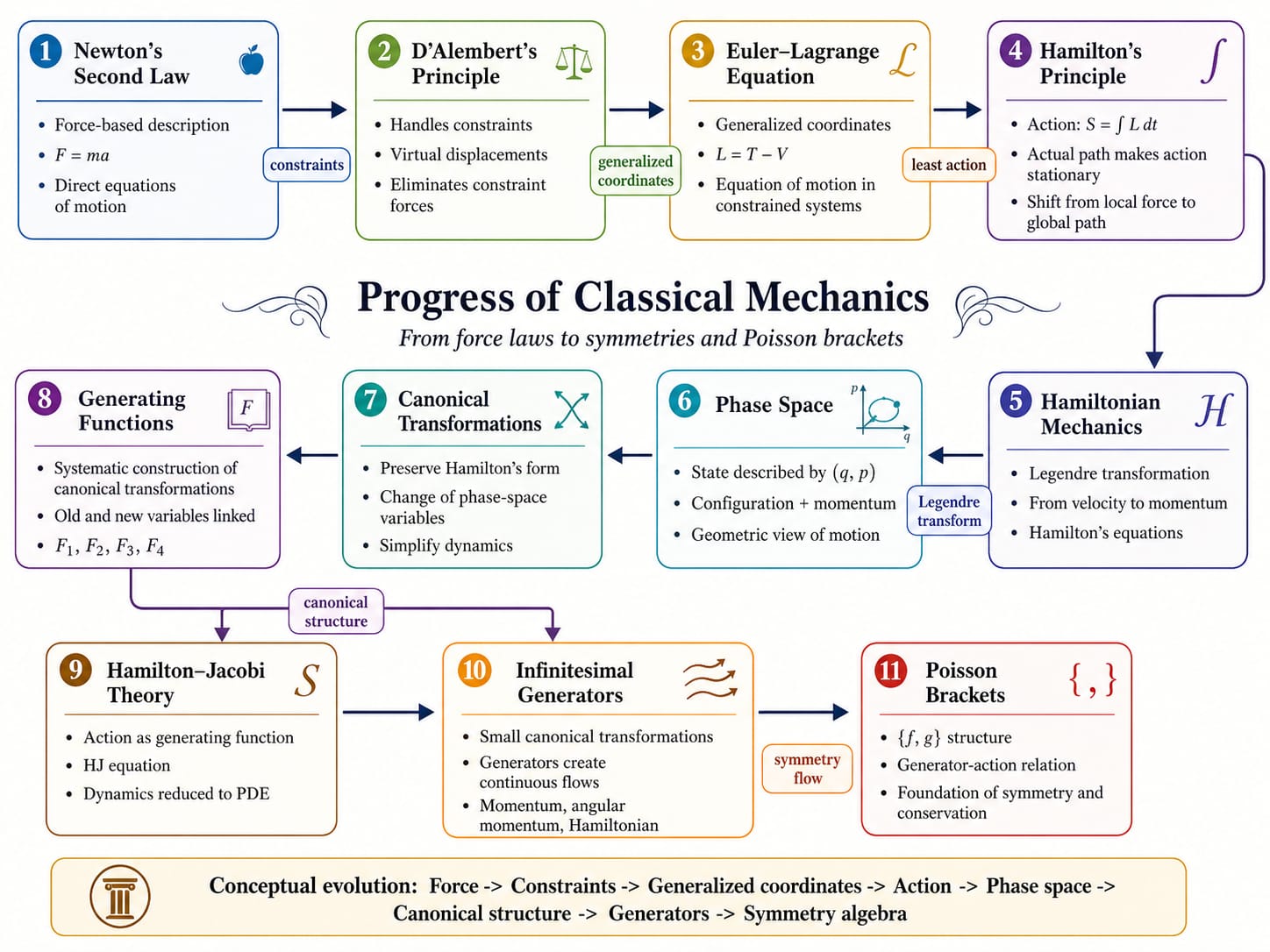
Flow of ideas
- D’Alembert principle removes ideal constraint forces through virtual work.
- Lagrange equations describe dynamics using generalized coordinates.
- Hamilton principle derives Lagrange equations from stationary action.
- Conservation theorems connect cyclic coordinates and symmetries with conserved quantities.
- Hamilton equations move the theory into phase space $(q,p)$.
- Hamilton-Jacobi equation converts dynamics into a first-order PDE for $S$.
- Canonical transformations preserve Hamilton’s form and are generated by functions.
- Infinitesimal generators produce translations, rotations, and time evolution.
- Poisson brackets encode time evolution and canonical structure.
- Small oscillations linearize motion near equilibrium and lead to normal modes.
The logical thread is that each new formulation keeps the same physics but gives a more powerful language for solving problems.
Core formulas
D’Alembert principle:
\[\sum_i(\mathbf F_i-m_i\ddot{\mathbf r}_i)\cdot\delta\mathbf r_i=0.\]Lagrange equation:
\[\frac{d}{dt}\left(\frac{\partial L}{\partial\dot q_i}\right) -\frac{\partial L}{\partial q_i}=0.\]Hamilton equations:
\[\dot q_i=\frac{\partial H}{\partial p_i}, \qquad \dot p_i=-\frac{\partial H}{\partial q_i}.\]Hamilton-Jacobi equation:
\[H\left(q_i,\frac{\partial S}{\partial q_i},t\right) +\frac{\partial S}{\partial t}=0.\]Poisson evolution:
\[\frac{df}{dt}=\{f,H\}+\frac{\partial f}{\partial t}.\]Normal-mode equation:
\[(K-\omega^2M)\mathbf a=0.\]Revision strategy
Read the notes in this order:
- D’Alembert principle and Lagrange equations
- Hamilton principle and calculus of variations
- Least action and Hamilton equations
- Hamilton-Jacobi equation
- Canonical transformations and generating functions
- Poisson brackets
- Poisson theorems and angular momentum
- Conservation theorems and infinitesimal generators
- Small oscillations and normal modes
Standard derivations
For a long-answer question, the following derivations should be prepared in full:
- Lagrange’s equation from D’Alembert’s principle.
- Lagrange’s equation from Hamilton’s principle.
- Hamilton’s equations from the Legendre transform.
- Hamilton-Jacobi equation from Hamilton’s principal function.
- Poisson-bracket form of Hamilton’s equations.
- Normal-mode equation for small oscillations.
Answer sequence
A good mechanics answer usually has this order:
- state the principle or definition;
- write the mathematical form;
- identify the coordinates and constraints;
- derive the required equation;
- interpret the conserved quantity, frequency, or physical result.
Main points
- The syllabus moves from constraints to variational methods, then to phase space.
- Symmetry appears first through cyclic coordinates and later through generators.
- Poisson brackets provide the shortest notation for Hamiltonian dynamics.
- Small oscillations turn nonlinear mechanics into an eigenvalue problem.
Practice questions
- Arrange the main topics of SEM-I classical mechanics in logical order.
- List three conservation laws and the symmetries associated with them.
- Write the Hamilton-Jacobi equation and explain the meaning of $S$.
- State the Poisson-bracket form of Hamilton’s equations.
- Why do small oscillations lead to an eigenvalue problem?


Discussion