

07 Jul 2026
Alpha-Particle and Rutherford Scattering
Coulomb orbit of an alpha particle, impact parameter, closest approach, Rutherford cross section, and laboratory-frame conversion.
An alpha particle has charge $Z_1e=2e$. A nucleus of charge $Z_2e=Ze$ repels it through
\[V(r)=\frac{\kappa}{r}, \qquad \kappa=\frac{Z_1Z_2e^2}{4\pi\varepsilon_0}>0.\]In the centre-of-mass frame, use the reduced mass $\mu$, asymptotic speed $v$, energy $E=\tfrac12\mu v^2$, and angular momentum $L=\mu vb$.
Repulsive Coulomb orbit
The radial equation of motion and angular-momentum conservation are
\[\mu(\ddot r-r\dot\phi^2)=\frac{\kappa}{r^2}, \qquad L=\mu r^2\dot\phi.\]Set $u=1/r$ and let a prime denote $d/d\phi$. Since
\[\dot\phi=\frac{L}{\mu}u^2,\]the chain rule gives
\[\dot r =\frac{d(1/u)}{d\phi}\dot\phi =-\frac{u'}{u^2}\frac{L}{\mu}u^2 =-\frac{L}{\mu}u',\]and
\[\ddot r =-\frac{L}{\mu}u''\dot\phi =-\frac{L^2}{\mu^2}u^2u''.\]The angular term is
\[r\dot\phi^2 =\frac1u\left(\frac{L}{\mu}u^2\right)^2 =\frac{L^2}{\mu^2}u^3.\]Substitution in the radial equation, followed by multiplication by $\mu/(L^2u^2)$, produces
\[\frac{d^2u}{d\phi^2}+u=-\frac{\mu\kappa}{L^2} =-\frac1p, \qquad p=\frac{L^2}{\mu\kappa}.\]The homogeneous solutions are $\cos\phi$ and $\sin\phi$, while $-1/p$ is a particular solution. Combining the sine and cosine into one shifted cosine,
\[u=\frac1p\left[e\cos(\phi-\phi_0)-1\right],\]and therefore
\[\boxed{ r(\phi)=\frac{p}{e\cos(\phi-\phi_0)-1}. }\]The energy relation follows directly from
\[\dot r=-\frac{L}{\mu}\frac{du}{d\phi}, \qquad E=\frac{L^2}{2\mu} \left[ \left(\frac{du}{d\phi}\right)^2+u^2 \right]+\kappa u.\]Write $\chi=\phi-\phi_0$. Since
\[u=\frac{e\cos\chi-1}{p}, \qquad u'=-\frac{e\sin\chi}{p},\]and $1/p=\mu\kappa/L^2$, the dimensionless numerator inside the energy is
\[\begin{aligned} &e^2\sin^2\chi+(e\cos\chi-1)^2 +2(e\cos\chi-1)\\ &\hspace{3em}=e^2-1. \end{aligned}\]Therefore
\[E=\frac{\mu\kappa^2}{2L^2}(e^2-1).\]Thus
\[e^2=1+\frac{2EL^2}{\mu\kappa^2}.\]With $L=\mu vb$, $2E=\mu v^2$, and
\[a=\frac{\kappa}{2E},\]this becomes
\[\boxed{ e=\sqrt{1+\frac{b^2}{a^2}}, \qquad p=\frac{b^2}{a}. }\]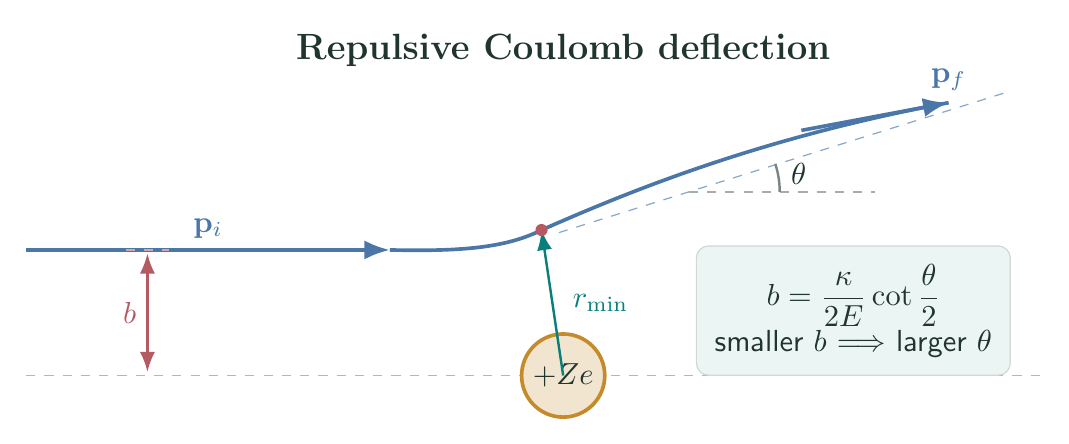
The denominator vanishes on the two asymptotes. Choose the incoming asymptote at $\phi=\pi$ and the outgoing one at $\phi=\theta$. Symmetry about the periapsis fixes
\[\phi_0=\frac{\pi+\theta}{2}.\]At either asymptote,
\[\frac1e =\cos\frac{\pi-\theta}{2} =\sin\frac{\theta}{2}.\]Combining $e^2=\csc^2(\theta/2)$ with $e^2=1+b^2/a^2$,
\[\cot^2\frac{\theta}{2}=\frac{b^2}{a^2},\]so the positive impact parameter is
\[\boxed{ b=a\cot\frac{\theta}{2} =\frac{\kappa}{2E}\cot\frac{\theta}{2}. }\]At the periapsis $\phi=\phi_0$, $dr/d\phi=0$. Its distance from the nucleus is
\[r_{\min}=\frac{p}{e-1} =\frac{a(e^2-1)}{e-1} =a(e+1),\]or
\[\boxed{ r_{\min}=a+\sqrt{a^2+b^2}. }\]For a head-on collision, $b=0$ and $r_{\min}=\kappa/E$.
Rutherford differential cross section
Differentiate the deflection law:
\[\frac{db}{d\theta} =-\frac{a}{2}\csc^2\frac{\theta}{2}.\]Using $\sin\theta=2\sin(\theta/2)\cos(\theta/2)$ in $d\sigma/d\Omega=(b/\sin\theta)|db/d\theta|$,
\[\begin{aligned} \frac{d\sigma}{d\Omega} &=\frac{ a\cot(\theta/2) }{ 2\sin(\theta/2)\cos(\theta/2) } \frac{a}{2}\csc^2\frac{\theta}{2}\\ &=\frac{a^2}{4}\csc^4\frac{\theta}{2}. \end{aligned}\]Therefore
\[\boxed{ \frac{d\sigma}{d\Omega} =\left(\frac{\kappa}{4E}\right)^2 \csc^4\frac{\theta}{2}. }\]The forward divergence makes the ideal Coulomb total cross section infinite. With a lower acceptance angle $\theta_{\min}$,
\[\begin{aligned} \sigma(\theta\geq\theta_{\min}) &=2\pi\int_{\theta_{\min}}^\pi \frac{a^2}{4}\csc^4\frac{\theta}{2} \sin\theta\,d\theta\\ &=2\pi a^2 \int_{\theta_{\min}/2}^{\pi/2} \frac{\cos x}{\sin^3x}\,dx. \end{aligned}\]Here $x=\theta/2$, and
\[\int\frac{\cos x}{\sin^3x}\,dx =-\frac{1}{2\sin^2x}.\]Evaluation at the limits produces
\[\boxed{ \sigma(\theta\geq\theta_{\min}) =\pi a^2\cot^2\frac{\theta_{\min}}{2}. }\]These formulas use $E=E_{\mathrm{cm}}$. For a target initially at rest,
\[E_{\mathrm{cm}} =\frac{m_2}{m_1+m_2}E_{\mathrm{lab}}.\]For a non-heavy target, the measured angle also requires
\[\tan\theta_{\mathrm{lab}} =\frac{\sin\theta_{\mathrm{cm}}} {\cos\theta_{\mathrm{cm}}+m_1/m_2},\]and the laboratory cross section is obtained with the corresponding solid-angle Jacobian. The common heavy-nucleus approximation $m_2\gg m_1$ makes both corrections small.
The orbit equation, asymptotes, periapsis, deflection law, and cross sections are verified in the Maxima worksheet.


Discussion