

19 Jul 2026
Born Approximation
Outgoing Green function, Lippmann–Schwinger equation, first Born amplitude, central-potential transform, and screened Coulomb scattering.
Write the stationary Schrödinger equation as
\[\left(\nabla^2+k^2\right)\psi(\mathbf r) =\frac{2\mu}{\hbar^2}V(\mathbf r)\psi(\mathbf r).\]For $\mathbf r\neq\mathbf r’$, set a radial Green function equal to $G=\chi(r)/r$. The free Helmholtz equation reduces to
\[\chi''+k^2\chi=0.\]The outgoing condition selects
\[G^{(+)}(r)=C\frac{e^{ikr}}r.\]To determine $C$, integrate $(\nabla^2+k^2)G^{(+)}=\delta^{(3)}(\mathbf r)$ over a sphere of radius $\epsilon$. The $k^2$ volume term vanishes as $\epsilon\to0$, while Gauss’s theorem gives
\[\begin{aligned} \int\nabla^2G^{(+)}\,d^3r &=\oint \frac{\partial}{\partial r} \left(C\frac{e^{ikr}}r\right)dS\\ &\underset{\epsilon\to0}{\longrightarrow} \oint\left(-\frac{C}{\epsilon^2}\right) \epsilon^2d\Omega\\ &=-4\pi C. \end{aligned}\]The delta function integrates to one, so $-4\pi C=1$ and $C=-1/(4\pi)$. Therefore the outgoing Green function is
\[G^{(+)}(\mathbf r-\mathbf r') =-\frac1{4\pi} \frac{e^{ik|\mathbf r-\mathbf r'|}} {|\mathbf r-\mathbf r'|}\]and satisfies
\[\left(\nabla^2+k^2\right)G^{(+)} =\delta^{(3)}(\mathbf r-\mathbf r').\]Adding the homogeneous incident solution $e^{i\mathbf k_i\cdot\mathbf r}$ and applying this Green function to the source term produces the Lippmann–Schwinger equation:
\[\boxed{ \psi(\mathbf r) =e^{i\mathbf k_i\cdot\mathbf r} -\frac{\mu}{2\pi\hbar^2} \int \frac{e^{ik|\mathbf r-\mathbf r'|}} {|\mathbf r-\mathbf r'|} V(\mathbf r')\psi(\mathbf r')\,d^3r'. }\]The coefficient $\mu/(2\pi\hbar^2)$ is the product of the source factor $2\mu/\hbar^2$ and the Green-function factor $1/(4\pi)$.
Exact amplitude from the far field
For $r$ much larger than the range of the potential,
\[\begin{aligned} |\mathbf r-\mathbf r'| &=r\left[ 1-\frac{2\hat{\mathbf r}\cdot\mathbf r'}r +\frac{r'^2}{r^2} \right]^{1/2}\\ &\simeq r-\hat{\mathbf r}\cdot\mathbf r', \end{aligned}\]and
\[\frac{e^{ik|\mathbf r-\mathbf r'|}} {|\mathbf r-\mathbf r'|} \simeq \frac{e^{ikr}}r e^{-ik\hat{\mathbf r}\cdot\mathbf r'}.\]Define $\mathbf k_f=k\hat{\mathbf r}$. Comparison with
\[\psi\sim e^{i\mathbf k_i\cdot\mathbf r} +f(\mathbf k_f,\mathbf k_i)\frac{e^{ikr}}r\]identifies the exact elastic amplitude:
\[\boxed{ f(\mathbf k_f,\mathbf k_i) =-\frac{\mu}{2\pi\hbar^2} \int e^{-i\mathbf k_f\cdot\mathbf r} V(\mathbf r)\psi(\mathbf r)\,d^3r. }\]First Born approximation
If the potential changes the incident wave only weakly inside the interaction region, use the zeroth iterate
\[\psi(\mathbf r)\simeq e^{i\mathbf k_i\cdot\mathbf r}\]inside the exact amplitude. Then
\[\boxed{ f_{\mathrm B}(\mathbf q) =-\frac{\mu}{2\pi\hbar^2} \int e^{-i\mathbf q\cdot\mathbf r} V(\mathbf r)\,d^3r, \qquad \mathbf q=\mathbf k_f-\mathbf k_i. }\]The Born amplitude is therefore proportional to the spatial Fourier transform of the potential.
For elastic scattering,
\[\begin{aligned} q^2 &=|\mathbf k_f-\mathbf k_i|^2\\ &=k_f^2+k_i^2-2k_fk_i\cos\theta\\ &=2k^2(1-\cos\theta) =4k^2\sin^2\frac{\theta}{2}. \end{aligned}\]Hence
\[\boxed{ q=2k\sin\frac{\theta}{2}. }\]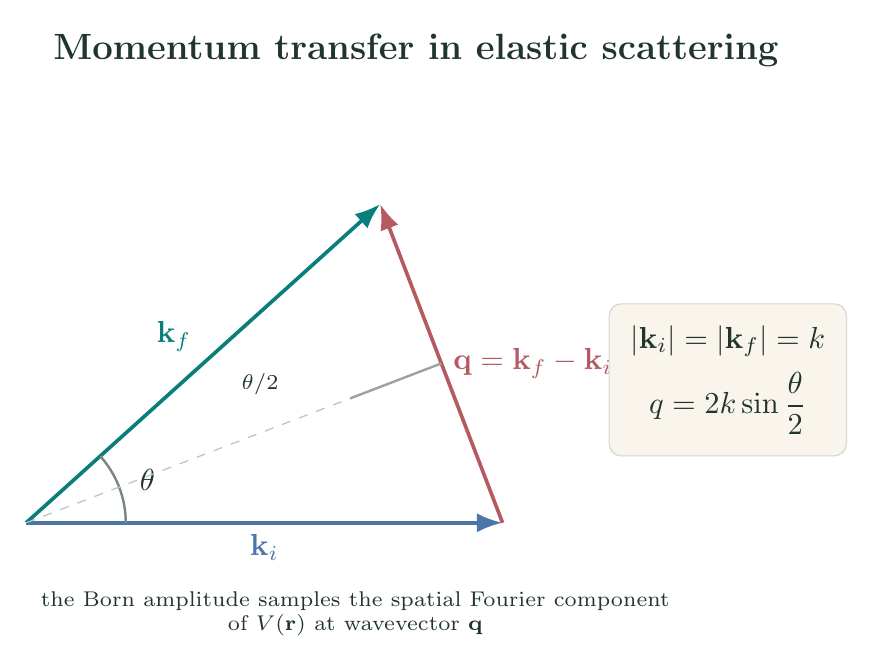
Spherically symmetric potential
For $V(\mathbf r)=V(r)$, choose the polar axis along $\mathbf q$. Then
\[\mathbf q\cdot\mathbf r=qr\cos\vartheta, \qquad d^3r=r^2dr\,d\varphi\,d(\cos\vartheta).\]The angular factor is
\[\begin{aligned} \int e^{-i\mathbf q\cdot\mathbf r}\,d\Omega &=2\pi\int_{-1}^{1}e^{-iqrx}\,dx\\ &=2\pi \left[ \frac{e^{-iqrx}}{-iqr} \right]_{-1}^{1}\\ &=4\pi\frac{\sin(qr)}{qr}. \end{aligned}\]Substitution in the Fourier integral gives
\[\boxed{ f_{\mathrm B}(q) =-\frac{2\mu}{\hbar^2q} \int_0^\infty rV(r)\sin(qr)\,dr. }\]Screened Coulomb potential
For
\[V(r)=\kappa\frac{e^{-\lambda r}}r, \qquad \lambda>0,\]the remaining integral is
\[\begin{aligned} \int_0^\infty e^{-\lambda r}\sin(qr)\,dr &=\operatorname{Im} \int_0^\infty e^{-(\lambda-iq)r}\,dr\\ &=\operatorname{Im}\frac1{\lambda-iq} =\frac{q}{\lambda^2+q^2}. \end{aligned}\]Therefore
\[\boxed{ f_{\mathrm B}(q) =-\frac{2\mu\kappa} {\hbar^2(q^2+\lambda^2)}. }\]In the limit $\lambda\to0$,
\[|f_{\mathrm B}|^2 =\frac{4\mu^2\kappa^2}{\hbar^4q^4}.\]Using $q=2k\sin(\theta/2)$ and $E=\hbar^2k^2/(2\mu)$,
\[\boxed{ \frac{d\sigma}{d\Omega} =|f_{\mathrm B}|^2 =\left(\frac{\kappa}{4E}\right)^2 \csc^4\frac{\theta}{2}. }\]The screened transform is well behaved. A strictly unscreened Coulomb wave has a long-range phase absent from the plane-wave Born state, although its exact modulus has the same Rutherford angular dependence.
The approximation is controlled when the next iteration of the integral equation is small compared with the incident wave, which is favored by a weak potential or sufficiently high incident energy. The momentum-transfer identity, central angular integral, screened-Coulomb transform, and Rutherford limit are evaluated in the Maxima worksheet.


Discussion