

01 Jul 2026
Collisions in Three Dimensions
Two-body collision kinematics, relative motion, impact parameter, scattering angle, and the geometrical meaning of a cross section.
Consider a projectile of mass $m_1$ and a target of mass $m_2$, with positions $\mathbf r_1$ and $\mathbf r_2$. If their interaction depends only on their separation,
\[V=V\!\left(\lvert\mathbf r_1-\mathbf r_2\rvert\right),\]the translational motion of the pair can be separated from the collision itself.
Centre-of-mass and relative motion
Define
\[\mathbf R=\frac{m_1\mathbf r_1+m_2\mathbf r_2}{M}, \qquad \mathbf r=\mathbf r_1-\mathbf r_2, \qquad M=m_1+m_2.\]The inverse transformation is
\[\mathbf r_1=\mathbf R+\frac{m_2}{M}\mathbf r, \qquad \mathbf r_2=\mathbf R-\frac{m_1}{M}\mathbf r.\]Differentiating and substituting into the kinetic energy,
\[\begin{aligned} T &=\frac12m_1\dot{\mathbf r}_1^{\,2} +\frac12m_2\dot{\mathbf r}_2^{\,2}\\ &=\frac12m_1 \left(\dot{\mathbf R}+\frac{m_2}{M}\dot{\mathbf r}\right)^2 +\frac12m_2 \left(\dot{\mathbf R}-\frac{m_1}{M}\dot{\mathbf r}\right)^2. \end{aligned}\]The two cross terms cancel. The coefficients of $\dot{\mathbf R}^{\,2}$ and $\dot{\mathbf r}^{\,2}$ reduce to $M$ and
\[\mu=\frac{m_1m_2}{m_1+m_2},\]respectively. Therefore
\[T=\frac12M\dot{\mathbf R}^{\,2} +\frac12\mu\dot{\mathbf r}^{\,2},\]and the Hamiltonian separates:
\[\boxed{ H=\frac{P^2}{2M} +\left[\frac{p^2}{2\mu}+V(r)\right]. }\]Here $\mathbf P=M\dot{\mathbf R}$ is the conserved total momentum and $\mathbf p=\mu\dot{\mathbf r}$ is the relative momentum. The bracketed term is the complete collision problem: one effective particle of mass $\mu$ scatters from $V(r)$.
Three-dimensional collision geometry
Far from the interaction region, the incoming relative momentum $\mathbf p_i$ defines the beam direction. The perpendicular displacement of its asymptote from the force centre is the impact-parameter vector $\mathbf b$. The outgoing asymptotic momentum $\mathbf p_f$ is described by a polar scattering angle $\theta$ and an azimuth $\phi$.
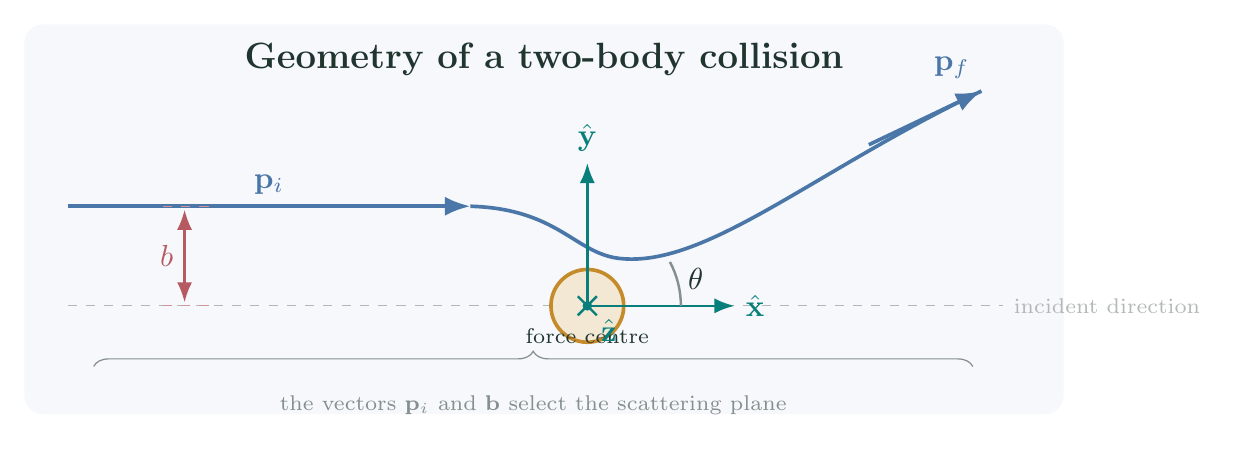
For a central potential,
\[\dot{\mathbf L} =\frac{d}{dt}(\mathbf r\times\mathbf p) =\dot{\mathbf r}\times\mathbf p +\mathbf r\times\dot{\mathbf p}.\]Since $\mathbf p=\mu\dot{\mathbf r}$ and $\dot{\mathbf p}=\mathbf F$,
\[\dot{\mathbf L} =\mu\dot{\mathbf r}\times\dot{\mathbf r} +\mathbf r\times\mathbf F=0,\]because $\mathbf F$ is parallel to $\mathbf r$. Hence each orbit remains in a plane perpendicular to the conserved $\mathbf L$. The experiment is nevertheless three-dimensional because different incident particles can emerge into different elements of solid angle.
In an elastic collision, the relative energy is conserved:
\[\frac{p_i^2}{2\mu} =\frac{p_f^2}{2\mu}.\]Thus $p_i=p_f=p$, and in quantum mechanics $p=\hbar k$. Only the momentum direction changes.
Geometrical definition of cross section
Particles with impact parameters in $[b,b+db]$ and azimuths in $[\varphi,\varphi+d\varphi]$ occupy the incident area
\[d\sigma=b\,db\,d\varphi.\]If the incident flux is $\mathcal F$, the corresponding particle rate is
\[d\dot N=\mathcal F\,d\sigma.\]For axial symmetry, integration over $\varphi$ produces
\[d\dot N=\mathcal F\,2\pi b\,db.\]The same rate emerges between $\theta$ and $\theta+d\theta$, where
\[d\Omega=2\pi\sin\theta\,d\theta.\]Equating it to $\mathcal F(d\sigma/d\Omega)d\Omega$ and cancelling $\mathcal F$,
\[\boxed{ \frac{d\sigma}{d\Omega} =\frac{b}{\sin\theta} \left\lvert\frac{db}{d\theta}\right\rvert. }\]This form assumes one monotonic impact-parameter branch. If several $b_i$ reach the same $\theta$, their incident annuli add:
\[\boxed{ \frac{d\sigma}{d\Omega} =\sum_i\frac{b_i}{\sin\theta} \left\lvert\frac{db_i}{d\theta}\right\rvert. }\]The differential cross section has dimensions of area per steradian. The dynamics enters through the deflection function; the geometrical relation itself is independent of the particular central potential.
The coordinate transformation, kinetic-energy separation, and cross-section identity are verified in the Maxima worksheet.


Discussion