

17 Jun 2026
Dirac Current, Electron Spin, and Magnetic Moment
Positive Dirac density, conserved current, and the emergence of electron spin and magnetic moment.
The first-order time derivative in the Dirac equation permits a conserved density that is positive for every nonzero spinor. It is useful to derive it covariantly and then identify its time and space components.
In natural units $(\hbar=c=1)$, the free equation is
\[\left(i\gamma^\mu\partial_\mu-m\right)\psi=0.\]Define the Dirac adjoint
\[\bar\psi=\psi^\dagger\gamma^0.\]To obtain its equation, take the Hermitian conjugate of the Dirac equation. The derivative then acts on $\psi^\dagger$:
\[-i(\partial_\mu\psi^\dagger)(\gamma^\mu)^\dagger -m\psi^\dagger=0.\]The gamma matrices satisfy
\[(\gamma^\mu)^\dagger =\gamma^0\gamma^\mu\gamma^0, \qquad (\gamma^\mu)^\dagger\gamma^0 =\gamma^0\gamma^\mu.\]Multiply the conjugated equation on the right by $\gamma^0$:
\[-i(\partial_\mu\psi^\dagger)\gamma^0\gamma^\mu -m\psi^\dagger\gamma^0=0.\]Because the matrices are constant,
\[(\partial_\mu\psi^\dagger)\gamma^0 =\partial_\mu(\psi^\dagger\gamma^0) =\partial_\mu\bar\psi.\]After multiplication by $-1$, the adjoint equation is therefore
\[i(\partial_\mu\bar\psi)\gamma^\mu+m\bar\psi=0.\]Multiplying the original equation from the left by $\bar\psi$ gives
\[i\bar\psi\gamma^\mu\partial_\mu\psi -m\bar\psi\psi=0.\]Multiplying the adjoint equation from the right by $\psi$ gives
\[i(\partial_\mu\bar\psi)\gamma^\mu\psi +m\bar\psi\psi=0.\]Add these equations. The mass terms cancel:
\[i\left[ (\partial_\mu\bar\psi)\gamma^\mu\psi +\bar\psi\gamma^\mu\partial_\mu\psi \right]=0.\]The bracket is a product derivative, so
\[\boxed{\partial_\mu(\bar\psi\gamma^\mu\psi)=0}.\]Restoring $c$, define the probability four-current
\[J^\mu=c\,\bar\psi\gamma^\mu\psi=(c\rho,\mathbf j).\]Its time component is
\[J^0 =c\bar\psi\gamma^0\psi =c\psi^\dagger\gamma^0\gamma^0\psi =c\psi^\dagger\psi.\]Its spatial components are
\[J^i =c\bar\psi\gamma^i\psi =c\psi^\dagger\gamma^0\gamma^i\psi =c\psi^\dagger\alpha_i\psi.\]Comparison with $J^\mu=(c\rho,\mathbf j)$ gives
\[\boxed{\rho=\psi^\dagger\psi\ge0}, \qquad \boxed{\mathbf j=c\,\psi^\dagger\boldsymbol\alpha\psi}.\]The covariant conservation law is exactly
\[\frac{\partial\rho}{\partial t}+\nabla\cdot\mathbf j=0.\]For a normalized one-particle state, $\int\rho\,d^3x=1$. The electric charge current is a different quantity, $j_q^\mu=qJ^\mu$; for an electron $q=-e$, its charge density is negative even though its probability density is positive.
Electromagnetic coupling and the Pauli limit
Use SI units throughout this section. In electromagnetic potentials $(\Phi,\mathbf A)$, introduce the kinetic momentum
\[\boldsymbol\Pi=\mathbf p-q\mathbf A.\]The Dirac Hamiltonian is
\[H_D=c\,\boldsymbol\alpha\cdot\boldsymbol\Pi +\beta mc^2+q\Phi.\]In the Dirac–Pauli representation, write the positive-energy spinor after removing its rapid rest-energy phase as
\[\psi=e^{-imc^2t/\hbar} \begin{pmatrix}\varphi\\ \chi\end{pmatrix}.\]The Hamiltonian has the block form
\[H_D= \begin{pmatrix} mc^2+q\Phi & c\,\boldsymbol\sigma\cdot\boldsymbol\Pi\\ c\,\boldsymbol\sigma\cdot\boldsymbol\Pi & -mc^2+q\Phi \end{pmatrix}.\]Differentiating the phase on the left side of the Dirac equation and comparing the upper two components gives
\[i\hbar\frac{\partial\varphi}{\partial t} =q\Phi\,\varphi +c\,\boldsymbol\sigma\cdot\boldsymbol\Pi\,\chi.\]The lower two components give
\[i\hbar\frac{\partial\chi}{\partial t} =c\,\boldsymbol\sigma\cdot\boldsymbol\Pi\,\varphi +q\Phi\,\chi-2mc^2\chi.\]Equivalently,
\[\left( 2mc^2+i\hbar\frac{\partial}{\partial t}-q\Phi \right)\chi =c\,\boldsymbol\sigma\cdot\boldsymbol\Pi\,\varphi.\]In the nonrelativistic regime, kinetic and potential energies are much smaller than $mc^2$. The derivative and potential terms in the bracket are then small compared with $2mc^2$, so
\[\chi\simeq\frac{\boldsymbol\sigma\cdot\boldsymbol\Pi}{2mc}\,\varphi.\]Substitution into the upper equation gives
\[i\hbar\frac{\partial\varphi}{\partial t} = \left[ q\Phi+\frac{1}{2m} (\boldsymbol\sigma\cdot\boldsymbol\Pi)^2 \right]\varphi.\]To simplify the square, use
\[\sigma_i\sigma_j =\delta_{ij}I+i\epsilon_{ijk}\sigma_k.\]Then
\[\begin{aligned} (\boldsymbol\sigma\cdot\boldsymbol\Pi)^2 &=\sigma_i\sigma_j\Pi_i\Pi_j\\ &=\Pi^2+i\epsilon_{ijk}\sigma_k\Pi_i\Pi_j\\ &=\Pi^2+\frac{i}{2}\epsilon_{ijk}\sigma_k [\Pi_i,\Pi_j]. \end{aligned}\]For $\boldsymbol\Pi=\mathbf p-q\mathbf A$,
\[\begin{aligned} [\Pi_i,\Pi_j] &=[p_i-qA_i,p_j-qA_j]\\ &=-q[p_i,A_j]-q[A_i,p_j]\\ &=iq\hbar \left(\partial_iA_j-\partial_jA_i\right)\\ &=iq\hbar\,\epsilon_{ijl}B_l. \end{aligned}\]Using $\epsilon_{ijk}\epsilon_{ijl}=2\delta_{kl}$,
\[\begin{aligned} (\boldsymbol\sigma\cdot\boldsymbol\Pi)^2 &=\Pi^2 -\frac{q\hbar}{2} \epsilon_{ijk}\epsilon_{ijl}\sigma_kB_l\\ &=\boxed{\Pi^2-q\hbar\,\boldsymbol\sigma\cdot\mathbf B}. \end{aligned}\]The upper equation consequently becomes the Pauli equation
\[i\hbar\frac{\partial\varphi}{\partial t} = \left[ \frac{\Pi^2}{2m}+q\Phi -\frac{q\hbar}{2m}\boldsymbol\sigma\cdot\mathbf B \right]\varphi.\]Identification of spin one-half
The Pauli matrices obey
\[[\sigma_i,\sigma_j]=2i\epsilon_{ijk}\sigma_k.\]For the reduced two-component Pauli spinor $\varphi$, define
\[\mathbf S=\frac{\hbar}{2}\boldsymbol\sigma.\]Then
\[\begin{aligned} [S_i,S_j] &=\frac{\hbar^2}{4}[\sigma_i,\sigma_j]\\ &=i\hbar\epsilon_{ijk}S_k, \end{aligned}\]which is the angular-momentum algebra. Since
\[\sigma_z= \begin{pmatrix}1&0\\0&-1\end{pmatrix},\]the eigenvalues of $S_z=(\hbar/2)\sigma_z$ are
\[S_z=\pm\frac{\hbar}{2}.\]Also, $\sigma_x^2=\sigma_y^2=\sigma_z^2=I_2$, so
\[\begin{aligned} \mathbf S^2 &=\frac{\hbar^2}{4} \left(\sigma_x^2+\sigma_y^2+\sigma_z^2\right)\\ &=\frac{3\hbar^2}{4}I_2. \end{aligned}\]Comparison with $\mathbf S^2=s(s+1)\hbar^2I_2$ gives
\[s(s+1)=\frac{3}{4}, \qquad \boxed{s=\frac{1}{2}}.\]On the original four-component Dirac spinor, the corresponding spin operator is
\[\boxed{ \mathbf S_D=\frac{\hbar}{2}\boldsymbol\Sigma, \qquad \Sigma_i= \begin{pmatrix} \sigma_i&0\\ 0&\sigma_i \end{pmatrix}. }\]Thus the same two Pauli-spin eigenvalues occur in both the upper and lower two-component sectors of a Dirac spinor.
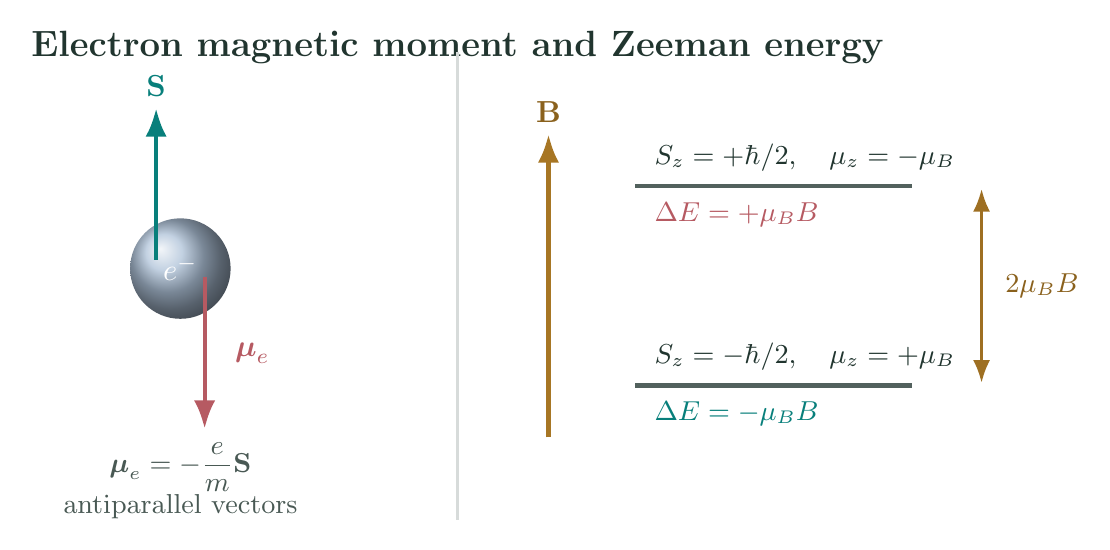
The field-dependent energy in the Pauli equation is
\[-\frac{q\hbar}{2m}\boldsymbol\sigma\cdot\mathbf B =-\boldsymbol\mu\cdot\mathbf B.\]Since $\boldsymbol\sigma=2\mathbf S/\hbar$, comparison with $-\boldsymbol\mu\cdot\mathbf B$ gives
\[\boxed{\boldsymbol\mu=\frac{q}{m}\mathbf S}.\]For the electron,
\[\boldsymbol\mu_e=-\frac{e}{m}\mathbf S =-g\mu_B\frac{\mathbf S}{\hbar}, \qquad g=2, \qquad \mu_B=\frac{e\hbar}{2m}.\]Thus the magnetic moment is antiparallel to the electron spin, and the Dirac equation supplies the spin-$\tfrac12$ magnetic coupling without adding it separately.


Discussion