

24 Jun 2026
Free Dirac Particle and Negative-Energy States
Free-particle Dirac spinors, positive and negative frequency branches, and their antiparticle interpretation.
For a free particle it is convenient to use natural units $\hbar=c=1$. Write
\[p\cdot x=Et-\mathbf p\cdot\mathbf x, \qquad p^\mu=(E,\mathbf p), \qquad E>0.\]The Dirac equation admits two kinds of plane-wave modes:
\[\psi^{(+)}_s(x)=u_s(\mathbf p)e^{-ip\cdot x}, \qquad \psi^{(-)}_s(x)=v_s(\mathbf p)e^{+ip\cdot x}.\]For the first mode,
\[\partial_\mu \left(u_se^{-ip\cdot x}\right) =-ip_\mu u_se^{-ip\cdot x}.\]Substitution into $(i\gamma^\mu\partial_\mu-m)\psi=0$ gives
\[\left(\gamma^\mu p_\mu-m\right)u_s=0.\]For the second mode,
\[\partial_\mu \left(v_se^{+ip\cdot x}\right) =+ip_\mu v_se^{+ip\cdot x},\]so the Dirac equation gives
\[\left(-\gamma^\mu p_\mu-m\right)v_s=0.\]After multiplying this equation by $-1$, the two momentum-space equations are
\[\boxed{(\not\!p-m)u_s(\mathbf p)=0}, \qquad \boxed{(\not\!p+m)v_s(\mathbf p)=0},\]where $\not!p=\gamma^\mu p_\mu$. For example, multiply the $u_s$ equation by $\not!p+m$:
\[(\not\!p+m)(\not\!p-m)u_s =\left(\not\!p\,\not\!p-m^2\right)u_s=0.\]Since $p_\mu p_\nu$ is symmetric,
\[\begin{aligned} \not\!p\,\not\!p &=\gamma^\mu\gamma^\nu p_\mu p_\nu\\ &=\frac{1}{2}\{\gamma^\mu,\gamma^\nu\}p_\mu p_\nu\\ &=g^{\mu\nu}p_\mu p_\nu I_4 =p^\mu p_\mu I_4. \end{aligned}\]A nonzero spinor therefore requires
\[p^\mu p_\mu=m^2, \qquad E=\sqrt{\lvert\mathbf p\rvert^2+m^2}.\]The opposite signs in the exponential are frequency labels. Their one-particle energy and momentum eigenvalues make the distinction explicit:
\[i\partial_t\psi_s^{(-)}=-E\psi_s^{(-)}, \qquad -i\nabla\psi_s^{(-)}=-\mathbf p\,\psi_s^{(-)}.\]Consequently,
\[\boxed{ H_D(-\mathbf p)v_s(\mathbf p)=-E\,v_s(\mathbf p). }\]Thus $\mathbf p$ in $v_s(\mathbf p)e^{+ip\cdot x}$ is the spatial part of the positive-energy four-momentum label $p^\mu$, not the canonical momentum eigenvalue of that negative-frequency one-particle wave. This is also the standard label for the antiparticle created by this mode after field quantization.
Explicit free spinors
In the Dirac–Pauli representation,
\[\not\!p = \begin{pmatrix} EI_2&-\boldsymbol\sigma\cdot\mathbf p\\ \boldsymbol\sigma\cdot\mathbf p&-EI_2 \end{pmatrix}.\]Write $u_s=(\phi_s,\chi_s)^{\mathsf T}$, where each entry is a two-component spinor. The equation $(\not!p-m)u_s=0$ becomes the pair
\[(E-m)\phi_s -(\boldsymbol\sigma\cdot\mathbf p)\chi_s=0,\] \[(\boldsymbol\sigma\cdot\mathbf p)\phi_s -(E+m)\chi_s=0.\]The second equation gives
\[\chi_s =\frac{\boldsymbol\sigma\cdot\mathbf p}{E+m}\phi_s.\]Substitute it into the first:
\[\left[ (E-m) -\frac{(\boldsymbol\sigma\cdot\mathbf p)^2}{E+m} \right]\phi_s=0.\]For commuting free-momentum components, the Pauli product $\sigma_i\sigma_j=\delta_{ij}I_2+i\epsilon_{ijk}\sigma_k$ gives
\[\begin{aligned} (\boldsymbol\sigma\cdot\mathbf p)^2 &=\sigma_i\sigma_jp_ip_j\\ &=\delta_{ij}p_ip_jI_2 +i\epsilon_{ijk}\sigma_kp_ip_j\\ &=\lvert\mathbf p\rvert^2I_2. \end{aligned}\]The last term vanishes because $\epsilon_{ijk}$ is antisymmetric while $p_ip_j$ is symmetric. Hence
\[\frac{E^2-m^2-\lvert\mathbf p\rvert^2}{E+m}\phi_s=0,\]which vanishes because $E^2=\lvert\mathbf p\rvert^2+m^2$. If $\xi_s$ is a normalized basis spinor, the positive-frequency solution is therefore
\[u_s(\mathbf p) =N \begin{pmatrix} \xi_s\\[2mm] \dfrac{\boldsymbol\sigma\cdot\mathbf p}{E+m}\xi_s \end{pmatrix}.\]For $v_s=(\zeta_s,\eta_s)^{\mathsf T}$, choose $\eta_s^\dagger\eta_s=1$. The equation $(\not!p+m)v_s=0$ gives
\[(E+m)\zeta_s -(\boldsymbol\sigma\cdot\mathbf p)\eta_s=0,\] \[(\boldsymbol\sigma\cdot\mathbf p)\zeta_s -(E-m)\eta_s=0.\]The first equation gives
\[\zeta_s =\frac{\boldsymbol\sigma\cdot\mathbf p}{E+m}\eta_s.\]Substitution into the second again leaves
\[\frac{\lvert\mathbf p\rvert^2-(E^2-m^2)}{E+m}\eta_s=0.\]Thus
\[v_s(\mathbf p) =N \begin{pmatrix} \dfrac{\boldsymbol\sigma\cdot\mathbf p}{E+m}\eta_s\\[2mm] \eta_s \end{pmatrix}.\]Normalization and the rest limit
Let $\xi_s^\dagger\xi_s=1$. Since $\boldsymbol\sigma\cdot\mathbf p$ is Hermitian,
\[\begin{aligned} u_s^\dagger u_s &=N^2\left[ 1+\frac{ \xi_s^\dagger(\boldsymbol\sigma\cdot\mathbf p)^2\xi_s }{(E+m)^2} \right]\\ &=N^2\left(1+\frac{\lvert\mathbf p\rvert^2}{(E+m)^2}\right). \end{aligned}\]Use $\lvert\mathbf p\rvert^2=E^2-m^2=(E-m)(E+m)$:
\[\begin{aligned} 1+\frac{\lvert\mathbf p\rvert^2}{(E+m)^2} &= \frac{(E+m)^2+(E-m)(E+m)}{(E+m)^2}\\ &=\frac{2E}{E+m}. \end{aligned}\]The choice $u_s^\dagger u_s=1$ therefore fixes
\[N=\sqrt{\frac{E+m}{2E}}.\]The same calculation applies to $v_s$. The normalized spinors are
\[u_s(\mathbf p) = \sqrt{\frac{E+m}{2E}} \begin{pmatrix} \xi_s\\[2mm] \dfrac{\boldsymbol\sigma\cdot\mathbf p}{E+m}\xi_s \end{pmatrix},\]and
\[v_s(\mathbf p) = \sqrt{\frac{E+m}{2E}} \begin{pmatrix} \dfrac{\boldsymbol\sigma\cdot\mathbf p}{E+m}\eta_s\\[2mm] \eta_s \end{pmatrix}.\]At rest, $E=m$ and $\mathbf p=0$, so
\[u_s(\mathbf 0)= \begin{pmatrix}\xi_s\\0\end{pmatrix}, \qquad v_s(\mathbf 0)= \begin{pmatrix}0\\\eta_s\end{pmatrix}.\]Momentum mixes the upper and lower two-component sectors, but each branch retains two independent spin polarizations.
Meaning of the negative-energy branch
For a free momentum eigenstate,
\[H_D^2=(\lvert\mathbf p\rvert^2c^2+m^2c^4)I_4.\]If $H_Dw=\mathcal Ew$, applying $H_D$ once more gives
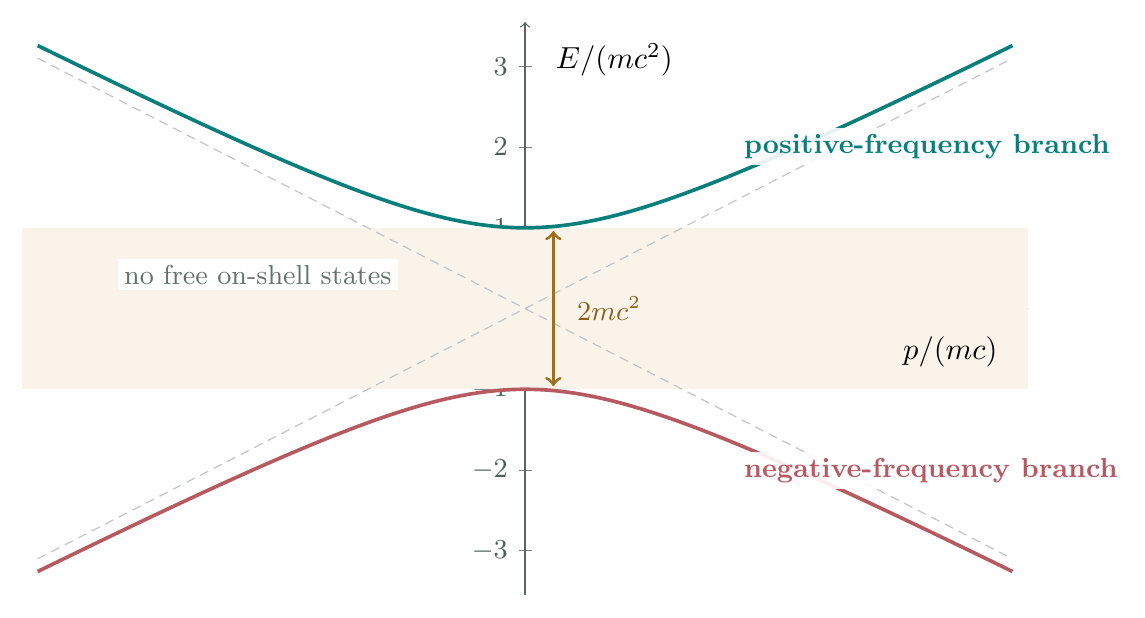
\[H_D^2w=\mathcal E^2w =(\lvert\mathbf p\rvert^2c^2+m^2c^4)w.\]Hence the first-quantized Hamiltonian has the two eigenvalue branches
\[\mathcal E_\pm =\pm\sqrt{\lvert\mathbf p\rvert^2c^2+m^2c^4}.\]The factor $e^{-ip\cdot x}$ contains $e^{-iEt}$ and has canonical eigenvalues $(E,\mathbf p)$. The factor $e^{+ip\cdot x}$ contains $e^{+iEt}=e^{-i(-E)t}$ and has canonical eigenvalues $(-E,-\mathbf p)$, as derived above. It therefore lies on the $-\mathcal E$ branch of the one-particle equation. That lower branch seems to make an electron unstable because states of ever more negative energy are available. Dirac’s historical resolution was to regard all negative-energy electron states as filled; a missing electron in that sea behaves as a positively charged hole.
In quantum field theory the complete mode expansion has the structure
\[\widehat\psi(x) = \sum_s\int d^3p\, \left[ a_s(\mathbf p)u_s(\mathbf p)e^{-ip\cdot x} +b_s^\dagger(\mathbf p)v_s(\mathbf p)e^{+ip\cdot x} \right],\]apart from the conventional momentum normalization factor. The operator $a_s$ annihilates an electron. The coefficient of the negative-frequency mode is not another electron annihilation operator: $b_s^\dagger(\mathbf p)$ creates a positron whose physical momentum label is $\mathbf p$. When the field Hamiltonian and momentum operator are expressed in these operators, the antiparticle excitation carries positive energy $E$ and physical momentum $\mathbf p$. The two excitations have equal mass and opposite electric charge. Thus negative-frequency solutions remain essential to the relativistic field, but observable particles do not carry unbounded negative energy.


Discussion