

04 Jul 2026
Laboratory and Centre-of-Mass Frames
Transformation of energies, velocities, scattering angles, and differential cross sections between laboratory and centre-of-mass frames.
The laboratory frame is the natural frame of an experiment: the target is initially at rest. The centre-of-mass frame is the natural frame of the dynamics: its total momentum vanishes.
Let a projectile of mass $m_1$ have laboratory velocity $\mathbf v=v\hat{\mathbf x}$, while a target of mass $m_2$ is at rest. Conservation of total momentum fixes the centre-of-mass velocity:
\[\mathbf V_{\mathrm{cm}} =\frac{m_1\mathbf v+m_2\mathbf 0}{m_1+m_2} =\boxed{\frac{m_1}{m_1+m_2}\mathbf v}.\]Subtracting this velocity from each laboratory velocity,
\[\mathbf u_1 =\mathbf v-\mathbf V_{\mathrm{cm}} =\frac{m_2}{m_1+m_2}\mathbf v,\] \[\mathbf u_2 =-\mathbf V_{\mathrm{cm}} =-\frac{m_1}{m_1+m_2}\mathbf v.\]Consequently,
\[m_1\mathbf u_1+m_2\mathbf u_2=0, \qquad m_1\mathbf u_1=-m_2\mathbf u_2=\mu\mathbf v.\]Energy available for scattering
The kinetic energy in the centre-of-mass frame is
\[\begin{aligned} E_{\mathrm{cm}} &=\frac12m_1u_1^2+\frac12m_2u_2^2\\ &=\frac{v^2}{2(m_1+m_2)^2} \left(m_1m_2^2+m_2m_1^2\right)\\ &=\frac12\frac{m_1m_2}{m_1+m_2}v^2 =\frac12\mu v^2. \end{aligned}\]Since $E_{\mathrm{lab}}=\tfrac12m_1v^2$,
\[\boxed{ E_{\mathrm{cm}} =\frac{m_2}{m_1+m_2}E_{\mathrm{lab}}. }\]Scattering-angle transformation
For an elastic collision, the centre-of-mass projectile velocity retains its magnitude $u_1$ and rotates through $\theta_{\mathrm{cm}}$. Choose the scattering plane as the $xy$-plane:
\[\mathbf u_1' =u_1 \left( \cos\theta_{\mathrm{cm}}\,\hat{\mathbf x} +\sin\theta_{\mathrm{cm}}\,\hat{\mathbf y} \right).\]Returning to the laboratory requires
\[\mathbf v_1'=\mathbf V_{\mathrm{cm}}+\mathbf u_1'.\]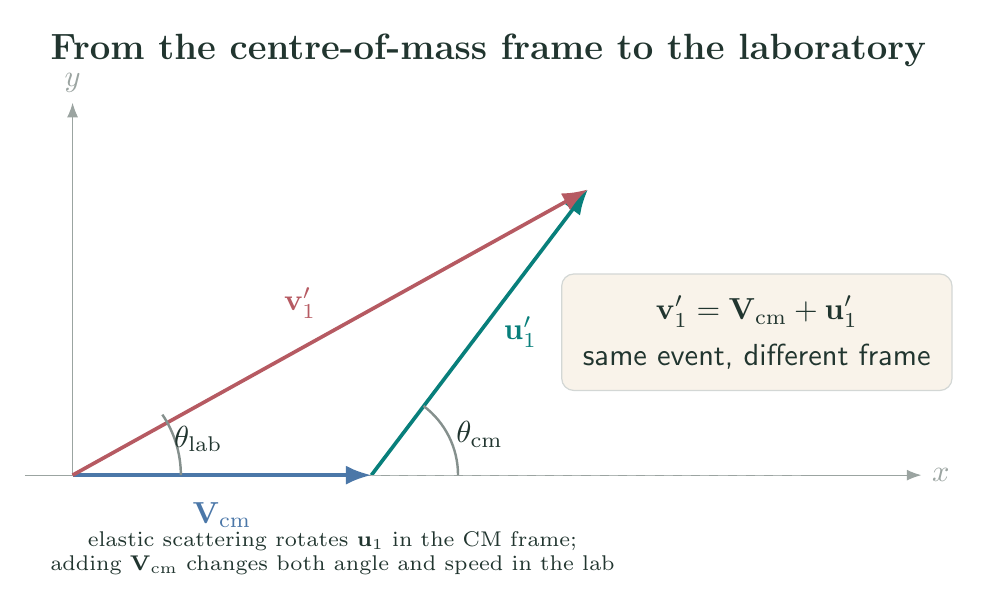
Its components are
\[v_{1x}' =\frac{v}{m_1+m_2} \left(m_1+m_2\cos\theta_{\mathrm{cm}}\right),\] \[v_{1y}' =\frac{m_2v}{m_1+m_2}\sin\theta_{\mathrm{cm}}.\]Their ratio gives
\[\boxed{ \tan\theta_{\mathrm{lab}} =\frac{\sin\theta_{\mathrm{cm}}} {\cos\theta_{\mathrm{cm}}+m_1/m_2}. }\]Squaring and adding the components,
\[v_1'^2 =\frac{v^2}{(m_1+m_2)^2} \left[ m_1^2+m_2^2+2m_1m_2\cos\theta_{\mathrm{cm}} \right],\]so
\[\boxed{ \frac{E_1'}{E_{\mathrm{lab}}} =\frac{m_1^2+m_2^2+2m_1m_2\cos\theta_{\mathrm{cm}}} {(m_1+m_2)^2}. }\]For equal masses, the angle relation reduces through $\sin\theta/(1+\cos\theta)=\tan(\theta/2)$ to $\theta_{\mathrm{lab}}=\theta_{\mathrm{cm}}/2$ on the projectile branch. For $m_2\gg m_1$, the two angles and the two collision energies are nearly equal.
Solid-angle Jacobian
Put $\gamma=m_1/m_2$, $c=\cos\theta_{\mathrm{cm}}$, and
\[D=1+2\gamma c+\gamma^2.\]The component result can be written
\[v_{1x}'=\frac{m_2v}{M}(c+\gamma).\]The squared-speed result gives its magnitude:
\[v_1'=\frac{m_2v}{M}\sqrt D.\]Therefore
\[\cos\theta_{\mathrm{lab}} =\frac{v_{1x}'}{v_1'} =\frac{c+\gamma}{\sqrt D}.\]Direct differentiation produces
\[\frac{d\cos\theta_{\mathrm{lab}}}{dc} =\frac{D-\gamma(c+\gamma)}{D^{3/2}} =\frac{1+\gamma c}{D^{3/2}}.\]| Since $d\Omega=2\pi\, | d(\cos\theta) | $, one centre-of-mass branch contributes |
For $m_1>m_2$, the map from $\theta_{\mathrm{cm}}$ to $\theta_{\mathrm{lab}}$ can have two physical branches. The measured laboratory cross section is then the sum of the boxed contribution over both centre-of-mass angles that reach the same laboratory angle.
The energy, angle, and Jacobian identities are checked in the Maxima worksheet.


Discussion