

26 May 2026
Electron Spin Resonance
Electron Zeeman splitting, magnetic-dipole transitions, resonance, populations, hyperfine structure, and linewidth.
Electron spin resonance (ESR), also called electron paramagnetic resonance, measures transitions between magnetic energy levels of an unpaired electron. The electron must be unpaired because a closed shell has zero resultant electronic magnetic moment.
Spin magnetic moment
For a spin-$1/2$ electron,
\[\hat{\mathbf S}=\frac{\hbar}{2}\boldsymbol{\sigma},\]where $\boldsymbol{\sigma}$ denotes the three Pauli matrices. The magnetic moment associated with spin is
\[\boxed{ \hat{\boldsymbol{\mu}}_{\mathrm e} =-g_{\mathrm e}\mu_B\frac{\hat{\mathbf S}}{\hbar} },\]with
\[\mu_B=\frac{e\hbar}{2m_{\mathrm e}}.\]Here $e$ is the positive elementary-charge magnitude. The minus sign follows from the negative electron charge: the electron magnetic moment is antiparallel to its spin. For a free electron, $g_{\mathrm e}\simeq2.0023$; in an atom, molecule, or solid, spin–orbit coupling and the local electronic environment generally make the measured effective $g$ different from the free-electron value.
Apply a static magnetic field
\[\mathbf B_0=B_0\hat{\mathbf z}.\]The magnetic interaction energy is
\[\hat H_0=-\hat{\boldsymbol{\mu}}_{\mathrm e}\cdot\mathbf B_0.\]Substituting the magnetic moment,
\[\hat H_0 =g_{\mathrm e}\mu_BB_0\frac{\hat S_z}{\hbar}.\]The spin eigenvalue equation is
\[\hat S_z\lvert m_s\rangle =m_s\hbar\lvert m_s\rangle, \qquad m_s=\pm\frac12.\]Therefore
\[\hat H_0\lvert m_s\rangle =g_{\mathrm e}\mu_BB_0m_s\lvert m_s\rangle,\]and the two energies are
\[E_{+1/2}=+\frac12g_{\mathrm e}\mu_BB_0, \qquad E_{-1/2}=-\frac12g_{\mathrm e}\mu_BB_0.\]Their separation is
\[\boxed{ \Delta E =E_{+1/2}-E_{-1/2} =g_{\mathrm e}\mu_BB_0 }.\]The $m_s=-1/2$ state is lower in energy for $B_0>0$ because its magnetic moment is parallel to the field.
Why the oscillating field must be transverse
Let a microwave magnetic field be applied along $x$:
\[\mathbf B_1(t)=B_1\cos\omega t\,\hat{\mathbf x}.\]Its interaction with the electron is
\[\hat H_1(t) =-\hat{\boldsymbol{\mu}}_{\mathrm e}\cdot\mathbf B_1(t) =g_{\mathrm e}\mu_BB_1 \frac{\hat S_x}{\hbar}\cos\omega t.\]In the $\hat S_z$ basis,
\[\hat S_x =\frac{\hbar}{2} \begin{pmatrix} 0&1\\ 1&0 \end{pmatrix}.\]The diagonal matrix elements vanish:
\[\langle +\tfrac12\lvert\hat S_x\rvert+\tfrac12\rangle=0, \qquad \langle -\tfrac12\lvert\hat S_x\rvert-\tfrac12\rangle=0.\]The off-diagonal matrix element is nonzero:
\[\langle +\tfrac12\lvert\hat S_x\rvert-\tfrac12\rangle =\frac{\hbar}{2}.\]Thus the transverse field couples the two Zeeman states and gives the magnetic-dipole selection rule
\[\boxed{\Delta m_s=\pm1}.\]A field parallel to $z$ would be proportional to $\hat S_z$, whose off-diagonal elements vanish, so it would shift the levels without driving this transition.
Resonance condition
Absorption is largest when the microwave photon energy equals the Zeeman separation:
\[\hbar\omega=\Delta E.\]Using $\omega=2\pi\nu$ and $\hbar\omega=h\nu$,
\[h\nu=g_{\mathrm e}\mu_BB_0.\]Hence
\[\boxed{ \nu=\frac{g_{\mathrm e}\mu_B}{h}B_0 }.\]An ESR spectrometer commonly holds $\nu$ fixed and sweeps $B_0$. The resonance field is then
\[\boxed{ B_{\mathrm{res}}=\frac{h\nu}{g_{\mathrm e}\mu_B} }.\]Consequently, a measured resonance field determines
\[g_{\mathrm e}=\frac{h\nu}{\mu_BB_{\mathrm{res}}}.\]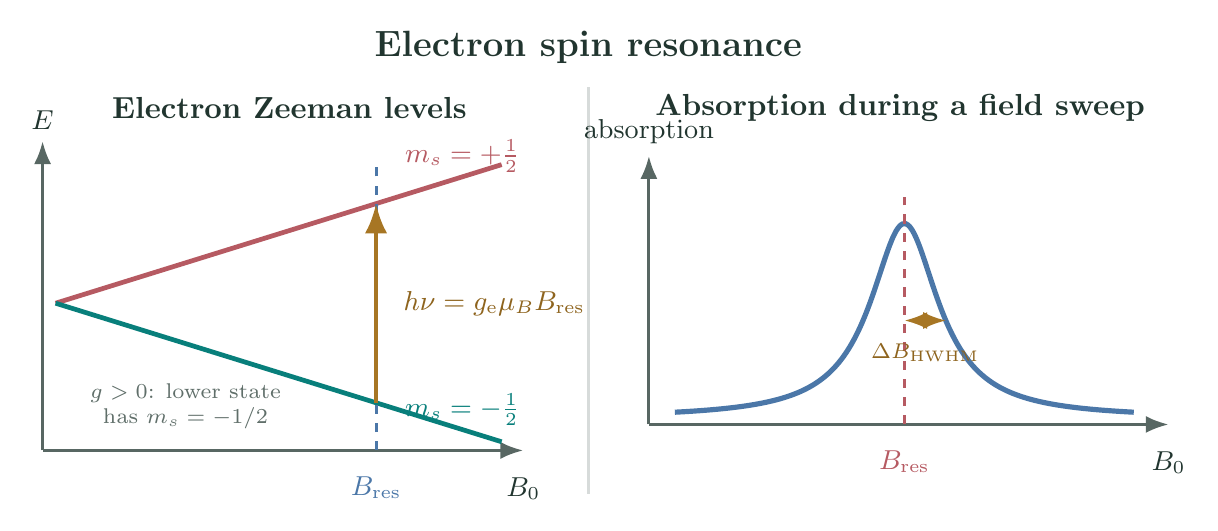
Thermal population and net absorption
Write the two energies as
\[E_{\mathrm{upper}}=+\frac{\Delta E}{2}, \qquad E_{\mathrm{lower}}=-\frac{\Delta E}{2}.\]The Boltzmann populations obey
\[\frac{N_{\mathrm{upper}}}{N_{\mathrm{lower}}} =\exp\left[ -\frac{E_{\mathrm{upper}}-E_{\mathrm{lower}}}{k_BT} \right] =e^{-\Delta E/(k_BT)}.\]If $N=N_{\mathrm{lower}}+N_{\mathrm{upper}}$, direct substitution of the two Boltzmann weights gives
\[\frac{N_{\mathrm{lower}}-N_{\mathrm{upper}}}{N} = \frac{e^{\Delta E/(2k_BT)}-e^{-\Delta E/(2k_BT)}} {e^{\Delta E/(2k_BT)}+e^{-\Delta E/(2k_BT)}} =\tanh\left(\frac{\Delta E}{2k_BT}\right).\]For $\Delta E\ll k_BT$, $\tanh x\simeq x$, so
\[N_{\mathrm{lower}}-N_{\mathrm{upper}} \simeq N\frac{g_{\mathrm e}\mu_BB_0}{2k_BT}.\]There are therefore slightly more absorptive upward transitions than stimulated downward transitions. This small population excess produces the observed net ESR absorption.
Hyperfine splitting
If the electron spin interacts with a nucleus of spin $I$, an isotropic hyperfine Hamiltonian can be written
\[\hat H_{\mathrm{hf}} =\frac{A}{\hbar^2}\hat{\mathbf I}\cdot\hat{\mathbf S},\]where $A$ has dimensions of energy. In a strong field, the Zeeman direction defines the quantization axis and the nonsecular terms are neglected to first order:
\[\hat H_{\mathrm{hf}} \simeq\frac{A}{\hbar^2}\hat I_z\hat S_z.\]Since
\[\hat I_z\lvert m_I,m_s\rangle =m_I\hbar\lvert m_I,m_s\rangle, \qquad \hat S_z\lvert m_I,m_s\rangle =m_s\hbar\lvert m_I,m_s\rangle,\]the approximate energy is
\[E(m_s,m_I) =g_{\mathrm e}\mu_BB_0m_s+Am_Im_s.\]For an allowed ESR transition, $m_s$ changes from $-1/2$ to $+1/2$ while $m_I$ is unchanged. Therefore
\[\Delta E(m_I) =g_{\mathrm e}\mu_BB_0+Am_I.\]The resonance field at fixed frequency becomes
\[\boxed{ B_{\mathrm{res}}(m_I) =\frac{h\nu-Am_I}{g_{\mathrm e}\mu_B} }.\]Because $m_I=-I,-I+1,\ldots,I$, one equivalent nucleus produces $2I+1$ hyperfine lines.
Linewidth and spin relaxation
After excitation, transverse spin coherence decays approximately as
\[M_\perp(t)=M_\perp(0)e^{-t/T_2}e^{-i\omega_0t}.\]Its frequency response is obtained from
\[\int_0^\infty e^{-t/T_2}e^{i(\omega-\omega_0)t}\,dt = \left[ \frac{-e^{-[1/T_2-i(\omega-\omega_0)]t}} {1/T_2-i(\omega-\omega_0)} \right]_0^\infty,\]which gives
\[\frac{1}{1/T_2-i(\omega-\omega_0)}.\]The absorbed intensity is therefore Lorentzian:
\[\mathcal I(\omega)\propto \frac{1/T_2} {(\omega-\omega_0)^2+(1/T_2)^2}.\]At half maximum,
\[\lvert\omega-\omega_0\rvert=\frac1{T_2}.\]Since the electron resonance angular frequency satisfies
\[\omega_0=\frac{g_{\mathrm e}\mu_B}{\hbar}B_{\mathrm{res}},\]the field half-width at half maximum is
\[\boxed{ \Delta B_{\mathrm{HWHM}} =\frac{\hbar}{g_{\mathrm e}\mu_BT_2} }.\]Thus a shorter transverse relaxation time $T_2$ produces a broader resonance line. Longitudinal relaxation, characterized by $T_1$, restores the equilibrium population difference required for continued absorption.
The spin-matrix, resonance, hyperfine, and linewidth identities are checked in the Maxima worksheet.


Discussion