

08 May 2026
Electronic Spectra of Diatomic Molecules
Born–Oppenheimer separation and the electronic, vibrational, and rotational structure of a diatomic band spectrum.
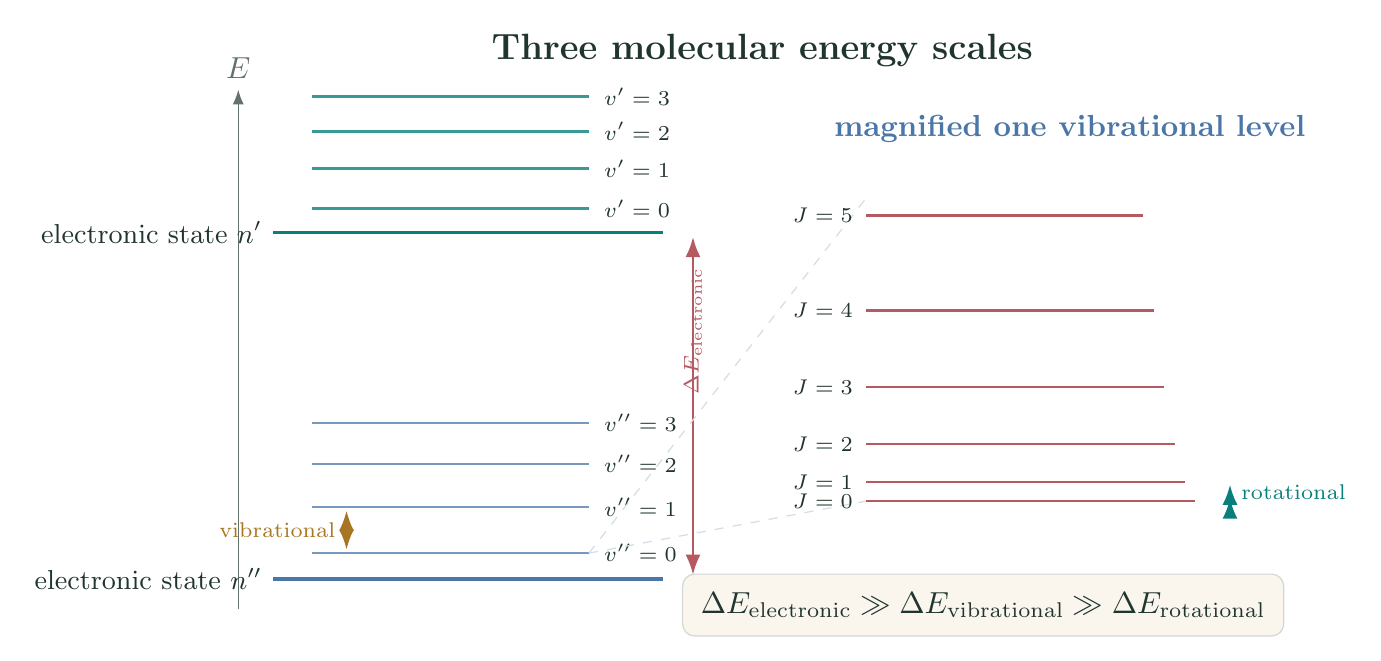
An electronic transition in a molecule differs from one in an isolated atom because the nuclei can vibrate and the whole molecule can rotate. Every electronic state therefore carries a set of vibrational levels, and every vibrational level carries a set of rotational levels.
Separation of electronic and nuclear motion
After removal of the centre-of-mass motion, write the molecular Hamiltonian as
\[\widehat H =-\frac{\hbar^2}{2\mu_N}\nabla_R^2 +\widehat H_{\mathrm e}(\mathbf r;R).\]Here $R$ is the internuclear separation, $\mu_N$ is the nuclear reduced mass, and $\mathbf r$ denotes all electronic coordinates. The electronic Hamiltonian contains the electronic kinetic energy and all Coulomb interactions, including the nuclear repulsion at the fixed value of $R$.
Because nuclei are much heavier than electrons, their motion is slower. First hold $R$ fixed and solve
\[\widehat H_{\mathrm e}(\mathbf r;R) \phi_n(\mathbf r;R) =U_n(R)\phi_n(\mathbf r;R).\]The eigenvalue $U_n(R)$ is a potential-energy curve for the nuclear motion in electronic state $n$. Expand the complete wavefunction as
\[\Psi(\mathbf r,R)=\sum_n\phi_n(\mathbf r;R)\chi_n(R).\]When the nuclear kinetic operator acts on one product,
\[\begin{aligned} \nabla_R^2(\phi_n\chi_n) ={}&\phi_n\nabla_R^2\chi_n +2(\nabla_R\phi_n)\cdot(\nabla_R\chi_n)\\ &+\chi_n\nabla_R^2\phi_n. \end{aligned}\]The last two terms couple different electronic states. The Born–Oppenheimer approximation neglects these derivative couplings. Projection onto $\phi_n$ then gives the nuclear equation
\[\left[ -\frac{\hbar^2}{2\mu_N}\nabla_R^2+U_n(R) \right]\chi_n=E\chi_n.\]Thus each electronic state supplies its own equilibrium bond length, force constant, vibrational frequency, and rotational constant.
Hierarchy of molecular term values
Near the minimum $R_e$ of one electronic potential,
\[U_n(R) \simeq U_n(R_e)+\frac12k_n(R-R_e)^2.\]Quantizing the nuclear vibration and rotation gives, to leading order,
\[\boxed{ \frac{E(n,v,J)}{hc} =T_e(n)+G_n(v)+F_{n,v}(J), }\]where
\[T_e(n)=\frac{U_n(R_e)-U_0(R_{e,0})}{hc},\] \[G_n(v)\simeq \widetilde\nu_{e,n}\left(v+\frac12\right), \qquad \widetilde\nu_{e,n} =\frac{1}{2\pi c}\sqrt{\frac{k_n}{\mu_N}},\]and
\[F_{n,v}(J)\simeq B_{n,v}J(J+1), \qquad B_{n,v} =\frac{h}{8\pi^2c\mu_N} \left\langle R^{-2}\right\rangle_{n,v}.\]Since electronic binding energies are much larger than vibrational spacings, which in turn are much larger than rotational spacings, the typical order is
\[\Delta E_{\mathrm{electronic}} \gg\Delta E_{\mathrm{vibrational}} \gg\Delta E_{\mathrm{rotational}}.\]Electronic spectra accordingly occur mainly in the visible and ultraviolet, but each electronic transition appears as a system of vibrational bands, and each sufficiently resolved band consists of rotational lines.
Wavenumber of an individual line
Let double primes label the lower state and single primes label the upper state. The photon condition is
\[hc\widetilde\nu =E(n',v',J')-E(n'',v'',J'').\]Dividing by $hc$ and using the term-value decomposition gives
\[\begin{aligned} \widetilde\nu ={}& \left[T_e'-T_e''\right] +\left[G'(v')-G''(v'')\right]\\ &+\left[F'_{v'}(J')-F''_{v''}(J'')\right]. \end{aligned}\]For fixed $v’$ and $v’’$, the first two brackets are constant. They define the vibrational band origin,
\[\widetilde\nu_{v'v''} =T_e'-T_e''+G'(v')-G''(v'').\]The last bracket produces the rotational fine structure around that origin. Changing $v’$ and $v’’$ produces the different bands of the electronic band system.
Transition moment and electronic selection rules
For electric-dipole absorption, the transition amplitude is proportional to
\[\mathbf M_{fi} =\int \Psi_f^*(\mathbf r,R)\, \widehat{\boldsymbol\mu}\, \Psi_i(\mathbf r,R)\, d\mathbf r\,dR.\]Using one Born–Oppenheimer product for each state,
\[\mathbf M_{fi} =\int \chi_{v'}^*(R)\, \mathbf M_{\mathrm e}(R)\, \chi_{v''}(R)\,dR,\]where
\[\mathbf M_{\mathrm e}(R) =\int \phi_{n'}^*(\mathbf r;R) \widehat{\boldsymbol\mu} \phi_{n''}(\mathbf r;R)\,d\mathbf r.\]Therefore an energy difference alone is insufficient: the transition moment must also be nonzero.
For a linear molecule, let $\Lambda$ be the magnitude of the projection of electronic orbital angular momentum on the internuclear axis. The values $\Lambda=0,1,2,\ldots$ are denoted by $\Sigma,\Pi,\Delta,\ldots$. With total electronic spin $S$, a basic electronic term symbol is
\[{}^{2S+1}\Lambda.\]Only a homonuclear diatomic molecule possesses inversion symmetry about its centre, so only its states carry the additional labels $g$ and $u$. Reflection in a plane containing the internuclear axis supplies the $+$ or $-$ label only for a $\Sigma$ state.
The dipole operator is a vector, so its body-fixed components carry projections $0,\pm1$. Conservation of the projected angular momentum gives
\[\Delta\Lambda=0,\pm1.\]The electric dipole does not act on spin, so in the absence of strong spin–orbit mixing,
\[\Delta S=0.\]For a homonuclear molecule, the dipole is odd under inversion. The integrand has even overall parity only when the two electronic states have opposite inversion parity:
\[g\leftrightarrow u \quad\text{is allowed},\qquad g\leftrightarrow g,\;u\leftrightarrow u \quad\text{are forbidden}.\]These symmetry rules identify which electronic band systems can carry electric-dipole intensity. Conservation of total angular momentum in an electric-dipole transition further gives
\[\Delta J=0,\pm1, \qquad J=0\not\leftrightarrow J'=0.\]The $\Delta J=-1,0,+1$ sets form the $P$, $Q$, and $R$ branches. For a $\Sigma\leftrightarrow\Sigma$ transition the $Q$-branch matrix element vanishes, leaving only $P$ and $R$. The vibrational overlap determines how the electronic intensity is distributed among the bands that satisfy these electronic and rotational conditions. Spin–orbit or vibronic mixing can lend weak intensity to a nominally forbidden band, but such intensity reflects state mixing rather than violation of the electric-dipole rules.


Discussion