

14 May 2026
Franck–Condon Principle
Fixed-nuclear-coordinate electronic transitions and the vibrational overlap factors that shape a molecular band system.
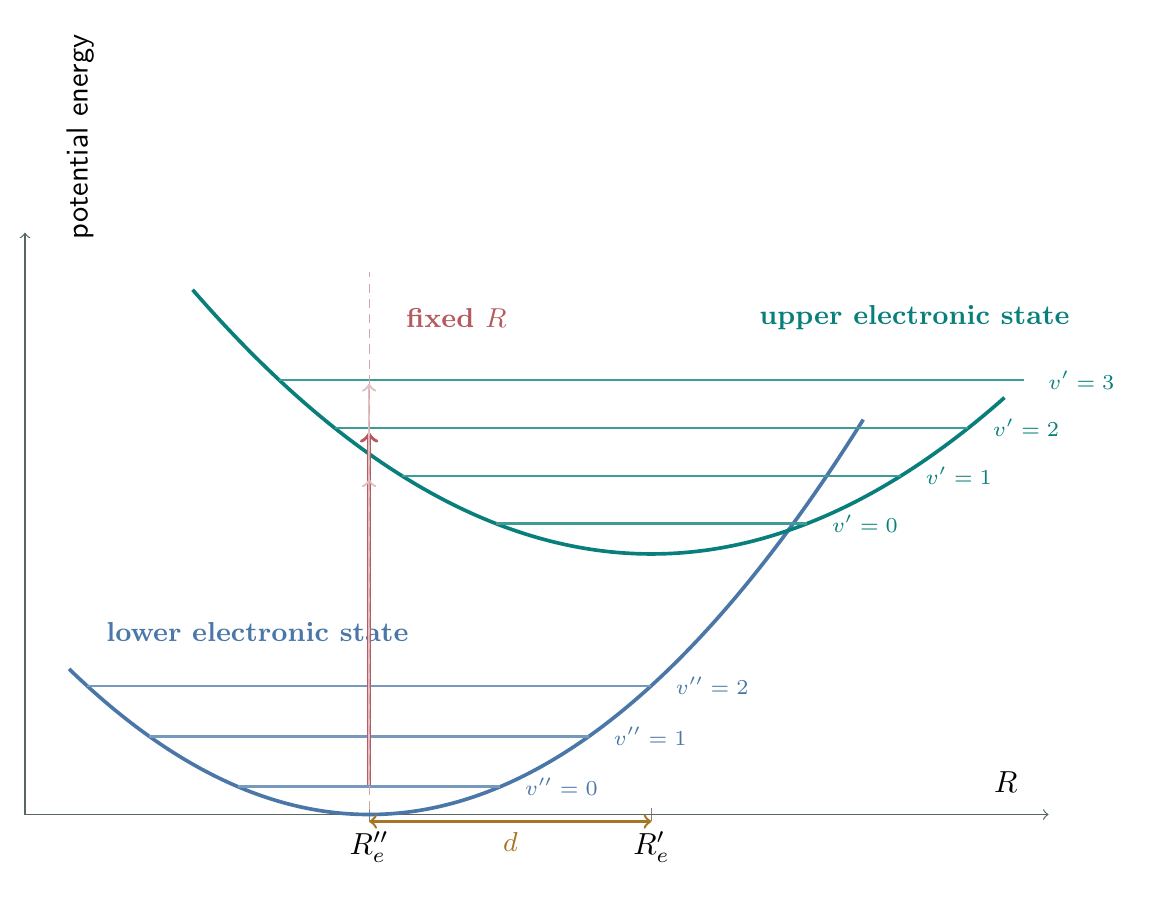
Electrons move on a much shorter time scale than nuclei. During an electronic absorption or emission event, the electronic distribution can change while the internuclear separation $R$ has essentially no time to change. This is the Franck–Condon principle:
An electronic transition occurs at fixed nuclear coordinates.
In a potential-energy diagram whose horizontal axis is $R$, such a transition is drawn vertically. “Vertical” means constant $R$; it does not mean that the nuclei move vertically or that energy is unconstrained.
Quantum-mechanical factorization
In the Born–Oppenheimer approximation, neglecting rotation for the moment,
\[\Psi_i(\mathbf r,R) =\phi_i(\mathbf r;R)\chi_{v''}(R), \qquad \Psi_f(\mathbf r,R) =\phi_f(\mathbf r;R)\chi_{v'}(R).\]The electric-dipole transition amplitude is
\[\mathbf M_{fi} =\int dR\int d\mathbf r\, \chi_{v'}^*(R)\phi_f^*(\mathbf r;R) \widehat{\boldsymbol\mu} \phi_i(\mathbf r;R)\chi_{v''}(R).\]Perform the electronic integral first:
\[\mathbf M_{\mathrm e}(R) =\int \phi_f^*(\mathbf r;R) \widehat{\boldsymbol\mu} \phi_i(\mathbf r;R)\,d\mathbf r.\]Then
\[\mathbf M_{fi} =\int \chi_{v'}^*(R)\, \mathbf M_{\mathrm e}(R)\, \chi_{v''}(R)\,dR.\]The Condon approximation assumes that the electronic transition moment changes slowly over the range in which the vibrational wavefunctions are appreciable:
\[\mathbf M_{\mathrm e}(R)\simeq\mathbf M_{\mathrm e}(R_0).\]Here $R_0$ is a representative internuclear separation within that overlap region; it is not a new dynamical coordinate.
It may therefore be taken outside the nuclear integral:
\[\mathbf M_{fi} \simeq \mathbf M_{\mathrm e}(R_0) \left\langle\chi_{v'}\middle|\chi_{v''}\right\rangle.\]The Franck–Condon factor is
\[\boxed{ q_{v'v''} =\left| \int\chi_{v'}^*(R)\chi_{v''}(R)\,dR \right|^2. }\]It is a probability-like overlap factor, not an additional energy-selection rule. Energy conservation still fixes the photon frequency.
Exactly displaced harmonic potentials
The origin of a vibrational progression can be seen analytically. Suppose the lower and upper potentials have the same curvature, but their equilibrium positions differ by $d$. Put
\[\mu_{\mathrm r}=\frac{m_1m_2}{m_1+m_2}, \qquad \alpha=\frac{\mu_{\mathrm r}\omega}{\hbar}, \qquad x=R-R_e''.\]Here $\mu_{\mathrm r}$ is the nuclear reduced mass and $\omega$ is the common angular vibrational frequency of the two harmonic potentials.
Take the lower state to be $v’‘=0$. The normalized functions are
\[\chi_0''(x) =\left(\frac{\alpha}{\pi}\right)^{1/4} e^{-\alpha x^2/2},\]and
\[\chi_n'(x) =\left(\frac{\alpha}{\pi}\right)^{1/4} \frac{H_n\!\left(\sqrt\alpha(x-d)\right)} {\sqrt{2^n n!}}\, e^{-\alpha(x-d)^2/2}.\]Let $z=\sqrt\alpha x$ and $\delta=\sqrt\alpha d$. To evaluate the overlaps, use the Hermite generating function
\[\sum_{n=0}^{\infty}\frac{H_n(z-\delta)}{n!}t^n =e^{2(z-\delta)t-t^2}.\]The Gaussian integral that generates the unnormalized overlap is
\[\begin{aligned} K(t) &=\frac1{\sqrt\pi}\int_{-\infty}^{\infty} e^{-[z^2+(z-\delta)^2]/2} e^{2(z-\delta)t-t^2}\,dz\\ &=\frac1{\sqrt\pi} e^{-\delta^2/2-2\delta t-t^2} \int_{-\infty}^{\infty} e^{-z^2+(\delta+2t)z}\,dz. \end{aligned}\]Completing the square,
\[\int_{-\infty}^{\infty}e^{-z^2+bz}\,dz =\sqrt\pi\,e^{b^2/4}.\]With $b=\delta+2t$,
\[\begin{aligned} K(t) &=e^{-\delta^2/2-2\delta t-t^2} e^{(\delta+2t)^2/4}\\ &=e^{-\delta^2/4}e^{-\delta t}. \end{aligned}\]Comparing equal powers of $t$ and restoring the normalization $1/\sqrt{2^n n!}$ gives
\[\left\langle\chi_n'\middle|\chi_0''\right\rangle =e^{-\delta^2/4} \frac{(-\delta)^n}{\sqrt{2^n n!}}.\]Define the dimensionless displacement
\[S=\frac{\delta^2}{2} =\frac{\mu_{\mathrm r}\omega d^2}{2\hbar}.\]The overlap amplitude and factor become
\[\left\langle\chi_n'\middle|\chi_0''\right\rangle =e^{-S/2}\frac{(-\sqrt S)^n}{\sqrt{n!}},\] \[\boxed{ q_{n0}=e^{-S}\frac{S^n}{n!}. }\]The factors are normalized:
\[\sum_{n=0}^{\infty}q_{n0} =e^{-S}\sum_{n=0}^{\infty}\frac{S^n}{n!} =e^{-S}e^S=1.\]If $d=0$, then $S=0$ and only $q_{00}=1$. If the minima are displaced, the largest factor occurs near $n\simeq S$, so the strongest band need not end at $v’=0$. For unequal curvatures, the overlaps are no longer this simple Poisson distribution, but the defining integral remains valid.
What determines a measured band intensity
The Franck–Condon factor is only the vibrational part. A measured line or band intensity also contains
\[I_{v'v''J'J''} \propto N_{v''J''}\, \mathcal F(\nu)\, \left|\mathbf M_{\mathrm e}\right|^2 q_{v'v''}\, S_{J'J''}.\]Here $N_{v’‘J’’}$ is the initial population, $\mathcal F(\nu)$ is the frequency-dependent radiation factor appropriate to absorption or emission, and $S_{J’J’’}$ is the rotational line-strength factor. Thus the Franck–Condon principle explains the vibrational envelope only after the electronic transition is allowed; it does not by itself determine the full observed intensity.
The Gaussian completion, Poisson recurrence, normalization, and zero-displacement limit are checked in the Maxima worksheet.


Discussion