

17 May 2026
Infrared Spectra of Diatomic Molecules
Electric-dipole absorption, infrared activity, vibration–rotation selection rules, and the structure of a diatomic infrared band.
Infrared absorption occurs when the oscillating electric field of light drives an allowed molecular electric-dipole transition. Let
\[\mathbf E(t)=E_0\boldsymbol\epsilon\cos\omega t.\]In the electric-dipole approximation the interaction Hamiltonian is
\[\widehat H'(t) =-\widehat{\boldsymbol\mu}\cdot\mathbf E(t).\]If the molecule begins in $|i\rangle$, first-order time-dependent perturbation theory gives the amplitude for reaching $|f\rangle$:
\[c_f^{(1)}(t) =-\frac{i}{\hbar} \int_0^t \langle f|\widehat H'(t')|i\rangle e^{i\omega_{fi}t'}\,dt',\]where $\omega_{fi}=(E_f-E_i)/\hbar$. Since
\[\cos\omega t' =\frac12\left(e^{i\omega t'}+e^{-i\omega t'}\right),\]the absorption part contains
\[\int_0^t e^{i(\omega_{fi}-\omega)t'}dt' =e^{i(\omega_{fi}-\omega)t/2} \frac{2\sin[(\omega_{fi}-\omega)t/2]} {\omega_{fi}-\omega}.\]For a long interaction time this function is sharply peaked at $\omega=\omega_{fi}$. The corresponding transition rate has the form
\[W_{i\rightarrow f} \propto \left| \left\langle f\middle| \widehat{\boldsymbol\mu}\cdot\boldsymbol\epsilon \middle|i\right\rangle \right|^2 \delta(E_f-E_i-\hbar\omega).\]An infrared line therefore requires both energy conservation and a nonzero transition-dipole matrix element.
Vibrational infrared activity
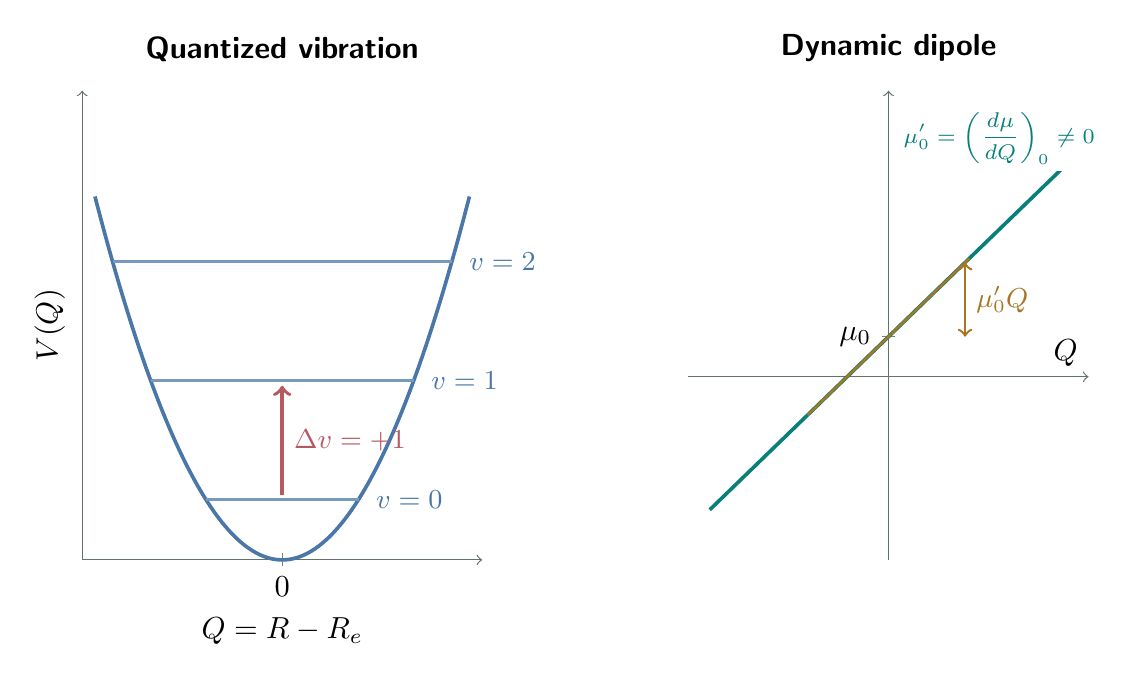
Let $Q=R-R_e$ be the bond-stretching coordinate. Expand the body-fixed dipole moment about equilibrium:
\[\mu(Q) =\mu_0+\mu_0'Q+\frac12\mu_0''Q^2+\cdots,\]where
\[\mu_0' =\left(\frac{d\mu}{dQ}\right)_0.\]For harmonic vibration,
\[Q=\sqrt{\frac{\hbar}{2\mu_{\mathrm r}\omega_e}}\,(a+a^\dagger).\]Here
\[\mu_{\mathrm r}=\frac{m_1m_2}{m_1+m_2}\]is the nuclear reduced mass and $\omega_e=\sqrt{k/\mu_{\mathrm r}}$ is the angular vibrational frequency.
The constant term gives
\[\langle v'|\mu_0|v\rangle =\mu_0\delta_{v'v}\]and cannot change the vibrational state. The linear term gives
\[\begin{aligned} \langle v'|Q|v\rangle =\sqrt{\frac{\hbar}{2\mu_{\mathrm r}\omega_e}} \left( \langle v'|a|v\rangle +\langle v'|a^\dagger|v\rangle \right). \end{aligned}\]Using
\[a|v\rangle=\sqrt v\,|v-1\rangle, \qquad a^\dagger|v\rangle=\sqrt{v+1}\,|v+1\rangle,\]one obtains
\[\langle v'|Q|v\rangle =\sqrt{\frac{\hbar}{2\mu_{\mathrm r}\omega_e}} \left[ \sqrt v\,\delta_{v',v-1} +\sqrt{v+1}\,\delta_{v',v+1} \right].\]Consequently, the harmonic fundamental obeys
\[\boxed{\Delta v=\pm1}\]and is infrared active only when
\[\boxed{\left(\frac{d\mu}{dQ}\right)_0\ne0.}\]This derivative criterion, rather than merely the value of the permanent dipole, governs a pure vibrational transition. A homonuclear diatomic molecule has $\mu(Q)=0$ for every bond length by inversion symmetry and is therefore inactive in electric-dipole vibrational absorption.
Rotational structure of the fundamental
For a linear diatomic molecule in a $\Sigma$ electronic state, the space-fixed dipole operator contains the angular factor $\cos\theta$. The exact recurrence relation
\[\begin{aligned} \cos\theta\,Y_J^M ={}& \sqrt{\frac{(J+1)^2-M^2}{(2J+1)(2J+3)}}Y_{J+1}^M\\ &+ \sqrt{\frac{J^2-M^2}{(2J-1)(2J+1)}}Y_{J-1}^M \end{aligned}\]contains no $Y_J^M$ term. Orthogonality therefore gives
\[\Delta J=\pm1.\]For a pure rotational infrared transition the radial factor is the permanent dipole $\mu_0$, so $\mu_0\ne0$ is also required.
Combining this with $v’‘=0\rightarrow v’=1$ produces a $P$ branch with $J’=J’‘-1$ and an $R$ branch with $J’=J’‘+1$. There is no $Q$ branch for a $\Sigma\leftrightarrow\Sigma$ vibration–rotation band.
Write
\[\frac{E(v,J)}{hc} =G(v)+B_vJ(J+1)\]and let $\widetilde\nu_0=G(1)-G(0)$. For a line originating from $J=J’’$,
\[\widetilde\nu =\widetilde\nu_0+B'J'(J'+1)-B''J(J+1).\]Substitution of $J’=J+1$ gives
\[\boxed{ \widetilde\nu_R(J) =\widetilde\nu_0+(B'+B'')(J+1) +(B'-B'')(J+1)^2. }\]Substitution of $J’=J-1$ gives
\[\boxed{ \widetilde\nu_P(J) =\widetilde\nu_0-(B'+B'')J +(B'-B'')J^2. }\]Usually vibration increases the mean bond length, so $B’<B’’$. The $R$-branch spacing is
\[\widetilde\nu_R(J+1)-\widetilde\nu_R(J) =B'+B''+(B'-B'')(2J+3),\]and therefore contracts with $J$. Measured in the direction of decreasing wavenumber, the positive $P$-branch spacing is
\[\widetilde\nu_P(J)-\widetilde\nu_P(J+1) =B'+B''-(B'-B'')(2J+1),\]and therefore expands when $B’<B’’$.
The population of the absorbing lower rotational level is approximately
\[N_J\propto(2J+1) \exp\left[-\frac{hcB''J(J+1)}{k_{\mathrm B}T}\right].\]Together with the rotational transition moment, this population creates the intensity envelope across the $P$ and $R$ branches.
Overtones and hot bands
For an anharmonic oscillator,
\[G(v) =\widetilde\nu_e\left(v+\frac12\right) -\widetilde\nu_ex_e\left(v+\frac12\right)^2.\]The adjacent vibrational interval is
\[G(v+1)-G(v) =\widetilde\nu_e-2\widetilde\nu_ex_e(v+1).\]At elevated temperature, transitions beginning at $v>0$ produce hot bands at slightly lower wavenumber than the $0\rightarrow1$ fundamental.
The quadratic dipole term contains $Q^2\propto a^2+(a^\dagger)^2+aa^\dagger+a^\dagger a$ and can connect $\Delta v=\pm2$. Anharmonic wavefunctions also mix harmonic basis states. These two mechanisms give weak overtone intensity. Anharmonic level spacing alone does not make all overtones allowed.


Discussion