

29 May 2026
Nuclear Magnetic Resonance
Nuclear Zeeman levels, Larmor precession, radio-frequency transitions, equilibrium magnetization, shielding, and relaxation.
Nuclear magnetic resonance (NMR) is the resonant response of a nuclear magnetic moment to a radio-frequency field in the presence of a static magnetic field. A nucleus can show NMR only when its spin quantum number is nonzero, because then it possesses angular momentum and a magnetic moment.
Nuclear moment and Zeeman energy
For a particular nucleus, angular momentum and magnetic moment are related by
\[\boxed{ \hat{\boldsymbol{\mu}}=\gamma\hat{\mathbf I} },\]where $\gamma$ is the nuclear gyromagnetic ratio. Apply
\[\mathbf B_0=B_0\hat{\mathbf z}.\]The magnetic Hamiltonian is
\[\hat H_0 =-\hat{\boldsymbol{\mu}}\cdot\mathbf B_0 =-\gamma B_0\hat I_z.\]The angular-momentum eigenvalue equation is
\[\hat I_z\lvert I,m\rangle =m\hbar\lvert I,m\rangle, \qquad m=-I,-I+1,\ldots,I.\]It follows that
\[\hat H_0\lvert I,m\rangle =-\gamma\hbar B_0m\lvert I,m\rangle.\]Thus
\[\boxed{ E_m=-\gamma\hbar B_0m }.\]For a spin-$1/2$ nucleus with $\gamma>0$,
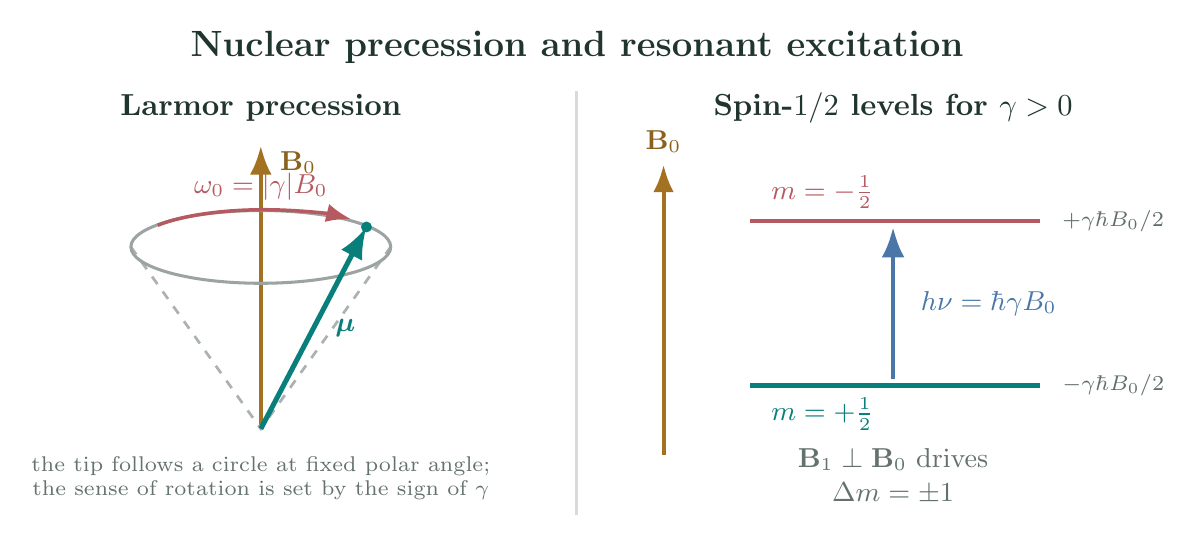
\[E_{+1/2}=-\frac12\gamma\hbar B_0, \qquad E_{-1/2}=+\frac12\gamma\hbar B_0.\]Thus $m=+1/2$ is the lower state when $\gamma>0$. If $\gamma<0$, this ordering reverses; the resonance frequency remains positive and is therefore written using $\lvert\gamma\rvert$.
The adjacent-level separation is
\[\Delta E =E_{m-1}-E_m =\gamma\hbar B_0.\]For either sign of $\gamma$, its magnitude is
\[\boxed{ \lvert\Delta E\rvert =\hbar\lvert\gamma\rvert B_0 }.\]Larmor precession from the torque equation
The magnetic torque on a moment is
\[\boldsymbol{\tau} =\boldsymbol{\mu}\times\mathbf B_0.\]Torque is the rate of change of angular momentum:
\[\frac{d\mathbf I}{dt} =\boldsymbol{\mu}\times\mathbf B_0.\]Since $\boldsymbol{\mu}=\gamma\mathbf I$,
\[\frac{d\boldsymbol{\mu}}{dt} =\gamma\frac{d\mathbf I}{dt} =\gamma\boldsymbol{\mu}\times\mathbf B_0.\]For $\mathbf B_0=B_0\hat{\mathbf z}$,
\[\boldsymbol{\mu}\times\mathbf B_0 = \begin{vmatrix} \hat{\mathbf x}&\hat{\mathbf y}&\hat{\mathbf z}\\ \mu_x&\mu_y&\mu_z\\ 0&0&B_0 \end{vmatrix} =B_0\mu_y\hat{\mathbf x} -B_0\mu_x\hat{\mathbf y}.\]Therefore
\[\frac{d\mu_x}{dt}=\gamma B_0\mu_y, \qquad \frac{d\mu_y}{dt}=-\gamma B_0\mu_x, \qquad \frac{d\mu_z}{dt}=0.\]Define the transverse complex component
\[\mu_+=\mu_x+i\mu_y.\]Then
\[\frac{d\mu_+}{dt} =\gamma B_0\mu_y-i\gamma B_0\mu_x =-i\gamma B_0(\mu_x+i\mu_y),\]so
\[\frac{d\mu_+}{dt}=-i\gamma B_0\mu_+.\]Separating variables and integrating,
\[\frac{d\mu_+}{\mu_+}=-i\gamma B_0\,dt,\] \[\ln\frac{\mu_+(t)}{\mu_+(0)} =-i\gamma B_0t,\]and hence
\[\mu_+(t)=\mu_+(0)e^{-i\gamma B_0t}.\]Define the signed Larmor angular velocity and its positive resonance magnitude by
\[\omega_L=\gamma B_0, \qquad \omega_0=\lvert\omega_L\rvert=\lvert\gamma\rvert B_0.\]The sign of $\omega_L$ determines the sense of precession, whereas the resonance angular frequency is
\[\boxed{ \omega_0=\lvert\gamma\rvert B_0 }.\]The constancy of $\mu_z$ and $\mu_x^2+\mu_y^2$ means that the tip of the moment traces a circle at a fixed polar angle about $\mathbf B_0$.
Radio-frequency excitation and selection rule
Add a weak field perpendicular to $\mathbf B_0$:
\[\mathbf B_1(t)=B_1\cos\omega t\,\hat{\mathbf x}.\]The time-dependent interaction is
\[\hat H_1(t)=-\gamma B_1\hat I_x\cos\omega t.\]Using the ladder operators,
\[\hat I_x=\frac12(\hat I_++\hat I_-),\]with
\[\hat I_\pm\lvert I,m\rangle =\hbar \sqrt{I(I+1)-m(m\pm1)} \lvert I,m\pm1\rangle,\]shows that $\hat I_x$ connects only states for which
\[\boxed{\Delta m=\pm1}.\]Resonant absorption requires the photon energy to equal the adjacent-level separation:
\[\hbar\omega=\hbar\lvert\gamma\rvert B_0.\]Cancelling $\hbar$,
\[\omega=\lvert\gamma\rvert B_0.\]Since $\omega=2\pi\nu$,
\[\boxed{ \nu=\frac{\lvert\gamma\rvert}{2\pi}B_0 }.\]The same frequency has therefore appeared in two ways: as the classical Larmor precession frequency and as the Bohr frequency between quantum Zeeman levels.
Equilibrium population and magnetization
For $I=1/2$ and $\gamma>0$, let
\[\Delta E=\hbar\gamma B_0.\]The lower and upper energies are $-\Delta E/2$ and $+\Delta E/2$. Their population ratio is
\[\frac{N_{\mathrm{upper}}}{N_{\mathrm{lower}}} =e^{-\Delta E/(k_BT)}.\]The fractional population difference is
\[\frac{N_{\mathrm{lower}}-N_{\mathrm{upper}}}{N} =\tanh\left(\frac{\Delta E}{2k_BT}\right).\]If $\Delta E\ll k_BT$,
\[\tanh\left(\frac{\Delta E}{2k_BT}\right) \simeq\frac{\Delta E}{2k_BT} =\frac{\hbar\gamma B_0}{2k_BT}.\]For number density $n$, each spin-$1/2$ nucleus contributes a field-directed moment of magnitude $\gamma\hbar/2$ with a sign set by its state. The equilibrium magnetization is therefore
\[M_0 =n\frac{\gamma\hbar}{2} \tanh\left(\frac{\hbar\gamma B_0}{2k_BT}\right).\]In the high-temperature limit,
\[\boxed{ M_0\simeq \frac{n\gamma^2\hbar^2}{4k_BT}B_0 }.\]The NMR signal grows with magnetic field and decreases with temperature because both effects change the small population imbalance.
Shielding and resonance position
Electrons circulate in the applied field and produce a local field at the nucleus. For an isotropic environment, define the shielding constant $\sigma$ by
\[B_{\mathrm{loc}}=(1-\sigma)B_0.\]Replacing $B_0$ by the field actually experienced by the nucleus gives
\[\boxed{ \nu=\frac{\lvert\gamma\rvert}{2\pi}(1-\sigma)B_0 }.\]Chemically different electronic environments have different $\sigma$ and hence different resonance frequencies. Relative to a reference frequency $\nu_{\mathrm{ref}}$, the chemical shift is written
\[\boxed{ \delta= \frac{\nu-\nu_{\mathrm{ref}}}{\nu_{\mathrm{ref}}} \times10^6\ \mathrm{ppm} }.\]Because both frequencies scale approximately with $B_0$, the dimensionless chemical shift is essentially independent of the spectrometer field.
Relaxation and detection
A radio-frequency pulse can tip the macroscopic magnetization away from its equilibrium direction. After the pulse, longitudinal relaxation is described by
\[\frac{dM_z}{dt} =-\frac{M_z-M_0}{T_1}.\]Let $Y=M_z-M_0$. Then
\[\frac{dY}{Y}=-\frac{dt}{T_1}.\]Integrating from $0$ to $t$ gives
\[\ln\frac{Y(t)}{Y(0)}=-\frac{t}{T_1},\]so
\[\boxed{ M_z(t)=M_0+[M_z(0)-M_0]e^{-t/T_1} }.\]Transverse dephasing and precession obey
\[\frac{dM_+}{dt} =-\left(\frac1{T_2}+i\omega_L\right)M_+, \qquad M_+=M_x+iM_y.\]Separation and integration give
\[\boxed{ M_+(t)=M_+(0)e^{-t/T_2}e^{-i\omega_Lt} }.\]The rotating transverse magnetization changes the magnetic flux through a receiver coil. Faraday’s law,
\[\mathcal E(t)=-\frac{d\Phi(t)}{dt},\]then produces an oscillating, exponentially decaying voltage called the free-induction decay. Its frequencies reveal the NMR resonance positions, while its decay contains the transverse relaxation information.
The spin-matrix, signed-precession, magnetization, shielding, and relaxation identities are checked in the Maxima worksheet.


Discussion