

20 May 2026
Raman Spectra of Diatomic Molecules
Induced-dipole scattering, vibrational and rotational Raman selection rules, and Stokes–anti-Stokes spectra of diatomic molecules.
Raman spectroscopy measures inelastic scattering rather than direct absorption. An incident photon polarizes the molecule; the oscillating induced dipole radiates a photon whose frequency may differ from that of the incident light.
Induced dipole and Raman frequencies
Let the incident electric field be
\[E(t)=E_0\cos(2\pi\nu_0t).\]For one molecular vibration,
\[Q(t)=Q_0\cos(2\pi\nu_vt).\]Expand the polarizability along the chosen polarization direction:
\[\alpha(Q) =\alpha_0+\alpha_0'Q+\cdots, \qquad \alpha_0' =\left(\frac{d\alpha}{dQ}\right)_0.\]The induced dipole is
\[\begin{aligned} p(t) &=\alpha(Q)E(t)\\ &=\alpha_0E_0\cos(2\pi\nu_0t)\\ &\quad +\alpha_0'Q_0E_0 \cos(2\pi\nu_vt)\cos(2\pi\nu_0t). \end{aligned}\]Using
\[\cos A\cos B =\frac12\left[\cos(A+B)+\cos(A-B)\right],\]one obtains
\[\begin{aligned} p(t) ={}&\alpha_0E_0\cos(2\pi\nu_0t)\\ &+\frac12\alpha_0'Q_0E_0 \cos\!\left[2\pi(\nu_0+\nu_v)t\right]\\ &+\frac12\alpha_0'Q_0E_0 \cos\!\left[2\pi(\nu_0-\nu_v)t\right]. \end{aligned}\]The three radiated frequencies are therefore
\[\begin{array}{lll} \nu_0&:&\text{Rayleigh scattering},\\ \nu_0-\nu_v&:&\text{Stokes Raman scattering},\\ \nu_0+\nu_v&:&\text{anti-Stokes Raman scattering}. \end{array}\]The sideband amplitudes vanish unless
\[\boxed{\left(\frac{d\alpha}{dQ}\right)_0\ne0.}\]This is the vibrational Raman activity criterion.
Quantum interpretation
For Stokes scattering the molecule gains energy:
\[h\nu_0-h\nu_s=E_f-E_i>0,\]so
\[\nu_s=\nu_0-\frac{E_f-E_i}{h}.\]For anti-Stokes scattering the molecule loses energy:
\[\nu_{as}=\nu_0+\frac{E_i-E_f}{h}.\]The polarizability is an operator in the molecular coordinates. For harmonic vibration,
\[\widehat\alpha \simeq\alpha_0+\alpha_0'\widehat Q, \qquad \widehat Q =\sqrt{\frac{\hbar}{2\mu_{\mathrm r}\omega_v}}(a+a^\dagger).\]Here
\[\mu_{\mathrm r}=\frac{m_1m_2}{m_1+m_2}\]is the nuclear reduced mass and $\omega_v=2\pi\nu_v$ is the angular vibrational frequency.
Therefore
\[\begin{aligned} \langle v'|\widehat Q|v\rangle =\sqrt{\frac{\hbar}{2\mu_{\mathrm r}\omega_v}} \left[ \sqrt v\,\delta_{v',v-1} +\sqrt{v+1}\,\delta_{v',v+1} \right], \end{aligned}\]and the harmonic vibrational Raman rule is
\[\Delta v=\pm1.\]The transition is present only when $\alpha_0’\ne0$, because the constant term $\alpha_0$ is diagonal in $v$.
The first anti-Stokes line requires a molecule initially in $v=1$, whereas the first Stokes line may begin in $v=0$. Since
\[\frac{N_1}{N_0} =\exp\left(-\frac{h\nu_v}{k_{\mathrm B}T}\right),\]anti-Stokes scattering is normally weaker. Including the fourth-power frequency dependence of dipole radiation gives approximately
\[\frac{I_{\mathrm{AS}}}{I_{\mathrm S}} = \left(\frac{\nu_0+\nu_v}{\nu_0-\nu_v}\right)^4 \exp\left(-\frac{h\nu_v}{k_{\mathrm B}T}\right).\]Pure rotational Raman spectrum
For a linear molecule with unit vector $\widehat{\mathbf n}$ along its axis, the polarizability tensor is
\[\boldsymbol\alpha =\alpha_\perp\mathbf 1 +(\alpha_\parallel-\alpha_\perp) \widehat{\mathbf n}\widehat{\mathbf n}.\]With the field along $z$,
\[\begin{aligned} \alpha_{zz} &=\alpha_\perp +(\alpha_\parallel-\alpha_\perp)\cos^2\theta\\ &=\frac{\alpha_\parallel+2\alpha_\perp}{3} +\frac{2(\alpha_\parallel-\alpha_\perp)}{3} P_2(\cos\theta), \end{aligned}\]because $\cos^2\theta=[1+2P_2(\cos\theta)]/3$. The angular matrix element contains three spherical harmonics,
\[\int Y_{J'M'}^*Y_2^0Y_J^M\,d\Omega.\]It can be nonzero only when the angular momenta satisfy
\[|J'-J|\le2\le J'+J\]and $J’+J+2$ is even. Together these conditions give
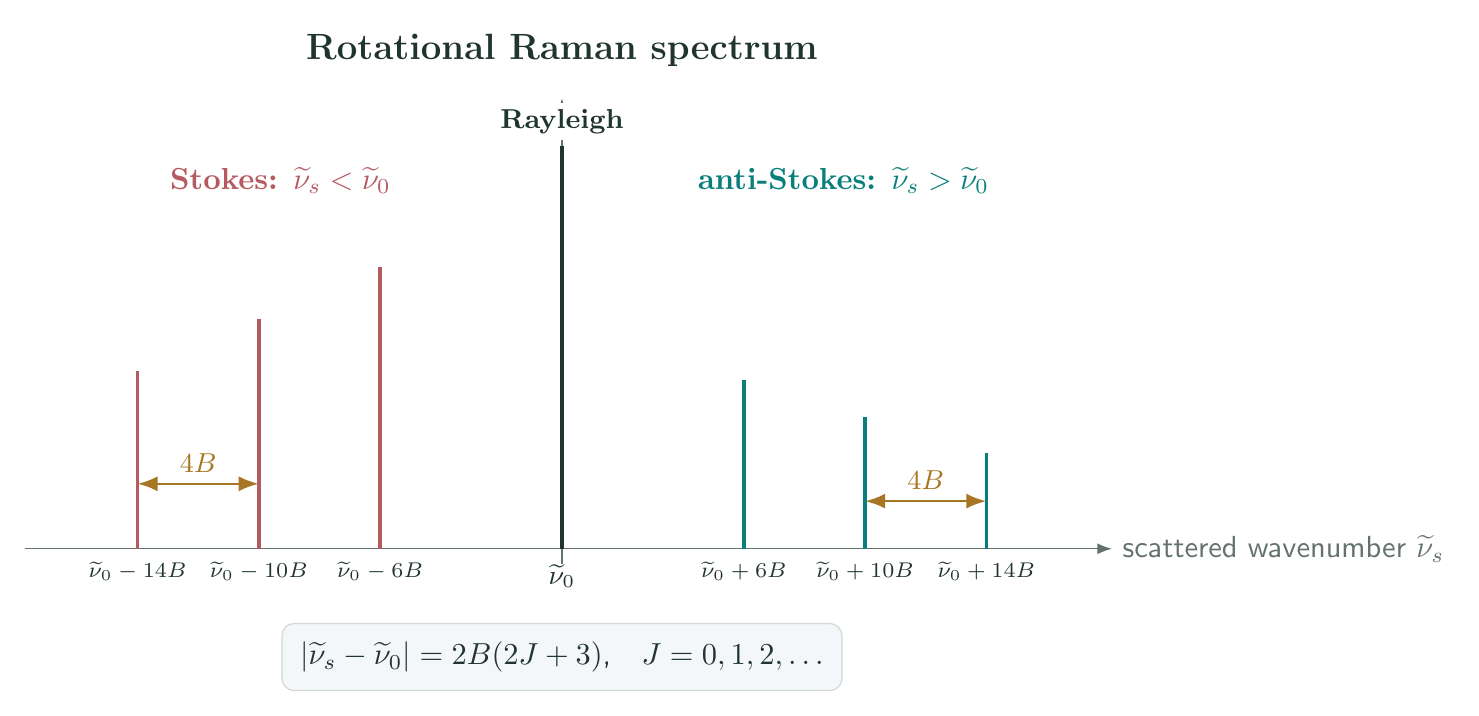
\[\Delta J=0,\pm2.\]For a pure rotational Raman shift, $\Delta J=0$ is elastic Rayleigh scattering. Stokes lines have $J\rightarrow J+2$. With
\[B=\frac{h}{8\pi^2cI}\]the rotational constant in wavenumber units, $F(J)=BJ(J+1)$ and
\[\begin{aligned} \Delta\widetilde\nu_J &=F(J+2)-F(J)\\ &=B\left[(J+2)(J+3)-J(J+1)\right]\\ &=\boxed{2B(2J+3)}. \end{aligned}\]For $J=0,1,2,\ldots$, the Raman shifts are
\[6B,\;10B,\;14B,\ldots,\]and successive lines are separated by
\[\Delta\widetilde\nu_{J+1}-\Delta\widetilde\nu_J=4B.\]Rotational Raman scattering requires anisotropic polarizability, $\alpha_\parallel-\alpha_\perp\ne0$, but not a permanent electric dipole. Homonuclear diatomic molecules can therefore possess rotational Raman spectra even though their pure rotational electric-dipole spectra are absent.
Vibration–rotation Raman branches
When vibration and rotation both change, the vibrational rule is $\Delta v=\pm1$ and the rotational rules are
\[\Delta J=-2,0,+2.\]They form the $O$, $Q$, and $S$ branches, respectively. The $Q$ branch can receive a rank-zero scalar contribution as well as a rank-two anisotropic contribution. The scalar part contributes only to $Q$, whereas the $O$ and $S$ branches necessarily arise from the anisotropic part.
For a centrosymmetric molecule, an infrared-active normal coordinate must transform like the odd dipole operator, whereas a Raman-active coordinate must transform like the even polarizability tensor. This gives the mutual exclusion rule: a centrosymmetric normal mode cannot be both infrared and Raman active in the electric-dipole approximation. The symmetric stretch of a homonuclear diatomic molecule is the simplest Raman-active, infrared-inactive example.
The sideband identity, rotational Raman shifts and spacing, anharmonic hot-band interval, and quadratic-coordinate coefficient are checked in the Maxima worksheet.


Discussion