

02 May 2026
Rotational Spectra of Diatomic Molecules
Rigid-rotor dynamics, quantized rotational levels, electric-dipole selection rules, and the microwave line spectrum of a diatomic molecule.
Consider two nuclei of masses $m_1$ and $m_2$ at positions $\mathbf r_1$ and $\mathbf r_2$. Introduce the centre-of-mass and relative coordinates
\[\mathbf R=\frac{m_1\mathbf r_1+m_2\mathbf r_2}{m_1+m_2}, \qquad \mathbf r=\mathbf r_1-\mathbf r_2.\]If $M=m_1+m_2$ and
\[\mu=\frac{m_1m_2}{m_1+m_2}\]is the reduced mass, the inverse transformation is
\[\mathbf r_1=\mathbf R+\frac{m_2}{M}\mathbf r, \qquad \mathbf r_2=\mathbf R-\frac{m_1}{M}\mathbf r.\]Substitution into the nuclear kinetic energy gives
\[\begin{aligned} T &=\frac12m_1\dot{\mathbf r}_1^{\,2} +\frac12m_2\dot{\mathbf r}_2^{\,2}\\ &=\frac12m_1 \left(\dot{\mathbf R}+\frac{m_2}{M}\dot{\mathbf r}\right)^2 +\frac12m_2 \left(\dot{\mathbf R}-\frac{m_1}{M}\dot{\mathbf r}\right)^2\\ &=\frac12(m_1+m_2)\dot{\mathbf R}^{\,2} +\frac{m_1m_2-m_2m_1}{M} \dot{\mathbf R}\cdot\dot{\mathbf r}\\ &\quad +\frac12\left( \frac{m_1m_2^2+m_2m_1^2}{M^2} \right)\dot{\mathbf r}^{\,2}\\ &=\frac12M\dot{\mathbf R}^{\,2} +\frac12\frac{m_1m_2}{M}\dot{\mathbf r}^{\,2}\\ &=\frac12M\dot{\mathbf R}^{\,2} +\frac12\mu\dot{\mathbf r}^{\,2}. \end{aligned}\]The translational motion of the whole molecule therefore separates from its internal motion. Spectroscopy concerns the second term.
The rigid rotor
At rotational energies much smaller than the vibrational spacing, take the internuclear distance to be fixed at its equilibrium value $r_e$. In spherical coordinates,
\[\dot{\mathbf r}^{\,2} =\dot r^{\,2}+r^2\dot\theta^{\,2} +r^2\sin^2\theta\,\dot\phi^{\,2}.\]Putting $\dot r=0$ and $r=r_e$ gives
\[T_{\mathrm{rot}} =\frac12I\left(\dot\theta^{\,2} +\sin^2\theta\,\dot\phi^{\,2}\right), \qquad I=\mu r_e^2.\]Since the classical angular momentum satisfies $L^2=2IT_{\mathrm{rot}}$, the quantum Hamiltonian is
\[\widehat H_{\mathrm{rot}}=\frac{\widehat L^2}{2I}.\]The spherical harmonics obey
\[\widehat L^2Y_J^M =\hbar^2J(J+1)Y_J^M, \qquad J=0,1,2,\ldots,\]and hence
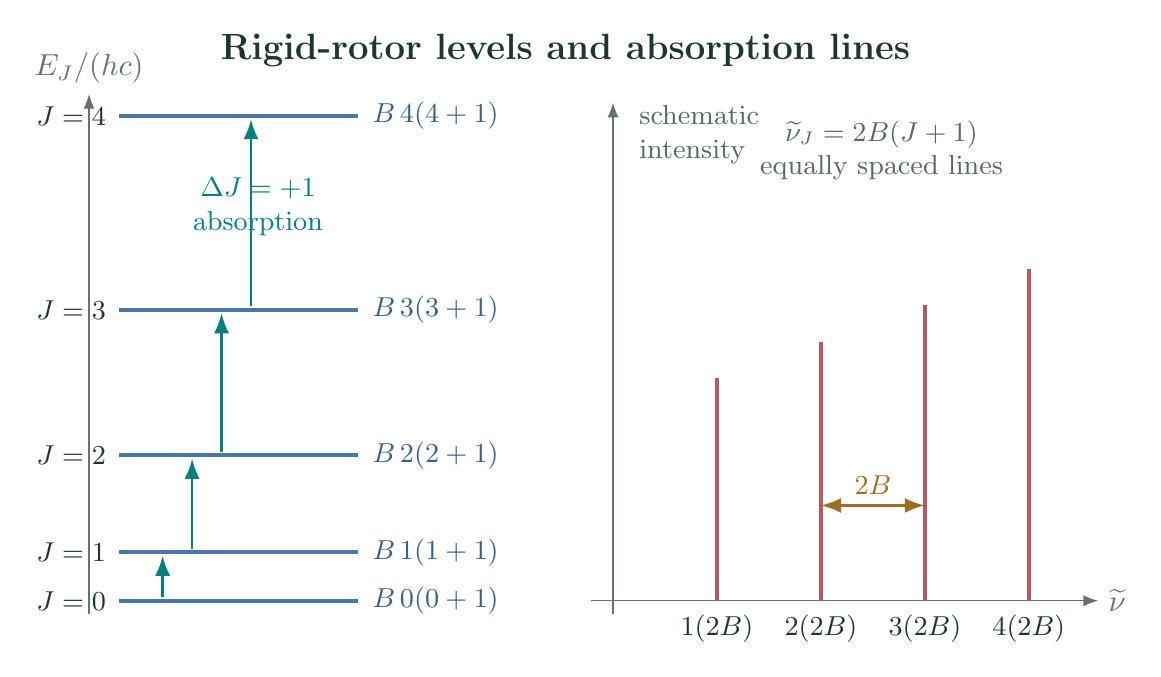
\[\boxed{E_J=\frac{\hbar^2}{2I}J(J+1)}.\]For a given $J$, $M$ takes the $2J+1$ values $-J,-J+1,\ldots,J$, so a field-free rotational level is $(2J+1)$-fold degenerate.
Spectroscopic energies are usually divided by $hc$. Define the rotational term value
\[F(J)=\frac{E_J}{hc}=BJ(J+1),\]where
\[\boxed{ B=\frac{\hbar^2}{2Ihc} =\frac{h}{8\pi^2cI} =\frac{h}{8\pi^2c\mu r_e^2}. }\]Thus a measured rotational constant determines the molecular moment of inertia and, if the isotopic masses are known, the bond length.
Electric-dipole selection rule
Let a heteronuclear molecule possess a permanent electric dipole $\boldsymbol\mu_e=\mu_e\widehat{\mathbf r}$. In a radiation field polarized along $z$, the perturbation contains
\[\widehat H'(t)=-\mu_eE_0\cos\theta\cos\omega t.\]A transition is possible only if
\[\left\langle J'M'\middle|\cos\theta\middle|JM\right\rangle\ne0.\]The spherical-harmonic recurrence relation is
\[\begin{aligned} \cos\theta\,Y_J^M ={}& \sqrt{\frac{(J+1)^2-M^2}{(2J+1)(2J+3)}}\,Y_{J+1}^M\\ &+ \sqrt{\frac{J^2-M^2}{(2J-1)(2J+1)}}\,Y_{J-1}^M. \end{aligned}\]Orthogonality of the spherical harmonics leaves only
\[\Delta J=\pm1, \qquad \Delta M=0\]for $z$-polarized radiation. The other two polarizations give $\Delta M=\pm1$, but the rotational rule remains $\Delta J=\pm1$. Absorption raises the rotational quantum number, so $J\rightarrow J+1$.
A homonuclear diatomic molecule has no permanent electric dipole: exchanging its identical nuclei reverses $\widehat{\mathbf r}$ without changing the molecule, which requires $\boldsymbol\mu_e=-\boldsymbol\mu_e=0$. It therefore has no pure electric-dipole rotational spectrum.
Positions of the absorption lines
For $J\rightarrow J+1$,
\[\begin{aligned} \widetilde\nu_J &=\frac{E_{J+1}-E_J}{hc}\\ &=B\left[(J+1)(J+2)-J(J+1)\right]\\ &=2B(J+1). \end{aligned}\]Therefore
\[\boxed{\widetilde\nu_J=2B,\,4B,\,6B,\ldots}\]and neighbouring lines have the constant separation
\[\widetilde\nu_{J+1}-\widetilde\nu_J=2B.\]The photon energies lie mainly in the microwave or far-infrared region. At thermal equilibrium the population of the lower level is proportional to
\[N_J\propto(2J+1) \exp\left[-\frac{hcBJ(J+1)}{k_{\mathrm B}T}\right].\]The degeneracy initially increases with $J$, whereas the Boltzmann factor eventually decreases. Their competition produces a maximum in the observed line-intensity envelope.
Departure from perfect rigidity
Rotation stretches a real bond. Let $x=r-r_e$ and approximate the stretching potential by $kx^2/2$. For a fixed $J$, the internal energy is
\[E_J(x) =\frac12kx^2 +\frac{\hbar^2J(J+1)}{2\mu(r_e+x)^2}.\]Define
\[A_J=\frac{\hbar^2J(J+1)}{2\mu r_e^2}.\]| For $ | x | \ll r_e$, |
Therefore
\[E_J(x)\simeq A_J+\frac12kx^2-\frac{2A_J}{r_e}x.\]The stretched equilibrium for this rotational state follows from
\[\frac{dE_J}{dx}=kx-\frac{2A_J}{r_e}=0,\]so
\[x_J=\frac{2A_J}{kr_e}>0.\]Substitution back into the energy gives
\[\begin{aligned} E_J(x_J) &=A_J+\frac12k\left(\frac{2A_J}{kr_e}\right)^2 -\frac{2A_J}{r_e}\left(\frac{2A_J}{kr_e}\right)\\ &=A_J-\frac{2A_J^2}{kr_e^2}. \end{aligned}\]After division by $hc$, this has the form
\[F(J)=BJ(J+1)-D[J(J+1)]^2, \qquad D>0.\]Indeed,
\[D=\frac{2hcB^2}{kr_e^2} =\frac{4B^3}{\widetilde\nu_e^{\,2}},\]where $k=4\pi^2c^2\mu\widetilde\nu_e^{\,2}$ has been used in the second equality.
Taking the difference of adjacent terms gives
\[\begin{aligned} \widetilde\nu_J &=F(J+1)-F(J)\\ &=2B(J+1)-4D(J+1)^3. \end{aligned}\]The correction is negative because centrifugal stretching increases $I$ and therefore lowers the rotational energy. Consequently, the spacings contract slightly at large $J$ instead of remaining exactly $2B$.


Discussion