

11 May 2026
Vibrational Analysis of Molecular Band Systems
Extraction of vibrational and rotational constants from band origins, Deslandres differences, isotope shifts, and branch structure.
An electronic band system contains transitions between the vibrational levels of two electronic states. Before rotational structure is considered, the origin of the $(v’,v’’)$ band is
\[\boxed{ \widetilde\nu_{v'v''} =T_e'-T_e''+G'(v')-G''(v''). }\]For an anharmonic diatomic oscillator,
\[G(v) =\widetilde\nu_e\left(v+\frac12\right) -\widetilde\nu_ex_e\left(v+\frac12\right)^2.\]The observed array of band origins can therefore determine the vibrational constants of both electronic states.
Upper-state differences
Hold $v’’$ fixed and compare two neighbouring upper vibrational levels:
\[\begin{aligned} \Delta_1'(v') &=\widetilde\nu_{v'+1,v''} -\widetilde\nu_{v',v''}\\ &=G'(v'+1)-G'(v'). \end{aligned}\]Put $n=v’+1/2$. Then
\[\begin{aligned} G'(v'+1)-G'(v') ={}&\widetilde\nu_e' -\widetilde\nu_e'x_e' \left[(n+1)^2-n^2\right]\\ ={}&\widetilde\nu_e' -\widetilde\nu_e'x_e'(2n+1). \end{aligned}\]Since $2n+1=2(v’+1)$,
\[\boxed{ \Delta_1'(v') =\widetilde\nu_e' -2\widetilde\nu_e'x_e'(v'+1). }\]Successive upper differences themselves differ by
\[\begin{aligned} \Delta_2' &=\Delta_1'(v'+1)-\Delta_1'(v')\\ &=-2\widetilde\nu_e'x_e'. \end{aligned}\]The intercept of $\Delta_1’$ against $v’+1$ gives $\widetilde\nu_e’$, and its slope gives $-2\widetilde\nu_e’x_e’$.
Lower-state differences and their sign
Now hold $v’$ fixed and increase the lower quantum number:
\[\begin{aligned} \Delta_1''(v'') &=\widetilde\nu_{v',v''+1} -\widetilde\nu_{v',v''}\\ &=-\left[G''(v''+1)-G''(v'')\right]. \end{aligned}\]The minus sign is essential because lower-state energy is subtracted from the upper-state energy. Therefore
\[\boxed{ \Delta_1''(v'') =-\widetilde\nu_e'' +2\widetilde\nu_e''x_e''(v''+1), }\]and
\[\boxed{ \Delta_2'' =\Delta_1''(v''+1)-\Delta_1''(v'') =2\widetilde\nu_e''x_e''. }\]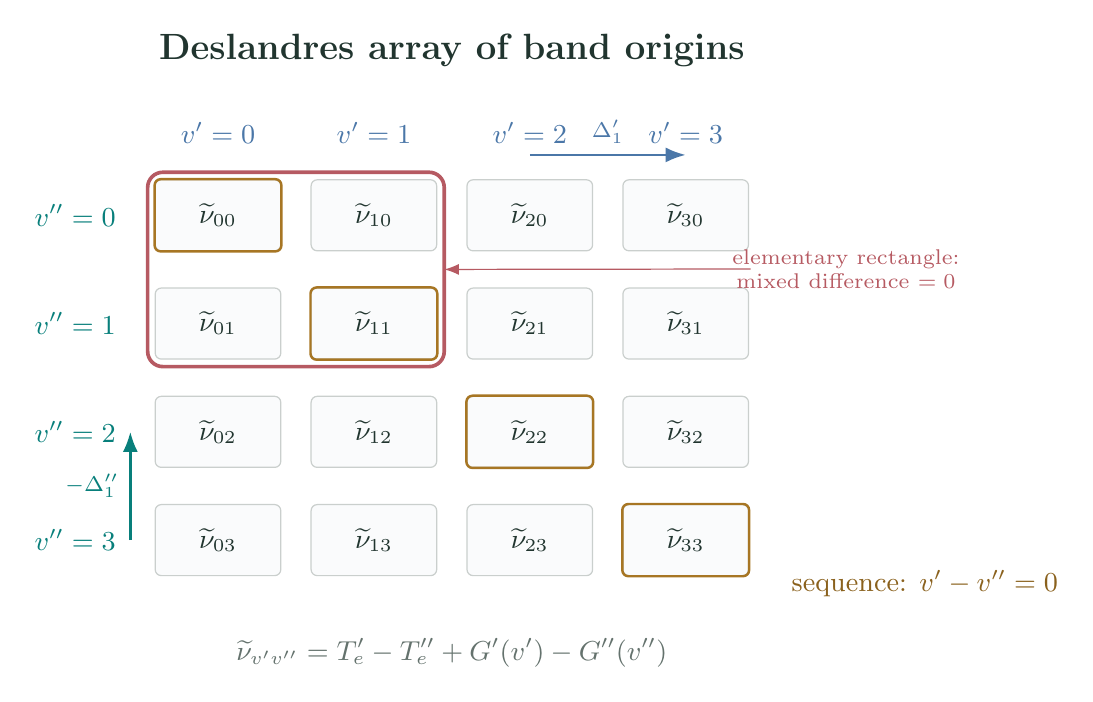
Arrange the measured origins in a Deslandres table with $v’$ along one axis and $v’’$ along the other. Because an unperturbed band origin is the sum of a function of $v’$ and a function of $v’’$, the mixed second difference is
\[\begin{aligned} &\widetilde\nu_{v'+1,v''+1} -\widetilde\nu_{v'+1,v''} -\widetilde\nu_{v',v''+1} +\widetilde\nu_{v',v''}\\ &= \left[G'(v'+1)-G''(v''+1)\right] -\left[G'(v'+1)-G''(v'')\right]\\ &\quad -\left[G'(v')-G''(v''+1)\right] +\left[G'(v')-G''(v'')\right]\\ &=0. \end{aligned}\]A systematic nonzero value signals a perturbation, a wrong vibrational assignment, or failure of the simple separated term-value model.
A progression holds $v’’$ fixed and varies $v’$. A sequence follows bands with fixed $\Delta v=v’-v’’$. These patterns help assign quantum numbers before the constants are fitted.
Rotational combination differences
Within one band,
\[\widetilde\nu =\widetilde\nu_{v'v''} +F'(J')-F''(J''), \qquad F(J)=BJ(J+1).\]For a band without a $Q$ branch,
\[\begin{aligned} R(J)&=\widetilde\nu_{v'v''} +F'(J+1)-F''(J),\\ P(J)&=\widetilde\nu_{v'v''} +F'(J-1)-F''(J). \end{aligned}\]Subtracting lines chosen to share the same upper level removes the entire upper term:
\[\begin{aligned} R(J)-P(J+2) &=F''(J+2)-F''(J)\\ &=B''\left[(J+2)(J+3)-J(J+1)\right]\\ &=\boxed{2B''(2J+3)}. \end{aligned}\]Likewise, lines sharing the same lower level give
\[\begin{aligned} R(J)-P(J) &=F'(J+1)-F'(J-1)\\ &=B'\left[(J+1)(J+2)-(J-1)J\right]\\ &=\boxed{2B'(2J+1)}. \end{aligned}\]These combination differences determine $B’’$ and $B’$ without requiring the band origin.
Band origin and band head are different
Introduce
\[m= \begin{cases} J+1,&R\text{ branch},\\ -J,&P\text{ branch}. \end{cases}\]Both branch formulas then take the form
\[\boxed{ \widetilde\nu(m) =\widetilde\nu_{v'v''} +(B'+B'')m+(B'-B'')m^2. }\]The band origin $\widetilde\nu_{v’v’’}$ is the hypothetical position obtained by removing rotational energy. A band head is instead a crowding of actual rotational lines near an extremum. Treating $m$ as continuous locates that extremum:
\[\frac{d\widetilde\nu}{dm} =(B'+B'')+2(B'-B'')m=0,\]so
\[m_{\mathrm{head}} =-\frac{B'+B''}{2(B'-B'')}.\]A visible head occurs only if this value lies in the allowed integer range of the corresponding branch.
Isotope shifts
Under isotopic substitution the electronic potential, force constant, and equilibrium bond length are nearly unchanged, whereas the nuclear reduced mass changes. From
\[\widetilde\nu_e=\frac1{2\pi c}\sqrt{\frac{k}{\mu}}, \qquad B=\frac{h}{8\pi^2c\mu r_e^2},\]two isotopologues with reduced masses $\mu_a$ and $\mu_b$ satisfy
\[\frac{\widetilde\nu_{e,b}}{\widetilde\nu_{e,a}} \simeq\sqrt{\frac{\mu_a}{\mu_b}}, \qquad \frac{B_b}{B_a}\simeq\frac{\mu_a}{\mu_b}.\]The correlated vibrational and rotational shifts are therefore a sensitive test of band assignments and isotope identity.
All upper, lower, mixed, combination-difference, band-head, and isotope relations are checked symbolically in the Maxima worksheet.


Discussion