

05 May 2026
Vibrational and Rovibrational Spectra of Diatomic Molecules
Quantization of bond vibration and the origin of the P and R branches in a vibration–rotation band.
After the centre-of-mass motion of a diatomic molecule has been removed, write the three-dimensional radial wavefunction as $R(r)=u(r)/r$. For $J=0$, the reduced radial function $u(r)$ on $r>0$ obeys
\[\widehat H_{\mathrm{vib}} =-\frac{\hbar^2}{2\mu_{\mathrm r}}\frac{d^2}{dr^2}+V(r),\]where
\[\mu_{\mathrm r}=\frac{m_1m_2}{m_1+m_2}\]is the nuclear reduced mass.
The stable equilibrium separation $r_e$ satisfies
\[\left.\frac{dV}{dr}\right|_{r_e}=0, \qquad \left.\frac{d^2V}{dr^2}\right|_{r_e}=k>0.\]Put $x=r-r_e$. A Taylor expansion about equilibrium gives
\[V(r) =V(r_e)+\frac12kx^2+\frac16V^{(3)}(r_e)x^3+\cdots.\]Choosing the zero of energy at $V(r_e)$ and retaining the first nonconstant term produces the harmonic approximation
\[\widehat H_{\mathrm{vib}} =-\frac{\hbar^2}{2\mu_{\mathrm r}}\frac{d^2}{dx^2}+\frac12kx^2.\]Exactly, $x>-r_e$ and the reduced radial function satisfies $u(0)=0$. For low vibrational states localized tightly around $r_e$, their amplitude is negligible near $r=0$, so the coordinate may be extended to $-\infty<x<\infty$ and the standard one-dimensional oscillator solution may be used. In the following equations,
\[\psi(x)\equiv u(r_e+x).\]Vibrational eigenvalues
Define
\[\omega=\sqrt{\frac{k}{\mu_{\mathrm r}}}, \qquad \xi=\sqrt{\frac{\mu_{\mathrm r}\omega}{\hbar}}\,x, \qquad \epsilon=\frac{E}{\hbar\omega}.\]Since
\[\frac{d}{dx} =\sqrt{\frac{\mu_{\mathrm r}\omega}{\hbar}}\frac{d}{d\xi},\]the Schrödinger equation becomes
\[\frac{d^2\psi}{d\xi^2}+(2\epsilon-\xi^2)\psi=0.\]For large $|\xi|$, normalizability requires $\psi\sim e^{-\xi^2/2}$. Write
\[\psi(\xi)=e^{-\xi^2/2}H(\xi).\]Direct differentiation gives
\[\psi'' =e^{-\xi^2/2} \left[H''-2\xi H'+(\xi^2-1)H\right].\]Substitution cancels the $\xi^2H$ terms:
\[H''-2\xi H'+(2\epsilon-1)H=0.\]Let $H=\sum_{n=0}^{\infty}a_n\xi^n$. Equating the coefficient of $\xi^n$ gives
\[a_{n+2} =\frac{2n+1-2\epsilon}{(n+2)(n+1)}a_n.\]If the series never terminates, it ultimately grows as $e^{\xi^2}$ and makes $\psi$ non-normalizable. It must stop at some nonnegative integer $v$, so
\[2v+1-2\epsilon=0.\]Therefore
\[\boxed{E_v=\hbar\omega\left(v+\frac12\right)}, \qquad v=0,1,2,\ldots.\]In wavenumber units,
\[G(v)=\frac{E_v}{hc} =\widetilde\nu_e\left(v+\frac12\right), \qquad \widetilde\nu_e=\frac{\omega}{2\pi c} =\frac{1}{2\pi c}\sqrt{\frac{k}{\mu_{\mathrm r}}}.\]The molecule has a nonzero zero-point energy $E_0=\hbar\omega/2$ because a state with both exactly fixed position and zero momentum would violate the uncertainty principle.
Vibrational transition rule
Near equilibrium, expand the molecular dipole moment:
\[\mu(x)=\mu_e+ \left(\frac{d\mu}{dx}\right)_e x+\cdots.\]The constant term has the matrix element $\mu_e\langle v’|v\rangle$ and therefore cannot connect different vibrational states. Introduce the oscillator operators
\[x=\sqrt{\frac{\hbar}{2\mu_{\mathrm r}\omega}}\,(a+a^\dagger),\]with
\[a|v\rangle=\sqrt v\,|v-1\rangle, \qquad a^\dagger|v\rangle=\sqrt{v+1}\,|v+1\rangle.\]It follows step by step that
\[\begin{aligned} \langle v'|x|v\rangle =\sqrt{\frac{\hbar}{2\mu_{\mathrm r}\omega}} \left[ \sqrt v\,\delta_{v',v-1} +\sqrt{v+1}\,\delta_{v',v+1} \right]. \end{aligned}\]Thus the harmonic electric-dipole rule is
\[\boxed{\Delta v=\pm1}\]provided $(d\mu/dx)_e\ne0$. In absorption from the ground vibrational state, the fundamental transition is $v=0\rightarrow1$ at $\widetilde\nu_e$.
Anharmonic vibration
A real molecular potential has a finite dissociation energy and is not parabolic far from equilibrium. The Morse potential,
\[V(x)=D_e\left(1-e^{-ax}\right)^2,\]has the correct minimum $V(0)=0$ and approaches $D_e$ as $x\rightarrow\infty$. Define
\[\lambda=\frac{\sqrt{2\mu_{\mathrm r}D_e}}{a\hbar}, \qquad y=2\lambda e^{-ax}.\]Because
\[\frac{d}{dx}=-ay\frac{d}{dy}, \qquad \frac{d^2}{dx^2} =a^2\left(y^2\frac{d^2}{dy^2}+y\frac{d}{dy}\right),\]the Schrödinger equation becomes
\[y^2\psi_{yy}+y\psi_y +\left(\varepsilon+\lambda y-\frac{y^2}{4}\right)\psi=0, \qquad \varepsilon=\frac{2\mu_{\mathrm r}(E-D_e)}{a^2\hbar^2}.\]For a bound state $E<D_e$, put $s=\sqrt{-\varepsilon}$ and $\psi=y^s e^{-y/2}L(y)$. Substitution gives
\[yL''+(2s+1-y)L' +\left(\lambda-s-\frac12\right)L=0.\]Normalizability requires the associated-Laguerre series to terminate at degree $v$. Hence
\[\lambda-s-\frac12=v, \qquad s=\lambda-v-\frac12.\]A bound state also requires $s>0$, so
\[v<\lambda-\frac12.\]Unlike the harmonic oscillator, the Morse well therefore has only finitely many bound vibrational levels before dissociation.
Using $\omega_e=a\sqrt{2D_e/\mu_{\mathrm r}}$, expansion of $E=D_e-a^2\hbar^2s^2/(2\mu_{\mathrm r})$ gives
\[E_v =\hbar\omega_e\left(v+\frac12\right) -\frac{\hbar^2\omega_e^2}{4D_e} \left(v+\frac12\right)^2.\]Therefore, in wavenumber units,
\[\boxed{ G(v)=\widetilde\nu_e\left(v+\frac12\right) -\widetilde\nu_ex_e\left(v+\frac12\right)^2, }\]where $x_e=\hbar\omega_e/(4D_e)$. The adjacent spacing is
\[\begin{aligned} G(v+1)-G(v) &=\widetilde\nu_e -\widetilde\nu_ex_e\left[(v+\tfrac32)^2-(v+\tfrac12)^2\right]\\ &=\widetilde\nu_e-2\widetilde\nu_ex_e(v+1). \end{aligned}\]It decreases with $v$, and the zero-point term is
\[G(0)=\frac{\widetilde\nu_e}{2} -\frac{\widetilde\nu_ex_e}{4}.\]Weak overtones may acquire intensity because anharmonic eigenfunctions mix harmonic-oscillator basis states and because higher derivatives of $\mu(x)$ contribute. Anharmonicity does not make every $\Delta v$ transition automatically allowed.
Simultaneous vibration and rotation
The nuclear energy contains both motions. To leading order,
\[\frac{E(v,J)}{hc} =G(v)+F_v(J) =\widetilde\nu_e\left(v+\frac12\right)+B_vJ(J+1),\]where the rotational constant depends weakly on the vibrational state because
\[B_v=\frac{h}{8\pi^2c\mu_{\mathrm r}} \left\langle\frac1{r^2}\right\rangle_v.\]For a fundamental vibration–rotation absorption,
\[v''=0\longrightarrow v'=1.\]The electric-dipole rotational rule is $\Delta J=\pm1$. Therefore the spectrum separates into
\[\begin{array}{ll} P\text{ branch}:&J'=J''-1,\\[2pt] R\text{ branch}:&J'=J''+1. \end{array}\]There is no $Q$ branch with $\Delta J=0$ for an ordinary $\Sigma\leftrightarrow\Sigma$ electric-dipole band of a diatomic molecule.
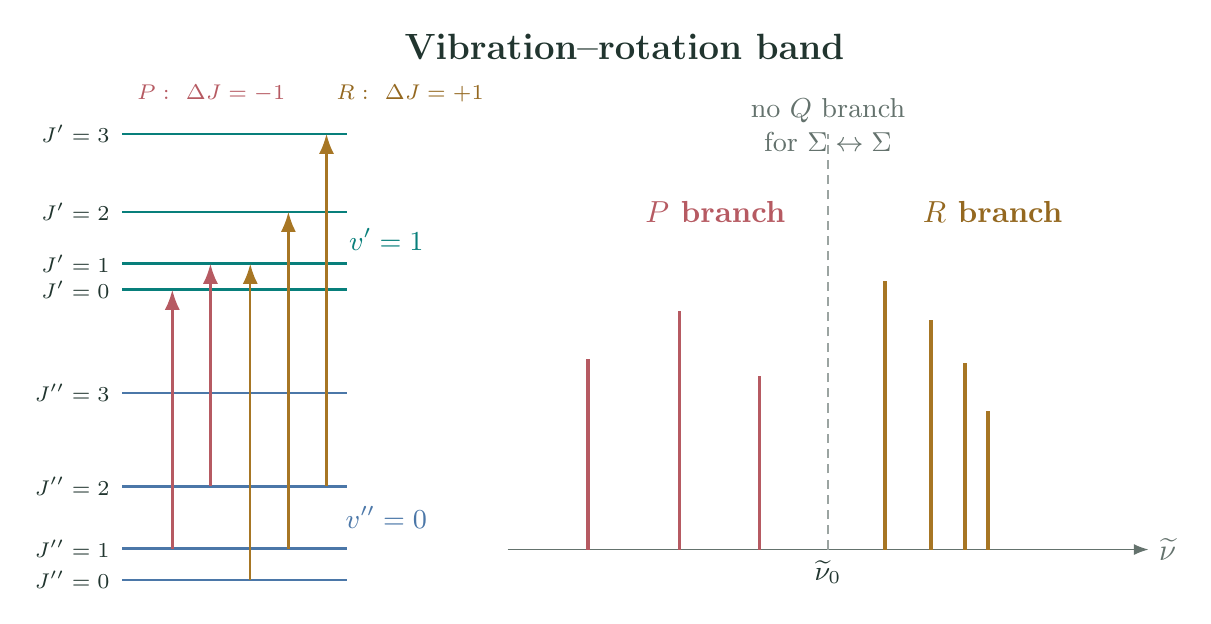
Let
\[\widetilde\nu_0=G(1)-G(0)\]be the vibrational band origin. A line beginning at the lower rotational quantum number $J=J’’$ has
\[\widetilde\nu =\widetilde\nu_0+B'J'(J'+1)-B''J(J+1).\]For the $R$ branch, $J’=J+1$, so
\[\begin{aligned} \widetilde\nu_R(J) &=\widetilde\nu_0+B'(J+1)(J+2)-B''J(J+1)\\ &=\widetilde\nu_0+(B'+B'')(J+1) +(B'-B'')(J+1)^2. \end{aligned}\]For the $P$ branch, $J’=J-1$, so
\[\begin{aligned} \widetilde\nu_P(J) &=\widetilde\nu_0+B'(J-1)J-B''J(J+1)\\ &=\widetilde\nu_0-(B'+B'')J+(B'-B'')J^2. \end{aligned}\]If bond-length changes are neglected, $B’=B’‘=B$. These expressions reduce to
\[\boxed{ \widetilde\nu_R(J)=\widetilde\nu_0+2B(J+1), \qquad \widetilde\nu_P(J)=\widetilde\nu_0-2BJ. }\]Thus the simplest band consists of two line combs separated by a central gap of approximately $4B$, with adjacent lines separated by approximately $2B$.
The reduced-mass separation, rigid and distorted rotational lines, Morse spacing, and complete $P/R$ branch algebra are checked in the Maxima worksheet.


Discussion