

16 Jul 2026
Partial-Wave Analysis and Phase Shifts
Construction of the elastic scattering amplitude from angular-momentum channels, phase shifts, partial cross sections, and unitarity.
Take the incident direction as the $z$-axis. Because $z=r\cos\theta$, expand the plane wave in Legendre polynomials:
\[e^{ikr\cos\theta} =\sum_{l=0}^{\infty}a_l(kr)P_l(\cos\theta).\]Multiplication by $P_l(x)$ and integration over $x=\cos\theta$ use
\[\int_{-1}^{1}P_l(x)P_{l'}(x)\,dx =\frac{2}{2l+1}\delta_{ll'}.\]The coefficient is
\[a_l(kr) =\frac{2l+1}{2} \int_{-1}^{1}e^{ikrx}P_l(x)\,dx =(2l+1)i^l j_l(kr).\]Thus
\[\boxed{ e^{ikz} =\sum_{l=0}^{\infty} i^l(2l+1)j_l(kr)P_l(\cos\theta). }\]Incoming and outgoing parts
For a central potential, distinct values of $l$ do not mix. Outside the potential, the $l$th radial wave is a superposition of incoming and outgoing spherical waves. If their amplitudes are $A_l^{(-)}$ and $A_l^{(+)}$, write
\[u_l(r)\sim A_l^{(-)}e^{-i\alpha} +A_l^{(+)}e^{i\alpha}, \qquad \alpha=kr-\frac{l\pi}{2}.\]The radial current of $Ae^{\pm ikr}/r$ is $j_r=\pm(\hbar k/\mu)|A|^2/r^2$. Elastic probability conservation therefore requires $|A_l^{(+)}|=|A_l^{(-)}|$. The regular free wave $\sin\alpha=(e^{i\alpha}-e^{-i\alpha})/(2i)$ has $A_l^{(+)}/A_l^{(-)}=-1$, so define the partial-wave scattering matrix by
\[S_l=-\frac{A_l^{(+)}}{A_l^{(-)}}.\]This convention makes $S_l=1$ when there is no interaction. Conservation gives $|S_l|=1$, and a unit-modulus complex number can be written
\[\boxed{ S_l=e^{2i\delta_l}. }\]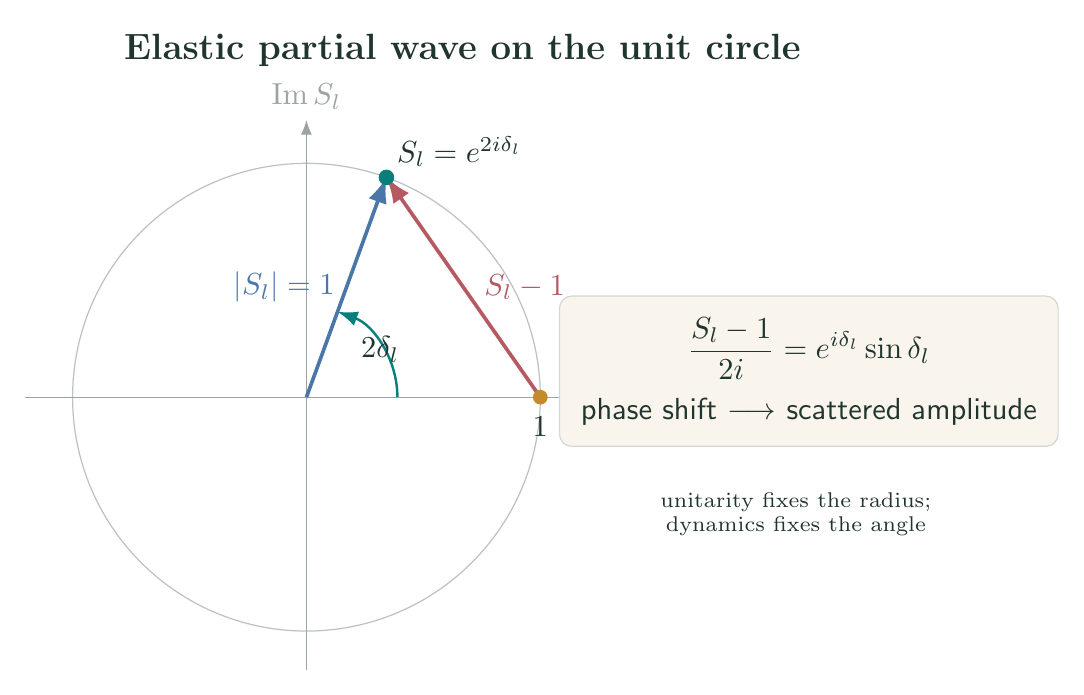
The large-$r$ spherical Bessel function is
\[j_l(kr) \sim\frac{\sin\alpha}{kr} =\frac{e^{i\alpha}-e^{-i\alpha}}{2ikr}.\]Multiplication by $i^l=e^{il\pi/2}$ turns the free plane-wave channel into
\[\psi_l^{(0)} \sim \frac{2l+1}{2ikr}P_l(\cos\theta) \left[e^{ikr}-(-1)^l e^{-ikr}\right].\]The second exponential is incoming and retains its plane-wave coefficient. The interaction multiplies the outgoing coefficient by $S_l$:
\[\psi_l \sim \frac{2l+1}{2ikr}P_l(\cos\theta) \left[S_l e^{ikr}-(-1)^l e^{-ikr}\right].\]Subtracting the free channel,
\[\psi_l-\psi_l^{(0)} \sim \frac{2l+1}{2ik}(S_l-1)P_l(\cos\theta) \frac{e^{ikr}}r.\]Comparison with $f_l(\theta)e^{ikr}/r$ identifies
\[f_l(\theta) =\frac{2l+1}{2ik}(S_l-1)P_l(\cos\theta).\]Summing the channels,
\[\boxed{ f(\theta) =\frac{1}{2ik} \sum_{l=0}^{\infty} (2l+1)(S_l-1)P_l(\cos\theta). }\]Now
\[\begin{aligned} \frac{e^{2i\delta_l}-1}{2i} &=\frac{e^{i\delta_l} \left(e^{i\delta_l}-e^{-i\delta_l}\right)}{2i}\\ &=e^{i\delta_l}\sin\delta_l. \end{aligned}\]The phase-shift form of the amplitude is
\[\boxed{ f(\theta) =\frac1k\sum_{l=0}^{\infty} (2l+1)e^{i\delta_l}\sin\delta_l P_l(\cos\theta). }\]Partial and total cross sections
Insert this amplitude into $\sigma_{\mathrm{tot}}=\int|f|^2d\Omega$. The angular integral contains
\[\int P_l(\cos\theta)P_{l'}(\cos\theta)\,d\Omega =2\pi\int_{-1}^{1}P_l(x)P_{l'}(x)\,dx =\frac{4\pi}{2l+1}\delta_{ll'}.\]All terms with $l\neq l’$ vanish, and $|e^{i\delta_l}\sin\delta_l|^2=\sin^2\delta_l$. Therefore
\[\boxed{ \sigma_{\mathrm{tot}} =\frac{4\pi}{k^2} \sum_{l=0}^{\infty} (2l+1)\sin^2\delta_l. }\]The contribution of one channel is
\[\boxed{ \sigma_l =\frac{4\pi}{k^2}(2l+1)\sin^2\delta_l. }\]Since $\sin^2\delta_l\leq1$, elastic unitarity imposes
\[\sigma_l\leq\frac{4\pi}{k^2}(2l+1).\]The coefficient identity, Legendre orthogonality, and partial-cross-section sum are verified in the Maxima worksheet.


Discussion