

13 Jul 2026
Scattering by Spherically Symmetric Potentials
Separation of the central-potential Schrödinger equation into radial angular-momentum channels and the origin of scattering phase shifts.
For a spherically symmetric interaction,
\[V(\mathbf r)=V(r),\]the Hamiltonian is invariant under rotations. Hence
\[[H,L^2]=[H,L_z]=0,\]and a scattering state can be resolved into independent angular-momentum channels.
Separation of the Schrödinger equation
The Laplacian may be written
\[\nabla^2 =\frac1{r^2}\frac{\partial}{\partial r} \left(r^2\frac{\partial}{\partial r}\right) -\frac{L^2}{\hbar^2r^2}.\]Expand the state in simultaneous eigenfunctions of $L^2$ and $L_z$:
\[\psi(\mathbf r) =\sum_{l,m}R_{lm}(r)Y_l^m(\theta,\phi),\]where
\[L^2Y_l^m=\hbar^2l(l+1)Y_l^m.\]Substitution into
\[\left[-\frac{\hbar^2}{2\mu}\nabla^2+V(r)\right]\psi=E\psi\]and projection onto one spherical harmonic produces
\[-\frac{\hbar^2}{2\mu} \left[ \frac1{r^2}\frac{d}{dr} \left(r^2\frac{dR_l}{dr}\right) -\frac{l(l+1)}{r^2}R_l \right] +V(r)R_l=ER_l.\]Define the reduced radial function
\[u_l(r)=rR_l(r).\]Its derivatives obey
\[\frac{dR_l}{dr} =\frac{u_l'}r-\frac{u_l}{r^2},\] \[\frac1{r^2}\frac{d}{dr} \left(r^2\frac{dR_l}{dr}\right) =\frac{u_l''}{r}.\]After multiplication by $r$, the radial equation becomes
\[\boxed{ \frac{d^2u_l}{dr^2} +\left[ k^2-\frac{2\mu}{\hbar^2}V(r) -\frac{l(l+1)}{r^2} \right]u_l=0, }\]with $E=\hbar^2k^2/(2\mu)$.
The same equation has the one-dimensional form
\[-\frac{\hbar^2}{2\mu}u_l'' +V_{\mathrm{eff},l}(r)u_l=Eu_l,\]where
\[\boxed{ V_{\mathrm{eff},l}(r) =V(r)+\frac{\hbar^2l(l+1)}{2\mu r^2}. }\]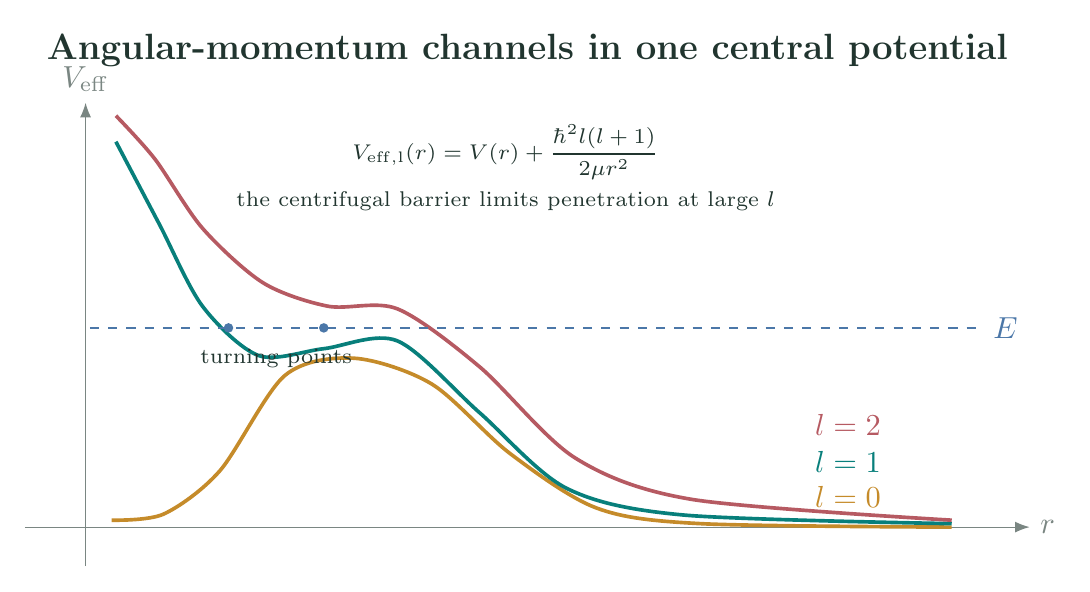
Origin and exterior forms
For $l>0$ near a nonsingular origin, the centrifugal term dominates. Trying $u_l\propto r^\alpha$ in
\[u_l''-\frac{l(l+1)}{r^2}u_l\simeq0\]produces
\[\alpha(\alpha-1)-l(l+1)=0.\]The roots are $\alpha=l+1$ and $\alpha=-l$. The second makes $R_l=u_l/r$ singular. For $l=0$ the centrifugal term is absent, but finiteness of $R_0=u_0/r$ requires $u_0(0)=0$, so $u_0\propto r$. Both cases are summarized by
\[u_l(r)\propto r^{l+1}.\]Suppose $V(r)=0$ for $r>R$. The exterior radial equation is
\[u_l''+\left[k^2-\frac{l(l+1)}{r^2}\right]u_l=0.\]Its independent solutions are $kr\,j_l(kr)$ and $kr\,n_l(kr)$. A real elastic solution can therefore be written
\[u_l=C_lkr \left[ \cos\delta_l\,j_l(kr) -\sin\delta_l\,n_l(kr) \right].\]For large $x$,
\[j_l(x)\sim\frac{\sin(x-l\pi/2)}x, \qquad n_l(x)\sim-\frac{\cos(x-l\pi/2)}x.\]Substitution and the sine-addition identity lead to
\[\boxed{ u_l(r)\sim C_l\sin\left(kr-\frac{l\pi}{2}+\delta_l\right). }\]The phase shift $\delta_l(E)$ is zero for a free particle and records the effect of the potential on that channel.
Semiclassically,
\[p b\simeq\hbar\sqrt{l(l+1)} \simeq\hbar\left(l+\frac12\right),\]so $b\simeq(l+1/2)/k$. For a potential of range $R$, channels with $l\gg kR$ pass outside the interaction region and normally have negligible phase shifts.


Discussion