

10 Jul 2026
Scattering Amplitude and Cross Sections
Asymptotic scattering states, probability flux, differential cross section, and total cross section.
For relative motion of reduced mass $\mu$ in a localized potential $V(\mathbf r)$, the stationary Schrödinger equation is
\[\left[-\frac{\hbar^2}{2\mu}\nabla^2+V(\mathbf r)\right]\psi =E\psi, \qquad E=\frac{\hbar^2k^2}{2\mu}.\]Choose the incident wavevector as $\mathbf k=k\hat{\mathbf z}$. Before reaching the potential, a monochromatic beam is represented by
\[\psi_{\mathrm{in}}=e^{ikz}.\]Outside the finite interaction region the equation is free. For its radial $l=0$ part, write $R(r)=\chi(r)/r$. Substitution into
\[\frac1{r^2}\frac{d}{dr} \left(r^2\frac{dR}{dr}\right)+k^2R=0\]reduces it to
\[\chi''+k^2\chi=0.\]Hence
\[R(r)=\frac{Ae^{ikr}+Be^{-ikr}}r.\]With time dependence $e^{-iEt/\hbar}$, constant phase in $e^{i(kr-Et/\hbar)}$ moves toward increasing $r$, while the $e^{-ikr}$ term moves inward. The Sommerfeld condition
\[\lim_{r\to\infty}r \left(\frac{\partial}{\partial r}-ik\right)\psi_{\mathrm{sc}}=0\]selects the outgoing term. Allowing its coefficient to depend on direction produces the physical large-distance boundary condition
\[\boxed{ \psi(\mathbf r) \underset{r\to\infty}{\sim} e^{ikz}+f(\theta,\phi)\frac{e^{ikr}}{r}. }\]The coefficient $f(\theta,\phi)$ is the scattering amplitude. It contains both a magnitude and a phase and has dimensions of length. Its angular dependence is determined by the potential.
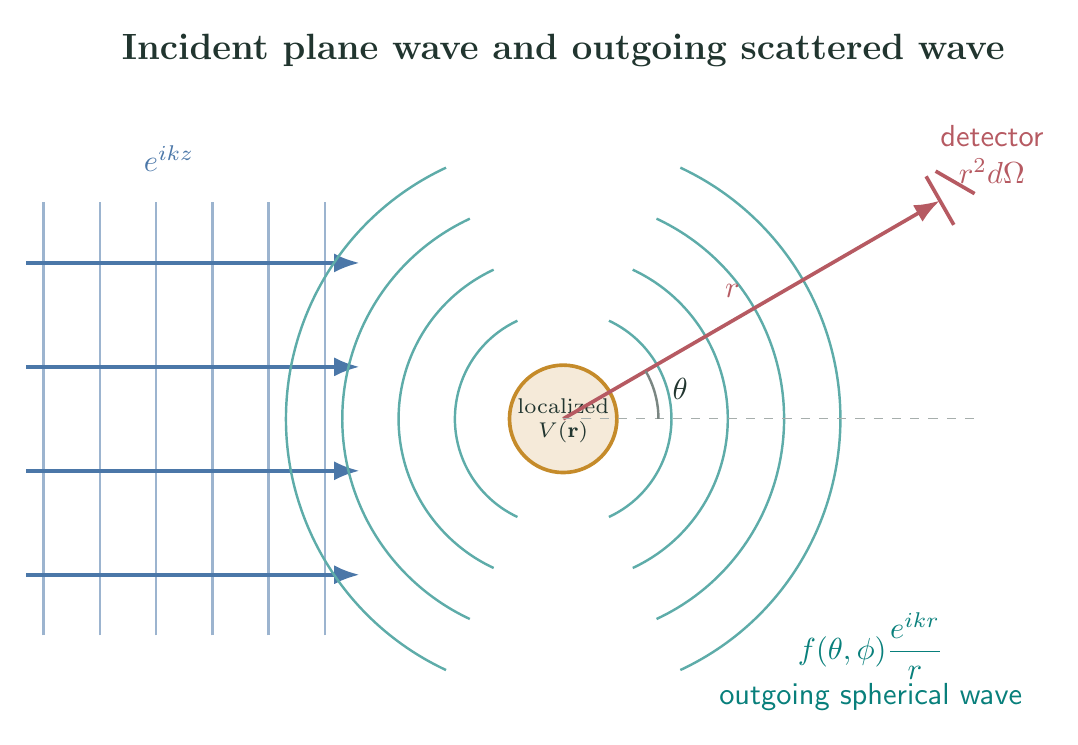
Incident probability flux
Begin with the time-dependent Schrödinger equation and its conjugate:
\[i\hbar\frac{\partial\psi}{\partial t} =-\frac{\hbar^2}{2\mu}\nabla^2\psi+V\psi,\] \[-i\hbar\frac{\partial\psi^*}{\partial t} =-\frac{\hbar^2}{2\mu}\nabla^2\psi^*+V\psi^*.\]Multiply the first by $\psi^*$, the second by $\psi$, and subtract. The real-potential terms cancel:
\[\frac{\partial|\psi|^2}{\partial t} =-\frac{\hbar}{2\mu i} \left(\psi^*\nabla^2\psi-\psi\nabla^2\psi^*\right).\]Using
\[\psi^*\nabla^2\psi-\psi\nabla^2\psi^* =\nabla\cdot \left(\psi^*\nabla\psi-\psi\nabla\psi^*\right),\]one obtains
\[\frac{\partial|\psi|^2}{\partial t}+\nabla\cdot\mathbf j=0,\]with probability-current density
\[\mathbf j =\frac{\hbar}{2\mu i} \left(\psi^*\nabla\psi-\psi\nabla\psi^*\right).\]For the incident plane wave,
\[\nabla\psi_{\mathrm{in}} =ik\hat{\mathbf z}\psi_{\mathrm{in}}, \qquad \nabla\psi_{\mathrm{in}}^* =-ik\hat{\mathbf z}\psi_{\mathrm{in}}^*.\]| Since $ | \psi_{\mathrm{in}} | ^2=1$, |
Thus the incident particle flux is
\[\mathcal F_{\mathrm{in}}=\frac{\hbar k}{\mu}.\]Scattered radial flux
Write
\[\psi_{\mathrm{sc}}=f(\theta,\phi)\frac{e^{ikr}}{r}.\]At fixed direction,
\[\frac{\partial\psi_{\mathrm{sc}}}{\partial r} =f e^{ikr}\left(\frac{ik}{r}-\frac1{r^2}\right).\]Insert this derivative into the radial component of the current:
\[j_{\mathrm{sc},r} =\frac{\hbar}{2\mu i} \left( \psi_{\mathrm{sc}}^* \frac{\partial\psi_{\mathrm{sc}}}{\partial r} -\psi_{\mathrm{sc}} \frac{\partial\psi_{\mathrm{sc}}^*}{\partial r} \right).\]The real $1/r^3$ terms cancel, leaving
\[\boxed{ j_{\mathrm{sc},r} =\frac{\hbar k}{\mu}\frac{|f(\theta,\phi)|^2}{r^2}. }\]The rate through the detector area $dA=r^2d\Omega$ is therefore
\[d\dot N_{\mathrm{sc}} =j_{\mathrm{sc},r}r^2d\Omega =\frac{\hbar k}{\mu}|f|^2d\Omega.\]By definition,
\[d\dot N_{\mathrm{sc}} =\mathcal F_{\mathrm{in}}\,d\sigma.\]Dividing by $\mathcal F_{\mathrm{in}}d\Omega$ produces the elastic differential cross section:
\[\boxed{ \frac{d\sigma}{d\Omega}=|f(\theta,\phi)|^2. }\]The phase of one isolated amplitude disappears from this modulus, but relative phases remain observable when different scattering contributions interfere.
Total cross section
Adding the rates in all directions,
\[\boxed{ \sigma_{\mathrm{tot}} =\int_{4\pi}|f(\theta,\phi)|^2\,d\Omega. }\]For a spherically symmetric potential, rotations about the incident direction change neither the experiment nor $f$, so $f=f(\theta)$. With $d\Omega=\sin\theta\,d\theta\,d\phi$,
\[\boxed{ \sigma_{\mathrm{tot}} =2\pi\int_0^\pi |f(\theta)|^2\sin\theta\,d\theta. }\]A short-range potential normally makes this integral finite. The unscreened Coulomb amplitude is singular in the forward direction, which is why its ideal total cross section diverges.


Discussion