

29 May 2025
8085 Arithmetic Programming: Multibyte, BCD and Delay Loops
Unsigned and signed flag interpretation, multibyte carry propagation, packed-BCD correction, multiplication and cycle-counted software delays.
The 8085 arithmetic unit operates primarily on eight-bit operands through the accumulator. Larger integers, decimal quantities and time intervals must therefore be constructed by software. Correct programs depend on three separate layers: the bit-level representation, the condition flags produced by each instruction, and a loop or carry invariant that remains true throughout the calculation.
Eight-bit addition and flag interpretation
For unsigned bytes $a,b$ and input carry $c\in{0,1}$, define
\[s=a+b+c,\qquad r=s\bmod 2^8,\qquad C_{out}=\left\lfloor\frac{s}{2^8}\right\rfloor.\]ADD uses $c=0$; ADC includes the current carry flag. The accumulator receives $r$. The carry flag represents unsigned overflow, while auxiliary carry records a carry from bit 3 into bit 4:
Zero, sign and parity are properties of the eight-bit result. The sign flag is simply result bit 7 and does not by itself report signed overflow. For two’s-complement addition, overflow occurs precisely when the operands have the same sign and the result has the opposite sign:
\[V=\neg(a_7\oplus b_7)\,(a_7\oplus r_7).\]The 8085 has no overflow flag, so signed code must test this relation explicitly when overflow matters. Carry and signed overflow answer different questions: $F0_H+20_H$ produces carry without signed overflow, whereas $70_H+20_H$ produces signed overflow without carry.
Subtraction uses the carry flag as a borrow indication on the 8085. After CMP source, $CY=1$ means the unsigned accumulator value was smaller than the source, even though the accumulator itself is unchanged.
Multibyte unsigned addition
Let two $n$-byte integers be stored low byte first:
\[X=\sum_{i=0}^{n-1}x_i2^{8i},\qquad Y=\sum_{i=0}^{n-1}y_i2^{8i}.\]Starting with $c_0=0$, bytewise addition obeys
\[t_i=x_i+y_i+c_i,\qquad z_i=t_i\bmod256,\qquad c_{i+1}=\left\lfloor\frac{t_i}{256}\right\rfloor.\]After byte $i$, the loop invariant is
\[\sum_{j=0}^{i}z_j2^{8j}+c_{i+1}2^{8(i+1)} =\sum_{j=0}^{i}(x_j+y_j)2^{8j}.\]This proves that the final result bytes and $c_n$ represent the exact $(n+1)$-byte sum.
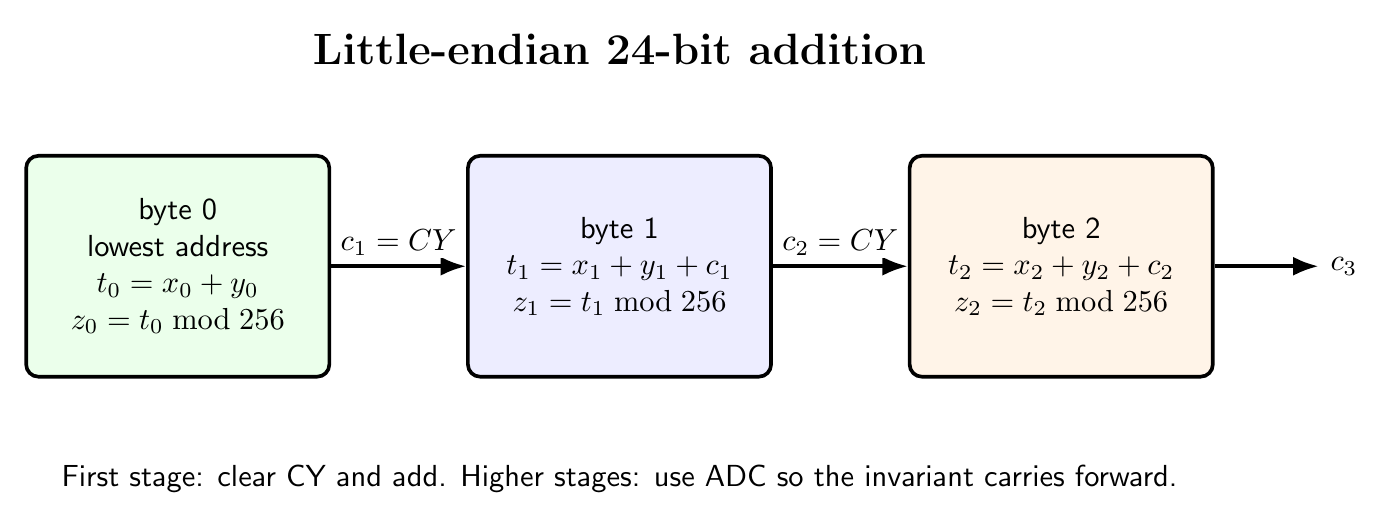
The following complete routine adds two 24-bit unsigned integers and stores a fourth byte containing the final carry. LDA, MOV, STA and INX do not alter carry, so the carry from one ADC survives until the next.
        ORG 2000H
        LXI H,NUM1      ; HL -> least-significant byte of X
        LXI D,NUM2      ; DE -> least-significant byte of Y
        STC
        CMC             ; CY = 0 without depending on old accumulator

        LDAX D
        ADC M
        STA SUM
        INX H
        INX D

        LDAX D
        ADC M
        STA SUM+1
        INX H
        INX D

        LDAX D
        ADC M
        STA SUM+2
        MVI A,00H       ; MVI preserves the final CY
        ACI 00H
        STA SUM+3
        HLT

NUM1:   DB 56H,34H,F2H
NUM2:   DB EFH,45H,23H
SUM:    DS 4
        END
For a 16-bit sum, DAD rp is shorter: it adds a register pair to HL and affects only carry. Thus LHLD X, XCHG, LHLD Y, DAD D, SHLD Z computes $Z=(X+Y)\bmod65536$, with $CY$ holding the seventeenth bit. Because only carry is defined by DAD, zero or sign must be established separately if required.
Multibyte subtraction propagates borrow in the same low-to-high order. With incoming borrow $b_i$,
\[d_i=x_i-y_i-b_i,\qquad z_i=d_i\bmod256,\qquad b_{i+1}=\begin{cases}1,&d_i<0,\\0,&d_i\geq0.\end{cases}\]SUB establishes the first borrow and SBB includes it at every higher byte. The 8085 convention is $CY=b_{i+1}$ after subtraction. This complete fixed-address example computes a 16-bit difference and records the unsigned underflow in a separate byte:
        LDA X
        MOV B,A
        LDA Y
        MOV C,A
        MOV A,B
        SUB C
        STA DIFF

        LDA X+1         ; transfers leave the low-byte borrow unchanged
        MOV B,A
        LDA Y+1
        MOV C,A
        MOV A,B
        SBB C
        STA DIFF+1

        MVI A,00H       ; preserve CY, then convert borrow to 00 or 01
        ACI 00H
        STA BORROW
        HLT

X:      DW 1234H
Y:      DW 09F8H
DIFF:   DS 2
BORROW: DS 1
For the displayed data, DIFF becomes $083C_H$ and BORROW becomes zero. If $X<Y$, the two result bytes contain $(X-Y)\bmod2^{16}$ and BORROW is one. Transfer instructions placed between byte stages are safe only because they do not modify carry.
Repeated-addition multiplication
An eight-by-eight-bit unsigned product fits in sixteen bits. If the multiplicand is placed in DE with $D=0$, repeated DAD D accumulates the exact product in HL:
; Input: E = multiplicand, C = multiplier
; Output: HL = unsigned 16-bit product; destroys A, B, D and flags
MUL8:   MVI D,00H
        LXI H,0000H
        MOV A,C
        ORA A
        RZ              ; essential zero-multiplier case
        MOV B,C
MLOOP:  DAD D
        DCR B
        JNZ MLOOP
        RET
At the start of an iteration with $B=k$, the invariant is
\[HL=(C_{initial}-k)E,\qquad 0<k\leq C_{initial}.\]DAD D advances the product and DCR B advances the count, so termination at $B=0$ gives $HL=C_{initial}E$. The initial zero test prevents an eight-bit counter value of zero from wrapping and executing 256 iterations.
Packed-BCD addition and DAA
In packed BCD, each nibble represents one decimal digit; only $0$ through $9$ are valid nibble values. Ordinary binary addition can produce invalid digits. After an accumulator addition, DAA performs decimal correction using the accumulator nibbles together with auxiliary carry and carry.
Conceptually, the correction is
- add $06_H$ if the low nibble exceeds 9 or $AC=1$;
- add $60_H$ if the corrected high digit requires it or $CY=1$.
The adjusted accumulator contains two valid BCD digits, and carry represents a decimal carry beyond the two-digit byte. For example,
\[59_{BCD}+73_{BCD}=CC_H \xrightarrow{+06_H}D2_H \xrightarrow{+60_H}32_H,\quad CY=1,\]which represents $132_{10}$.
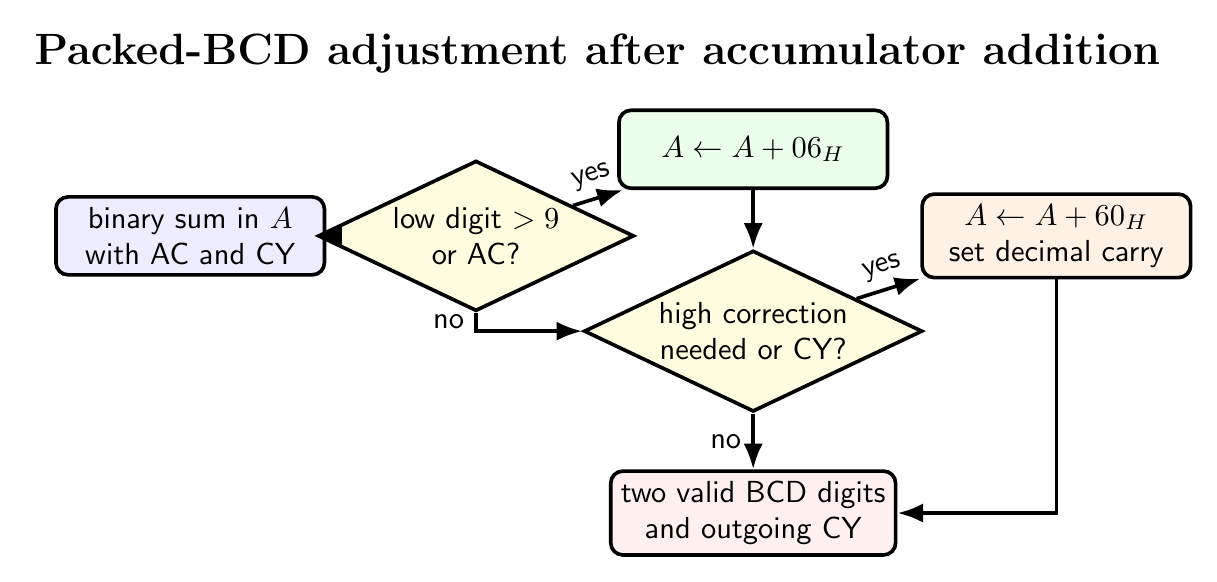
The following program adds two four-digit packed-BCD numbers. The low-order two digits are stored first.
        LDA BCD1
        MOV B,A
        LDA BCD2
        ADD B
        DAA
        STA BCDSUM

        LDA BCD1+1      ; these transfer instructions preserve CY
        MOV B,A
        LDA BCD2+1
        ADC B
        DAA
        STA BCDSUM+1

        MVI A,00H       ; convert decimal carry to byte 00 or 01
        ACI 00H
        STA BCDSUM+2
        HLT

BCD1:   DB 99H,99H     ; 9999
BCD2:   DB 01H,00H     ; 0001
BCDSUM: DS 3           ; becomes 00H,00H,01H = 10000
The operands must be valid BCD before the operation. DAA is not a general conversion from arbitrary binary to decimal, and it should not be inserted after logical instructions or treated as a substitute for division by ten.
Cycle-counted delay loops
A software delay consumes a known number of processor clock states. For a processor T-state frequency $f_T$, a path of $N_T$ states delays
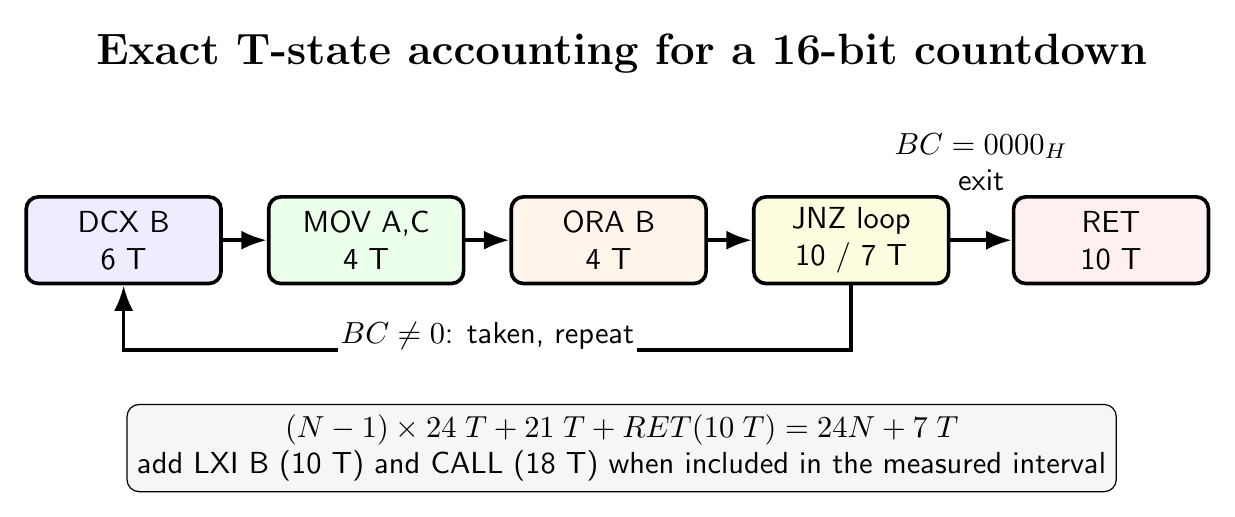
\[t_d=\frac{N_T}{f_T}.\]Timing must distinguish taken and not-taken conditional branches. Consider the sixteen-bit countdown routine
; Input: BC = N, where 1 <= N <= FFFFH
; Output: BC = 0000H; destroys A and flags
DELAY:  ; caller executes CALL DELAY separately
DLOOP:  DCX B          ; 6 T
        MOV A,C        ; 4 T
        ORA B          ; 4 T
        JNZ DLOOP      ; 10 T taken, 7 T not taken
        RET            ; 10 T
For $N-1$ taken iterations and one final not-taken iteration,
\[N_T=(N-1)(6+4+4+10)+(6+4+4+7)+10=24N+7.\]If the calling sequence includes LXI B,N and CALL DELAY, add 10 and 18 T-states respectively, giving
For a requested delay $t_d$, the nearest legal count is
\[N=\operatorname{round}\!\left(\frac{f_Tt_d-35}{24}\right)\]when setup and call are included. At $f_T=3.072$ MHz and $t_d=5.000$ ms, $N=639$ gives
\[t_{actual}=\frac{24(639)+35}{3.072\times10^6} =5.00358\ \text{ms}.\]This is a nominal delay, not a precision timebase. Clock tolerance, wait states and interrupt service add error. If an interrupt of duration $t_I$ occurs during the loop, the elapsed wall time increases by approximately $t_I$. DI can remove that source of jitter for a critical interval, but it increases interrupt latency and cannot block TRAP. A hardware timer is preferable for long delays or stringent accuracy.
Preparation questions
- Derive carry, auxiliary carry and signed overflow for $8F_H+92_H$ and interpret the same bit patterns as signed integers.
- Prove the multibyte-addition loop invariant and extend the 24-bit program to four bytes.
- Write a 32-bit subtraction routine and state precisely how borrow propagates through
SBB. - Trace
MUL8for $E=0D_H$, $C=05_H$ and prove that no 16-bit overflow is possible for byte operands. - Apply
DAAstep by step to $48_{BCD}+76_{BCD}$, including $AC$ and $CY$. - Modify the packed-BCD program to add two six-digit operands.
- Derive the delay formula when
PUSH PSWandPOP PSWare added to preserve accumulator and flags. - Calculate the count and percentage timing error for a $10$ ms delay at $2.5$ MHz, including setup,
CALLandRET.


Discussion