

31 May 2025
8085 Array Programming: Block Transfer, Search, Sort and Tables
Memory-block traversal, overlap-safe copying, linear search contracts, adjacent-exchange sorting, table lookup, checksums and complexity analysis.
An array algorithm maps an abstract index $i$ to a physical address. For a byte array of length $n$ beginning at address $B$,
\[A[i]=M[B+i],\qquad 0\leq i<n.\]On the 8085, HL is the natural source pointer because M denotes the byte addressed by HL; DE is a natural second pointer because LDAX D and STAX D access memory through DE. A byte counter supplies termination. Every routine must define the zero-length case explicitly, because decrementing an eight-bit zero counter wraps to $FF_H$ and can produce 256 unintended iterations.
Forward block transfer
The following subroutine copies $C$ bytes from the source beginning at HL to the destination beginning at DE.
; Input: HL = source, DE = destination, C = length (0...255)
; Output: HL and DE advanced by the original length, C = 0
; Preserves B; destroys A and flags
COPYF:  MOV A,C
        ORA A
        RZ
CFLOOP: MOV A,M
        STAX D
        INX H
        INX D
        DCR C
        JNZ CFLOOP
        RET
At the start of the iteration for index $i$, the invariant is
\[HL=S+i,\quad DE=D+i,\quad C=n-i,\quad M[D+j]=M_0[S+j]\quad(0\leq j<i),\]where $M_0$ denotes memory before copying. The load occurs before the store, so the current source byte is protected within that iteration. The invariant proves correct copying when the source and destination do not overlap, or when forward traversal cannot overwrite a source byte that will be needed later.
Let the half-open source and destination intervals be
\[I_S=[S,S+n),\qquad I_D=[D,D+n).\]Forward copying is safe if $D\leq S$ or $D\geq S+n$. If $S<D<S+n$, a forward store can corrupt an unread higher source byte; copying must proceed from the last byte toward the first.
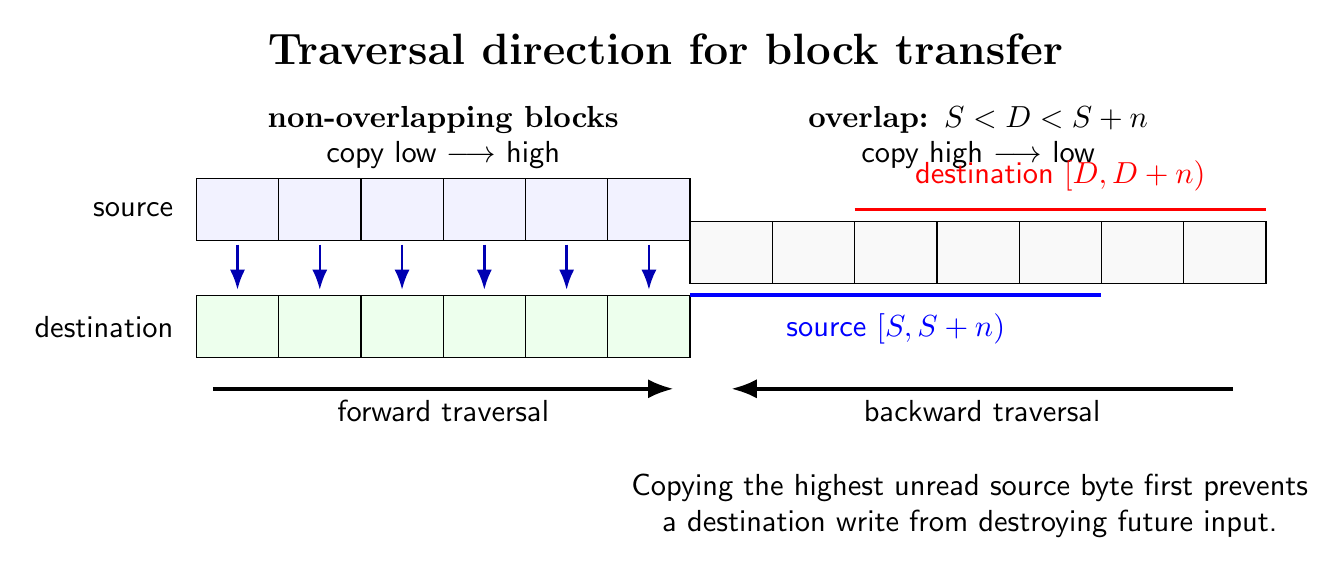
An overlap-safe backward routine can use $BC=n-1$ temporarily to place both pointers at the last elements:
; Input: HL = source, DE = destination, C = length (0...255)
; Use when source < destination < source+length
; Output: C = 0; for nonzero length, HL = source-1 and DE = destination-1
; Destroys A, B and flags
COPYB:  MOV A,C
        ORA A
        RZ
        MVI B,00H
        DCX B           ; BC = n-1
        DAD B           ; HL = source+n-1
        XCHG            ; HL = destination, DE = source+n-1
        DAD B           ; HL = destination+n-1
        XCHG            ; HL = source end, DE = destination end
        INX B           ; BC = n, hence C = n
CBLOOP: MOV A,M
        STAX D
        DCX H
        DCX D
        DCR C
        JNZ CBLOOP
        RET
Since the input length is at most 255, forming $BC=00(n-1)_H$ and then incrementing it recovers $BC=00n_H$. The routine is valid only under its stated direction condition; a general memmove dispatcher must compare the sixteen-bit interval bounds before choosing COPYF or COPYB and must account for address wraparound if buffers can cross $FFFF_H$.
Linear search with a flag contract
A linear search compares the key with successive bytes until equality or exhaustion. The routine below returns $CY=0$ with HL at the first matching byte. It returns $CY=1$ with HL one address beyond the searched block when no match exists.
; Input: HL = first byte, B = length, C = key
; Output: CY=0 and HL->first match, or CY=1 and HL=first byte+length
; Preserves C; destroys A and B; flags other than returned CY are unspecified
FIND8:  MOV A,B
        ORA A
        JZ NOTFND
FLOOP:  MOV A,M
        CMP C
        JZ FOUND        ; equality also leaves CY=0
        INX H
        DCR B
        JNZ FLOOP
NOTFND: STC
        RET
FOUND:  RET
At loop entry for index $i$, the invariant is
\[HL=B_0+i,\quad B=n-i,\quad A[j]\ne key\quad(0\leq j<i).\]If equality occurs, the invariant proves that no earlier element matches, so the routine returns the first occurrence. If the counter reaches zero, every valid index has been excluded.
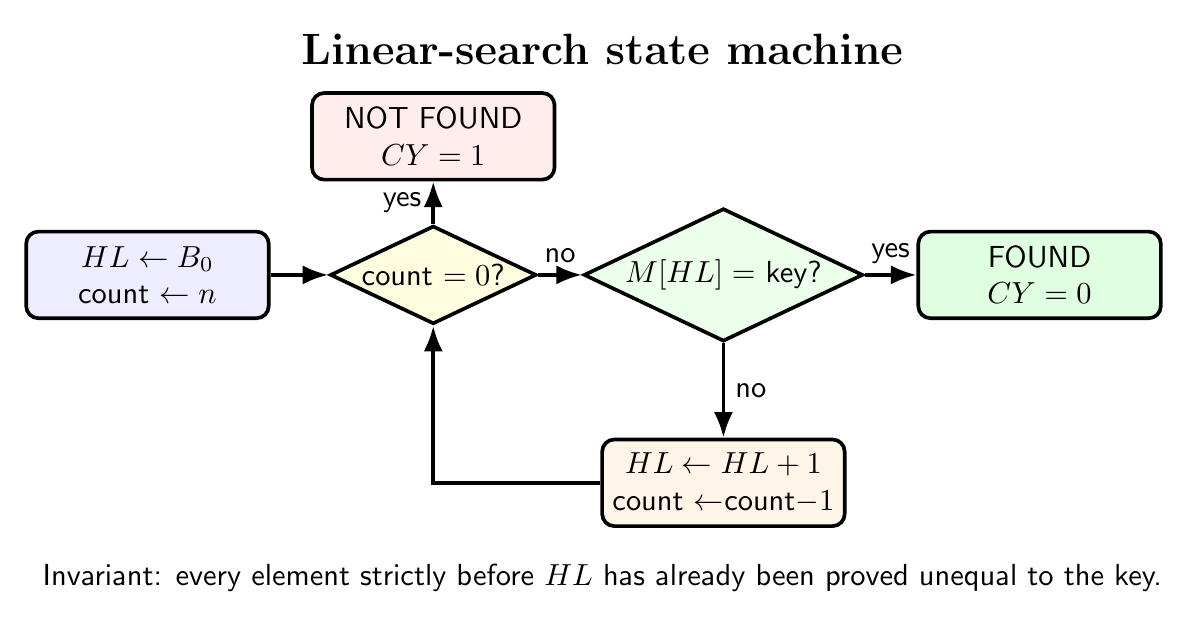
Worst-case unsuccessful search makes $n$ comparisons; a match at zero-based index $i$ makes $i+1$. If a match is equally likely to occur at any position and is guaranteed to exist, the mean is
\[E[C]=\frac1n\sum_{i=0}^{n-1}(i+1)=\frac{n+1}{2}.\]The program therefore has time complexity $\Theta(n)$ and constant auxiliary storage. The exact execution time depends on the match position because the conditional jump path changes.
Adjacent-exchange sorting
Bubble sort compares adjacent elements and exchanges a pair when it is out of ascending order. After one complete left-to-right pass, the maximum element of the active prefix is at its right boundary. The next pass can therefore omit that final element.
N       EQU 05H
        LXI H,ARRAY
        MVI B,N
        CALL SORT8
        HLT

; Input: B = length, array begins at fixed label ARRAY
; Output: ARRAY ascending; destroys A, B, C, D, HL and flags
SORT8:  MOV A,B
        CPI 02H
        RC              ; length 0 or 1 is already sorted
        DCR B           ; number of remaining passes
OUTER:  LXI H,ARRAY
        MOV C,B         ; comparisons shrink by one each pass
INNER:  MOV A,M         ; A = left element
        INX H           ; M = right element
        CMP M
        JC ORDERED
        JZ ORDERED
        MOV D,M         ; exchange; HL currently points right
        MOV M,A
        DCX H
        MOV M,D
        INX H
ORDERED:DCR C
        JNZ INNER
        DCR B
        JNZ OUTER
        RET

ARRAY:  DB 42H,17H,63H,08H,31H
At the end of pass $p$ ($p=1$ for the first pass), the $p$ largest values occupy their final positions at the right end. The total number of comparisons is
\[(n-1)+(n-2)+\cdots+1=\frac{n(n-1)}2.\]Define an inversion as a pair $(i,j)$ with $i<j$ but $A[i]>A[j]$. Exchanging an adjacent inverted pair removes exactly one inversion and introduces none. The number of executed swaps is therefore exactly the initial inversion count. This supplies a termination measure and a correctness argument: when no inversion remains, the array is nondecreasing.
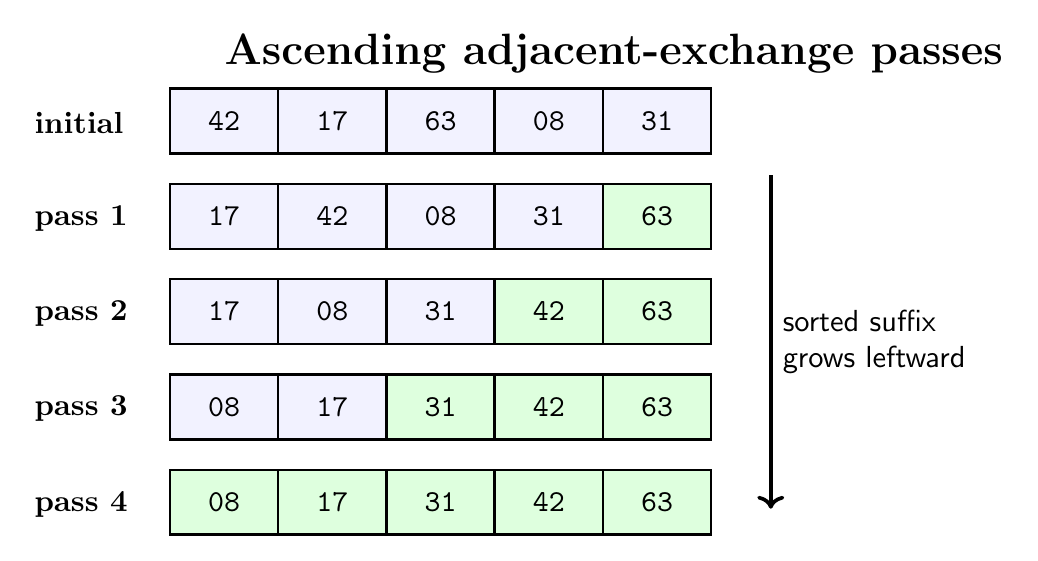
For the sample, the passes produce
initial : 42 17 63 08 31
pass 1  : 17 42 08 31 63
pass 2  : 17 08 31 42 63
pass 3  : 08 17 31 42 63
pass 4  : 08 17 31 42 63
Bubble sort is suitable for demonstrating pointer and flag discipline, but its $\Theta(n^2)$ comparison count makes it unsuitable for large tables.
Table lookup and checksums
The 8085 has no base-plus-index addressing mode, but an unsigned byte index can be promoted to a word and added to a table base:
; Input: A = index 0...15
; Output: A = SQUARES[index]; destroys DE, HL and CY
LOOKUP: MOV L,A
        MVI H,00H
        LXI D,SQUARES
        DAD D
        MOV A,M
        RET

SQUARES:DB 00H,01H,04H,09H,10H,19H,24H,31H
        DB 40H,51H,64H,79H,90H,A9H,C4H,E1H
The table stores $i^2$ for $0\leq i\leq15$. The caller must enforce the index range; otherwise a legal memory read occurs outside the table. For fixed-size records of $r$ bytes, compute $B+ri$ rather than $B+i$, using shifts or repeated addition appropriate to $r$.
A simple modulo-256 additive checksum is
\[S=\left(\sum_{i=0}^{n-1}A[i]\right)\bmod256.\]; Input: HL = block, B = length
; Output: A = modulo-256 sum, HL advanced by original length, B = 0
; Destroys flags
SUM8: MOV A,B
ORA A
JZ SUMZERO
XRA A
SLOOP: ADD M
INX H
DCR B
JNZ SLOOP
RET
SUMZERO:XRA A
RET
At iteration $i$, $A$ equals the sum of the first $i$ bytes modulo 256. The final carry flag reports only the carry from the last byte addition; it is not an accumulated count of all carries. This checksum detects many errors but not all permutations or compensating byte changes, so it is an instructional integrity check rather than a cryptographic one.
Preparation questions
- Prove
COPYFfrom its loop invariant and give an explicit overlapping memory example for which it fails. - Trace
COPYBfor $S=3000_H$, $D=3002_H$, $n=5$, including both pointer values at every iteration. - Extend
FIND8to return the zero-based index inA, with $FF_H$ representing failure. - Derive the expected number of comparisons when the key is absent with probability $q$ and otherwise uniformly located.
- Trace every comparison and swap of
SORT8for05 02 05 01, and verify stability of equal keys. - Prove that the number of adjacent swaps performed by bubble sort equals the initial inversion count.
- Write a table-lookup routine for 16-bit entries stored low byte first and return the result in
HL. - Modify
SUM8to form a 16-bit sum and derive its maximum value for 255 input bytes.


Discussion