

07 May 2025
8085 Opcodes, Operands, Mnemonics and Machine Code
Precise assembly-language terminology, structured 8085 opcode fields, object-byte generation and worked instruction encodings.
An 8085 program can be described at three connected levels. Assembly source uses symbols such as MOV A,C; the assembler translates that statement; machine code is the resulting byte sequence, 79H in this example, which the processor fetches from memory. A mnemonic is readable notation, an operand identifies data or a location, and an opcode byte is the binary pattern decoded by the processor.
The word opcode is used in two nearby senses. In an assembly source line, the opcode field contains a mnemonic such as MOV. In the object program, the operation code is a numeric byte such as 79H. The context must make clear whether “opcode” means the source-language field or the encoded byte.
The terminology and encodings here follow Intel’s primary 8080/8085 Assembly Language Programming Manual, with system-level context from the MCS-80 User’s Manual.
Anatomy of an assembly statement
A conventional source line contains up to four logical fields:
LOOP:   ADD M       ; add the byte addressed by HL to A
label   mnemonic operand                 comment
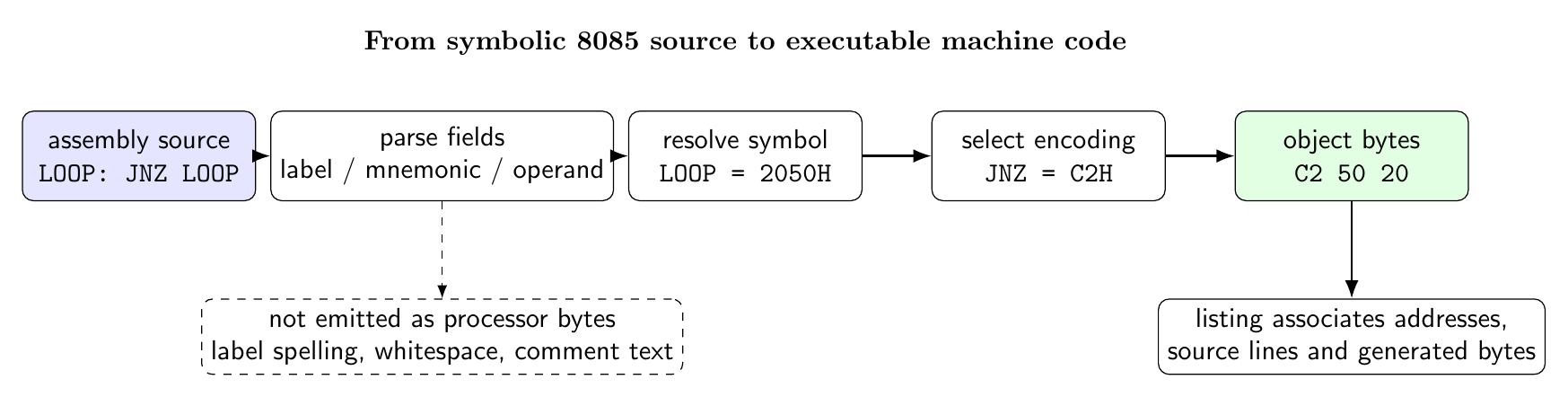
The optional label gives a symbolic name to the current location. ADD is the mnemonic in the source opcode field. M is the operand. Text after the comment delimiter documents the program and produces no processor byte. Whitespace and punctuation are assembler syntax; they are not stored as ASCII characters in the executable instruction.
A statement may contain two operands, as in MOV D,E or MVI C,7FH. Their order is instruction-specific. For data-transfer instructions Intel notation normally writes destination first and source second:
For MVI C,7FH, C is the destination and 7FH is immediate data. In contrast, STA 2500H has one written operand: a direct address. The source A is implied by the instruction definition.
Mnemonics express operations
A mnemonic is a compact name chosen to suggest the instruction’s action. Important families include:
- data transfer:
MOV,MVI,LXI,LDA,STA,PUSH,POP; - arithmetic:
ADD,ADC,SUB,SBB,INR,DCR,DAD; - logical:
ANA,XRA,ORA,CMP, rotates and complements; - branch:
JMP, conditional jumps,CALL,RET, andRST; - I/O and machine control:
IN,OUT,EI,DI,HLT,NOP,SIM,RIM.
Mnemonic similarity does not imply identical encoding or flag effects. INR B and ADD B both perform arithmetic, but INR preserves carry while ADD defines it from the addition. MOV changes no condition flags. Exact semantics, flags, byte count, and timing belong to the instruction definition, not to an informal reading of the name.
Operands and what they denote
An operand can denote a register (A, B, C, D, E, H, L), a register pair (B, D, H, or SP in pair-using instructions), the memory symbol M, immediate data, a direct address, a port, or a program label. The assembler interprets the operand according to the mnemonic.
M is not an eighth physical general-purpose register. It means the memory byte whose address is in HL. Thus MOV A,M performs $A\leftarrow M[HL]$, and source code using M may require an external memory cycle even though the instruction itself is only one byte.
A symbol such as LOOP stands for a value maintained in the assembler’s symbol table. If LOOP is assigned address 2050H, JNZ LOOP can assemble as the same three bytes as JNZ 2050H. The label improves maintainability; the processor ultimately receives only numeric bytes.
Machine code and structured opcode fields
Machine code is commonly printed in hexadecimal because one hexadecimal digit represents four bits. The processor nevertheless decodes eight binary lines. Many 8085 opcodes are systematic fields rather than unrelated numbers.
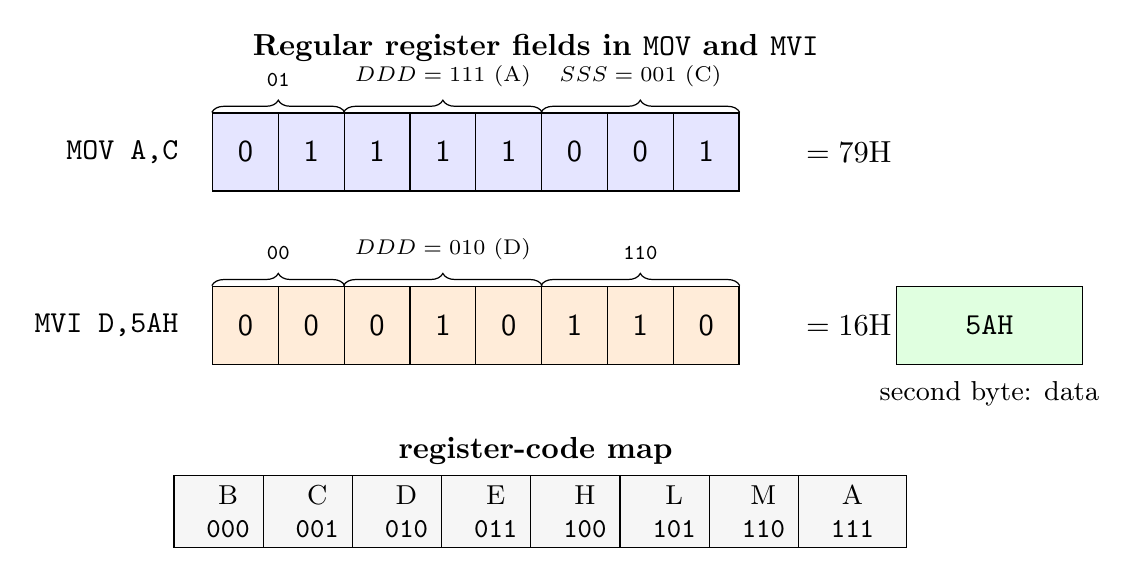
For the MOV family,
The three-bit register code is
| register | B | C | D | E | H | L | M | A |
|---|---|---|---|---|---|---|---|---|
| code | 000 | 001 | 010 | 011 | 100 | 101 | 110 | 111 |
Therefore MOV A,C is
The nominal bit pattern for MOV M,M is 01 110 110, or 76H. Copying a memory location onto itself would have no useful effect, so this code is assigned to HLT. This exception must be learned with the otherwise regular MOV matrix.
The MVI family uses
followed by the data byte. MVI D,5AH has destination code 010, giving 00010110B = 16H, followed by 5AH. The complete machine instruction is 16 5A.
Other reusable encoding patterns
The eight accumulator-register ALU groups occupy a regular region:
10000 SSS   ADD source
10001 SSS   ADC source
10010 SSS   SUB source
10011 SSS   SBB source
10100 SSS   ANA source
10101 SSS   XRA source
10110 SSS   ORA source
10111 SSS   CMP source
For example, ADD M appends the M code 110 to 10000, producing 10000110B = 86H. CMP A is 10111 111B = BFH. The source field changes the operand without changing the operation family.
Register-pair encodings normally use a two-bit RP field: 00 for BC, 01 for DE, 10 for HL, and 11 for SP. LXI rp,data16 has the opcode pattern 00 RP 0001. With RP=10, LXI H,2050H begins with 21H; the complete bytes are 21 50 20 because the low byte of the immediate word comes first.
Restart instructions have the compact form
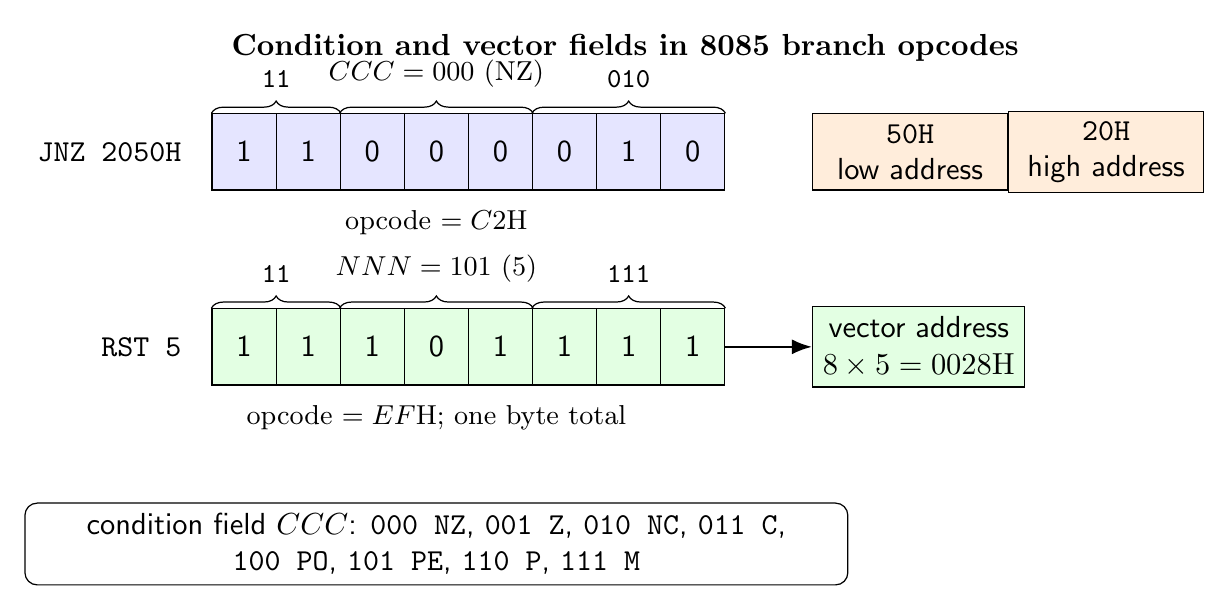
\[\boxed{\texttt{RST n}:\quad 11\;NNN\;111},\qquad n=0,1,\ldots,7.\]The encoded number selects vector address $8n$. RST 5 is 11 101 111B = EFH and transfers control to 0028H after saving the return address on the stack.
Conditional jumps follow 11 CCC 010, where CCC selects NZ, Z, NC, C, PO, PE, P, or M. Thus JNZ 2050H is C2 50 20, whereas JZ 2050H is CA 50 20. The address bytes are identical; only the condition field changes.
From source operands to object bytes
The assembler makes several decisions for each instruction:
- recognize the mnemonic and permitted operand forms;
- map registers or conditions into their bit fields;
- evaluate numeric expressions and resolve labels;
- check whether values fit the required 8- or 16-bit range;
- emit the opcode and any following bytes in prescribed order.
Consider the source sequence beginning at 2000H:
        MVI A,3CH
        MOV B,A
        ADI 04H
        STA 2500H
It becomes
address   bytes       source
2000      3E 3C       MVI A,3CH
2002      47          MOV B,A
2003      C6 04       ADI 04H
2005      32 00 25    STA 2500H
The next instruction begins at 2008H: the byte counts are $2+1+2+3=8$. The two bytes after STA encode the direct address 2500H as low byte 00H, high byte 25H.
Decoding a byte sequence
Decoding reverses assembly. Suppose memory contains
21 00 30 7E B7 CA 12 20
21H matches LXI H and consumes the following bytes as 3000H. 7EH matches MOV A,M. B7H matches ORA A, a common way to set S, Z, and P according to A while clearing carry and auxiliary carry as specified for logical OR. CAH matches JZ and consumes 12H 20H as destination 2012H. Correct decoding therefore requires both the opcode map and the length prescribed by that opcode; treating every byte as a fresh opcode would misalign the stream.
Assembler directives such as DB, DW, ORG, and EQU are not processor instructions. They control data generation, location assignment, or symbol values during assembly. A byte emitted by DB 76H is numerically indistinguishable from the HLT opcode when fetched as an instruction. Meaning depends on whether program control reaches that memory as code or the program accesses it as data.
Accuracy checks when hand-encoding
For manual translation, first identify instruction length and addressing mode. Then write the binary template, insert register or condition fields, convert to hexadecimal, and append operands. For a 16-bit quantity, append low byte before high byte. Finally recompute successive addresses and ensure that labels point to opcode bytes rather than to an operand byte.
Do not infer an encoding merely from a mnemonic’s spelling. Use the documented opcode pattern or instruction table, particularly for implied instructions and 8085-specific operations such as RIM and SIM. A machine-code listing is exact only when byte order, instruction boundaries, and operand interpretation all agree.
Preparation questions
- Distinguish a mnemonic, the assembly opcode field, an operand, an opcode byte, and a complete machine instruction.
- Derive the machine byte for
MOV E,Hfrom the01 DDD SSSformat. - Encode
MVI L,A6Hand explain why the immediate byte is not part of the opcode. - Derive the opcodes for
ADD C,XRA M, andCMP Ausing the accumulator-ALU family patterns. - Explain the special status of the nominal
MOV M,Mbit pattern. - Encode
LXI D,4A20H,JZ 2150H, andRST 6, preserving the correct byte order. - Starting at
4000H, assign addresses to the bytes generated byMVI B,02H,DCR B, andJNZ 4002H.


Discussion