

20 May 2026
Neutron Scattering by Phonons
Coherent one-phonon scattering, energy and reciprocal-lattice selection rules, polarization factors, detailed balance, and neutron kinematics.
Thermal and cold neutrons have wavelengths comparable with interatomic distances and energies comparable with phonon energies. Inelastic neutron scattering can therefore determine both the wavevector and frequency of a lattice vibration throughout the Brillouin zone. The result is not merely a frequency spectrum: energy conservation, reciprocal-lattice momentum selection and the phonon polarization all enter the measured intensity.
The convention used below is
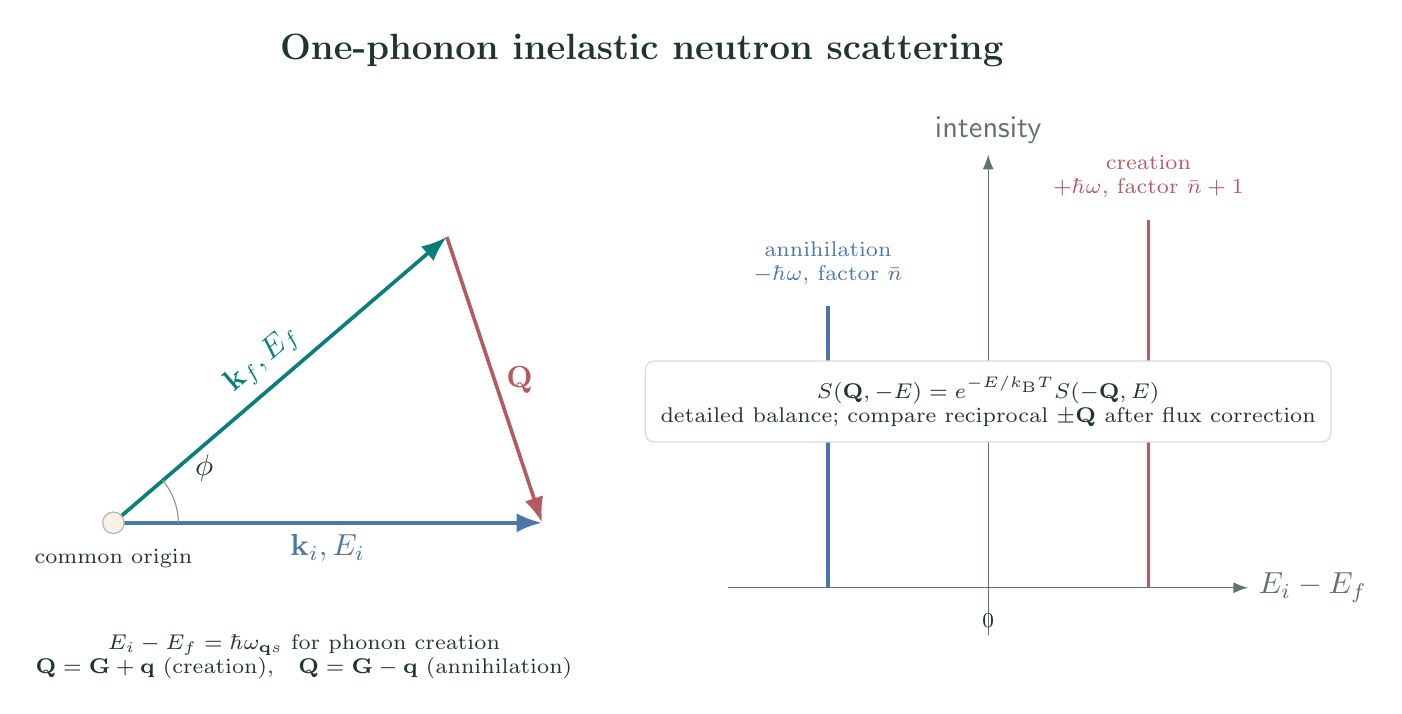
\[\mathbf Q=\mathbf k_i-\mathbf k_f, \qquad E=E_i-E_f.\]Thus $\mathbf Q$ and $E$ are momentum and energy transferred from the neutron to the sample. Positive $E$ denotes neutron energy loss and sample excitation.
Neutron kinematics
For a free neutron of mass $m_n$,
\[E_i=\frac{\hbar^2k_i^2}{2m_n}, \qquad E_f=\frac{\hbar^2k_f^2}{2m_n}.\]If $\phi$ is the angle between $\mathbf k_i$ and $\mathbf k_f$, then
\[\boxed{ Q^2=k_i^2+k_f^2-2k_ik_f\cos\phi. }\]In practical units,
\[\boxed{ E_n^{\mathrm{kin}}(\mathrm{meV}) =2.072\,k^2(\mathrm{\mathring A^{-2}}). }\]For elastic scattering $k_i=k_f=k$ and
\[Q=2k\sin\frac{\phi}{2}.\]For inelastic scattering $k_i\ne k_f$, so both the magnitude and direction of $\mathbf Q$ must be obtained from the full scattering triangle.
Neutron–nucleus interaction and scattering law
At energies used for lattice spectroscopy, the strong neutron–nucleus interaction is represented by the Fermi pseudopotential
\[V(\mathbf r) =\frac{2\pi\hbar^2}{m_n} \sum_j b_j\, \delta(\mathbf r-\mathbf r_j),\]where $b_j$ is the nuclear scattering length. Unlike an x-ray atomic form factor, a nuclear scattering length does not decrease systematically with atomic number and is essentially independent of $Q$ over ordinary diffraction ranges. Isotopes of the same element can have very different scattering lengths.
Define the scattering-length-weighted density operator
\[\rho_b(\mathbf Q) =\sum_j b_j e^{i\mathbf Q\cdot\mathbf r_j}.\]A sign-unambiguous spectral definition of the weighted dynamic structure factor is
\[\boxed{ S_b(\mathbf Q,E) =\sum_{I,F}p_I \left\lvert \langle F\lvert\rho_b(\mathbf Q)\rvert I\rangle \right\rvert^2 \delta\!\left[ E-(E_F-E_I) \right], }\]where $I$ and $F$ are sample states and $p_I$ is the equilibrium probability of $I$. In the first Born approximation,
\[\boxed{ \frac{d^2\sigma}{d\Omega\,dE_f} =\frac{k_f}{k_i}S_b(\mathbf Q,E). }\]With this definition $S_b$ already includes the scattering lengths and has units of area per energy. Textbooks often factor out a cross section such as $\sigma_{\mathrm{coh}}/(4\pi)$ and define a dimensionless $S$; their displayed prefactor then differs, while the phonon selection rules and relative intensities are unchanged.
Coherent and incoherent scattering
Write the scattering length at a crystallographically equivalent site as
\[b_j=\overline b+\Delta b_j, \qquad \langle\Delta b_j\rangle=0.\]The coherent cross section is
\[\sigma_{\mathrm{coh}}=4\pi\left\lvert\overline b\right\rvert^2,\]whereas isotopic and nuclear-spin fluctuations give
\[\sigma_{\mathrm{inc}} =4\pi\left( \overline{\left\lvert b\right\rvert^2} -\left\lvert\overline b\right\rvert^2 \right).\]Coherent one-phonon scattering contains interference between different unit cells and therefore obeys a reciprocal-lattice wavevector selection rule. It is used to map $\omega_{\mathbf q s}$. Incoherent scattering lacks this long-range interference; after suitable averaging, it is more closely related to a scattering-weighted phonon density of states.
Expansion in atomic displacements
For atom $\kappa$ in cell $l$,
\[\mathbf r_{l\kappa} =\mathbf R_l+\boldsymbol\tau_\kappa +\mathbf u_{l\kappa}.\]The scattering operator contains
\[e^{i\mathbf Q\cdot\mathbf r_{l\kappa}} =e^{i\mathbf Q\cdot (\mathbf R_l+\boldsymbol\tau_\kappa)} e^{i\mathbf Q\cdot\mathbf u_{l\kappa}}.\]The displacement exponential itself has the series
\[e^{i\mathbf Q\cdot\mathbf u} \simeq \left[ 1+i\mathbf Q\cdot\mathbf u -\frac12(\mathbf Q\cdot\mathbf u)^2+\cdots \right].\]Here
\[W_\kappa(\mathbf Q) =\frac12 \left\langle (\mathbf Q\cdot\mathbf u_{l\kappa})^2 \right\rangle.\]Evaluation of harmonic matrix elements supplies a Debye–Waller amplitude factor $e^{-W_\kappa}$ to each term. The constant term gives elastic Bragg scattering. The term linear in $\mathbf u$ creates or annihilates one phonon. Quadratic and higher terms generate two-phonon and multiphonon scattering. Since a one-phonon amplitude contains $\mathbf Q\cdot\mathbf u$, neutron scattering directly probes the component of atomic motion parallel to $\mathbf Q$.
One-phonon coherent structure factor
Use the quantized displacement
\[\mathbf u_{l\kappa} =\frac{1}{\sqrt{NM_\kappa}} \sum_{\mathbf q s} \sqrt{\frac{\hbar}{2\omega_{\mathbf q s}}} \left[ \mathbf e_\kappa(\mathbf q,s) a_{\mathbf q s} e^{i\mathbf q\cdot\mathbf R_l} +\mathbf e_\kappa^{*}(\mathbf q,s) a_{\mathbf q s}^{\dagger} e^{-i\mathbf q\cdot\mathbf R_l} \right].\]The phonon-creation structure amplitude is
\[\boxed{ F_s^{\mathrm{cr}}(\mathbf Q,\mathbf q) =\sum_{\kappa} \frac{b_\kappa e^{-W_\kappa(\mathbf Q)}} {\sqrt{M_\kappa}}\, \left[ \mathbf Q\cdot \mathbf e_\kappa^{*}(\mathbf q,s) \right] e^{i\mathbf Q\cdot\boldsymbol\tau_\kappa}. }\]The annihilation amplitude is
\[\boxed{ F_s^{\mathrm{an}}(\mathbf Q,\mathbf q) =\sum_{\kappa} \frac{b_\kappa e^{-W_\kappa(\mathbf Q)}} {\sqrt{M_\kappa}}\, \left[ \mathbf Q\cdot \mathbf e_\kappa(\mathbf q,s) \right] e^{i\mathbf Q\cdot\boldsymbol\tau_\kappa}. }\]For an ideal crystal, the coherent lattice sum is non-zero only when the scattering vector differs from the phonon wavevector by a reciprocal-lattice vector. Apart from the conventional normalization of reciprocal-space delta functions, the coherent one-phonon scattering law is
\[\boxed{ \begin{aligned} S_b^{(1)}(\mathbf Q,E) =\frac{N\hbar}{2} \sum_{\mathbf q s} \frac{1}{\omega_{\mathbf q s}} \sum_{\mathbf G} \Big\{& (\bar n_{\mathbf q s}+1) \left\lvert F_s^{\mathrm{cr}}(\mathbf Q,\mathbf q) \right\rvert^2 \Delta(\mathbf Q-\mathbf G-\mathbf q) \delta(E-\hbar\omega_{\mathbf q s}) \\ &+\bar n_{\mathbf q s} \left\lvert F_s^{\mathrm{an}}(\mathbf Q,\mathbf q) \right\rvert^2 \Delta(\mathbf Q-\mathbf G+\mathbf q) \delta(E+\hbar\omega_{\mathbf q s}) \Big\}. \end{aligned} }\]$\Delta$ denotes the reciprocal-space selection function: a Kronecker delta for a finite periodic crystal and a reciprocal-space Dirac delta, with the corresponding volume normalization, in the infinite-crystal limit. The two contributions contain the experimentally invariant content:
Phonon creation
The neutron loses energy and creates a phonon:
\[\boxed{ E=+\hbar\omega_{\mathbf q s}, \qquad \mathbf Q=\mathbf G+\mathbf q. }\]The oscillator matrix element is
\[\left\lvert \langle n+1\lvert a^\dagger\rvert n\rangle \right\rvert^2=n+1,\]so the thermal intensity factor is $\bar n+1$. Creation remains possible at $T=0$ because of the unity term.
Phonon annihilation
The neutron gains energy by destroying a thermally occupied phonon:
\[\boxed{ E=-\hbar\omega_{\mathbf q s}, \qquad \mathbf Q=\mathbf G-\mathbf q. }\]Since
\[\left\lvert \langle n-1\lvert a\rvert n\rangle \right\rvert^2=n,\]the intensity factor is $\bar n$. Annihilation vanishes as $T\to0$. In optical-spectroscopy language, creation is the Stokes side and annihilation the anti-Stokes side.
The reduced phonon wavevector is obtained by subtracting a reciprocal vector:
\[\mathbf q=\mathbf Q-\mathbf G\]for creation, and it is conventionally folded into the first Brillouin zone. Momentum is conserved as crystal momentum modulo $\mathbf G$, not as unrestricted continuum momentum.
Bose factors and detailed balance
The equilibrium occupation is
\[\bar n(\omega) =\frac{1}{e^{\beta\hbar\omega}-1}.\]It obeys
\[\frac{\bar n}{\bar n+1} =e^{-\beta\hbar\omega}.\]Consequently, after comparing equivalent wavevectors and correcting the kinematic factor $k_f/k_i$,
\[\boxed{ \frac{I_{\mathrm{ann}}}{I_{\mathrm{cre}}} =e^{-\hbar\omega/(k_{\mathrm B}T)}. }\]The general detailed-balance relation is
\[\boxed{ S_b(\mathbf Q,-E) =e^{-E/(k_{\mathrm B}T)} S_b(-\mathbf Q,E). }\]For a reciprocal system with $S_b(-\mathbf Q,E)=S_b(\mathbf Q,E)$, this reduces to the familiar relation between negative- and positive-energy sides at the same $\mathbf Q$.
Polarization and basis selection rules
The factor
\[\left\lvert \mathbf Q\cdot\mathbf e_\kappa(\mathbf q,s) \right\rvert^2\]suppresses a mode whose displacement is perpendicular to $\mathbf Q$. It is therefore incorrect to say that neutrons detect only longitudinal phonons. A transverse phonon relative to $\mathbf q$ can be strong whenever its polarization has a component along the total scattering vector $\mathbf Q=\mathbf G+\mathbf q$.
For a multi-atom basis, amplitudes from different atoms add before their modulus is squared:
\[\left\lvert \sum_\kappa \frac{b_\kappa}{\sqrt{M_\kappa}} (\mathbf Q\cdot\mathbf e_\kappa) e^{i\mathbf Q\cdot\boldsymbol\tau_\kappa} \right\rvert^2.\]Relative phases can cause constructive or destructive interference. Hence a phonon can be absent near one reciprocal-lattice point and intense near another even though its frequency is unchanged. To select a mode experimentally, one chooses a Brillouin zone where both the polarization factor and basis structure factor are favourable.
The remaining one-phonon factors have clear origins:
\[\frac{1}{\omega_{\mathbf q s}}\]comes from the squared quantum displacement amplitude.
The Debye–Waller amplitude $e^{-W_\kappa}$ suppresses scattering at large $Q$ and high temperature. For a monatomic crystal, or for an individual diagonal term in an incoherent sum, squaring this amplitude gives the intensity factor
\[e^{-2W_\kappa}.\]For a coherent multi-atom basis, $e^{-W_\kappa}$ must remain inside the sum over $\kappa$; an interference term involving atoms $\kappa$ and $\kappa’$ contains $e^{-(W_\kappa+W_{\kappa’})}$. Finally,
\[\frac{k_f}{k_i}\]is the final-to-initial neutron phase-space factor.
Experimental scanning geometry
In a triple-axis experiment, monochromator and analyser crystals select $k_i$ and $k_f$, while sample and detector angles set $\mathbf Q$. The four conservation variables are related by
\[\mathbf Q=\mathbf k_i-\mathbf k_f, \qquad E=\frac{\hbar^2}{2m_n}(k_i^2-k_f^2).\]A constant-$\mathbf Q$ scan varies energy transfer while maintaining a chosen scattering vector. A phonon appears as a peak at $E=\pm\hbar\omega_{\mathbf q s}$. A constant-energy scan moves through reciprocal space at fixed energy transfer and locates wavevectors satisfying the dispersion relation. Time-of-flight instruments record a broad range of final energies and detector angles simultaneously and reconstruct $S(\mathbf Q,E)$ over a multi-dimensional region.
The conservation equations are necessary but not sufficient for measurable intensity. A proposed point must also satisfy the instrument’s incident-energy range, accessible scattering angles, polarization factor, structure factor and energy–momentum resolution.
Worked kinematic example
Suppose a neutron with
\[E_i=30.0\,\mathrm{meV}\]creates a phonon of energy
\[\hbar\omega=8.00\,\mathrm{meV}.\]Then
\[E_f=22.0\,\mathrm{meV},\]and
\[k_i=\sqrt{\frac{30.0}{2.072}} =3.805\,\mathrm{\mathring A^{-1}},\] \[k_f=\sqrt{\frac{22.0}{2.072}} =3.258\,\mathrm{\mathring A^{-1}}.\]Let $\mathbf k_i$ define the $x$ axis and let the scattering angle be $\phi=40.0^\circ$. Then
\[\mathbf Q =\left( k_i-k_f\cos\phi,\, -k_f\sin\phi \right) =(1.309,-2.094)\,\mathrm{\mathring A^{-1}},\]so
\[Q=2.470\,\mathrm{\mathring A^{-1}}.\]For a cubic lattice with $a=4.00\,\mathrm{\mathring A}$, one reciprocal-lattice spacing is
\[\frac{2\pi}{a} =1.571\,\mathrm{\mathring A^{-1}}.\]Choosing
\[\mathbf G =\frac{2\pi}{a}(1,-1) =(1.571,-1.571)\,\mathrm{\mathring A^{-1}},\]the creation selection rule gives the reduced wavevector
\[\mathbf q=\mathbf Q-\mathbf G =(-0.262,-0.524)\,\mathrm{\mathring A^{-1}}.\]Both components lie inside the first-zone interval $-\pi/a$ to $\pi/a$, and
\[q=0.585\,\mathrm{\mathring A^{-1}}.\]A scattering peak occurs only if a phonon branch at this reduced wavevector has energy $8.00\,\mathrm{meV}$ and a non-zero structure factor.
At $300\,\mathrm K$,
\[\bar n =\frac{1} {\exp\!\left[\dfrac{8.00\,\mathrm{meV}} {k_{\mathrm B}(300\,\mathrm K)}\right]-1} =2.76,\]so the creation and annihilation population factors are
\[\bar n+1=3.76, \qquad \bar n=2.76.\]Their corrected intensity ratio is
\[\frac{I_{\mathrm{ann}}}{I_{\mathrm{cre}}} =\exp\!\left[-\frac{8.00\,\mathrm{meV}}{25.85\,\mathrm{meV}}\right] =0.734.\]At $50.0\,\mathrm K$, the same ratio falls to
\[\exp\!\left[-\frac{8.00\,\mathrm{meV}}{4.309\,\mathrm{meV}}\right] =0.156.\]The disappearance of the energy-gain side on cooling is a direct consequence of the declining thermal phonon population.
Preparation questions
- Derive the neutron energy- and momentum-transfer equations and construct the inelastic scattering triangle.
- Starting from the Fermi pseudopotential, define the scattering-length-weighted dynamic structure factor and state its relation to the double-differential cross section.
- Expand the nuclear scattering operator in atomic displacements and identify the elastic, one-phonon and multiphonon terms.
- Derive the coherent one-phonon creation and annihilation terms, including their energy and reciprocal-lattice selection rules.
- Explain the origins of the polarization factor, basis structure factor, Debye–Waller factor and $1/\omega$ factor.
- Derive the detailed-balance relation between phonon creation and annihilation intensities.
- Distinguish coherent and incoherent neutron scattering and explain how each is used in phonon measurements.
- Given $E_i$, energy transfer, scattering angle and lattice constant, calculate $\mathbf Q$, choose an appropriate $\mathbf G$, and obtain the reduced phonon wavevector.


Discussion