

19 Jun 2026
Long-Wavelength Optical Modes in Ionic Crystals
Diatomic-lattice optical modes, Born effective charges, LO--TO splitting, the Lyddane--Sachs--Teller relation, and reststrahlen reflection.
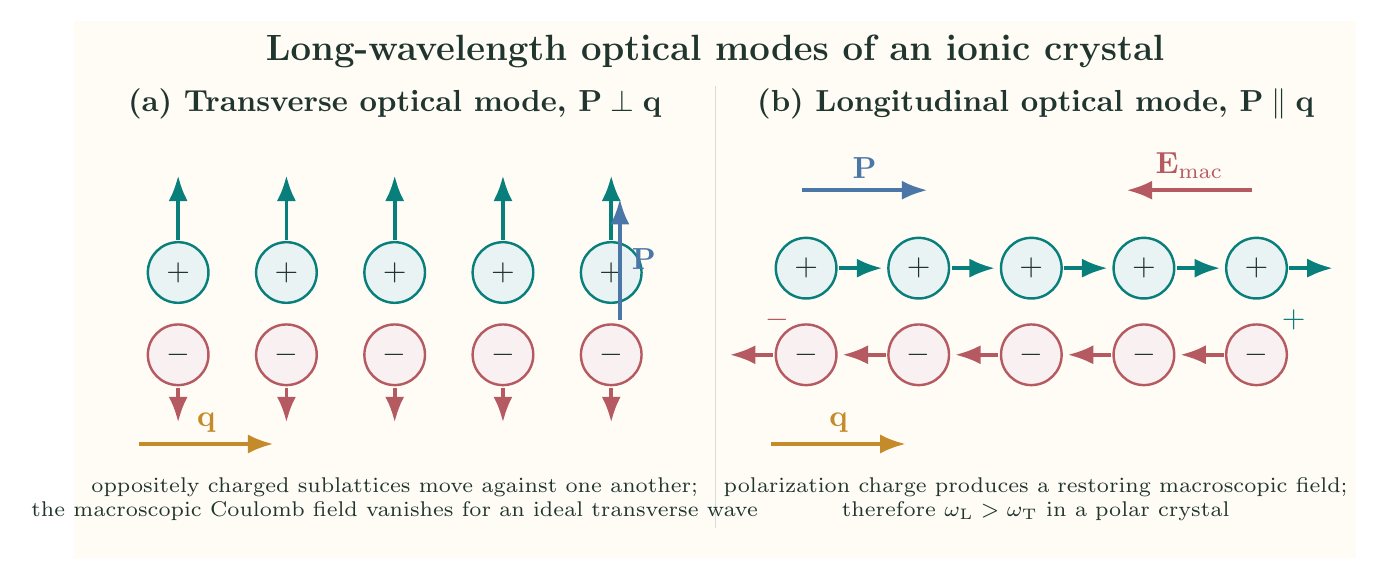
An optical lattice mode is a normal mode in which the positive and negative sublattices move against one another. In an ionic solid this relative displacement carries an electric dipole moment, so the long-wavelength dynamics cannot be obtained from short-range springs alone. A transverse displacement produces no macroscopic charge density in the strict $q\to0$ limit, whereas a longitudinal displacement produces polarization charge and a macroscopic Coulomb field. This distinction gives separate transverse-optical (TO) and longitudinal-optical (LO) limiting frequencies.
The mechanical diatomic-chain model is useful for deriving acoustic and optical branches. It does not, by itself, produce LO–TO splitting. That splitting belongs to the three-dimensional electromechanical problem and follows from the nonanalytic long-range Coulomb field.
Mechanical diatomic chain
Consider a one-dimensional lattice with repeat distance $a$. Each cell contains a mass $M$ with displacement $u_n$ and a mass $m$ with displacement $v_n$. Adjacent unlike atoms are joined by identical springs of force constant $C$. With only nearest-neighbour harmonic forces,
\[M\ddot u_n=C(v_n+v_{n-1}-2u_n),\] \[m\ddot v_n=C(u_n+u_{n+1}-2v_n).\]Take Bloch-wave solutions
\[u_n=Ue^{i(nka-\omega t)}, \qquad v_n=Ve^{i(nka-\omega t)}.\]Substitution gives
\[\begin{pmatrix} 2C-M\omega^2 & -C(1+e^{-ika})\\ -C(1+e^{ika}) & 2C-m\omega^2 \end{pmatrix} \begin{pmatrix}U\\V\end{pmatrix}=0.\]A nonzero eigenvector requires the determinant to vanish:
\[(2C-M\omega^2)(2C-m\omega^2) -C^2(1+e^{-ika})(1+e^{ika})=0.\]Since
\[(1+e^{-ika})(1+e^{ika}) =4\cos^2\!\left(\frac{ka}{2}\right),\]the secular equation is
\[Mm\omega^4-2C(M+m)\omega^2 +4C^2\sin^2\!\left(\frac{ka}{2}\right)=0.\]Its two roots are
\[\boxed{ \omega_{\pm}^2(k)= \frac{C(M+m)}{Mm} \pm\frac{C}{Mm} \sqrt{(M+m)^2-4Mm\sin^2\!\left(\frac{ka}{2}\right)} }\]where $\omega_-$ is the acoustic branch and $\omega_+$ is the optical branch.
At $k=0$,
\[\omega_-(0)=0, \qquad \omega_+^2(0)=2C\left(\frac1M+\frac1m\right).\]For the acoustic mode, $U=V$: the two atoms translate together and the unit cell is not internally distorted. For the optical mode,
\[MU+mV=0, \qquad V=-\frac{M}{m}U,\]so the centre of mass of a cell remains fixed while the two sublattices move oppositely.
To obtain the sound speed, expand the lower branch at $ka\ll1$. Using $\sin(ka/2)\simeq ka/2$ gives
\[\omega_-^2(k)\simeq \frac{Ca^2}{2(M+m)}k^2,\]and hence
\[v_s=\lim_{k\to0}\frac{\omega_-}{|k|} =a\sqrt{\frac{C}{2(M+m)}}.\]The optical branch has a nonzero limiting frequency because unlike atoms experience a restoring force even when every unit cell undergoes the same internal relative displacement.
At the Brillouin-zone edge $k=\pi/a$, the two frequencies, for $M>m$, are
\[\omega_-^2=\frac{2C}{M}, \qquad \omega_+^2=\frac{2C}{m}.\]This mechanical frequency gap is caused by the two unequal inertial masses. There is still no LO–TO distinction: a one-dimensional scalar spring model has not included the macroscopic electric field or the orientation of polarization relative to a three-dimensional wave vector.
Relative coordinate and infrared-active polarization
For a three-dimensional polar crystal, let $\mathbf u$ be the relative displacement coordinate of the two sublattices for one infrared-active normal mode, and let
\[\mu=\frac{M_+M_-}{M_++M_-}\]be the corresponding reduced mass. Let $N$ be the number of primitive cells per unit volume. In a cubic crystal with a scalar mode effective charge $Z^\ast e$, the macroscopic ionic polarization is
\[\mathbf P_{\mathrm{ion}}=N Z^\ast e\,\mathbf u.\]$Z^\ast$ is not generally the nominal ionic valence. The Born effective-charge tensor of sublattice $\kappa$ is defined by
\[Z^\ast_{\kappa,\alpha\beta} =\frac{\Omega}{e} \left(\frac{\partial P_\beta} {\partial u_{\kappa\alpha}}\right)_{\mathbf E=0} =\frac{1}{e} \left(\frac{\partial F_{\kappa\alpha}} {\partial E_\beta}\right)_{\mathbf u},\]where $\Omega=1/N$ is the cell volume. The first form describes polarization generated by displacement; the second is the reciprocal force generated by an electric field. Charge neutrality implies the acoustic sum rule
\[\sum_\kappa Z^\ast_{\kappa,\alpha\beta}=0.\]In a non-cubic crystal the effective charge and electronic dielectric constant are tensors, and a normal mode has a mode effective charge obtained by projecting the Born tensors onto its mass-normalized eigenvector. The scalar treatment below is the cubic, one-mode limit.
Let $\omega_{\mathrm{TO}}$ be the long-wavelength transverse frequency after all short-range forces and analytic local-field effects have been included. The driven harmonic equation is
\[\mu\left(\omega_{\mathrm{TO}}^2-\omega^2-i\gamma\omega\right) \mathbf u=Z^\ast e\,\mathbf E,\]where $\mathbf E$ is the macroscopic field acting through the mode effective charge. The high-frequency electronic polarization is included through $\varepsilon_\infty$, so
\[\mathbf D=\varepsilon_0\varepsilon_\infty\mathbf E +\mathbf P_{\mathrm{ion}}.\]It is important not to add an elementary Lorentz local field to this equation once $\omega_{\mathrm{TO}}$ and $Z^\ast$ are understood as crystal normal-mode parameters; that would count part of the microscopic field twice.
Transverse and longitudinal limiting frequencies
For a long-wavelength transverse optical displacement,
\[\mathbf q\cdot\mathbf u=0.\]The macroscopic polarization charge is
\[\rho_{\mathrm{pol}}=-\nabla\cdot\mathbf P \longrightarrow -i\mathbf q\cdot\mathbf P=0.\]Thus the nonretarded macroscopic Coulomb field vanishes for the free transverse mechanical mode, and its $q\to0$ frequency is $\omega_{\mathrm{TO}}$.
For a longitudinal optical displacement, $\mathbf u\parallel\mathbf q$. In a bulk normal mode with no externally supplied free charge, Gauss’s law requires
\[\mathbf q\cdot\mathbf D=0.\]All vectors are longitudinal, so
\[\varepsilon_0\varepsilon_\infty E_L+P_L=0,\]and therefore
\[E_L=-\frac{N Z^\ast e}{\varepsilon_0\varepsilon_\infty}u_L.\]Insert this depolarizing field into the undamped equation of motion:
\[\mu(\omega_{\mathrm{TO}}^2-\omega_{\mathrm{LO}}^2)u_L =-\frac{N(Z^\ast e)^2} {\varepsilon_0\varepsilon_\infty}u_L.\]Hence
\[\boxed{ \omega_{\mathrm{LO}}^2 =\omega_{\mathrm{TO}}^2 +\frac{N(Z^\ast e)^2} {\varepsilon_0\varepsilon_\infty\mu}}\]and $\omega_{\mathrm{LO}}>\omega_{\mathrm{TO}}$ for an infrared-active mode.
The same result appears as a direction-dependent, nonanalytic term in the dynamical matrix. In component notation its long-wavelength form is
\[D^{\mathrm{NA}}_{\kappa\alpha,\kappa'\beta}(\mathbf q) =\frac{e^2}{\varepsilon_0\Omega\sqrt{M_\kappa M_{\kappa'}}} \frac{ \left(\sum_\gamma q_\gamma Z^\ast_{\kappa,\gamma\alpha}\right) \left(\sum_\delta q_\delta Z^\ast_{\kappa',\delta\beta}\right)} {\sum_{\gamma\delta}q_\gamma \varepsilon_{\infty,\gamma\delta}q_\delta}.\]This term depends on the direction from which $\mathbf q$ approaches zero and acts only on polar mode components with nonzero longitudinal effective charge.
Dielectric response and the Lyddane–Sachs–Teller relation
Solving the driven oscillator equation gives
\[\mathbf P_{\mathrm{ion}} =\frac{N(Z^\ast e)^2} {\mu(\omega_{\mathrm{TO}}^2-\omega^2-i\gamma\omega)} \mathbf E.\]Therefore
\[\boxed{ \varepsilon(\omega)=\varepsilon_\infty +\frac{N(Z^\ast e)^2} {\varepsilon_0\mu(\omega_{\mathrm{TO}}^2-\omega^2-i\gamma\omega)}}.\]In the lossless limit, use the LO–TO splitting to rewrite this as
\[\boxed{ \varepsilon(\omega)=\varepsilon_\infty \frac{\omega_{\mathrm{LO}}^2-\omega^2} {\omega_{\mathrm{TO}}^2-\omega^2}}.\]The pole at $\omega_{\mathrm{TO}}$ is the resonant transverse response to an electric field. The zero at $\omega_{\mathrm{LO}}$ is the self-sustained longitudinal condition $D_L=0$.
Let $\varepsilon_s=\varepsilon(0)$ denote the static relative permittivity; it must not be confused with the vacuum permittivity $\varepsilon_0$. Setting $\omega=0$ gives
\[\varepsilon_s =\varepsilon_\infty +\frac{N(Z^\ast e)^2} {\varepsilon_0\mu\omega_{\mathrm{TO}}^2}\]and
\[\boxed{ \frac{\varepsilon_s}{\varepsilon_\infty} =\frac{\omega_{\mathrm{LO}}^2} {\omega_{\mathrm{TO}}^2}} }\]which is the one-mode Lyddane–Sachs–Teller (LST) relation. With several uncoupled infrared-active modes of the same symmetry, its generalized factorized form is
\[\frac{\varepsilon_s}{\varepsilon_\infty} =\prod_j\frac{\omega_{\mathrm{LO},j}^2} {\omega_{\mathrm{TO},j}^2}.\]For anisotropic crystals, this product relation applies to suitable principal dielectric components or, more generally, to dielectric determinants; one cannot arbitrarily pair every measured LO frequency with a TO frequency without accounting for mode symmetry and mixing.
The static ionic polarizability per primitive cell follows directly from the oscillator:
\[\alpha_{\mathrm{ion}}(0) =\frac{(Z^\ast e)^2}{\mu\omega_{\mathrm{TO}}^2},\]and its contribution to relative permittivity is
\[\varepsilon_s-\varepsilon_\infty =\frac{N\alpha_{\mathrm{ion}}(0)}{\varepsilon_0}.\]Reststrahlen band
For negligible damping and positive $\varepsilon_\infty$,
\[\varepsilon(\omega)<0 \qquad\text{when}\qquad \omega_{\mathrm{TO}}<\omega<\omega_{\mathrm{LO}}.\]A transverse plane wave would have
\[k^2=\varepsilon(\omega)\frac{\omega^2}{c^2}.\]Since $\varepsilon<0$, $k$ is imaginary and the field is evanescent rather than a propagating bulk wave. At normal incidence from vacuum, the complex amplitude reflection coefficient is
\[r(\omega)=\frac{1-\sqrt{\varepsilon(\omega)}} {1+\sqrt{\varepsilon(\omega)}},\]and the reflectance is
\[R(\omega)=|r(\omega)|^2.\]In the lossless negative-permittivity interval, $\lvert r\rvert=1$. With damping, $\varepsilon$ is complex, the sharp pole and zero are broadened, and $R$ remains high but is less than unity. This strong-reflection interval between the TO and LO frequencies is the reststrahlen band. Infrared reflectivity locates its edges; infrared absorption is strongest near the TO resonance, while longitudinal EELS or the zero of $\varepsilon$ identifies the LO mode.
Worked numerical examples
For a mechanical chain, take $M=40u$, $m=20u$, $C=100\,\mathrm{N\,m^{-1}}$, where $u=1.66054\times10^{-27}\,\mathrm{kg}$. The zone-centre optical frequency is
\[\frac{\omega_+(0)}{2\pi} =\frac{1}{2\pi}\sqrt{2C\left(\frac1M+\frac1m\right)} =15.13\,\mathrm{THz}.\]At $k=\pi/a$,
\[\frac{\omega_-}{2\pi}=8.73\,\mathrm{THz}, \qquad \frac{\omega_+}{2\pi}=12.35\,\mathrm{THz}.\]These are mechanical branch frequencies and should not be labelled LO and TO.
For a three-dimensional polar mode, take
\[N=2.00\times10^{28}\,\mathrm{m^{-3}},\quad Z^\ast=1.10,\quad \mu=2.30\times10^{-26}\,\mathrm{kg},\] \[\varepsilon_\infty=2.50, \qquad \frac{\omega_{\mathrm{TO}}}{2\pi}=5.00\,\mathrm{THz}.\]The Coulomb contribution to the squared angular frequency is
\[\Delta\omega^2 =\frac{N(Z^\ast e)^2} {\varepsilon_0\varepsilon_\infty\mu} =1.220\times10^{27}\,\mathrm{s^{-2}}.\]Thus
\[\frac{\omega_{\mathrm{LO}}}{2\pi} =\frac{1}{2\pi} \sqrt{\omega_{\mathrm{TO}}^2+\Delta\omega^2} =7.477\,\mathrm{THz}.\]The LST relation predicts
\[\varepsilon_s =\varepsilon_\infty \left(\frac{\omega_{\mathrm{LO}}} {\omega_{\mathrm{TO}}}\right)^2 =5.591.\]At $6.00\,\mathrm{THz}$, which lies between the TO and LO frequencies, the lossless dielectric function is
\[\varepsilon(2\pi\times6.00\,\mathrm{THz}) =2.50\, \frac{7.477^2-6.00^2}{5.00^2-6.00^2} =-4.52,\]so a propagating transverse bulk wave is excluded in this frequency interval.
Preparation questions
- Derive the acoustic and optical dispersion relations of a linear diatomic chain and obtain their limiting frequencies at $k=0$ and $k=\pi/a$.
- Why does the nearest-neighbour diatomic-chain model not, by itself, exhibit LO–TO splitting?
- Define the Born effective charge and derive the macroscopic polarization created by a long-wavelength infrared-active mode.
- Starting from $D_L=0$, derive the LO–TO splitting for a cubic polar crystal.
- Derive the oscillator dielectric function and the one-mode Lyddane–Sachs–Teller relation.
- Explain the physical origin and frequency limits of a reststrahlen band. How are its TO and LO edges identified experimentally?
- For $\varepsilon_\infty=3.0$, $\varepsilon_s=12.0$, and $\omega_{\mathrm{TO}}/(2\pi)=4.0\,\mathrm{THz}$, calculate the LO frequency and state the negative-permittivity interval.


Discussion