

22 Jun 2026
Phonon Polaritons: Coupled Electromagnetic and Optical Modes
Maxwell--lattice coupling, phonon-polariton dispersion branches, reststrahlen gap, group velocity, and mode mixing.
A phonon polariton is a normal mode of the combined electromagnetic field and an infrared-active optical lattice vibration. It is neither a photon merely absorbed by a phonon nor a mechanical phonon with a small radiative correction. The normal-mode frequency and eigenvector must be obtained by solving Maxwell’s equations and the ionic equation of motion simultaneously.
We consider a homogeneous, isotropic, nonmagnetic polar crystal with one infrared-active optical mode. The spatial and time dependence is $\exp[i(\mathbf k\cdot\mathbf r-\omega t)]$. Damping is initially neglected so that $\omega$ and $k$ are real in propagation bands. The high-frequency relative permittivity $\varepsilon_\infty$ contains electronic polarization, while $\omega_{\mathrm{TO}}$, $\omega_{\mathrm{LO}}$, and the ionic mode effective charge describe the lattice contribution.
Coupled field and lattice equations
Let $\mathbf u$ be the relative ionic displacement, $\mu$ the reduced mass per primitive cell, $N$ the number of cells per unit volume, and $Z^\ast e$ the mode effective charge. The transverse driven oscillator equation is
\[\mu(\omega_{\mathrm{TO}}^2-\omega^2)\mathbf u =Z^\ast e\,\mathbf E.\]The ionic polarization is
\[\mathbf P=N Z^\ast e\,\mathbf u,\]so
\[\mathbf D=\varepsilon_0\varepsilon_\infty\mathbf E +\mathbf P.\]Eliminating $\mathbf u$ gives
\[\mathbf D=\varepsilon_0\varepsilon(\omega)\mathbf E,\]with
\[\varepsilon(\omega)=\varepsilon_\infty +\frac{N(Z^\ast e)^2} {\varepsilon_0\mu(\omega_{\mathrm{TO}}^2-\omega^2)}.\]Using
\[\omega_{\mathrm{LO}}^2-\omega_{\mathrm{TO}}^2 =\frac{N(Z^\ast e)^2} {\varepsilon_0\varepsilon_\infty\mu},\]the dielectric function becomes
\[\boxed{ \varepsilon(\omega)=\varepsilon_\infty \frac{\omega_{\mathrm{LO}}^2-\omega^2} {\omega_{\mathrm{TO}}^2-\omega^2}}.\]For a source-free transverse plane wave, $\mathbf k\cdot\mathbf E=0$. Maxwell’s equations give
\[k^2\mathbf E=\mu_0\omega^2\mathbf D,\]and therefore
\[\boxed{c^2k^2=\omega^2\varepsilon(\omega)}.\]This equation is not the dispersion of a photon in a fixed background, because $\varepsilon$ contains a pole at the mechanical TO frequency. It is the secular equation of the coupled electromagnetic–lattice system.
The same secular equation can be retained as a two-component eigenproblem:
\[\begin{pmatrix} \mu(\omega_{\mathrm{TO}}^2-\omega^2) & -Z^\ast e\\[2mm] -\dfrac{\omega^2N Z^\ast e}{\varepsilon_0} & c^2k^2-\varepsilon_\infty\omega^2 \end{pmatrix} \begin{pmatrix}\mathbf u\\ \mathbf E\end{pmatrix}=0.\]The first row is the ionic equation. The second row is Maxwell’s equation written as
\[(c^2k^2-\varepsilon_\infty\omega^2)\mathbf E =\frac{\omega^2}{\varepsilon_0}\mathbf P.\]The determinant reproduces $c^2k^2=\omega^2\varepsilon(\omega)$.
Exact upper and lower polariton branches
Insert the factorized dielectric function into the wave equation:
\[c^2k^2(\omega_{\mathrm{TO}}^2-\omega^2) =\varepsilon_\infty\omega^2 (\omega_{\mathrm{LO}}^2-\omega^2).\]Rearrangement gives a quadratic equation in $x=\omega^2$:
\[\varepsilon_\infty x^2 -\left(\varepsilon_\infty\omega_{\mathrm{LO}}^2+c^2k^2\right)x +c^2k^2\omega_{\mathrm{TO}}^2=0.\]Define the bare photon angular frequency in the electronic background,
\[\Omega_k=\frac{ck}{\sqrt{\varepsilon_\infty}}.\]The two transverse normal-mode branches are
\[\boxed{ \omega_\pm^2(k)=\frac12\left[ \omega_{\mathrm{LO}}^2+\Omega_k^2 \pm\sqrt{(\omega_{\mathrm{LO}}^2+\Omega_k^2)^2 -4\Omega_k^2\omega_{\mathrm{TO}}^2} \right] }.\]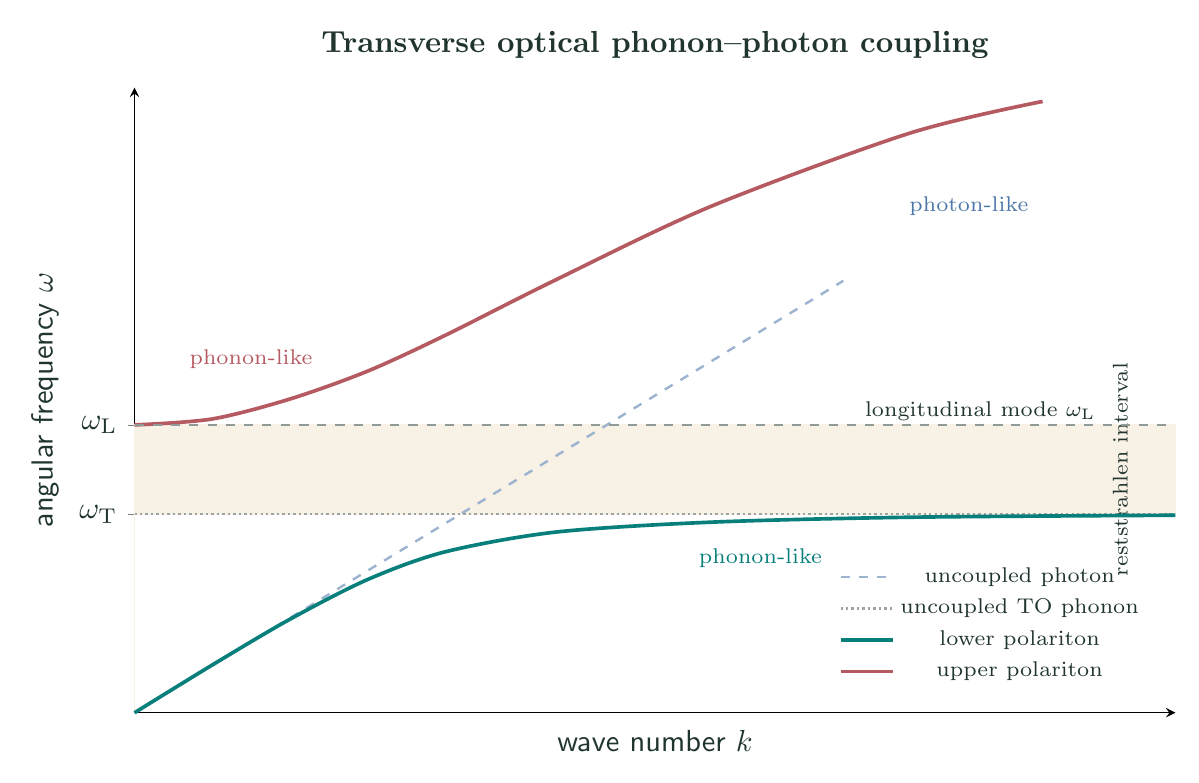
Several algebraic relations are useful:
\[\omega_+^2+\omega_-^2 =\omega_{\mathrm{LO}}^2+\Omega_k^2,\] \[\omega_+^2\omega_-^2 =\Omega_k^2\omega_{\mathrm{TO}}^2.\]At $k=0$,
\[\omega_-(0)=0, \qquad \omega_+(0)=\omega_{\mathrm{LO}}.\]The upper branch begins at the longitudinal frequency even though the propagating polariton is transverse for every nonzero $k$. At exactly $k=0$, Maxwell’s transverse/longitudinal directional distinction is singular; the electric restoring field contained in the coupled secular equation produces the LO limiting frequency.
In the long-wavelength limit the lower branch is
\[\omega_-^2\simeq \Omega_k^2\frac{\omega_{\mathrm{TO}}^2} {\omega_{\mathrm{LO}}^2} =\frac{c^2k^2}{\varepsilon_s},\]where
\[\varepsilon_s=\varepsilon_\infty \frac{\omega_{\mathrm{LO}}^2}{\omega_{\mathrm{TO}}^2}.\]Thus
\[\omega_-(k)\simeq\frac{ck}{\sqrt{\varepsilon_s}}.\]The lattice follows the slowly varying field nearly adiabatically, and the photon propagates with the static dielectric constant.
For large $k$ within the range where a local dielectric model remains meaningful,
\[\omega_-^2\simeq\omega_{\mathrm{TO}}^2 -\frac{\omega_{\mathrm{TO}}^2 (\omega_{\mathrm{LO}}^2-\omega_{\mathrm{TO}}^2)} {\Omega_k^2}+O(\Omega_k^{-4}),\]and
\[\omega_+^2\simeq \Omega_k^2+\omega_{\mathrm{LO}}^2-\omega_{\mathrm{TO}}^2 +O(\Omega_k^{-2}).\]Therefore the lower branch approaches $\omega_{\mathrm{TO}}$ from below and becomes phonon-like, while the upper branch becomes photon-like and approaches the electronic-background light line.
Forbidden interval and reststrahlen response
The lossless dielectric function has the signs
\[\begin{array}{c|c} \text{frequency interval} & \varepsilon(\omega)\\ \hline 0<\omega<\omega_{\mathrm{TO}} & \varepsilon>0\\ \omega_{\mathrm{TO}}<\omega<\omega_{\mathrm{LO}} & \varepsilon<0\\ \omega>\omega_{\mathrm{LO}} & \varepsilon>0. \end{array}\]Since $k^2=\varepsilon\omega^2/c^2$, no real bulk wave vector exists for
\[\boxed{\omega_{\mathrm{TO}}<\omega<\omega_{\mathrm{LO}}}.\]The lower polariton branch remains below $\omega_{\mathrm{TO}}$, and the upper branch remains above $\omega_{\mathrm{LO}}$. The interval between them is the polariton stop band and, in infrared reflection, the reststrahlen band. This is not an arbitrary avoided-crossing gap: its exact edges are the pole and zero of the lattice dielectric function in the lossless local model.
When damping is included,
\[\varepsilon(\omega)=\varepsilon_\infty +\frac{\varepsilon_\infty (\omega_{\mathrm{LO}}^2-\omega_{\mathrm{TO}}^2)} {\omega_{\mathrm{TO}}^2-\omega^2-i\gamma\omega},\]Then $k$ is complex for real $\omega$. The real part of $k$ describes phase accumulation and the imaginary part describes attenuation. The sharp forbidden interval becomes a strongly reflecting, finitely absorbing band.
Polariton eigenvectors and character mixing
The ionic displacement relative to the electric field follows from the first row of the coupled equations:
\[\boxed{ \frac{\mathbf u}{\mathbf E} =\frac{Z^\ast e} {\mu(\omega_{\mathrm{TO}}^2-\omega^2)}}.\]Correspondingly,
\[\frac{\mathbf P}{\varepsilon_0\varepsilon_\infty\mathbf E} =\frac{\omega_{\mathrm{LO}}^2-\omega_{\mathrm{TO}}^2} {\omega_{\mathrm{TO}}^2-\omega^2}.\]These ratios determine the relative amplitudes once either $\mathbf E$ or $\mathbf u$ is chosen. They do not by themselves give a photon or phonon probability, because the two coordinates have different dimensions and the energy normalization of a dispersive electromagnetic mode contains $d(\omega\varepsilon)/d\omega$.
The character can be assigned from continuous limiting behaviour:
- As $k\to0$, the lower branch is photon-like in a medium of static permittivity $\varepsilon_s$, with the ionic polarization following the field quasistatically.
- As $k\to\infty$, the lower branch approaches the TO vibration, its slope tends to zero, and it is predominantly lattice-like.
- At $k=0$, the upper branch starts as the field-coupled LO lattice mode.
- At large $k$, the upper branch approaches the photon light line in the electronic background and becomes predominantly electromagnetic.
Around the region where the uncoupled light line and optical-phonon frequency would intersect, neither description alone is adequate. The two eigenfrequencies repel and both eigenvectors contain appreciable field and lattice amplitudes.
Group velocity
Differentiate the implicit dispersion relation
\[F(k,\omega)=c^2k^2-\omega^2\varepsilon(\omega)=0.\]This gives
\[2c^2k- \left[2\omega\varepsilon(\omega) +\omega^2\frac{d\varepsilon}{d\omega}\right] \frac{d\omega}{dk}=0,\]so the lossless group velocity is
\[\boxed{ v_g=\frac{d\omega}{dk} =\frac{c^2k} {\omega\varepsilon(\omega) +\dfrac{\omega^2}{2}\dfrac{d\varepsilon}{d\omega}} }.\]The derivative term is the signature of material dispersion; omitting it incorrectly gives $c/\sqrt\varepsilon$. Near a flat, phonon-like part of the lower branch, $d\varepsilon/d\omega$ is large and $v_g$ becomes small.
An explicit branch derivative is obtained by setting $y=\Omega_k^2$ and
\[\Delta(y)=\sqrt{(\omega_{\mathrm{LO}}^2+y)^2 -4y\omega_{\mathrm{TO}}^2}.\]Then
\[\frac{d\omega_\pm^2}{dy} =\frac12\left[ 1\pm\frac{y+\omega_{\mathrm{LO}}^2 -2\omega_{\mathrm{TO}}^2}{\Delta(y)} \right],\]and
\[v_{g,\pm} =\frac{c^2k}{\varepsilon_\infty\omega_\pm} \frac{d\omega_\pm^2}{dy}.\]At $k\to0$, the lower-branch result reduces to $c/\sqrt{\varepsilon_s}$.
Surface phonon polaritons
Although no propagating bulk polariton exists inside the reststrahlen interval, an interface can support a bound surface phonon polariton. For a crystal with $\varepsilon(\omega)$ next to a nondispersive dielectric $\varepsilon_d$, the transverse-magnetic surface-mode dispersion is
\[k_\parallel=\frac{\omega}{c} \sqrt{\frac{\varepsilon(\omega)\varepsilon_d} {\varepsilon(\omega)+\varepsilon_d}}.\]A low-loss bound mode requires $\operatorname{Re}\varepsilon<-\varepsilon_d$. In the nonretarded limit $k_\parallel\gg\omega/c$, its frequency approaches the solution of
\[\varepsilon(\omega_{\mathrm{SO}})+\varepsilon_d=0.\]For the one-oscillator dielectric function,
\[\boxed{ \omega_{\mathrm{SO}}^2 =\frac{\varepsilon_\infty\omega_{\mathrm{LO}}^2 +\varepsilon_d\omega_{\mathrm{TO}}^2} {\varepsilon_\infty+\varepsilon_d}}.\]This frequency lies between $\omega_{\mathrm{TO}}$ and $\omega_{\mathrm{LO}}$. Prism coupling, gratings, and infrared near-field microscopy provide the extra parallel momentum needed to excite and map the surface branch.
Worked branch calculation
Take
\[\varepsilon_\infty=2.50, \qquad \frac{\omega_{\mathrm{TO}}}{2\pi}=5.00\,\mathrm{THz}, \qquad \frac{\omega_{\mathrm{LO}}}{2\pi}=7.477\,\mathrm{THz}.\]The static permittivity is
\[\varepsilon_s=2.50\left(\frac{7.477}{5.00}\right)^2 =5.591,\]and the small-$k$ lower-branch velocity is
\[v_g(0)=\frac{c}{\sqrt{5.591}}=0.4229c.\]Choose $k$ so that the bare electronic-background photon frequency is
\[\frac{\Omega_k}{2\pi}=6.00\,\mathrm{THz}.\]This corresponds to
\[k=\frac{\sqrt{\varepsilon_\infty}\Omega_k}{c} =1.988\times10^5\,\mathrm{m^{-1}}.\]Because all terms in the branch formula are homogeneous in frequency, ordinary frequencies in THz may be used consistently inside the squared ratios. Thus
\[f_\pm^2=\frac12\left[ 7.477^2+6.00^2 \pm\sqrt{(7.477^2+6.00^2)^2 -4(6.00)^2(5.00)^2} \right],\]which gives
\[f_-=3.338\,\mathrm{THz}, \qquad f_+=8.987\,\mathrm{THz}.\]The branch derivative gives
\[\frac{v_{g,-}}{c/\sqrt{\varepsilon_\infty}}=0.3577, \qquad \frac{v_{g,+}}{c/\sqrt{\varepsilon_\infty}}=0.5348.\]For a vacuum interface, $\varepsilon_d=1$, the nonretarded surface-mode frequency is
\[\frac{\omega_{\mathrm{SO}}}{2\pi} =\left[ \frac{(2.50)(7.477)^2+(5.00)^2}{3.50} \right]^{1/2} =6.861\,\mathrm{THz},\]which lies inside the $5.00$–$7.477\,\mathrm{THz}$ bulk reststrahlen interval.
Preparation questions
- Starting from Maxwell’s equations and the ionic oscillator equation, derive the phonon-polariton secular equation.
- Obtain the exact upper and lower polariton branches and prove their sum and product relations.
- Derive the $k\to0$ and large-$k$ asymptotes of both branches and identify their photon-like and phonon-like limits.
- Why is there no propagating bulk polariton between $\omega_{\mathrm{TO}}$ and $\omega_{\mathrm{LO}}$ in the lossless local model?
- Derive the group-velocity formula containing $d\varepsilon/d\omega$ and discuss its behaviour near the TO asymptote.
- Derive the nonretarded surface-phonon-polariton frequency at a crystal–dielectric interface.
- For $\varepsilon_\infty=4$, $\omega_{\mathrm{TO}}/(2\pi)=6\,\mathrm{THz}$, and $\omega_{\mathrm{LO}}/(2\pi)=9\,\mathrm{THz}$, calculate both polariton frequencies when $\Omega_k/(2\pi)=7\,\mathrm{THz}$.


Discussion