

11 May 2026
Quantization of Elastic Waves and Phonons
Normal coordinates, canonical quantization of lattice vibrations, creation and annihilation operators, zero-point motion, and phonon crystal momentum.
In the harmonic approximation, a crystal is a system of coupled oscillators. Its normal modes are independent at the classical level, and each normal mode becomes a quantum harmonic oscillator after canonical quantization. A phonon is one quantum of such a normal mode. The mode label contains both a wavevector and a branch index; it does not identify a particular atom carrying the excitation.
The derivation below first diagonalizes the harmonic-crystal Hamiltonian and then quantizes its normal coordinates. The continuum elastic-wave result follows as the long-wavelength limit of the same construction.
Harmonic Hamiltonian of a crystal
Let $l$ label primitive cells and let $\kappa=1,\ldots,r$ label the atoms in a cell. The equilibrium position of atom $(l,\kappa)$ is
\[\mathbf R_l+\boldsymbol\tau_\kappa,\]and its small displacement is $\mathbf u_{l\kappa}$. Expanding the potential energy about a stable equilibrium gives
\[H=\frac12\sum_{l\kappa}M_\kappa \dot{\mathbf u}_{l\kappa}^{\,2} +\frac12\sum_{l\kappa\alpha} \sum_{l'\kappa'\beta} u_{l\kappa\alpha} \Phi_{l\kappa\alpha,l'\kappa'\beta} u_{l'\kappa'\beta}.\]Here
\[\Phi_{l\kappa\alpha,l'\kappa'\beta} =\left. \frac{\partial^2 U} {\partial u_{l\kappa\alpha}\partial u_{l'\kappa'\beta}} \right\rvert_{\mathrm{eq}}\]is the force-constant matrix. There is no term linear in displacement because every atom is in mechanical equilibrium. The harmonic approximation neglects cubic and higher terms; consequently, normal modes neither decay nor exchange energy in this approximation.
Born–von Karman boundary conditions on $N$ primitive cells make the allowed wavevectors discrete. Translational invariance permits normal-mode solutions of the form
\[u_{l\kappa\alpha}(t) =\frac{1}{\sqrt{M_\kappa}} e_{\kappa\alpha}(\mathbf q,s) e^{i(\mathbf q\cdot\mathbf R_l-\omega t)}.\]The polarization vectors obey the dynamical-matrix eigenvalue equation
\[\sum_{\kappa'\beta} D_{\kappa\alpha,\kappa'\beta}(\mathbf q) e_{\kappa'\beta}(\mathbf q,s) =\omega_{\mathbf q s}^{\,2} e_{\kappa\alpha}(\mathbf q,s),\]where
\[D_{\kappa\alpha,\kappa'\beta}(\mathbf q) =\frac{1}{\sqrt{M_\kappa M_{\kappa'}}} \sum_{l'} \Phi_{0\kappa\alpha,l'\kappa'\beta} e^{i\mathbf q\cdot(\mathbf R_{l'}-\mathbf R_0)}.\]For each $\mathbf q$, this is a Hermitian $3r\times3r$ matrix. Its eigenvectors may be chosen to satisfy
\[\sum_{\kappa\alpha} e_{\kappa\alpha}^{*}(\mathbf q,s) e_{\kappa\alpha}(\mathbf q,s')=\delta_{ss'}.\]For real force constants one can choose
\[\mathbf e_\kappa(-\mathbf q,s) =\mathbf e_\kappa^{*}(\mathbf q,s), \qquad \omega_{-\mathbf q s}=\omega_{\mathbf q s}.\]Normal coordinates
Expand an arbitrary real displacement field in the complete set of normal modes:
\[u_{l\kappa\alpha} =\frac{1}{\sqrt{NM_\kappa}} \sum_{\mathbf q s} e_{\kappa\alpha}(\mathbf q,s) Q_{\mathbf q s} e^{i\mathbf q\cdot\mathbf R_l}.\]Reality requires
\[Q_{-\mathbf q s}=Q_{\mathbf q s}^{*}.\]Define the normal-coordinate velocity
\[\Pi_{\mathbf q s}=\dot Q_{\mathbf q s}.\]Classically, $\Pi_{-\mathbf q s}=\Pi_{\mathbf q s}^{*}$. After quantization the corresponding operator reality conditions are
\[Q_{\mathbf q s}^{\dagger}=Q_{-\mathbf q s}, \qquad \Pi_{\mathbf q s}^{\dagger}=\Pi_{-\mathbf q s}.\]Using polarization orthonormality and the dynamical-matrix eigenvalue equation, the Hamiltonian becomes
\[\boxed{ H=\frac12\sum_{\mathbf q s} \left[ \Pi_{\mathbf q s}\Pi_{-\mathbf q s} +\omega_{\mathbf q s}^{\,2} Q_{\mathbf q s}Q_{-\mathbf q s} \right]. }\]Thus the coupled atomic displacements have been transformed into independent normal oscillators. Because the sum contains both $\mathbf q$ and $-\mathbf q$, the momentum canonically conjugate to $Q_{\mathbf q s}$ is
\[P_{\mathbf q s} =\frac{\partial L}{\partial\dot Q_{\mathbf q s}} =\Pi_{-\mathbf q s}.\]Therefore the canonical commutator may be written
\[[Q_{\mathbf q s},\Pi_{\mathbf q's'}] =i\hbar\,\delta_{\mathbf q,-\mathbf q'}\delta_{ss'}.\]Creation and annihilation operators
Define bosonic operators by
\[Q_{\mathbf q s} =\sqrt{\frac{\hbar}{2\omega_{\mathbf q s}}} \left(a_{\mathbf q s}+a_{-\mathbf q s}^{\dagger}\right),\] \[\Pi_{\mathbf q s} =-i\sqrt{\frac{\hbar\omega_{\mathbf q s}}{2}} \left(a_{\mathbf q s}-a_{-\mathbf q s}^{\dagger}\right).\]The canonical commutator is equivalent to
\[[a_{\mathbf q s},a_{\mathbf q's'}^{\dagger}] =\delta_{\mathbf q\mathbf q'}\delta_{ss'}, \qquad [a_{\mathbf q s},a_{\mathbf q's'}]=0.\]Substitution into the normal-coordinate Hamiltonian gives
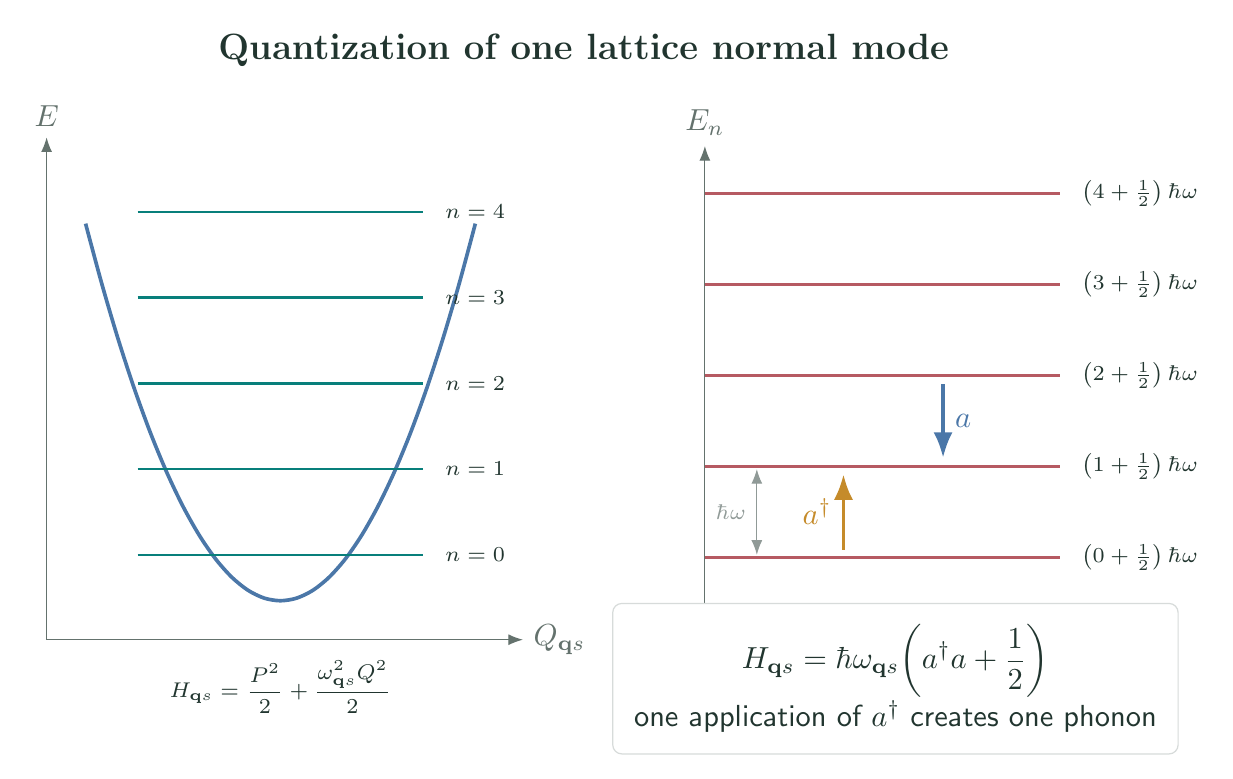
\[\boxed{ H=\sum_{\mathbf q s} \hbar\omega_{\mathbf q s} \left(a_{\mathbf q s}^{\dagger}a_{\mathbf q s}+\frac12\right). }\]The number operator
\[\hat n_{\mathbf q s} =a_{\mathbf q s}^{\dagger}a_{\mathbf q s}\]has eigenvalues $0,1,2,\ldots$. Acting on a number state,
\[a_{\mathbf q s}^{\dagger} \lvert n_{\mathbf q s}\rangle =\sqrt{n_{\mathbf q s}+1} \lvert n_{\mathbf q s}+1\rangle,\] \[a_{\mathbf q s} \lvert n_{\mathbf q s}\rangle =\sqrt{n_{\mathbf q s}} \lvert n_{\mathbf q s}-1\rangle.\]Creation or destruction of one phonon changes the vibrational energy by $\hbar\omega_{\mathbf q s}$.
Quantized displacement and momentum fields
In terms of phonon operators, the atomic displacement is
\[\boxed{ u_{l\kappa\alpha} =\frac{1}{\sqrt{NM_\kappa}} \sum_{\mathbf q s} \sqrt{\frac{\hbar}{2\omega_{\mathbf q s}}} \left[ e_{\kappa\alpha}(\mathbf q,s) a_{\mathbf q s}e^{i\mathbf q\cdot\mathbf R_l} +e_{\kappa\alpha}^{*}(\mathbf q,s) a_{\mathbf q s}^{\dagger}e^{-i\mathbf q\cdot\mathbf R_l} \right]. }\]The conjugate atomic momentum is
\[\boxed{ p_{l\kappa\alpha} =-i\sqrt{\frac{M_\kappa}{N}} \sum_{\mathbf q s} \sqrt{\frac{\hbar\omega_{\mathbf q s}}{2}} \left[ e_{\kappa\alpha}(\mathbf q,s) a_{\mathbf q s}e^{i\mathbf q\cdot\mathbf R_l} -e_{\kappa\alpha}^{*}(\mathbf q,s) a_{\mathbf q s}^{\dagger}e^{-i\mathbf q\cdot\mathbf R_l} \right]. }\]These expressions satisfy
\[[u_{l\kappa\alpha},p_{l'\kappa'\beta}] =i\hbar\, \delta_{ll'}\delta_{\kappa\kappa'}\delta_{\alpha\beta}.\]They are also the starting point for calculating neutron, x-ray, electron–phonon and infrared matrix elements. Every one-phonon amplitude contains the characteristic factor
\[\sqrt{\frac{\hbar}{2M_\kappa\omega_{\mathbf q s}}}.\]Low-frequency modes therefore have larger displacement amplitudes than high-frequency modes of the same participating mass.
Quantization of a one-dimensional elastic wave
Consider a uniform elastic medium of length $L$, mass per unit length $\mu$, tension or one-dimensional elastic coefficient $T$, and transverse displacement $u(x,t)$. Its Hamiltonian is
\[H=\frac12\int_0^L \left[ \frac{\pi^2(x)}{\mu} +T\left(\frac{\partial u}{\partial x}\right)^2 \right]dx,\]where $\pi(x)=\mu\dot u(x)$ and
\[[u(x),\pi(x')]=i\hbar\delta(x-x').\]Periodic boundary conditions give $q=2\pi n/L$ and the elastic-wave dispersion
\[\omega_q=c\lvert q\rvert, \qquad c=\sqrt{\frac{T}{\mu}}.\]The quantized field is
\[u(x)=\sum_q \sqrt{\frac{\hbar}{2\mu L\omega_q}} \left(a_qe^{iqx}+a_q^{\dagger}e^{-iqx}\right),\] \[\pi(x)=-i\sum_q \sqrt{\frac{\hbar\mu\omega_q}{2L}} \left(a_qe^{iqx}-a_q^{\dagger}e^{-iqx}\right),\]and
\[H=\sum_q\hbar\omega_q \left(a_q^{\dagger}a_q+\frac12\right).\]The $q=0$ mode is a rigid translation with $\omega=0$, not an internal harmonic vibration. It is removed by fixing the centre of mass or treated separately as free translational motion. A real crystal replaces the continuum spectrum by lattice branches and supplies a natural Brillouin-zone cutoff.
Zero-point motion and thermal occupation
Even the phonon vacuum has the energy
\[\boxed{E_0=\frac12\sum_{\mathbf q s} \hbar\omega_{\mathbf q s}.}\]This zero-point energy cannot be removed when comparing structures whose phonon spectra differ. It contributes, for example, to isotope-dependent equilibrium volumes and structural stability. The mean-square displacement of an atom contains a zero-point term because
\[\langle n\lvert (a+a^{\dagger})^2 \rvert n\rangle=2n+1.\]For a mode $(\mathbf q,s)$, its contribution is proportional to
\[\frac{\hbar}{2NM_\kappa\omega_{\mathbf q s}} \left(2n_{\mathbf q s}+1\right) \lvert\mathbf e_\kappa(\mathbf q,s)\rvert^2.\]At temperature $T$, a harmonic phonon mode has the Bose–Einstein mean occupation
\[\boxed{ \bar n_{\mathbf q s} =\frac{1}{ \exp(\hbar\omega_{\mathbf q s}/k_{\mathrm B}T)-1}. }\]Its mean energy is
\[\langle E_{\mathbf q s}\rangle =\hbar\omega_{\mathbf q s} \left(\bar n_{\mathbf q s}+\frac12\right).\]Phonon wavevector, momentum and crystal momentum
The wavevector $\mathbf q$ is defined modulo a reciprocal-lattice vector $\mathbf G$ because
\[e^{i(\mathbf q+\mathbf G)\cdot\mathbf R_l} =e^{i\mathbf q\cdot\mathbf R_l}.\]It is therefore sufficient to label phonons by $\mathbf q$ in the first Brillouin zone. A one-phonon state transforms under a primitive translation $\mathbf R$ with phase $e^{i\mathbf q\cdot\mathbf R}$, so it carries crystal momentum $\hbar\mathbf q$, defined modulo $\hbar\mathbf G$.
Crystal momentum is not generally the mechanical centre-of-mass momentum of the ions. The latter is
\[\mathbf P_{\mathrm{mech}} =\sum_{l\kappa}\mathbf p_{l\kappa},\]for which the lattice sum selects the uniform $\mathbf q=0$ translation. A finite-$\mathbf q$ normal mode can have zero net mechanical momentum while possessing non-zero crystal momentum. In a phonon interaction, discrete translational symmetry gives
\[\sum_{\mathrm{initial}}\mathbf q -\sum_{\mathrm{final}}\mathbf q =\mathbf G.\]Processes with $\mathbf G=0$ are called normal processes. Those with $\mathbf G\ne0$ are Umklapp processes; the lattice absorbs the difference in crystal momentum.
Worked example: quantized mode of a monatomic chain
For a nearest-neighbour monatomic chain,
\[\omega(q)=2\sqrt{\frac{C}{M}} \left\lvert\sin\frac{qa}{2}\right\rvert.\]Take
\[C=60.0\,\mathrm{N\,m^{-1}},\qquad M=28.0u,\qquad a=0.500\,\mathrm{nm},\]and $q=\pi/(2a)$. Then
\[\omega=\sqrt{\frac{2C}{M}} =5.080\times10^{13}\,\mathrm{rad\,s^{-1}},\] \[f=\frac{\omega}{2\pi}=8.086\,\mathrm{THz}, \qquad \hbar\omega=33.44\,\mathrm{meV}.\]At $300\,\mathrm K$,
\[\bar n =\frac{1}{\exp(33.44/25.85)-1} =0.378.\]For a periodic chain of $N=1000$ identical atoms, the displacement coefficient multiplying $a_q+a_{-q}^{\dagger}$ at any one atom is
\[u_{1\mathrm{ph}} =\sqrt{\frac{\hbar}{2NM\omega}} =1.49\times10^{-13}\,\mathrm m.\]The corresponding mean-square contribution in a number state is $(2n+1)u_{1\mathrm{ph}}^2$. The factor $1/\sqrt N$ expresses the fact that a normalized extended mode is shared by all $N$ atoms.
Preparation questions
- Starting from the harmonic-crystal Hamiltonian, introduce mass-weighted normal coordinates and show that the Hamiltonian is a sum of independent oscillators.
- Derive the quantized displacement and conjugate-momentum operators of a crystal and verify their equal-time commutator.
- Explain the physical meanings of $a_{\mathbf q s}^{\dagger}$, $a_{\mathbf q s}$ and $a_{\mathbf q s}^{\dagger}a_{\mathbf q s}$.
- Quantize a one-dimensional elastic wave with periodic boundary conditions and discuss the treatment of its zero-frequency mode.
- Derive the zero-point and thermal contributions of one mode to the mean-square atomic displacement.
- Distinguish phonon crystal momentum from the true mechanical momentum of the ions. Explain normal and Umklapp processes.
- A monatomic chain has $C=40\,\mathrm{N\,m^{-1}}$, $M=32u$ and $a=0.40\,\mathrm{nm}$. Find the phonon energy and Bose occupation at $T=200\,\mathrm K$ for $q=\pi/(2a)$.


Discussion