

14 May 2026
Three-Dimensional Lattice Dynamics
Force-constant and dynamical matrices, acoustic sum rule, polarization vectors, long-wavelength elasticity, and cubic-crystal examples.
Three-dimensional lattice dynamics differs from a one-dimensional chain in two essential respects. Each atom has three displacement components, and a primitive cell may contain several atoms. At every wavevector the normal-mode problem is therefore a matrix eigenvalue problem whose eigenvalues are squared phonon frequencies and whose eigenvectors specify the atomic polarization pattern.
Harmonic equations of motion
Let the equilibrium position of atom $\kappa$ in cell $l$ be
\[\mathbf r_{l\kappa}^{\,0} =\mathbf R_l+\boldsymbol\tau_\kappa,\]where $\mathbf R_l$ is a Bravais-lattice vector and $\boldsymbol\tau_\kappa$ is a basis vector. If $u_{l\kappa\alpha}$ is the Cartesian displacement, the potential energy through second order is
\[U=U_0+\frac12 \sum_{l\kappa\alpha} \sum_{l'\kappa'\beta} u_{l\kappa\alpha} \Phi_{l\kappa\alpha,l'\kappa'\beta} u_{l'\kappa'\beta}.\]The force constants are
\[\Phi_{l\kappa\alpha,l'\kappa'\beta} = \left. \frac{\partial^2U} {\partial u_{l\kappa\alpha} \partial u_{l'\kappa'\beta}} \right\rvert_{\mathrm{eq}}.\]Equality of mixed derivatives gives
\[\Phi_{l\kappa\alpha,l'\kappa'\beta} =\Phi_{l'\kappa'\beta,l\kappa\alpha}.\]Crystal translational symmetry implies that the force constants depend on cell differences:
\[\Phi_{l\kappa\alpha,l'\kappa'\beta} =\Phi_{0\kappa\alpha,(l'-l)\kappa'\beta}.\]Newton’s equations are
\[M_\kappa\ddot u_{l\kappa\alpha} =-\sum_{l'\kappa'\beta} \Phi_{l\kappa\alpha,l'\kappa'\beta} u_{l'\kappa'\beta}.\]Bloch form and the dynamical matrix
Use the mass-weighted Bloch trial solution
\[u_{l\kappa\alpha}(t) =\frac{1}{\sqrt{M_\kappa}} e_{\kappa\alpha}(\mathbf q,s) e^{i(\mathbf q\cdot\mathbf R_l-\omega t)}.\]Substitution gives
\[\sum_{\kappa'\beta} D_{\kappa\alpha,\kappa'\beta}(\mathbf q) e_{\kappa'\beta}(\mathbf q,s) =\omega_{\mathbf q s}^{\,2} e_{\kappa\alpha}(\mathbf q,s),\]with
\[\boxed{ D_{\kappa\alpha,\kappa'\beta}(\mathbf q) =\frac{1}{\sqrt{M_\kappa M_{\kappa'}}} \sum_{l'} \Phi_{0\kappa\alpha,l'\kappa'\beta} e^{i\mathbf q\cdot(\mathbf R_{l'}-\mathbf R_0)}. }\]The phase convention may instead include the basis-vector difference $\boldsymbol\tau_{\kappa’}-\boldsymbol\tau_\kappa$ in the exponential. This changes the phases assigned to polarization vectors but not the phonon frequencies or physical displacements.
For conservative forces,
\[D^\dagger(\mathbf q)=D(\mathbf q),\]so $\omega_{\mathbf q s}^{\,2}$ is real and eigenvectors belonging to distinct eigenvalues are orthogonal. A stable harmonic crystal requires every eigenvalue to be non-negative. A negative eigenvalue is conventionally reported as an imaginary phonon frequency and signals instability of the assumed structure.
For $r$ atoms in a primitive cell, $D(\mathbf q)$ has dimension $3r$. Hence there are $3r$ branches: three acoustic branches and, when $r>1$, $3r-3$ optical branches.
Polarization vectors
The mass-weighted eigenvectors can be normalized by
\[\sum_{\kappa\alpha} e_{\kappa\alpha}^{*}(\mathbf q,s) e_{\kappa\alpha}(\mathbf q,s') =\delta_{ss'}.\]Completeness at fixed $\mathbf q$ gives
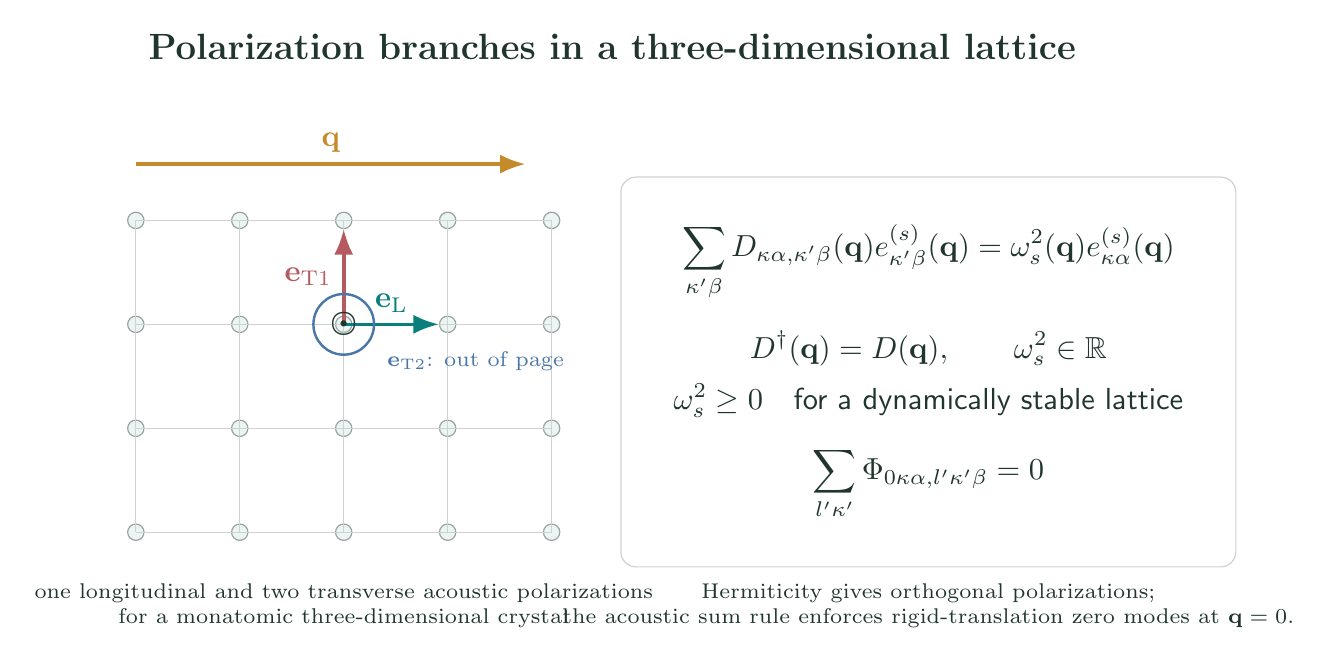
\[\sum_s e_{\kappa\alpha}(\mathbf q,s) e_{\kappa'\beta}^{*}(\mathbf q,s) =\delta_{\kappa\kappa'}\delta_{\alpha\beta}.\]For a monatomic isotropic medium, a mode is called longitudinal when
\[\mathbf e(\mathbf q,s)\parallel\mathbf q,\]and transverse when
\[\mathbf e(\mathbf q,s)\perp\mathbf q.\]In a general anisotropic crystal away from symmetry directions, polarization need not be exactly parallel or perpendicular to $\mathbf q$. The modes are then described as quasi-longitudinal and quasi-transverse. Their group velocity
\[\mathbf v_g=\nabla_{\mathbf q}\omega_{\mathbf q s}\]need not be parallel to $\mathbf q$, so the direction of energy transport can differ from the direction normal to the wavefront.
Acoustic sum rule
A uniform displacement of the entire crystal cannot change its energy. Put
\[u_{l'\kappa'\beta}=c_\beta\]for every $l’$ and $\kappa’$. The force on each coordinate must vanish, which requires
\[\boxed{ \sum_{l'\kappa'} \Phi_{0\kappa\alpha,l'\kappa'\beta}=0 }\]for every $\kappa,\alpha,\beta$. This is the acoustic sum rule.
At $\mathbf q=0$, the three rigid translations have polarization vectors
\[e_{\kappa\alpha}^{(\lambda)}(0) =\sqrt{\frac{M_\kappa}{M_{\mathrm{cell}}}}\, \xi_\alpha^{(\lambda)},\]where
\[M_{\mathrm{cell}}=\sum_\kappa M_\kappa\]and the three unit vectors $\boldsymbol\xi^{(\lambda)}$ span ordinary space. The factor $\sqrt{M_\kappa}$ ensures that the physical displacement $e_{\kappa\alpha}/\sqrt{M_\kappa}$ is the same for every atom. The sum rule then gives
\[\boxed{\omega_{\mathbf 0,\lambda}=0, \qquad \lambda=1,2,3.}\]Close to the zone centre, stable acoustic branches are normally linear:
\[\omega_{\mathbf q\lambda} =v_\lambda(\widehat{\mathbf q})q+O(q^2).\]Numerically fitted or first-principles force constants that violate the acoustic sum rule produce spurious non-zero acoustic frequencies at $\Gamma$. Enforcing the rule restores invariance under rigid translation.
Long-wavelength elastic limit
For wavelengths much larger than the lattice spacing, discrete displacements become a continuum field $u_i(\mathbf r,t)$. The elastic energy density is
\[\mathcal U =\frac12 C_{ijkl}\epsilon_{ij}\epsilon_{kl}, \qquad \epsilon_{ij} =\frac12\left( \frac{\partial u_i}{\partial x_j} +\frac{\partial u_j}{\partial x_i} \right),\]where $C_{ijkl}$ is the elastic-stiffness tensor. The equation of motion in a homogeneous crystal is
\[\rho\ddot u_i=C_{ijkl} \frac{\partial^2u_k}{\partial x_j\partial x_l}.\]For
\[\mathbf u=\mathbf e\, e^{i(\mathbf q\cdot\mathbf r-\omega t)}, \qquad \mathbf q=q\mathbf n,\]one obtains the Christoffel equation
\[\boxed{ \Gamma_{ik}(\mathbf n)e_k =\rho v^2 e_i, \qquad \Gamma_{ik}=C_{ijkl}n_jn_l, \qquad v=\frac{\omega}{q}. }\]The three eigenvalues of the Christoffel matrix are $\rho v_\lambda^2$. This continuum eigenproblem is the leading small-$q$ form of the acoustic part of the microscopic dynamical matrix.
For an isotropic solid with Lamé coefficients $\lambda$ and $\mu$,
\[v_L=\sqrt{\frac{\lambda+2\mu}{\rho}}, \qquad v_T=\sqrt{\frac{\mu}{\rho}},\]and the transverse speed is doubly degenerate.
Sound velocities in a cubic crystal
A cubic crystal has three independent elastic constants $C_{11}$, $C_{12}$ and $C_{44}$. Along $[100]$,
\[\boxed{ v_L[100]=\sqrt{\frac{C_{11}}{\rho}}, \qquad v_{T1}[100]=v_{T2}[100] =\sqrt{\frac{C_{44}}{\rho}}. }\]Along $[110]$, the three polarizations can be chosen along $[110]$, $[1\bar10]$ and $[001]$. Their speeds are
\[\boxed{ v_L[110] =\sqrt{\frac{C_{11}+C_{12}+2C_{44}}{2\rho}}, }\] \[\boxed{ v_{T,[1\bar10]}[110] =\sqrt{\frac{C_{11}-C_{12}}{2\rho}}, \qquad v_{T,[001]}[110] =\sqrt{\frac{C_{44}}{\rho}}. }\]Along $[111]$,
\[v_L[111] =\sqrt{\frac{C_{11}+2C_{12}+4C_{44}}{3\rho}},\] \[v_T[111] =\sqrt{\frac{C_{11}-C_{12}+C_{44}}{3\rho}},\]where the transverse mode is doubly degenerate. Mechanical stability of a cubic crystal requires
\[C_{44}>0,\qquad C_{11}-C_{12}>0,\qquad C_{11}+2C_{12}>0.\]Example: a monatomic simple-cubic lattice
Take one atom of mass $M$ at each site of a simple-cubic lattice of constant $a$. For each bond parallel to a Cartesian unit vector $\widehat{\boldsymbol\delta}$, use the harmonic bond energy
\[U_{\mathrm{bond}} =\frac12K_L \left(\Delta\mathbf u\cdot \widehat{\boldsymbol\delta}\right)^2 +\frac12K_T \left[ \Delta\mathbf u^{\,2} -\left(\Delta\mathbf u\cdot \widehat{\boldsymbol\delta}\right)^2 \right].\]$K_L$ and $K_T$ are effective longitudinal and transverse bond force constants. Summing over the six nearest neighbours gives a diagonal dynamical matrix:
\[D_{xx}(\mathbf q) =\frac4M\left[ K_L\sin^2\frac{q_xa}{2} +K_T\sin^2\frac{q_ya}{2} +K_T\sin^2\frac{q_za}{2} \right],\]with $D_{yy}$ and $D_{zz}$ obtained by cyclic permutation, and $D_{\alpha\beta}=0$ for $\alpha\ne\beta$. Therefore
\[\omega_x^2(\mathbf q)=D_{xx}(\mathbf q), \qquad \omega_y^2(\mathbf q)=D_{yy}(\mathbf q), \qquad \omega_z^2(\mathbf q)=D_{zz}(\mathbf q).\]At $\mathbf q=0$, every matrix element vanishes, explicitly demonstrating the acoustic sum rule. Along $\mathbf q=(q,0,0)$,
\[\omega_L(q) =2\sqrt{\frac{K_L}{M}} \left\lvert\sin\frac{qa}{2}\right\rvert,\] \[\omega_T(q) =2\sqrt{\frac{K_T}{M}} \left\lvert\sin\frac{qa}{2}\right\rvert,\]with two degenerate transverse modes. For $qa\ll1$,
\[v_L=a\sqrt{\frac{K_L}{M}}, \qquad v_T=a\sqrt{\frac{K_T}{M}}.\]If a pure central nearest-neighbour spring is used at an unstressed equilibrium separation, then $K_T=0$. The model consequently predicts zero-frequency shear modes along $[100]$. This is not a general property of cubic crystals; it shows that such a restricted force model lacks shear rigidity and must be supplemented by angular, further-neighbour or effective transverse forces.
Worked elastic example
Take a cubic solid with
\[\rho=2330\,\mathrm{kg\,m^{-3}},\quad C_{11}=165.7\,\mathrm{GPa},\quad C_{12}=63.9\,\mathrm{GPa},\quad C_{44}=79.6\,\mathrm{GPa}.\]Along $[100]$,
\[v_L=8.43\,\mathrm{km\,s^{-1}}, \qquad v_T=5.85\,\mathrm{km\,s^{-1}}.\]Along $[110]$,
\[v_L=9.13\,\mathrm{km\,s^{-1}},\] \[v_{T,[1\bar10]}=4.67\,\mathrm{km\,s^{-1}}, \qquad v_{T,[001]}=5.85\,\mathrm{km\,s^{-1}}.\]The splitting of the transverse speeds along $[110]$ is an elastic manifestation of cubic anisotropy. The three stability combinations are
\[C_{44}=79.6\,\mathrm{GPa}>0,\] \[C_{11}-C_{12}=101.8\,\mathrm{GPa}>0, \qquad C_{11}+2C_{12}=293.5\,\mathrm{GPa}>0.\]Preparation questions
- Derive the $3r\times3r$ dynamical-matrix eigenvalue equation for a crystal containing $r$ atoms per primitive cell.
- Prove that the dynamical matrix is Hermitian and state the consequences for its eigenvalues and polarization vectors.
- Derive the acoustic sum rule from invariance under a uniform translation and obtain the three zero-frequency eigenvectors at $\mathbf q=0$.
- Starting from continuum elasticity, derive the Christoffel equation for sound propagation in an anisotropic solid.
- Obtain the longitudinal and transverse sound velocities along $[100]$, $[110]$ and $[111]$ in a cubic crystal.
- Construct the dynamical matrix of the nearest-neighbour simple-cubic model with longitudinal and transverse bond constants and derive its branches along $[100]$.
- Why does a central nearest-neighbour simple-cubic model with $K_T=0$ fail to resist some shear deformations?
- Explain why the group velocity and wavevector need not be parallel in an anisotropic crystal.


Discussion