

13 Jul 2026
Verification of Brewster's Law Using a Spectrometer
Aim
To verify Brewster’s law by measuring the polarising angle of a glass plate using a spectrometer.
Apparatus
Spectrometer, glass plate, polariser, analyser, sodium lamp, and reading telescope.
Experimental arrangement
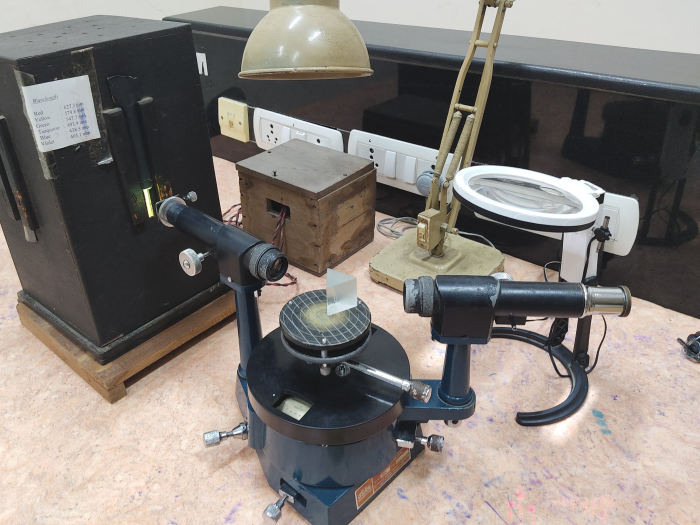
Theory
When unpolarised light falls on a transparent dielectric, the electric field can be resolved into components parallel and perpendicular to the plane of incidence. The reflection coefficients of these two components are different. At one particular incidence angle the parallel component has zero reflected amplitude; the remaining reflected light is then plane polarised. From the geometry of the reflected and refracted rays at this condition, they are perpendicular, and the polarising angle is $i_p$.
For light entering a medium of refractive index $\mu$ from air,
\[\tan i_p=\mu,\]where $\mu$ is the refractive index of the reflecting material. Measuring $i_p$ therefore gives the refractive index without directly measuring the refraction angle.
Observations
| Trial | Polarising angle $i_p$ |
|---|---|
| 1 | $56^\circ 10’$ |
| 2 | $56^\circ 20’$ |
| 3 | $56^\circ 15’$ |
Mean $i_p=56^\circ15’$ and $\mu=\tan i_p\approx1.50$.
Result
Brewster’s law is verified for the glass plate, with refractive index approximately $1.50$.
Viva Questions
- What is Brewster angle? The angle of incidence at which reflected light is completely plane polarised.
- What is the relation between reflected and refracted rays? They are perpendicular at Brewster angle.
- Why is an analyser used? To test the degree and direction of polarisation.


Discussion